How to Prepare for CLAT 2028
- Understand the official CLAT 2028 syllabus and exam pattern when released.
- Build a strong daily reading habit.
- Develop fundamentals across all major sections.
- Practise passage-based questions consistently.
- Build Current Affairs and General Knowledge gradually.
- Start sectional tests once your fundamentals are comfortable.
- Introduce full-length mocks progressively.
- Analyse every mock instead of focusing only on the score.
- Maintain an error log throughout your preparation.
- Revise regularly instead of postponing revision until the end.
Table of Contents
- Why Start Preparing for CLAT 2028 Early?
- CLAT 2028 Syllabus and Exam Pattern
- How to Prepare for CLAT 2028: Step-by-Step Strategy
- CLAT 2028 Section-Wise Preparation Strategy
- CLAT 2028 Study Plan: 24-Month Strategy
- CLAT 2028 12-Month Study Plan
- How Many Hours Should You Study for CLAT 2028?
- How to Make a CLAT 2028 Timetable
- CLAT 2028 Mock Test Strategy
- Common CLAT 2028 Preparation Mistakes to Avoid
- CLAT 2028 Preparation Tips for Beginners
- CLAT 2028 Preparation for Class 11 Students
- CLAT 2028 Preparation for Class 12 Students
- Final Takeaway: How to Prepare for CLAT 2028
Why Start Preparing for CLAT 2028 Early?
CLAT preparation is not only about memorising information. A large part of the preparation involves developing skills such as comprehension, critical thinking, logical reasoning, application and time management.These skills improve with consistent practice. Starting early gives you the opportunity to build these skills gradually instead of trying to develop them in the final few months before the examination.Early preparation also allows you to:- Develop a strong reading habit.
- Strengthen your fundamentals without rushing.
- Identify your strengths and weaknesses.
- Experiment with different preparation strategies.
- Build a strong Current Affairs knowledge base.
- Take mocks without excessive pressure.
- Improve your accuracy before focusing heavily on speed.
- Revise important concepts multiple times.
CLAT 2028 Syllabus and Exam Pattern
Before beginning your preparation, make sure you understand the official CLAT 2028 syllabus and examination pattern released by the Consortium of National Law Universities.The CLAT UG examination currently assesses students across five broad areas:- English Language
- Current Affairs, including General Knowledge
- Legal Reasoning
- Logical Reasoning
- Quantitative Techniques
How to Prepare for CLAT 2028: Step-by-Step Strategy
A long-term CLAT preparation plan becomes much easier when you break it into a simple cycle:1. Understand What CLAT Tests
Your first step should not be buying multiple books or attempting hundreds of questions.First understand the skills required for CLAT. The examination is designed around comprehension, reasoning, interpretation and application.Once you understand what the examination expects from you, you can choose your resources and practice methods more effectively.2. Make Reading a Daily Habit
Reading should become one of the foundations of your CLAT 2028 preparation strategy.Do not limit reading to the months immediately before the examination. Starting early allows you to develop reading speed and comprehension naturally.While reading, practise identifying:- The central idea of a passage.
- The author's viewpoint.
- Arguments and supporting evidence.
- Inferences.
- Important details.
- The meaning of words in context.
- Connections between different ideas.
3. Build Your Fundamentals
If you are starting your CLAT 2028 preparation early, do not worry about solving the most difficult questions immediately.Spend the initial phase understanding concepts and question types.For example, in Logical Reasoning, first understand concepts such as assumptions, conclusions, inference and arguments. In Quantitative Techniques, strengthen basic arithmetic and data interpretation skills before moving to more challenging timed sets.4. Practise Consistently
Once your fundamentals are clear, move towards regular practice.Begin with topic-wise sets and gradually move towards mixed and timed practice.Quality practice matters more than simply counting the number of questions you solve.5. Start Sectional Tests
Sectional tests help you understand how well you perform within a particular section.They can also reveal whether a problem is related to knowledge, comprehension, accuracy or time management.Use your sectional scores as feedback rather than treating them as a final judgement of your preparation.6. Introduce Full-Length Mocks Gradually
Full-length mock tests should become more important as you move closer to CLAT 2028.If you are still in the foundation phase, there is no need to take multiple full-length mocks every week. Focus first on building the skills required to perform well.As your preparation develops, gradually increase mock frequency and use each mock to identify areas that require improvement.7. Analyse Every Mock
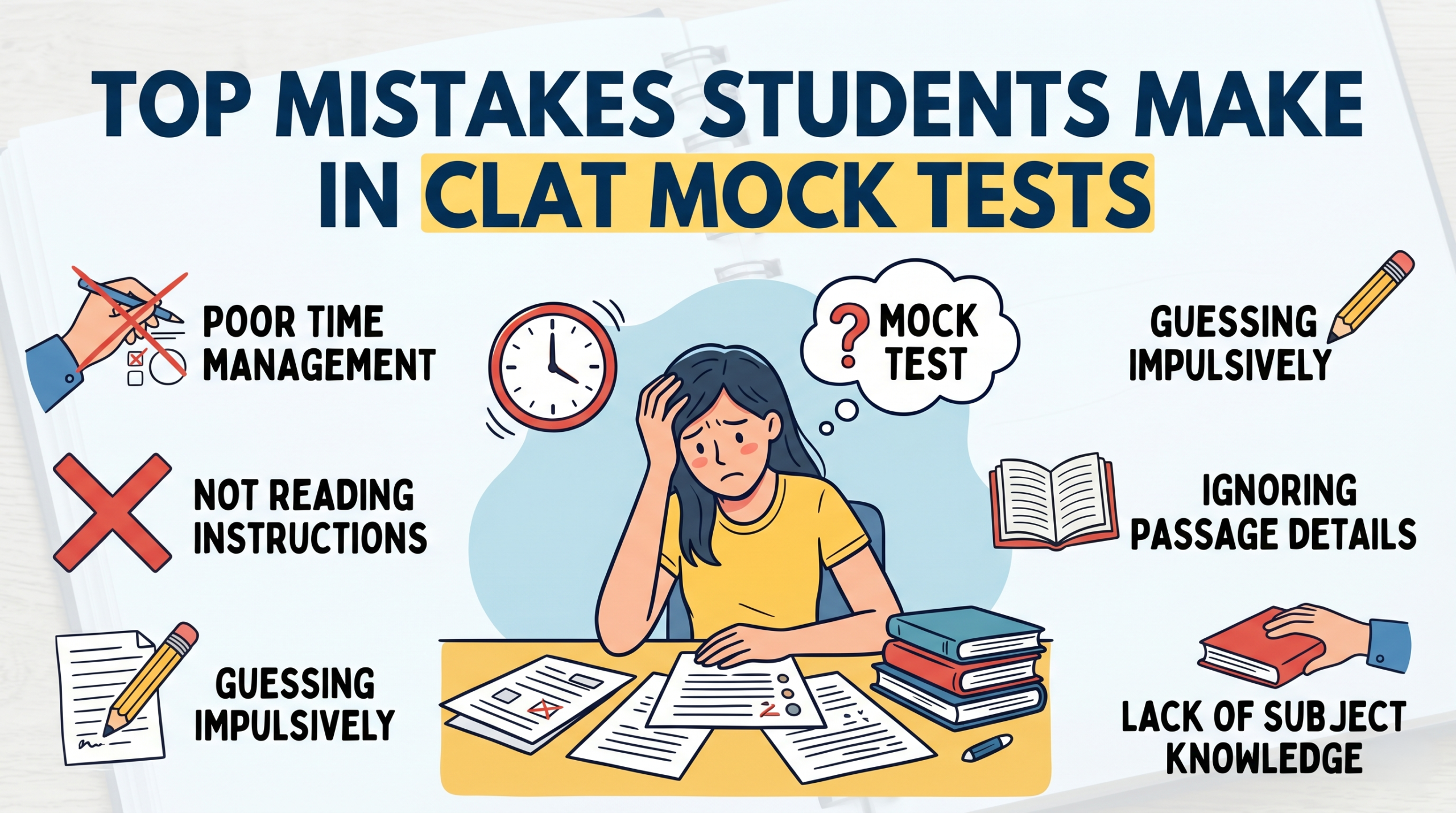
One of the biggest mistakes students make is treating mock tests as score-generating exercises.A mock is also a diagnostic tool.After every mock, ask yourself:- Which questions did I get wrong?
- Why did I get them wrong?
- Which questions took too much time?
- Where did I make careless mistakes?
- Which questions did I leave despite knowing the concept?
- Which question types repeatedly cause difficulty?
- What will I change before my next mock?
CLAT 2028 Section-Wise Preparation Strategy
Each section requires a slightly different preparation approach. Your CLAT 2028 study plan should therefore give every section a clear role.How to Prepare for CLAT 2028 English
English preparation should revolve around reading comprehension and language skills.For CLAT English preparation:- Read every day.
- Practise identifying the main idea of passages.
- Work on inference-based questions.
- Understand arguments and viewpoints.
- Build vocabulary through context.
- Practise Reading Comprehension regularly.
- Introduce timed practice gradually.
How to Prepare for CLAT 2028 Current Affairs and GK
Current Affairs should not become a last-minute subject.Since you are preparing for CLAT 2028, use the additional time to build a system that makes information easier to understand and revise.Your GK routine can include:- Daily current affairs reading.
- Short and organised notes.
- Weekly revision.
- Monthly consolidation.
- Regular quizzes.
- Revision of important national and international developments.
How to Prepare for CLAT 2028 Legal Reasoning
Legal Reasoning should be approached as a reasoning and application section rather than a subject that requires you to memorise an entire law syllabus.Prior legal education is not the objective. Your preparation should focus on reading the passage carefully, identifying the relevant principle and applying it to the facts provided.Practise:- Identifying principles from passages.
- Separating relevant facts from irrelevant information.
- Applying principles to new situations.
- Understanding changes in facts.
- Reading lengthy passages carefully.
How to Prepare for CLAT 2028 Logical Reasoning
Logical Reasoning requires you to understand arguments and evaluate the relationship between different ideas.Focus on:- Arguments and conclusions.
- Assumptions.
- Inferences.
- Strengthen and weaken questions.
- Cause and effect.
- Analogies and relationships.
- Critical reasoning.
How to Prepare for CLAT 2028 Quantitative Techniques
Quantitative Techniques becomes easier when your mathematical fundamentals are strong.Start by strengthening basic arithmetic and gradually move towards data interpretation and timed numerical sets.Your Quant preparation should include:- Basic arithmetic.
- Ratios and proportions.
- Percentages.
- Data interpretation.
- Tables and numerical information.
- Basic algebra.
- Regular calculation practice.
CLAT 2028 Study Plan: 24-Month Strategy
Students starting early have the advantage of being able to divide their preparation into multiple phases instead of trying to complete everything at once.Phase 1: Foundation
Focus: Reading, fundamentals and basic question types.- Build a daily reading habit.
- Understand all five areas.
- Strengthen basic concepts.
- Start Current Affairs preparation.
- Practise topic-wise questions.
Phase 2: Skill Building
Focus: Regular practice and sectional improvement.- Increase passage-based practice.
- Start sectional tests.
- Maintain an error log.
- Revise Current Affairs regularly.
- Work specifically on weaker areas.
Phase 3: Testing
Focus: Full-length mocks and performance analysis.- Introduce regular full-length mocks.
- Analyse every mock.
- Improve question selection.
- Work on time management.
- Identify recurring mistakes.
Phase 4: Final Preparation
Focus: Revision, mocks and consistency.- Revise existing notes.
- Continue mock practice.
- Revise Current Affairs systematically.
- Strengthen weak areas.
- Practise under exam-like conditions.
CLAT 2028 12-Month Study Plan
If you have around 18 months, divide your preparation into foundation, practice and testing phases.- Months 1–6: Fundamentals, reading and topic-wise practice.
- Months 7–12: Sectional tests, mixed practice and regular revision.
- Months 13–18: Full-length mocks, detailed analysis and intensive revision.
How Many Hours Should You Study for CLAT 2028?
A one-year plan should balance concept building and testing.- Months 1–3: Fundamentals and daily reading.
- Months 4–6: Topic-wise and sectional practice.
- Months 7–9: Mixed practice and regular mocks.
- Months 10–12: Mock analysis, revision and exam-oriented preparation.
How to Make a CLAT 2028 Timetable
There is no single number of hours that every CLAT 2028 aspirant needs to study.Your required study time will depend on your academic schedule, preparation level, strengths and weaknesses.Instead of asking only “How many hours should I study?”, ask:“What should I accomplish today?”A productive daily checklist could include:- 30-60 minutes of reading.
- One or more comprehension sets.
- Legal or Logical Reasoning practice.
- Regular Quant practice.
- Current Affairs revision.
- Error-log review.
CLAT 2028 Mock Test Strategy
Your timetable should be realistic enough to follow for months, not just for a few days.Divide your week between:- Concept building
- Reading
- Practice
- Current Affairs
- Sectional tests
- Mock tests
- Revision
CLAT 2028 Mock Test Strategy
Mock tests become increasingly important as you approach the examination. However, the purpose of a mock is not simply to produce a score.Your mock should help you understand your preparation.| What to Track | Question to Ask |
|---|---|
| Wrong Answers | Was the mistake conceptual, careless or due to misreading? |
| Unattempted Questions | Did I run out of time or deliberately skip them? |
| Time Taken | Which section consumed the most time? |
| Accuracy | Which question types repeatedly cause mistakes? |
| Question Selection | Did I spend too much time on difficult questions? |
Common CLAT 2028 Preparation Mistakes to Avoid
1. Starting With Too Many Resources More books and more PDFs do not automatically mean better preparation. Select reliable resources and use them consistently.2. Ignoring Reading Reading should not be treated as an optional activity. Make it part of your everyday preparation.3. Taking Mocks Without Analysis Your mock score tells you where you stand. Your analysis tells you what to do next.4. Leaving Current Affairs for the Final Months Build your Current Affairs knowledge gradually and revise it regularly.5. Focusing Only on Strong Sections Your strong sections deserve maintenance, but your weak areas need deliberate attention.6. Studying for Hours Without Clear Targets Sitting with books for several hours does not automatically mean productive preparation. Set measurable tasks for each study session.CLAT 2028 Preparation Tips for Beginners
If you are just beginning your CLAT 2028 journey, keep your first few weeks simple.- Understand the exam.
- Start reading every day.
- Learn the fundamentals of each section.
- Practise consistently.
- Start tracking your mistakes.
- Gradually introduce timed practice.
- Do not compare your beginning with someone else's final phase.
CLAT 2028 Preparation for Class 11 Students
Class 11 is a particularly useful time to begin building a CLAT foundation because you can focus on developing skills without immediately entering an intense final-exam phase.Students starting in Class 11 should prioritise:- Reading consistently.
- Building vocabulary through reading.
- Developing reasoning skills.
- Strengthening basic mathematics.
- Following Current Affairs.
- Understanding CLAT-style passages.
- Developing disciplined study habits.
CLAT 2028 Preparation for Class 12 Students
Students preparing alongside Class 12 need to balance board preparation with CLAT-specific practice.Create a weekly schedule rather than trying to follow an unrealistic daily routine. Use your school and academic reading to strengthen comprehension, while reserving dedicated time for CLAT practice, Current Affairs and mocks.The CLAT 2028 Preparation Cycle
- READ - Build comprehension and awareness.
- PRACTISE - Develop section-wise skills.
- TEST - Use sectional and full-length tests.
- ANALYSE - Understand your mistakes.
- REVISE - Fix the gaps.
- REPEAT - Keep improving.