By Team CLAT Possible I Nov 17, 2026
CLAT 2027-2028 Courses by CLAT Possible
What You'll Find in This Blog
- CLAT English Syllabus 2028 at a Glance
- What the Official Syllabus Says
- Will the English Section Change for CLAT 2028?
- CLAT English Syllabus 2028: Topic-Wise Breakdown
- Question Types in CLAT English (and How to Approach Them)
- Where CLAT English Passages Come From
- CLAT 2028 English Preparation Plan
- A Daily English Routine for CLAT 2028
- Best Resources for CLAT 2028 English
- Common Mistakes to Avoid
- Conclusion
CLAT English Syllabus 2028 at a Glance
| Particular | Details |
|---|---|
| Section name | English Language |
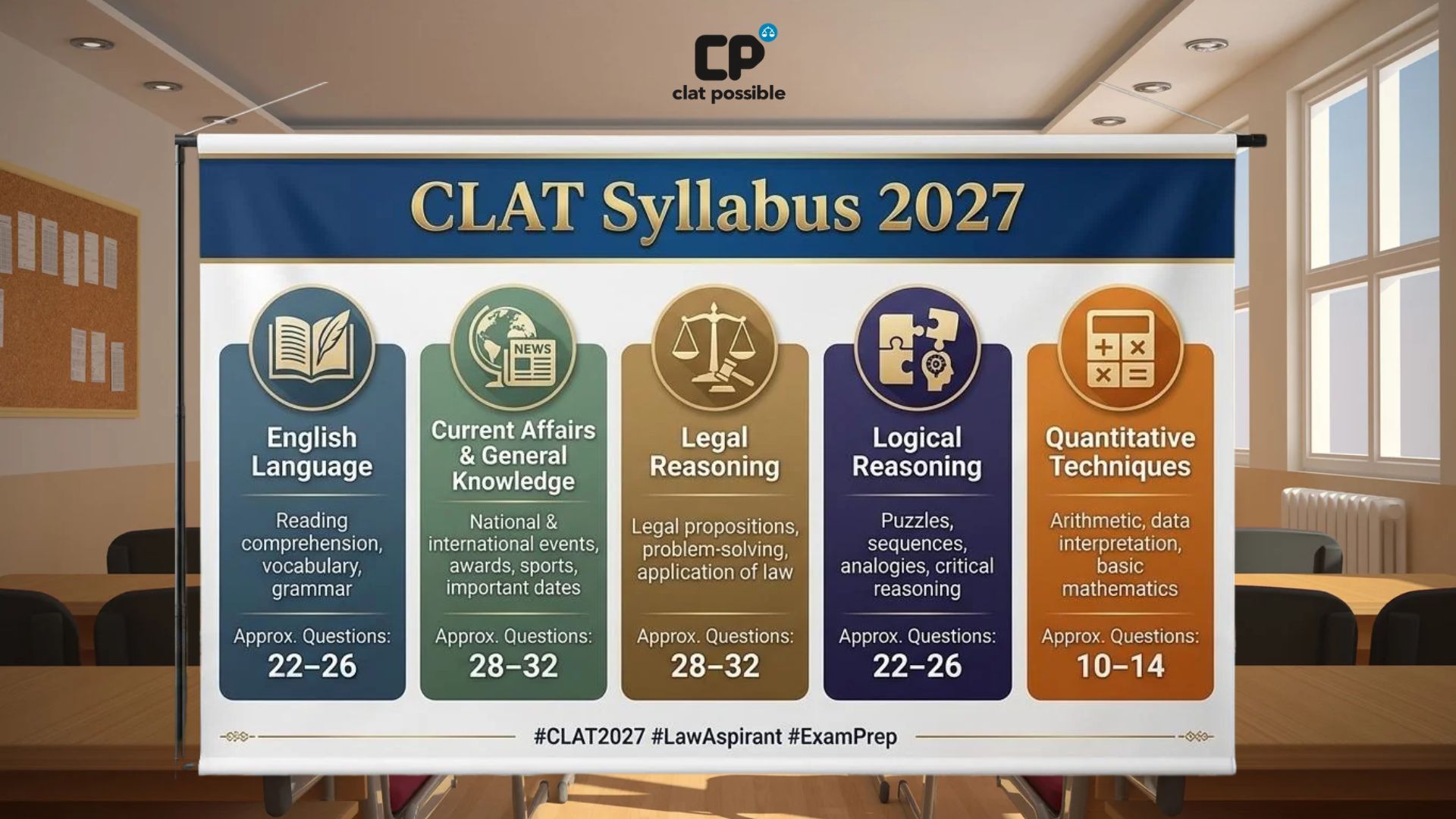
| Approximate share of the paper | About 20% (roughly 22 to 24 of 120 questions in recent papers) |
| Format | Passage-based multiple-choice questions |
| Passage length | About 450 words each |
| Reading time per passage | Roughly 5 to 7 minutes for a Class 12 student, as per the official syllabus |
| Passage sources | Contemporary or historically significant fiction and non-fiction writing |
| Marking | +1 for a correct answer, −0.25 for a wrong answer, 0 for unanswered |
| Status for CLAT 2028 | Current syllabus applies to CLAT 2027; an Expert Committee proposal to redesign the section is under consideration for CLAT 2028 |
What the Official Syllabus Says
According to the official CLAT UG syllabus published by the Consortium of NLUs, you will read passages of about 450 words and be expected to:- Identify the main point of the passage, along with the arguments and viewpoints in it.
- Draw inferences and conclusions from the text.
- Summarise the passage.
- Compare and contrast the different arguments or viewpoints presented.
- Work out the meaning of words and phrases from how they are used in the passage.
Will the English Section Change for CLAT 2028?
Possibly. CLAT 2027 (6 December 2026) keeps the current five-section pattern. However, an Expert Committee has recommended a redesigned three-section paper, and the Consortium has said it will consider the proposals for CLAT 2028. No final decision had been announced as of October 2026.| Feature | Current English section (CLAT 2027) | Proposed: Language and Comprehension (not confirmed) |
|---|---|---|
| Section name | English Language | Language and Comprehension |
| Focus | Reading comprehension, inference, vocabulary in context | Inference, implication, tone and the strength of arguments |
| Grammar and vocabulary | Tested through passages | Less emphasis on grammar and vocabulary |
| Number of questions | About 22 to 24 | No more than 10 to 15 per section |
| Skill rewarded | Reading speed across long passages | Depth and accuracy of understanding |
CLAT English Syllabus 2028: Topic-Wise Breakdown
1. Reading Comprehension
This is the heart of the section. Every question is linked to a passage, so your reading speed and accuracy decide your score.- Main idea and central argument
- Supporting arguments and evidence
- Author's viewpoint and purpose
- Comparing different viewpoints within a passage
2. Inference and Conclusions
These questions ask what follows from the passage, even though it is not stated directly. They are often the trickiest in the section.- What can be inferred from a line or paragraph
- Which conclusion the author would agree with
- Underlying assumptions in an argument
3. Tone and Author's Attitude
You need to judge how the author feels about the subject, based only on the words used.- Tone words such as critical, sarcastic, optimistic, nostalgic, objective
- Whether the author supports, opposes or remains neutral
4. Vocabulary in Context
CLAT does not test word lists. It asks what a word or phrase means as used in the passage.- Meaning of words and phrases in context
- Idioms and phrases used in the passage
- Synonyms and antonyms based on context
5. Summary and Title
You may be asked to pick the best summary of a passage or paragraph, or the most suitable title.- Best summary of the passage
- Most suitable title
- The author's main purpose in writing
6. Grammar in Use
Grammar is not tested on its own, but you need it to read accurately. Occasionally, questions may test correct usage within a sentence from the passage.- Tenses, subject-verb agreement and modifiers
- Connectors and how they change meaning ("however", "therefore", "despite")
- Sentence correction based on passage lines
7. Literary Devices
Fiction and literary non-fiction passages sometimes include figurative language.- Metaphor, simile, personification, irony
- What a figurative line actually means
Question Types in CLAT English (and How to Approach Them)
| Question type | What it asks | How to approach it |
|---|---|---|
| Main idea | What is the passage mainly about? | Read the first and last paragraphs closely; eliminate options that are too narrow or too broad. |
| Inference | What can be concluded from the passage? | Choose only what the passage supports. If an option needs outside knowledge, it is wrong. |
| Tone / attitude | How does the author feel about the subject? | Underline opinion words and adjectives as you read. |
| Vocabulary in context | What does a word mean as used here? | Reread the full sentence and test each option in place of the word. |
| Summary / title | Which option best captures the passage? | Pick the option that covers the whole passage, not one paragraph. |
| Strengthen / weaken | Which statement supports or undermines the author's argument? | Identify the author's main claim first, then test each option against it. |
| Fact-based | What does the passage say about a detail? | Go back to the exact line; do not rely on memory. |
Where CLAT English Passages Come From
The official syllabus says passages are drawn from contemporary or historically significant fiction and non-fiction writing. In practice, that covers a wide range:| Passage type | Examples of what you might read |
|---|---|
| Literary fiction | Extracts from novels and short stories, classic and modern |
| Opinion and editorials | Newspaper editorials and opinion columns on social or political issues |
| Essays and non-fiction | Long-form essays on philosophy, history, science, technology or economics |
| Social issues | Writing on education, gender, environment, inequality and public policy |
| Biography and memoir | Extracts from autobiographies, memoirs and speeches |
CLAT 2028 English Preparation Plan
This plan assumes CLAT 2028 will be held around December 2027, based on recent cycles. If you are in Class 11 now, you have about a year, which is plenty of time if you start building the reading habit today.| Phase | Time window | Focus | Goal |
|---|---|---|---|
| 1. Reading foundation | Now to March 2027 | Daily reading of editorials, essays and fiction; one passage a day without a timer | Summarise any 450-word passage in two lines |
| 2. Question types | April to July 2027 | Practise each question type; keep a vocabulary-in-context notebook and an error log | Steady accuracy on untimed passage sets |
| 3. Speed and accuracy | August to October 2027 | Timed sectional tests; full mocks aligned to the confirmed pattern | Finish each passage in 6 to 7 minutes without losing accuracy |
| 4. Final revision | November 2027 to the exam | Revise your error log and notebook; fewer, sharper mocks | A tested time plan for the English section |
A Daily English Routine for CLAT 2028
- Read one editorial or essay (15 minutes): write a one-line summary and one word for the author's tone.
- Solve one CLAT-style passage (10 minutes): untimed at first, timed once your accuracy is steady.
- Review every wrong option (10 minutes): understand why each wrong answer is wrong, not just why the right one is right.
- Add 3 to 5 words to your notebook: note each word with the sentence you found it in.
- Once a week: read one piece of fiction or a long-form essay outside your comfort zone.
Best Resources for CLAT 2028 English
- Newspapers: The Hindu or The Indian Express, especially the editorial and opinion pages.
- Long-form reading: essays and features from quality magazines and websites, plus classic and contemporary fiction.
- Official material: the official CLAT UG syllabus and CLAT previous year papers from 2020 onward.
- Roznama (Daily Mini CLAT): our free daily practice of about 25 to 30 questions based on the day's newspaper. Learn more about Roznama.
- Books: one passage-based English book is enough. See our list of CLAT preparation books.
Conclusion
The CLAT English syllabus for 2028 comes down to one skill: reading a passage carefully and answering only from what it says. Whether the Consortium keeps the current English section or moves to Language and Comprehension, that skill will carry you through. Start reading every day, practise each question type, analyse your mistakes, and keep checking the Consortium website for the official CLAT 2028 pattern.Frequently Asked questions
The official CLAT 2028 syllabus has not been released yet. Under the current syllabus, the English section has passages of about 450 words, and questions test the main idea, inferences, summary, comparison of viewpoints, and the meaning of words in context.
In recent papers, the English section has had roughly 22 to 24 of the 120 questions, about 20% of the paper. The number for CLAT 2028 will depend on the final pattern.
Not removed, but it may be redesigned. The Expert Committee has proposed replacing it with a Language and Comprehension section focused on inference, tone and argument. This is not confirmed yet.
Only the basics. Grammar is not tested as a separate topic; it helps you read accurately and handle the occasional usage question.
Start with one passage a day and analyse it fully. Once your accuracy is steady, move up to two or three timed passages a day.
Now. Reading speed and comprehension take months to build, so starting with a daily reading habit in Class 11 gives you a strong advantage.