CLAT 2028 is the Common Law Admission Test for admission to the five-year integrated LL.B. and one-year LL.M. programmes of the participating National Law Universities (NLUs) in the 2028–29 academic year. If you will write your Class 12 board exams in 2028, this is most likely your first CLAT.This cycle is different, because the exam pattern itself is undecided. An Expert Committee has recommended a major redesign of the paper, and the Consortium of NLUs has said it will consider the proposals in preparation for CLAT 2028. As of 23 October 2026, no final decision has been announced.
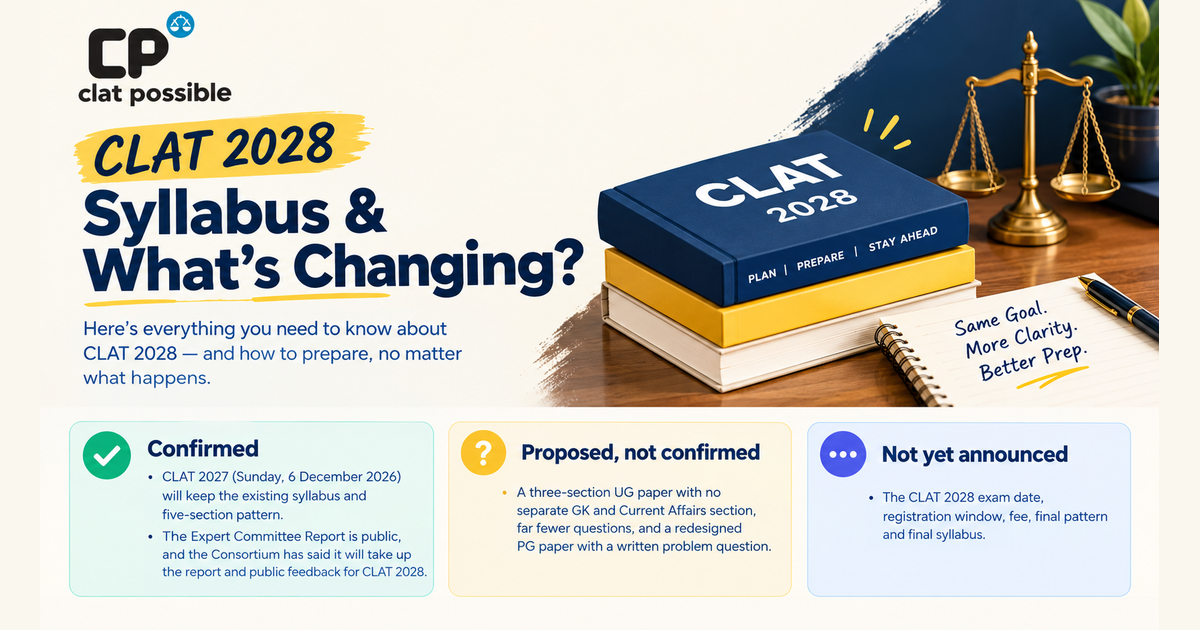
CLAT 2028 status check (as of 23 October 2026)
- Confirmed: CLAT 2027 (Sunday, 6 December 2026) keeps the existing syllabus and five-section pattern.
- Proposed, not confirmed: a three-section UG paper, no separate GK/Current Affairs section, fewer questions, and a redesigned PG paper with a written problem question.
- Not announced: the CLAT 2028 exam date, registration window, fee, final pattern and syllabus.
CLAT 2027-2028 Courses by CLAT Possible
What Is CLAT 2028?
CLAT is conducted by the Consortium of National Law Universities, which was formed on 19 August 2017 and currently lists 26 member NLUs. The year in the exam's name is the year of admission, not the year the exam is held. CLAT 2027 is being held on 6 December 2026 for admissions in 2027–28, so CLAT 2028 is for admissions in 2028–29.
CLAT UG 2028 and CLAT PG 2028
- CLAT UG 2028 is for five-year integrated law programmes such as BA LL.B. (Hons.) and BBA LL.B. (Hons.). Programmes and seats vary from one NLU to another.
- CLAT PG 2028 is for the one-year LL.M., for LL.B. graduates and final-year LL.B. students.
The two papers share a name and an application portal, but their eligibility and content are different. This guide focuses mainly on CLAT UG.
Is CLAT 2028 Your Exam? A Quick Check
| Where you are in the 2026–27 school year | Your likely first CLAT | What this guide means for you |
|---|
| Class 10 | CLAT 2029 | Too early for intensive preparation; build reading and reasoning habits now. |
| Class 11 | CLAT 2028 | This is your cycle. CLAT 2028 will fall during your Class 12 year. |
| Class 12 | CLAT 2027 (December 2026) | CLAT 2028 would be a second attempt, during a drop year or alongside college. |
| Class 12 passed / in college | CLAT 2028, if you meet the eligibility rules | CLAT 2027 had no upper age limit; confirm the 2028 rule when the notice is out. |
CLAT 2028 Exam Highlights
| Particular | CLAT 2028 details |
|---|
| Exam name | Common Law Admission Test (CLAT) 2028 |
| Conducting authority | Consortium of National Law Universities |
| Programmes | UG: five-year integrated LL.B.
PG: one-year LL.M. |
| Notification | Not officially announced |
| Application dates | Not officially announced |
| Exam date | Not officially announced (recent CLATs have been held in December of the year before admission) |
| Exam mode | Not officially announced for 2028 (CLAT 2027: offline, pen-and-paper) |
| Duration | Not officially announced (CLAT 2027: 2 hours; the Expert Committee also proposes 2 hours) |
| Pattern and syllabus | Under review. CLAT 2027 is unchanged; Expert Committee proposals are being considered for CLAT 2028 |
| Official website | consortiumofnlus.ac.in |
CLAT 2028 Exam Date and Important Events
The CLAT 2028 exam date has not been announced yet. Based on recent cycles, it is sensible to plan around December 2027 as a working assumption.
Reference Point: How the CLAT 2027 Schedule Was Announced
| CLAT 2027 event | Official date |
|---|
| Decision on exam date (Executive Committee and Governing Body meetings) | 18 July 2026 |
| Press release with exam date and application window | 22 July 2026 |
| Online applications open | 3 August 2026 |
| Last date to apply | 31 October 2026 |
| Exam | Sunday, 6 December 2026, 2:00 pm to 4:00 pm |
| Admit card, answer key, result, counselling | To be notified by the Consortium |
CLAT 2028 Events to Track
| Event | CLAT 2028 status | What you should do |
|---|
| Decision on pattern and syllabus | Pending | Watch for an official notice and any sample paper. The Expert Committee recommended that sample papers be made public if its proposals are accepted. |
| CLAT 2028 notification | Not announced | Read the eligibility, fee and syllabus sections in full on the official site. |
| Registration and application form | Not announced | Keep documents ready; apply well before the deadline. |
| Admit card | Not announced | Check your name, photo, centre and reporting time the day it is released. |
| Exam | Not announced | Visit your centre in advance if you can. |
| Provisional answer key and objections | Not announced | Calculate a rough score; raise objections only with solid reasoning. |
| Final answer key and result | Not announced | Download your scorecard and note your rank. |
| Counselling and seat allotment | Not announced | Register for counselling on time and plan your NLU preference list. |
Always rely on the Consortium's official notices, not social media screenshots. We will update this page as soon as the CLAT 2028 notification is released.
CLAT 2028 Eligibility Criteria
The CLAT 2028 eligibility rules have not been released yet. Until they are, the CLAT 2027 rules are the best reference.
CLAT UG Eligibility (CLAT 2027 Rules)
- Qualification: Class 12 or equivalent.
- Minimum marks: 45% (40% for SC/ST). Other category relaxations, including PwD, are given in each year's notice.
- Appearing candidates: students writing Class 12 in March/April can apply, but must show proof of passing at the time of admission.
- Age: no upper age limit.
- Stream: no specific stream is required. Science, Commerce and Humanities students can all apply.
CLAT PG Eligibility (CLAT 2027 Rules)
- Qualification: LL.B. or equivalent.
- Minimum marks: 50% (45% for SC/ST); check the notice for other relaxations.
- Appearing candidates: final-year LL.B. students can apply, with proof at admission.
- Age: no upper age limit.
| Criteria | CLAT UG | CLAT PG |
|---|
| Qualifying exam | Class 12 or equivalent | LL.B. or equivalent |
| Minimum marks (CLAT 2027) | 45% (40% SC/ST) | 50% (45% SC/ST) |
| Appearing candidates | Eligible, with proof at admission | Eligible, with proof at admission |
| Upper age limit | None | None |
- Your Class 12 marks decide whether you are eligible; your CLAT score decides your rank.
- Each NLU sets its own rules for domicile, reservation, NRI and foreign-national seats.
CLAT 2028 Exam Pattern: Current Format vs Proposed Changes
There are two possibilities for CLAT 2028: the current five-section paper used for CLAT 2027, or the three-section design proposed by the Expert Committee.
The Current CLAT UG Pattern (Applies to CLAT 2027)
| Feature | CLAT 2027 (UG) |
|---|
| Conducting body | Consortium of National Law Universities |
| Exam date | Sunday, 6 December 2026 |
| Exam timing | 2:00 pm – 4:00 pm |
| Application window | 3 August – 31 October 2026 |
| Duration | 2 hours |
| Mode | Offline, pen-and-paper (OMR) |
| Total questions | 120 multiple-choice questions |
| Marks per correct answer | +1 |
| Negative marking | −0.25 for every wrong answer; no penalty for unanswered questions |
| Number of sections | 5 |
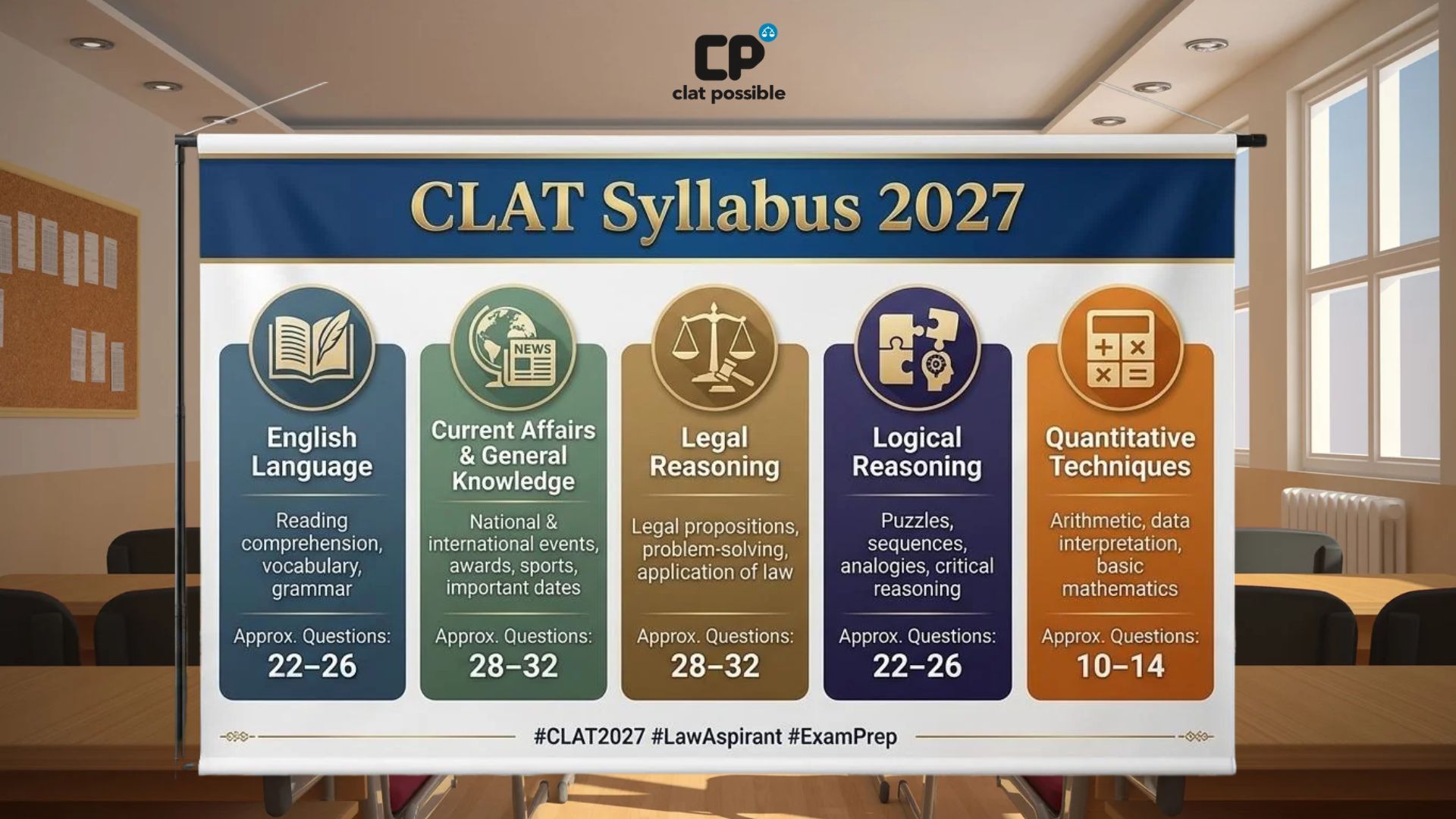
| Sections | English Language; Current Affairs including General Knowledge; Legal Reasoning; Logical Reasoning; Quantitative Techniques |
| Question format | Passage-based, with passages of roughly 450 words in the reading-heavy sections |
As a rough guide from earlier papers, English carries about 20% of the questions, Current Affairs about 25%, Legal Reasoning about 25%, Logical Reasoning about 20% and Quantitative Techniques about 10%.
The Proposed CLAT 2028 UG Pattern (Expert Committee)
The Expert Committee, made up of five legal academics from Oxford, LSE, Columbia, Cambridge and BML Munjal University, has proposed a three-section paper:
- Logical Reasoning and Legal Aptitude: merges the current Legal and Logical Reasoning sections. It would use purely hypothetical scenarios and need no prior legal knowledge.
- Language and Comprehension: replaces English, with a focus on inference, implication, tone and the strength of arguments rather than grammar or vocabulary.
- Quantitative Techniques: stays as a separate section, with more emphasis on data sufficiency, conceptual numeracy and logic puzzles.
- There would be no separate GK/Current Affairs section.
- Each section would have no more than 10 to 15 questions, and the total time would stay at 2 hours.
- An essay was considered but not recommended for now; it may be revisited after about three years.
Current vs Proposed CLAT UG: Side by Side
| Feature | Current pattern (CLAT 2027) | Proposed by Expert Committee (not confirmed) |
|---|
| Sections | 5 | 3 |
| Total questions | 120 | No more than 10 to 15 per section (roughly 30 to 45 in all) |
| Duration | 2 hours | 2 hours |
| GK and Current Affairs | Separate section | No separate section |
| Legal content | Legal Reasoning passages | Hypothetical rule application and rule derivation, merged with logic |
| Main skill rewarded | Reading speed across long passages | Depth, accuracy and reasoning |
| Essay | None | None for now; to be reconsidered later |
CLAT PG 2028: Current Paper and Proposed Redesign
Current paper: 120 multiple-choice questions in 2 hours, with the same marking as UG and no separate sections. It covers Constitutional, Administrative, Contract, Torts, Criminal, Family, Property, Company, Public International, Tax, Environmental and Labour Law, along with Jurisprudence.
Proposed redesign:- Three UG-style aptitude sections carrying 50% of the weight.
- A new Legal Knowledge MCQ section on legal developments from the previous two calendar years, focused on doctrine.
- No more than 10 questions in each of the four MCQ sections.
- A written Problem Question: candidates choose one of three problems (Public, Private, Commercial or International Law). NLUs would mark only shortlisted candidates' answers.
- Total time: 2 hours.
Where the Decision Stands: A Verified Timeline
- 15 September 2025: the Consortium forms the Expert Committee, with reforms originally intended from 2027.
- 15 October – 4 November 2025: public feedback is collected.
- 11 November 2025, 14 January 2026 and 2 February 2026: interim report, final recommendations and final report.
- 17 May 2026: meeting at the National Judicial Academy, Bhopal; the Office of the CJI is to constitute a committee to consider the recommendations further.
- 18 July 2026: the Governing Body decides on no change for CLAT 2027; the report is published and feedback invited until 31 August 2026.
- 21–22 July 2026: the report and press releases are published.
- As of 23 October 2026: no official notice on the CLAT 2028 pattern.
Since the reforms have already been deferred once, CLAT 2028 may adopt them fully, partly or not at all. That is why we recommend a dual-track preparation strategy, explained below.
CLAT 2028 Syllabus
The CLAT 2028 syllabus has not been released yet. For topic-level detail on the current syllabus, read our
CLAT Syllabus 2027 guide.
Current UG Syllabus (Confirmed for CLAT 2027)
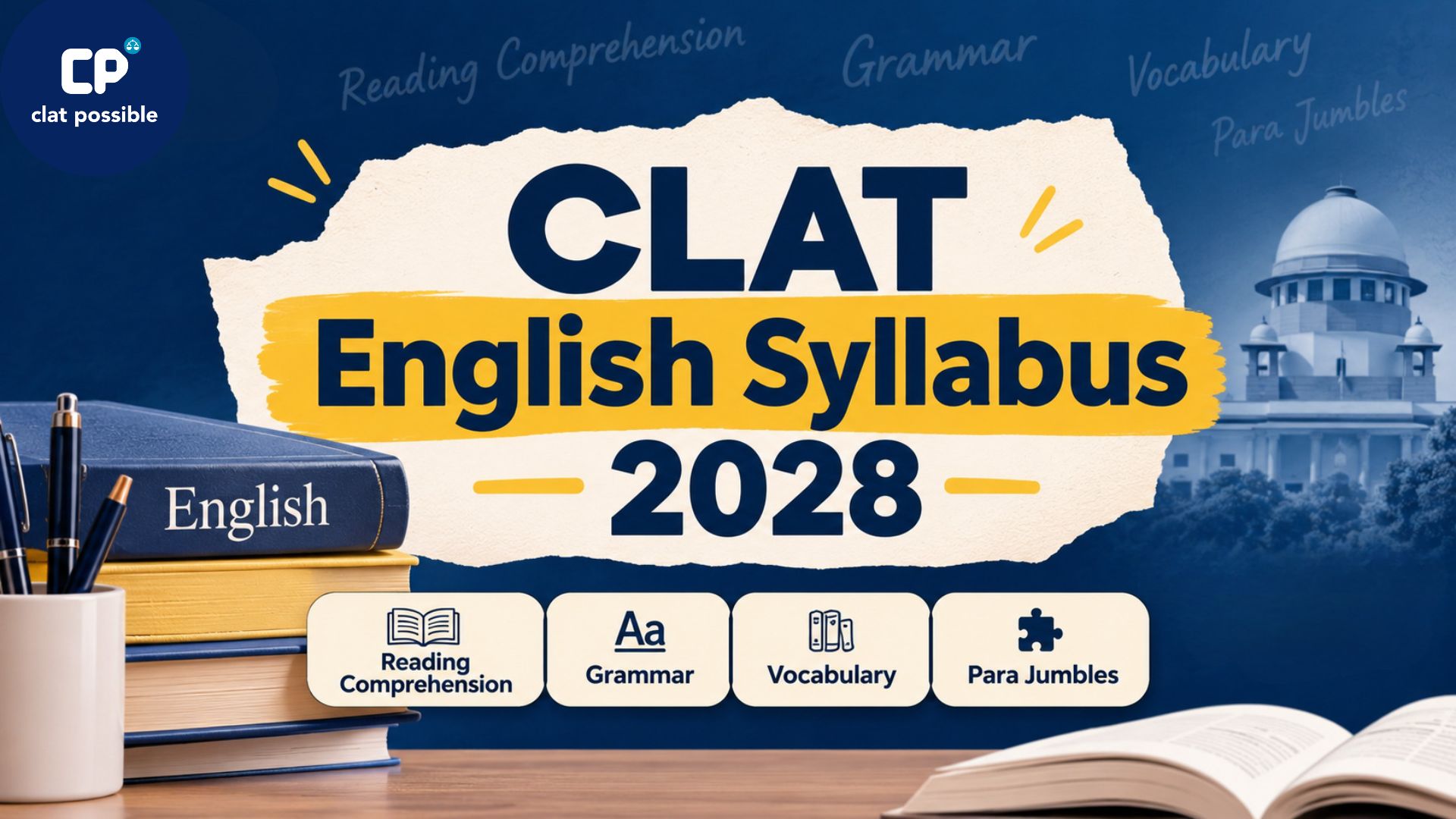
- English Language: fiction and non-fiction passages of about 450 words, testing the main idea, inference, summary, viewpoints and the meaning of words in context.
- Current Affairs including GK: news and non-fiction passages on Indian and world events, arts and culture, international affairs and historical events of lasting importance.
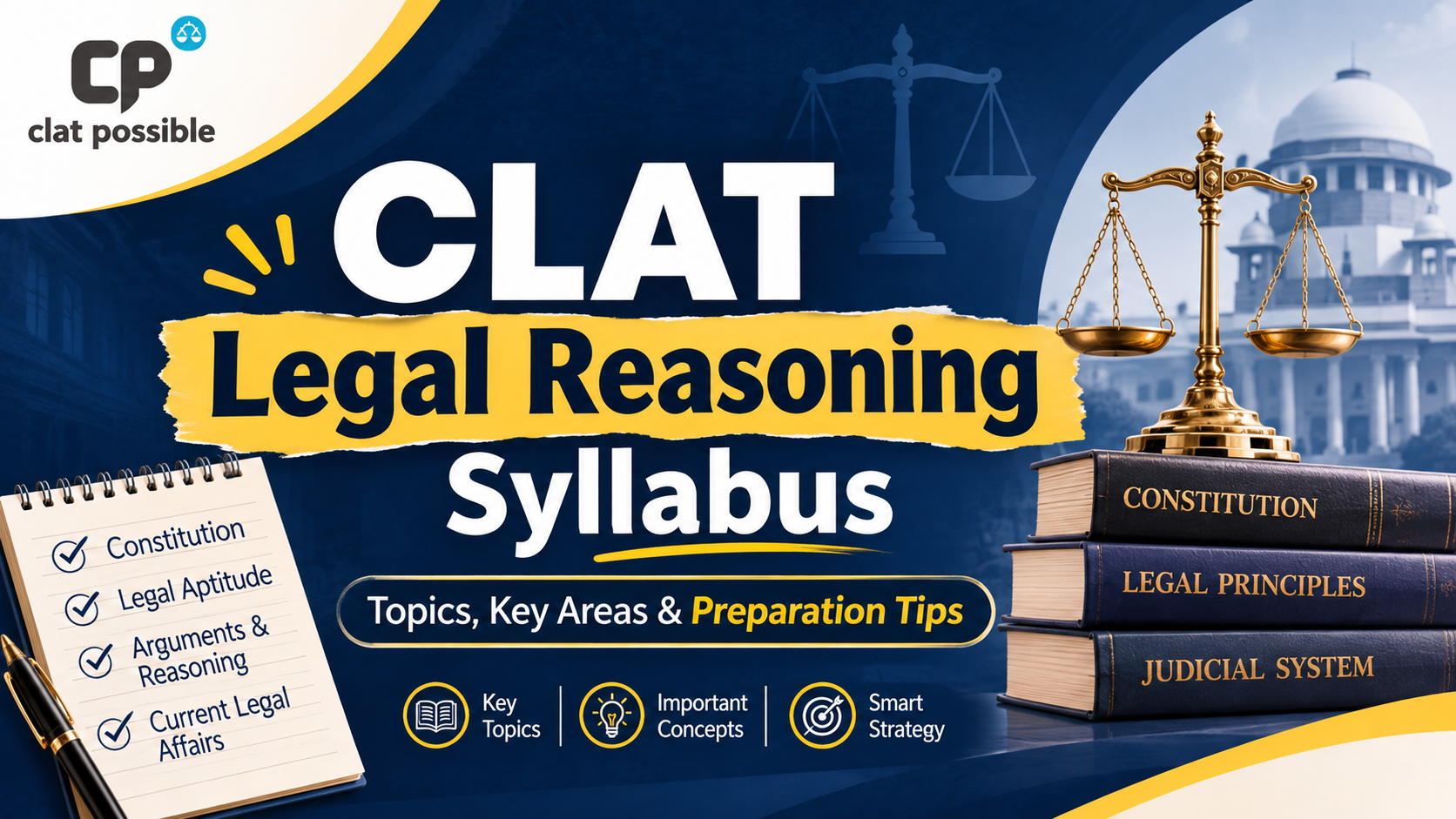
- Legal Reasoning: passages on legal, policy or moral issues. You identify the principle and apply it to the facts. No prior legal knowledge is needed, though general awareness helps.
- Logical Reasoning: arguments, premises, conclusions, strengthening and weakening statements, inferences, analogies and contradictions.
- Quantitative Techniques: data given in text, charts or tables, using Class 10-level maths such as ratios, proportions, basic algebra, mensuration and statistical estimation.
See the
official CLAT UG syllabus on the Consortium website.
Proposed UG Syllabus (Only If Reforms Are Adopted)
Under the proposal, the paper would have three sections and no separate GK section. Until the Consortium confirms the change, do not assume that any current section will survive or be removed.
Skills That Matter Under Either Syllabus
- Summarising the argument of a dense passage in one line.
- Applying a stated rule to facts without using outside knowledge.
- Spotting assumptions and what strengthens or weakens a conclusion.
- Comfort with percentages, ratios and data given in words or tables.
- Accuracy under time pressure, and knowing when to skip a question.
CLAT 2028 Registration and Application Form
CLAT 2028 registration is not open yet. The official notification will confirm the form, fee and deadline. Based on CLAT 2027, the process is likely to be:
- Visit consortiumofnlus.ac.in and open the CLAT 2028 page once it is live.
- Register with your mobile number and email address.
- Fill in your personal, academic and category details.
- Choose UG or PG and your test-centre preferences.
- Upload your photo, signature and certificates.
- Pay the application fee online.
- Submit the form and download the confirmation.
Application Fee (CLAT 2027, for Reference)
| Category | CLAT 2027 fee |
|---|
| General, OBC, NRI and other categories | ₹4,000 |
| SC, ST and BPL (check the notice for other concessions) | ₹3,500 |
| Previous years' question papers (optional) | ₹500 extra |
The fee is paid online only, is non-refundable, and any bank charges are borne by the candidate. The CLAT 2028 fee has not been announced.
Documents to Keep Ready
- A digital photograph and signature.
- Class 10 certificate (for name and date of birth) and Class 12 marksheet, if available.
- Category, PwD, BPL or domicile certificates, if applicable.
- An email ID and mobile number that you will keep active until admissions close.
How to Prepare for CLAT 2028
Do not wait for the final pattern to start preparing. The core skills are the same under both patterns, so every month you spend building them counts. Follow these six steps:
- Take a diagnostic, not a verdict: attempt one past paper or mock without a timer, then once under time. Note your weak areas, such as reading speed, misreading, maths gaps or guessing.
- Build foundations in the first few months: learn how each question type works. For reasoning, that means assumptions, inferences and conclusions; for maths, revisiting Classes 8 to 10; for legal reasoning, separating the rule, the facts and the question.
- Practise daily in small doses: do some serious reading and at least one passage-based set every day.
- Add timed work: only once your untimed accuracy is steady.
- Take mocks and analyse them: for every wrong or skipped question, record the cause and the fix.
- Schedule your revision: review your error log and notes every week and every month.
For a detailed month-by-month plan, see our
complete CLAT 2028 study plan.
The Dual-Track Rule for an Undecided Pattern
Make reading, argument analysis, rule application and numeracy your core under both tracks. Keep current affairs as a daily habit rather than heavy memorisation. Then adjust once the pattern is confirmed:
| If the Consortium confirms… | Adjust your preparation like this |
|---|
| The current five-section pattern | Step up GK revision, and practise managing time across 120 questions. |
| The proposed three-section pattern | Drop GK memorisation for CLAT, go deeper on rule application and rule derivation, practise data sufficiency, and prioritise accuracy because each question will count for more. |
| A partial or phased change | Treat the official sample paper as your main reference, and realign your mocks to it. |
AILET and some other law entrance exams still include GK, so check each exam's latest notice before you drop current affairs altogether.
Try Roznama (mini CLAT) for Free
Preparation Strategy for Different Students
- Class 10: you do not need a coaching timetable yet. Read long-form articles a few times a week, discuss the news, find out what studying law at an NLU involves, and keep your board exams first.
- Class 11 (the core CLAT 2028 group): you have about 13 to 14 months from October 2026. Build foundations first (daily reading, basic maths, reasoning logic), start sectional practice by spring 2027, then move to mocks and pattern adaptation in the second half of 2027. Read more about starting CLAT preparation in Class 11 or Class 12.
- Class 12: CLAT usually falls in December, before your boards. Put CLAT first from July to December, go lighter on mocks in the weeks before pre-boards, and then switch fully to boards. Board English and maths overlap with CLAT skills. See our guide on juggling CLAT and board exams.
- Droppers and repeat aspirants: start with an honest post-mortem: was it knowledge, speed or nerves? Set monthly targets, take mocks and analyse them, and protect your health and routine. Rebuild around the shared core skills rather than repeating your 2027 plan. Read our strategies for repeat attempts.
- Self-study without coaching: follow the official syllabus, use authentic practice material, analyse every test and keep an error log. Start with the Consortium's documents, then add a quality newspaper and a reliable mock series. Coaching helps most with structure, feedback and doubt-solving. Compare CLAT coaching vs self-study.
Section-Wise Preparation Tips
English Language / Language and Comprehension
- Method: read editorials and essays; for each, write a one-line summary and describe its tone in one word.
- Routine: one passage daily, and review why each wrong option is wrong.
- Mistakes to avoid: answering from memory instead of the passage; memorising word lists without context.
Read more on how to
improve reading comprehension for CLAT.
Current Affairs and General Knowledge
- Method: follow one daily newspaper and keep short thematic notes (polity, economy, international affairs, environment, legal developments).
- Routine: daily headlines, a weekly recap quiz and monthly consolidation.
- Mistakes to avoid: collecting PDFs you never revise; learning isolated facts without understanding why they matter.
- Note: keep this light until the pattern is confirmed. Understanding the news also helps with passage reading.
Legal Reasoning
- Method: underline the rule, list the material facts, and answer strictly within the passage.
- Routine: two to three passages a few times a week, plus a weekly "change one fact" drill.
- Mistakes to avoid: using outside law; skimming the facts.
- Note: the "change one fact" drill closely matches the rule-application style in the proposed pattern.
Follow our
step-by-step legal aptitude guide.
Logical Reasoning
- Method: identify the conclusion first, then the premises, then the hidden assumption.
- Routine: short critical reasoning sets most days, and analytical puzzles once or twice a week.
- Mistakes to avoid: choosing options that are true in real life but do not follow from the passage; ignoring qualifiers such as "some", "only" and "most".
Quantitative Techniques
- Method: rebuild percentages, ratios, averages, profit and loss, and simple algebra, then move on to data given in text and tables.
- Routine: a short calculation warm-up plus one data set several times a week.
- Mistakes to avoid: skipping the section entirely; spending too long on a single calculation.
- Note: add data-sufficiency questions to prepare for the proposed pattern.
Take Free Demo Class
CLAT 2028 Study Plan and Timetable
This plan assumes the exam will be held around December 2027. If the official date is different, shift the phases accordingly.
| Phase | Indicative window | Focus | You are ready to move on when… |
|---|
| 1. Foundation | Now to about March 2027 | Daily reading, maths basics, how each question type works | You can summarise a 450-word passage accurately and handle basic arithmetic without hesitation. |
| 2. Skill building | About April to July 2027 | Sectional practice, an error log, a steady current-affairs habit | Your sectional accuracy is consistent across a few weeks. |
| 3. Testing | About August to October 2027 | Full-length mocks aligned to the confirmed pattern, with detailed analysis | Your mock scores are stable and you have a clear section order and time plan. |
| 4. Final preparation | November 2027 to the exam | Revision of notes and error log, fewer but sharper mocks, exam-day routine | You go into the exam with a tested plan rather than new material. |
How to Adapt the Plan
- Starting late: compress Phase 1, but do not skip it.
- Strong reader, weak in maths: give Quantitative Techniques extra slots in Phases 1 and 2.
- Pattern confirmed mid-year: match your Phase 3 mocks to the official sample paper and re-weight GK accordingly.
A Sample Weekly Layout (Tasks, Not Hours)
| Day | CLAT tasks |
|---|
| Monday | Editorial reading + one English/comprehension passage + news notes |
| Tuesday | Two legal reasoning passages + one data set |
| Wednesday | Critical reasoning set + news notes |
| Thursday | One comprehension passage + maths fundamentals revision |
| Friday | Legal reasoning "change one fact" drill + puzzle set |
| Saturday | Sectional test or full mock (depending on your phase) |
| Sunday | Mock analysis, error-log update, weekly current-affairs quiz, rest |
Track the tasks you complete, not the hours you sit at your desk.
Best Books and Resources for CLAT 2028
A few resources used thoroughly will do far more for you than a pile of books you never finish.
1. Official Resources (Start Here)
- The official CLAT UG syllabus page on the Consortium website (switch to the 2028 version once it is published).
- Previous year papers (sold for ₹500 in the CLAT 2027 cycle).
- The CLAT Expert Committee Report 2026, which includes sample questions in the proposed styles. These are illustrations, not an official paper.
2. Everyday Reading
- One quality national newspaper daily, including the editorials.
- Long-form essays and opinion writing.
3. Supplementary Books and Material
- NCERT Maths for Classes 8 to 10.
- One passage-based legal reasoning book and one logical reasoning book.
- One current-affairs source that is updated every month.
- Check that any book you buy reflects the confirmed exam structure.
See our list of recommended
CLAT preparation books.
4. Practice from CLAT Possible
Our free
Roznama (Daily Mini CLAT) gives you about 25 to 30 questions every day, based on that day's newspaper, across the five current CLAT sections.
Try Roznama Free
CLAT 2028 Mock Tests and Previous Year Papers
How to Use Previous Year Papers
- Solve the most recent papers first.
- Attempt them under exam conditions, then analyse them slowly.
- Remember that older papers may follow older structures. CLAT moved to a passage-based format from 2019–20, so use past papers to build skills, not to predict questions.
How to Choose CLAT 2028 Mock Tests
- Choose mocks that follow the confirmed pattern. Until it is confirmed, focus on sectional and skill-based tests.
- Look for detailed solutions, section-wise and question-type breakdowns, and comparison with other students.
- Fewer mocks, analysed well, beat many mocks taken and forgotten.
A Simple Mock-Analysis Tracker
| Track | Ask yourself |
|---|
| Wrong answers | Was it a concept gap, a misread question or carelessness? |
| Skipped questions | Did you skip by choice or because time ran out? |
| Time per section | Where did the clock run away from you? |
| Repeated errors | Which question type has gone wrong three times or more? |
| Next action | What one change will you test in the next mock? |
Participating NLUs and Law Courses
The CLAT 2028 notification will confirm the participating NLUs and their seat matrices. As of October 2026, the Consortium lists 26 member NLUs:
| University | Location |
|---|
| National Law School of India University (NLSIU) | Bengaluru |
| NALSAR University of Law | Hyderabad |
| National Law Institute University (NLIU) | Bhopal |
| The West Bengal National University of Juridical Sciences (WBNUJS) | Kolkata |
| National Law University, Jodhpur | Jodhpur |
| Hidayatullah National Law University (HNLU) | Raipur |
| Gujarat National Law University (GNLU) | Gandhinagar |
| Dr. Ram Manohar Lohiya National Law University (RMLNLU) | Lucknow |
| Rajiv Gandhi National University of Law (RGNUL) | Patiala |
| Chanakya National Law University (CNLU) | Patna |
| National University of Advanced Legal Studies (NUALS) | Kochi |
| National Law University Odisha (NLUO) | Cuttack |
| National University of Study and Research in Law (NUSRL) | Ranchi |
| National Law University and Judicial Academy, Assam (NLUJA) | Guwahati |
| Damodaram Sanjivayya National Law University (DSNLU) | Visakhapatnam |
| Tamil Nadu National Law University (TNNLU) | Tiruchirappalli |
| Maharashtra National Law University, Mumbai | Mumbai |
| Maharashtra National Law University, Nagpur | Nagpur |
| Maharashtra National Law University, Chhatrapati Sambhajinagar | Chhatrapati Sambhajinagar (Aurangabad) |
| Himachal Pradesh National Law University (HPNLU) | Shimla |
| Dharmashastra National Law University (DNLU) | Jabalpur |
| Dr. B.R. Ambedkar National Law University | Sonipat |
| National Law University Tripura | Agartala |
| Dr. Rajendra Prasad National Law University | Prayagraj |
| India International University of Legal Education and Research (IIULER) | Goa |
| National Law University Meghalaya | Shillong |
NLU Delhi is not part of CLAT, as it admits students through its own exam, AILET. Several other universities and organisations also use CLAT scores, so check each one's rules. For seat numbers, see
total seats in NLUs for CLAT 2026.
What to Check for Each NLU
- Programmes: BA LL.B. is offered almost everywhere, while BBA, B.Com, B.Sc. and BSW LL.B. vary.
- Seat matrix: the split between all-India, domicile and special-category seats differs.
- Reservation policy: each NLU applies its own state and central rules.
- Fees and conditions: these are set by each university.
CLAT 2028 Result, Rank, Cut-Off and Counselling
Result and Scorecard
In recent cycles, the Consortium has released a provisional answer key, invited objections, published the final key, and then declared results with scores and all-India ranks. No CLAT 2028 dates have been announced yet.
CLAT Counselling: How It Worked in the CLAT 2026 Cycle
- Candidates completed a separate counselling registration, paid a counselling fee and submitted an NLU preference list.
- Seats were allotted centrally over five rounds, based on rank, category, preferences and seat availability.
- After each allotment, candidates could choose Freeze, Float (available until round four) or Exit.
- A confirmation fee had to be paid by the deadline, followed by the balance university fee.
The rules for CLAT 2028 may differ. For more detail, read our
CLAT 2026 UG counselling guide.
About Cut-Offs
No expected cut-offs for CLAT 2028 have been published. Past cut-offs must be read by year, category, domicile and counselling round, and should be treated as context, not targets. No particular score guarantees admission.
Common Preparation Mistakes to Avoid
- Reading only now and then instead of every day.
- Learning GK passively, without notes or recall practice.
- Taking mocks without analysing them.
- Spending too much time on a single passage.
- Believing unverified claims about the "new pattern".
- Postponing revision.
- Waiting for the final pattern before starting to prepare.
Why Choose CLAT Possible for CLAT 2028 Preparation?
- Zephyr for Class 11 (CLAT 2028): an offline and online classroom programme with weekend classes.
- Roznama (free): daily analysis of The Hindu, Words of the Day, the top five headlines and an evening test of 25 to 30 questions, in about 30 minutes a day.
- Mock tests and test series: the Hammer IT series for CLAT, AILET and other law exams, with a wide range of question styles.
- Mentorship and doubt-solving: personal mentoring and regular doubt sessions.
- Study material: prepared and updated by our core teaching team.
- Flexible formats: online, offline, correspondence and crash courses, with centres in Lucknow, Delhi NCR, Noida, Indirapuram, Chandigarh, Kanpur and Raipur. Use our centre locator to find one near you, and see our past Clat Possible results.
Start your preparation with a plan that works for either pattern.
Start Your CLAT 2028 Preparation
Conclusion
The CLAT 2028 pattern may still change, but the skills it rewards will not. Build a daily reading habit, strengthen your maths basics, practise rule application, keep up with current affairs, start an error log, and check the
Consortium website regularly. Once the pattern is announced, adjust your plan, and if you want a structured, mentored path that adapts to the final pattern,
explore our CLAT 2028 programmes.
Official Sources Used in This Guide