Home / Blog / CLAT Syllabus 2027: Section-Wise Topics, Weightage and What Is Actually Tested
CLAT Syllabus 2027: Section-Wise Topics, Weightage and What Is Actually Tested
By Team CLAT Possible I Oct 06, 2026
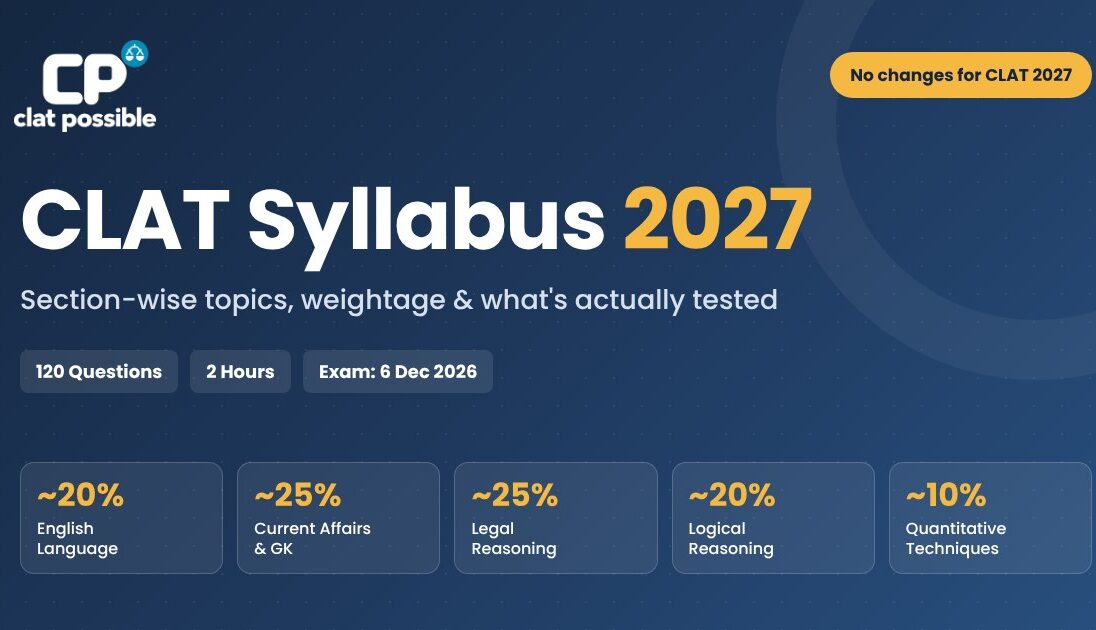
The CLAT syllabus 2027 has five sections: English Language, Current Affairs including General Knowledge, Legal Reasoning, Logical Reasoning and Quantitative Techniques. The paper has 120 multiple-choice questions in 2 hours. Each correct answer gets 1 mark, and each wrong answer loses 0.25 marks. The Consortium of NLUs has confirmed that the syllabus and pattern are unchanged for CLAT 2027.
CLAT 2027 is on Sunday, 6 December 2026, so you have about nine weeks left. This guide explains what each section actually tests and what you can safely skip. It also shows how to plan the time you have left.
CLAT 2027 Exam Pattern and Important Dates
Feature
CLAT 2027 (UG)
Conducting body
Consortium of National Law Universities
Exam date
Sunday, 6 December 2026
Exam timing
2:00 pm – 4:00 pm
Application window
3 August – 31 October 2026
Duration
2 hours
Total questions
120 multiple-choice questions
Marks per correct answer
+1
Negative marking
−0.25 for every wrong answer
Number of sections
5
Question format
Passage-based
Source: Consortium of NLUs – CLAT 2027 press release (22 July 2026) and official UG syllabus page.
CLAT 2027 Section-Wise Weightage
The official CLAT 2027 syllabus page does not fix the number of questions per section. In earlier cycles, the Consortium published the distribution below, and recent papers have broadly followed it. Use it as a planning guide, not a guarantee.
Section
Approx. Questions
Approx. Share
Priority
English Language
22–26
~20%
High
Current Affairs, including GK
28–32
~25%
Very High
Legal Reasoning
28–32
~25%
Very High
Logical Reasoning
22–26
~20%
High
Quantitative Techniques
10–14
~10%
Medium (but high-scoring)
Total
120
100%
CLAT Syllabus 2027: Section-by-Section Breakdown
All five sections at a glance:
Section
Passage Source
Core Skill Tested
Prior Knowledge Needed?
English Language
Fiction and non-fiction, contemporary and classic
Comprehension and inference
No
Current Affairs & GK
News and journalistic writing
Awareness of events and context
Yes – current affairs and GK
Legal Reasoning
Legal fact situations, policy and moral questions
Applying given rules to facts
No legal knowledge needed
Logical Reasoning
Short argumentative passages
Critical reasoning
No
Quantitative Techniques
Text-based numerical information
Class 10 maths and data reading
Class 10 maths
1. English Language
Passage length
About 450 words. A Class 12 student should be able to read one in roughly 5–7 minutes.
Passage source
Contemporary or historically significant fiction and non-fiction
Question types
Main idea and arguments
Inferences and conclusions
Summary of the passage
Comparing viewpoints
Meaning of words and phrases in context
How to prepare
Read one long-form article daily and summarise it in two lines. Learn vocabulary from context, not from word lists.
2. Current Affairs, including General Knowledge
Passage length
Up to 450 words
Passage source
News, journalism and other non-fiction
Areas covered
Significant events in India and the world
Arts and culture
International affairs
Historical events of continuing significance
Key point
The passage introduces a topic, but the questions often test related facts you must already know.
How to prepare
Follow the news daily and revise a monthly compilation. For every big story, note the who, what, why and background.
3. Legal Reasoning
Passage length
Around 450 words
Passage source
Legal fact situations, public policy questions, moral and philosophical issues
Prior legal knowledge
Not required, as stated in the official syllabus
Question types
Identify the rule or principle in the passage
Apply it to different fact situations
Work out how the outcome changes if the rule changes
How to prepare
Apply only the principle given, even if it feels unfair. Follow recent Supreme Court judgments and new laws for context.
4. Logical Reasoning
Passage length
Short passages of about 450 words
Question types
Identify the argument, its premises and its conclusion
Strengthen or weaken an argument
Draw inferences and apply them to new situations
Spot analogies, contradictions and equivalence
Judge how effective an argument is
Key point
This section tests critical reasoning, not puzzles.
How to prepare
State the conclusion in one line before reading the options. Rule out options that are true but irrelevant.
5. Quantitative Techniques
Format
Short sets of facts or text-based numerical information, followed by questions
Official topics
Ratios and proportions, basic algebra, mensuration, statistical estimation
Level
Class 10
Also practise
Percentages, averages, profit and loss, data interpretation. These often appear inside ratio and estimation problems.
How to prepare
Practise caselets, where the numbers sit inside a paragraph, rather than plain formula drills.
What Is In vs NOT In the CLAT 2027 Syllabus
Many syllabus lists online add topics that the official syllabus does not mention. This table shows where to spend your time.
Area
In the Syllabus ✅
Not in the Syllabus ❌
Law
Applying principles given in the passage
Memorising IPC/BNS sections or Acts
English
Comprehension, inference, vocabulary in context
Standalone grammar drills and error-spotting
Logical Reasoning
Arguments, assumptions, strengthen/weaken
Blood relations, coding-decoding (not listed)
Maths
Class 10 ratios, algebra, mensuration, estimation
Class 11–12 maths, calculus, trigonometry
GK
Passage-based current affairs and context
One-line fact questions
Want to see how well you handle passage-based questions? Try today's Daily Mini CLAT. It is a short, timed set that shows you where you stand.
Is the CLAT Syllabus Changing? CLAT 2027 vs CLAT 2028
On 18 July 2026, the Consortium's Governing Body confirmed that CLAT 2027 will have no changes to the syllabus, pattern or sections. Paper setters will try to adopt the Expert Committee's suggestions on question format and quality where feasible.The CLAT Expert Committee Report 2026 recommends bigger changes. A committee constituted by the Office of the Chief Justice of India will review them ahead of CLAT 2028.
Aspect
CLAT 2027
CLAT 2028
Syllabus status
Confirmed unchanged
Under review
Number of sections
5
Not decided (3 proposed)
GK / Current Affairs
Included
Removal proposed, not confirmed
Who should care
Class 12 students and droppers
Class 11 students
What to do
Prepare on the current pattern
Build core reading and reasoning skills; follow official notices only
Class 11 students: don't drop GK or Quant because of a recommendation. Reading, legal reasoning and critical reasoning matter under both the current and the proposed patterns.
9-Week Plan to Finish CLAT 2027 Preparation
Weeks
Goal
What to Do
Mocks per Week
1–2
Diagnose
Take a full mock. Find your 2 weakest sections and the question types costing you marks.
1
3–5
Fix and build
Do daily sectional practice on weak areas and daily current affairs revision.
2
6–8
Simulate
Take mocks at 2:00 pm, the real exam slot. Analyse each mock for as long as you took to write it.
3
9
Consolidate
Revise current affairs and your error log. Don't start any new material.
1–2 (light)
Common Mistakes and How to Fix Them
Mistake
Fix
Studying long "important topics" lists
Practise passages. The exam is built on them.
Using outside legal knowledge
Apply only the principle given in the passage.
Ignoring Quant
Spend 20 minutes daily on caselets. It's the easiest set of marks to secure.
Blind guessing
With −0.25 marking, attempt only when you can eliminate at least two options.
Not analysing mocks
Log every error by section and question type, then review the log weekly.
Not sure your plan fits the time you have left? Book your free demo now. They will review your mock scores and plan the weeks before 6 December with you. If you're starting early for CLAT 2028, explore our structured CLAT programmes.
Key Takeaways
The CLAT syllabus 2027 is short on paper but demanding in practice. It rewards careful reading, clear reasoning and staying current, not memorising. Use the official syllabus as your filter, and keep checking the Consortium of NLUs website for official updates.
Point
What You Need to Know
Format
Reading-and-reasoning test. Almost every question is built on a passage of about 450 words.
Legal knowledge
Not required. Legal Reasoning gives you the rule and asks you to apply it.
Maths level
Class 10 only
Highest weightage
Current Affairs + Legal Reasoning (roughly half the paper)
Syllabus changes
None for CLAT 2027. Expert Committee proposals apply only to CLAT 2028 discussions.
Frequently Asked questions
No. The Consortium has confirmed that the syllabus, pattern and sections of both the UG and PG papers are unchanged for CLAT 2027.
No. The official syllabus says Legal Reasoning requires no prior knowledge of law. Each passage gives you the principle to apply.
Current Affairs including GK and Legal Reasoning. Each has historically carried about 25% of the paper.
Class 10 level. The topics include ratios and proportions, basic algebra, mensuration and statistical estimation, usually set on short data passages.
It has been proposed, not decided. Until the Consortium officially notifies a change, keep preparing current affairs.
The Consortium publishes the CLAT 2027 UG syllabus on consortiumofnlus.ac.in. Treat that page as the final word over any third-party PDF.
No. CLAT PG is a separate, law-based paper for LLM admission. This guide covers the UG paper only.