By Team CLAT Possible I Nov 10, 2026
CLAT 2027 Courses by CLAT Possible
What This CLAT Official Sample Paper Guide Covers
- CLAT 2027 official sample paper: key highlights
- Download CLAT official sample paper 2027 PDF
- CLAT 2027 official sample paper analysis
- Section-wise analysis of the CLAT official paper
- Key takeaways: what the sample paper does and does not tell you
- How to use the CLAT official sample paper before 6 December
- Official sample paper vs previous year papers vs mocks
- Mistakes to avoid while solving the sample paper
Watch: CLAT Official Sample Paper 2027 Analysis
CLAT 2027 Official Paper Highlights
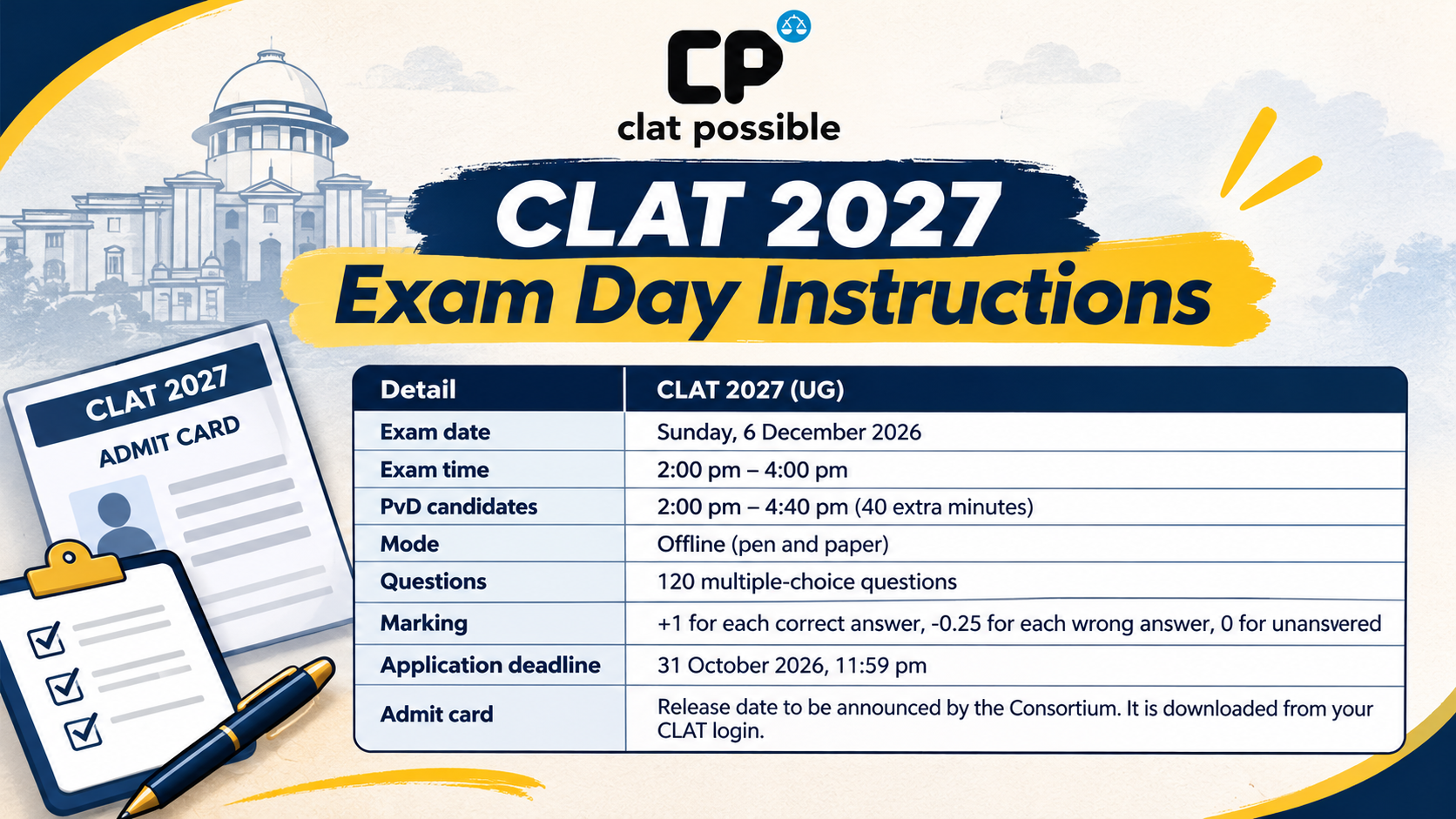
The CLAT official sample paper follows the same structure as the actual exam. Here is a quick overview of what the Consortium has released and how the paper is built.| Particular | Details |
|---|---|
| Released by | Consortium of National Law Universities |
| Number of official mocks | 2 (CLAT 2027 UG) |
| Official website | consortiumofnlus.ac.in |
| Total questions | 120 multiple-choice questions |
| Total passages | 24 passages across 5 sections |
| Marking scheme | +1 for each correct answer, −0.25 for each wrong answer |
| Overall difficulty | Easy |
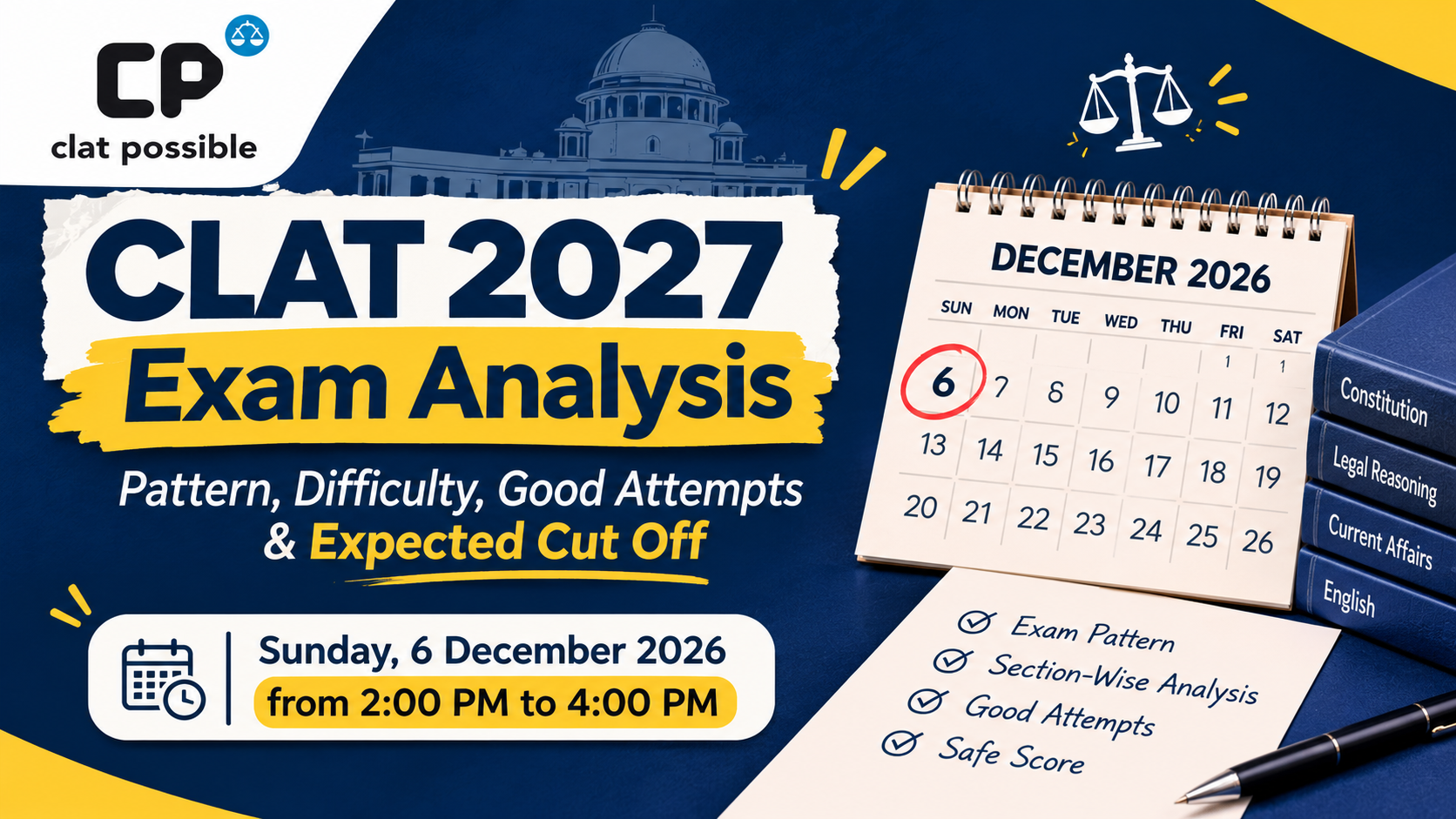
| CLAT 2027 exam date | Sunday, 6 December 2026, 2:00 PM to 4:00 PM |
Download CLAT Official Mock Papers 2027 PDF
Both CLAT official sample papers are available below. Download them, print them, and solve each one in a single 2-hour sitting, the same way you will sit the real exam.| Paper | Released by | Download |
|---|---|---|
| CLAT 2027 UG Mock 1 | Consortium of NLUs | Download PDF |
| CLAT 2027 UG Mock 2 (TBD) | Consortium of NLUs | Download PDF |
CLAT 2027 Official Mock 1 Analysis
Our faculty solved the CLAT official sample paper section by section. The verdict is clear: the paper is easy. Some passages are taken directly from old CLAT papers, while the new passages are of a very easy level.Therefore, the most important takeaway is this: do not assume the actual CLAT 2027 paper will be of the same standard or pattern. Treat the sample paper as a format check, not as a difficulty benchmark.| Section | Passages | Questions | Difficulty level |
|---|---|---|---|
| English Language | 5 | 25 | Easy to Moderate |
| Current Affairs including GK | 6 | 30 | Very Easy |
| Legal Reasoning | 6 | 30 | Easy |
| Logical Reasoning | 5 | 25 | Easy to Moderate |
| Quantitative Techniques | 2 | 10 | Easy |
| Total | 24 | 120 | Easy overall |
Section-Wise Analysis of the CLAT Official Paper
1. English Language: Easy to Moderate
The English section has 5 passages and 25 questions. The passages are of a reasonable length and difficulty, so a regular reader should finish them comfortably. Most questions refer directly to the passage. In addition, the section tests word meaning, the author's tone and figures of speech.2. Current Affairs including GK: Very Easy
This is the easiest section in the CLAT official sample paper, with 6 passages and 30 questions. In fact, many questions can be answered directly from the passage itself. The topics covered are:- ISRO
- Presidential Election of India
- Wetlands
- Election Commission
- UPI
- Constitution
3. Legal Reasoning: Easy
Legal Reasoning has 6 passages and 30 questions. The passages and principles are very short. Also, there are no current legal topics; every passage is based on static law. The topics covered are:- Writs
- Negligence
- Offer, acceptance and revocation
- Defamation
- Consumer law
- Right of private defence
4. Logical Reasoning: Easy to Moderate
The Logical Reasoning section has 5 passages and 25 questions. All of them are critical reasoning questions, and there are no analytical reasoning questions such as puzzles or arrangements. Even so, do not drop analytical reasoning from your practice, since it has appeared in past CLAT papers.5. Quantitative Techniques: Easy
Quant has 2 short passage sets with 10 questions. Every question is based on ratio and percentage. Therefore, this section should be a quick scoring zone, but still revise averages, profit and loss and data interpretation for the actual exam.Key Takeaways: What the CLAT Official Sample Paper Does and Does Not Tell You
| What it confirms | What it does not confirm |
|---|---|
| The paper still has 120 passage-based questions across five sections | The difficulty level of the actual CLAT 2027 paper |
| How the Consortium frames questions and options | The length of passages in the actual exam |
| The section order and the number of questions per passage | Whether analytical reasoning or current legal topics will be left out |
| Static law and core GK topics still matter | How much GK can be answered from the passage alone |
How to Use the CLAT Official Sample Paper Before 6 December
With less than four weeks left for CLAT 2027, use both official papers wisely rather than casually.- Solve each paper in one timed sitting. Use a 2-hour slot, ideally from 2:00 PM to 4:00 PM, to match the real exam timing.
- Fill a printed OMR sheet. CLAT is a pen-and-paper exam, so practise bubbling answers within the 2 hours.
- Analyse the paper the same day. Note whether each mistake came from a concept gap, a misread question or time pressure.
- Study the question style, not the difficulty. Focus on how the Consortium words its questions and builds its wrong options.
- Go back to tougher practice. After the sample papers, return to previous year papers and full-length mocks to stay ready for a harder actual paper.
CLAT Official Sample Paper vs Previous Year Papers vs Mocks
| Practice material | Best used for | Limitation |
|---|---|---|
| Official sample paper | Understanding the Consortium's format and question style | Easier than the actual exam; only two papers |
| Previous year papers | Judging the real difficulty level and recurring topics | Current affairs in older papers are outdated |
| Full-length mocks | Building speed, stamina and section-order strategy | Quality varies, so choose a CLAT-focused series |
Mistakes to Avoid While Solving the CLAT Official Sample Paper
1. Treating the Score as a Prediction
The sample paper is easy, so a high score here does not guarantee the same score in the actual exam.2. Skipping Analytical Reasoning and Legal Current Affairs
These were missing from the sample paper. However, both have appeared in past CLAT papers, so keep practising them.3. Solving Without a Timer
An untimed attempt hides your real speed. Always solve the full paper in 2 hours.4. Ignoring Negative Marking
Even on an easy paper, every wrong answer costs 0.25 marks. Therefore, attempt a question only when you can eliminate at least two options.5. Reading Too Much into the Topic List
The topics in this paper will not necessarily repeat in the actual exam. Instead, revise the full static law and current affairs syllabus.How CLAT Possible Helps You in the Final Weeks
At CLAT Possible, our final-phase preparation is built to close the gap between an easy sample paper and a demanding actual exam:- Full-length mocks set at the real CLAT difficulty level, with detailed analysis.
- Current affairs revision covering the legal and national news most likely to appear.
- Mentorship and doubt support for last-minute questions in Legal and Logical Reasoning.
- Exam strategy sessions on section order, time targets and smart attempts.
Conclusion
The CLAT official sample paper 2027 is a useful final-month resource, but mainly as a format check. It confirms the 120-question, five-section structure and shows how the Consortium frames its questions. However, its easy level should not set your expectations for 6 December. Solve both papers, analyse them honestly, and then return to tougher practice so that the actual exam feels familiar, not surprising.Frequently Asked questions
Yes. The Consortium of NLUs has released two official sample papers for CLAT 2027 UG. You can download both from the links in this blog or from consortiumofnlus.ac.in.
The paper has 120 questions across 24 passages: 25 in English, 30 in Current Affairs including GK, 30 in Legal Reasoning, 25 in Logical Reasoning and 10 in Quantitative Techniques.
Overall, the paper is easy. GK is the easiest section, while English and Logical Reasoning are easy to moderate.
Do not assume so. Some passages in the sample paper come from old CLAT papers and the new ones are very easy, so the actual paper may be considerably tougher.
Yes. Solve both papers under timed conditions to understand the Consortium's format, then return to previous year papers and full-length mocks for difficulty practice.
No. Two sample papers are useful but not enough. Combine them with previous year papers, full-length mocks and regular current affairs revision.