By Team CLAT Possible I Nov 18, 2026
CLAT 2027-2028 Courses by CLAT Possible
What You'll Find in This Blog
- CLAT Legal Reasoning Syllabus 2028
- What the Official CLAT Legal Reasoning Syllabus Says
- Will Legal Reasoning Change for CLAT 2028?
- CLAT Legal Reasoning Topics: Area-Wise Syllabus
- Which Legal Reasoning Topics Matter Most?
- Types of Legal Reasoning Questions in CLAT
- Sample CLAT Legal Reasoning Question 2028
- How to Solve a Legal Reasoning Passage: Step by Step
- CLAT 2028 Legal Reasoning Preparation Plan
- Best Resources for CLAT Legal Reasoning
- Conclusion
CLAT Legal Reasoning Syllabus 2028
| Particular | Details |
|---|---|
| Section name | Legal Reasoning |
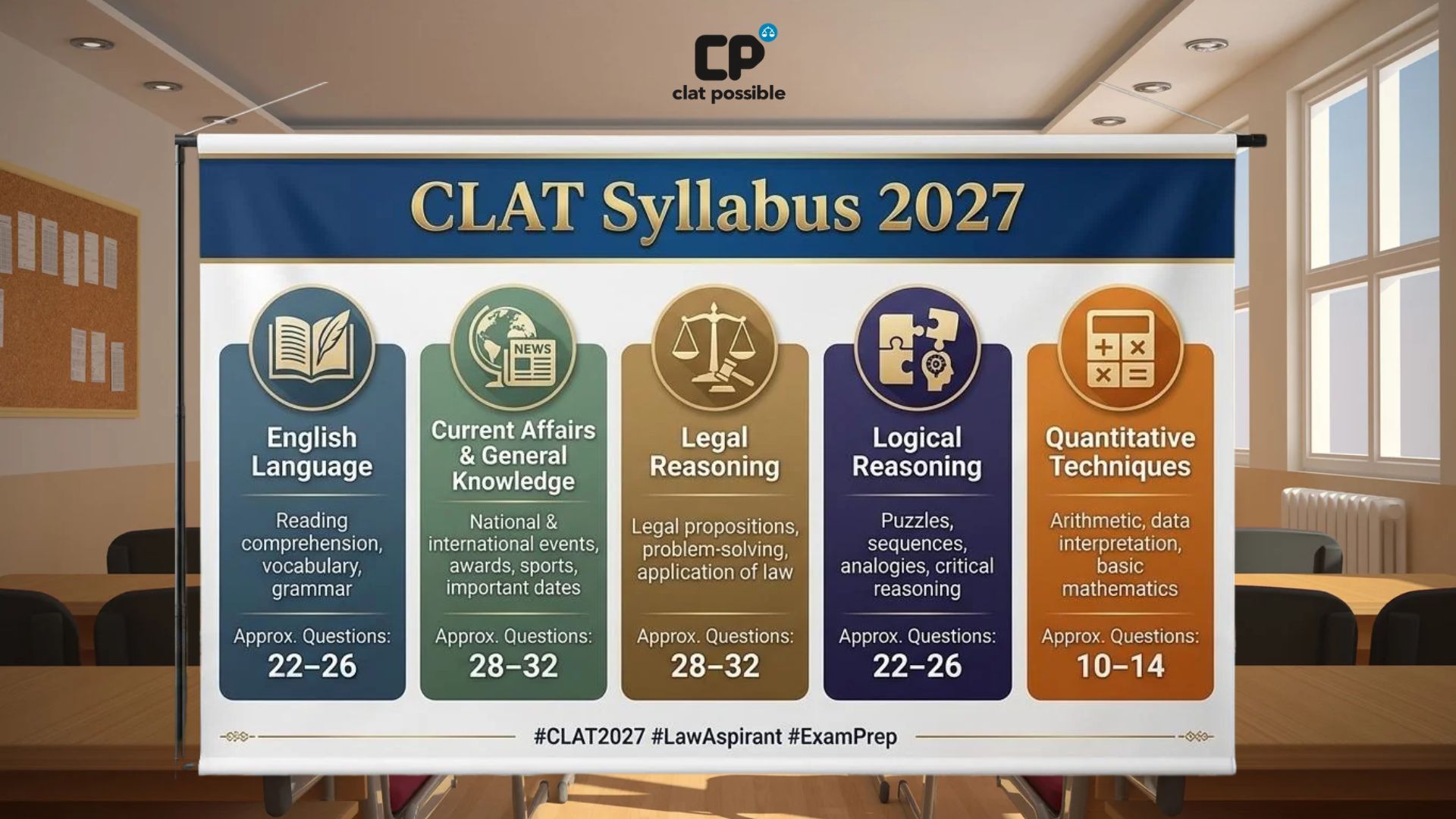
| Approximate share of the paper | About 25% (roughly 28 to 32 of 120 questions in recent papers) |
| Format | Passage-based multiple-choice questions |
| Passage length | Around 450 words each |
| Passage themes | Legal fact situations, public policy questions and moral or philosophical issues |
| Prior knowledge of law | Not required |
| Marking | +1 for a correct answer, −0.25 for a wrong answer, 0 for unanswered |
| Status for CLAT 2028 | Current syllabus applies to CLAT 2027; an Expert Committee proposal to merge Legal and Logical Reasoning is under consideration for CLAT 2028 |
What the Official CLAT Legal Reasoning Syllabus Says
According to the official CLAT UG syllabus, the Legal Reasoning section has passages of around 450 words dealing with legal fact situations, public policy questions or moral and philosophical issues. You are expected to:- Identify and infer the rules and principles set out in the passage.
- Apply those rules and principles to different fact situations.
- Understand how a change in the rule or principle would change its application to the facts.
Will Legal Reasoning Change for CLAT 2028?
It might. CLAT 2027 (6 December 2026) keeps the current five-section pattern. But the Expert Committee set up by the Consortium has recommended merging Legal Reasoning and Logical Reasoning into a single section called Logical Reasoning and Legal Aptitude, and the Consortium has said it will consider the proposals for CLAT 2028. As of October 2026, no final decision had been announced.| Feature | Current Legal Reasoning (CLAT 2027) | Proposed: Logical Reasoning and Legal Aptitude (not confirmed) |
|---|---|---|
| Section structure | Separate Legal Reasoning section | Merged with Logical Reasoning |
| Type of passages | Legal, policy and moral passages, often based on real laws or news | Purely hypothetical scenarios |
| Main tasks | Identify the principle and apply it to facts | Rule application and rule derivation (working out the rule from examples) |
| Prior legal knowledge | Not required | Not required |
| Number of questions | About 28 to 32 | No more than 10 to 15 per section |
| Skill rewarded | Accurate application at speed | Depth, accuracy and reasoning |
CLAT Legal Reasoning Topics: Area-Wise Syllabus
Although the passage always gives you the rule, most CLAT Legal Reasoning passages are built around a few areas of law. Knowing the basic ideas in each area helps you read faster and avoid traps.1. Law of Torts
Torts is one of the most frequently tested areas, because its principles are easy to turn into everyday fact situations.- Negligence and duty of care
- Strict and absolute liability
- Vicarious liability
- Defamation, nuisance and trespass
- Volenti non fit injuria (consent to risk)
- Remoteness of damage
2. Law of Contract
Contract passages test whether you can track who promised what, when, and under what conditions.- Offer, acceptance and revocation
- Consideration
- Capacity to contract (minors, persons of unsound mind)
- Free consent: coercion, undue influence, fraud, misrepresentation, mistake
- Void and voidable contracts
- Breach of contract and remedies
3. Criminal Law
Criminal law passages focus on intention, knowledge and the exceptions that excuse an act. The Bharatiya Nyaya Sanhita, 2023 has replaced the Indian Penal Code, so expect passages based on the new law.- Elements of a crime: guilty act and guilty mind
- General exceptions (mistake of fact, necessity, insanity, intoxication)
- Right of private defence
- Theft, extortion, cheating and criminal breach of trust
- Culpable homicide and murder
- Criminal intimidation and defamation
4. Constitutional Law
Constitutional passages often come from recent Supreme Court judgments or debates.- Fundamental Rights, especially Articles 14, 19 and 21
- Directive Principles of State Policy
- Writs and remedies
- Separation of powers and judicial review
- Centre-State relations
- Important constitutional amendments and doctrines
5. Other Areas and Legal Current Affairs
These areas appear less often but come up in news-based passages.- Consumer protection
- Basics of family law
- Environmental law
- Intellectual property basics
- Basics of evidence law (now the Bharatiya Sakshya Adhiniyam, 2023)
- Recent landmark judgments, new laws and legal reforms
Which Legal Reasoning Topics Matter Most?
| Area of law | Priority | Why it matters |
|---|---|---|
| Law of Torts | High | Principles translate easily into everyday situations, so passages are common |
| Law of Contract | High | Tests careful tracking of facts, conditions and timelines |
| Criminal Law | High | Intention, exceptions and new criminal laws make for tricky options |
| Constitutional Law | High | Frequently linked to recent judgments and current debates |
| Legal current affairs | Medium to high | Many passages are drawn from recent legal news |
| Consumer, family, environmental and IP law | Medium | Appear occasionally, usually through news-based passages |
Types of Legal Reasoning Questions in CLAT
| Question type | What it asks | How to approach it |
|---|---|---|
| Principle application | Apply the given rule to the facts and pick the correct outcome | Break the rule into conditions; check each condition against the facts one by one |
| Principle identification | Which principle from the passage applies to a situation? | Match the key facts (who, what, intention, consent) to each principle |
| Changed facts | How does the answer change if one fact is different? | Find which condition of the rule the new fact affects |
| Changed principle | How would the outcome change if the rule were modified? | Reapply the new rule from scratch; do not carry over the old answer |
| Inference | What can be concluded from the passage? | Choose only what the passage supports, not what seems fair |
| Strengthen / weaken | Which statement supports or undermines an argument in the passage? | Identify the claim first, then test each option against it |
| Rule derivation (proposed pattern) | Work out the rule from given examples | Look for the common factor that decides each outcome |
Sample CLAT Legal Reasoning Question 2028
Passage 1: Law of Torts
The law of negligence requires every person to take reasonable care to avoid acts or omissions which they can reasonably foresee would be likely to injure their "neighbour", that is, persons so closely and directly affected by their conduct that they ought reasonably to have them in contemplation. To succeed in a claim for negligence, a claimant must prove three things: first, that the defendant owed them a duty of care; second, that the defendant breached that duty by falling below the standard of a reasonable person in the same circumstances; and third, that the breach caused damage which was not too remote. A person who professes a special skill, such as a doctor or an engineer, is judged by the standard of a reasonably competent member of that profession, not by the standard of the most skilled expert in the field.
A defendant who is otherwise negligent may escape liability through the defence of volenti non fit injuria: to a willing person, no injury is done. The defence succeeds only where the claimant, with full knowledge of the nature and extent of the risk, freely and voluntarily agreed to bear that risk. Mere knowledge that a risk exists is not the same as consent to it. Courts have also refused to apply the defence to rescuers. Where a defendant's negligence creates a situation of danger, and a person is injured while trying to rescue someone from that danger, the rescue is treated as a natural and foreseeable consequence of the defendant's negligence rather than as a voluntary acceptance of risk.
Finally, where the claimant's own failure to take reasonable care for their own safety contributed to the damage they suffered, the defence of contributory negligence applies. Unlike volenti, contributory negligence does not defeat the claim altogether. The claimant still recovers, but the damages are reduced in proportion to the claimant's share of responsibility for the harm.
Question 1. Dr. Mehta, an orthopaedic surgeon, treats Kunal's fracture using a technique that is accepted and widely used by reasonably competent orthopaedic surgeons. The country's most renowned orthopaedic surgeon uses a newer technique that leads to slightly faster recovery. Kunal takes longer to recover than he would have with the newer technique, and sues Dr. Mehta for negligence. Will Kunal succeed?
- (a) No, because Dr. Mehta met the standard of a reasonably competent orthopaedic surgeon.
- (b) Yes, because a better technique was available and Dr. Mehta did not use it.
- (c) Yes, because Kunal suffered a slower recovery, which is damage caused by Dr. Mehta's choice.
- (d) No, because Kunal consented to the treatment and therefore accepted all its risks.
Show Answer & Explanation
Answer: (a)
A professional is judged by the standard of a reasonably competent member of the profession, not the most skilled expert. Since Dr. Mehta used a technique accepted by reasonably competent orthopaedic surgeons, there is no breach of duty. Option (d) is wrong because consent to treatment is not consent to negligence, and in any case there was no negligence here.
Question 2. A chemical factory negligently allows acid to leak from a damaged container onto a public footpath. A small child is about to step into the pool of acid when Arjun, a passer-by, rushes forward and pulls the child away. In doing so, Arjun slips into the acid and suffers severe burns. The factory argues that Arjun knew the acid was dangerous and chose to go near it. Is the factory liable?
- (a) No, because Arjun knew the acid was dangerous and voluntarily went near it, so volenti applies.
- (b) No, because the factory owed a duty only to the child, not to Arjun.
- (c) Yes, because Arjun was injured while rescuing the child from a danger created by the factory's negligence.
- (d) Yes, but Arjun's damages must be reduced because he chose to step close to the acid.
Show Answer & Explanation
Answer: (c)
The passage states that volenti does not apply to rescuers. A rescue is a natural and foreseeable consequence of creating a dangerous situation, so the factory owed a duty to Arjun as well. Nothing in the facts suggests Arjun acted carelessly in the rescue, so there is no basis to reduce damages under option (d).
Question 3. Sana buys a ticket to a motor race. The ticket states that motor racing is dangerous, that cars may leave the track, and that spectators agree to bear this risk. During the race, a car skids off the track and crashes through a section of the safety barrier that the organisers had negligently failed to repair after it was damaged the previous week. Sana, who had no idea the barrier was damaged, is injured. Can the organisers rely on volenti?
- (a) Yes, because Sana expressly agreed in writing to bear the risk of cars leaving the track.
- (b) No, because Sana did not have full knowledge of the nature and extent of the risk created by the damaged barrier.
- (c) Yes, because the injury was caused by a car leaving the track, which is exactly the risk Sana accepted.
- (d) No, because volenti can never apply to spectators at a sporting event.
Show Answer & Explanation
Answer: (b)
For volenti, the claimant must have full knowledge of the nature and extent of the risk. Sana accepted the ordinary risk of cars leaving the track, but she did not know of the unrepaired barrier, which was an additional risk created by the organisers' negligence. Option (d) overstates the rule; the passage does not say volenti never applies to spectators.
Question 4. Karan accepts a lift from his friend Dev. During the drive, Dev overtakes dangerously on a bend and crashes into a truck. Karan was not wearing a seatbelt. Medical evidence shows his injuries would have been much less serious if he had worn one. Karan sues Dev. What is the most likely outcome?
- (a) Dev is not liable, because Karan voluntarily got into the car and accepted the risks of the journey.
- (b) Dev is liable, and Karan recovers full damages because the crash was caused only by Dev's driving.
- (c) Dev is not liable, because Karan's own negligence in not wearing a seatbelt defeats his claim.
- (d) Dev is liable, but Karan's damages will be reduced because his failure to wear a seatbelt contributed to his injuries.
Show Answer & Explanation
Answer: (d)
Dev breached his duty of care by overtaking dangerously. Karan did not know of or agree to this specific risk when accepting the lift, so volenti fails. However, Karan's failure to wear a seatbelt contributed to the extent of his injuries, so contributory negligence applies. Under the passage, this reduces his damages rather than defeating his claim, which rules out option (c).
Question 5. Assume the passage did not contain the exception for rescuers, and that volenti applied whenever a claimant, with full knowledge of the risk, voluntarily chose to face it. Assume also that in the facts of Question 2, Arjun had clearly seen the acid and fully understood how dangerous it was before he stepped forward. What would be the outcome?
- (a) The factory would still be liable, because it was negligent in allowing the acid to leak.
- (b) The factory would not be liable, because Arjun, with full knowledge of the risk, voluntarily chose to face it.
- (c) The factory would be liable to the child but not to Arjun, because the child was the only person in danger.
- (d) The factory would be liable, but Arjun's damages would be reduced for contributory negligence.
Show Answer & Explanation
Answer: (b)
This question tests how a change in the principle changes the outcome. Without the rescuer exception, and with Arjun having full knowledge of the risk and voluntarily facing it, all the conditions for volenti are met. Volenti is a complete defence, so the factory escapes liability to Arjun. Option (a) ignores the defence, and option (c) is irrelevant because the child was not injured.
Passage 2: Law of Contract
Under the Indian Contract Act, 1872, an agreement becomes a contract when a proposal (or offer) made by one person is accepted by another. The communication of a proposal is complete when it comes to the knowledge of the person to whom it is made. The communication of an acceptance, however, is complete at two different moments. As against the proposer, it is complete when the acceptance is put in a course of transmission to the proposer, so that it is out of the power of the acceptor to recall it. As against the acceptor, it is complete only when the acceptance comes to the knowledge of the proposer.
This difference matters for revocation. A proposal may be revoked at any time before the communication of its acceptance is complete as against the proposer, but not afterwards. An acceptance may be revoked at any time before the communication of the acceptance is complete as against the acceptor, but not afterwards. A revocation is itself complete as against the person who makes it when it is put in a course of transmission, and as against the person to whom it is made when it comes to that person's knowledge.
An acceptance must be absolute and unqualified. If the person accepting introduces a new term or changes an existing one, the reply is not an acceptance but a counter-proposal, which the original proposer is free to accept or reject. A counter-proposal also brings the original proposal to an end, so it cannot later be accepted. A mere request for information, however, is not a counter-proposal and does not end the original proposal. Finally, silence does not ordinarily amount to acceptance, and a proposer cannot impose on the other party a condition that silence will be treated as acceptance.
Question 6. On 1 March, Priya posts a letter to Dev offering to sell her car for ₹4 lakh. Dev receives it on 3 March and posts a letter of acceptance at 10 a.m. on 4 March. At 11 a.m. on 4 March, Priya posts a letter revoking her offer. Both letters are delivered on 6 March. Is there a contract between Priya and Dev?
- (a) No, because Priya revoked her offer before Dev's acceptance came to her knowledge.
- (b) No, because both letters were delivered on the same day, so they cancel each other out.
- (c) Yes, because a proposal can never be revoked once it has reached the other party.
- (d) Yes, because Dev's acceptance was complete as against Priya when it was posted at 10 a.m., before she sent her revocation.
Show Answer & Explanation
Answer: (d)
A proposal can be revoked only before the acceptance is complete as against the proposer. As against Priya, Dev's acceptance was complete at 10 a.m., when he posted it. Her revocation at 11 a.m. came too late, so a contract was formed. Option (c) is wrong because a proposal can be revoked after it reaches the other party, as long as acceptance is not yet complete against the proposer.
Question 7. Dev posts a letter accepting Priya's offer at 10 a.m. on 4 March. At noon the same day, he changes his mind and emails Priya withdrawing his acceptance. Priya reads the email that evening. The acceptance letter reaches her on 6 March. Is there a contract?
- (a) No, because Dev revoked his acceptance before it came to Priya's knowledge, which is when it would have been complete as against him.
- (b) Yes, because the acceptance was complete as against Priya when Dev posted it at 10 a.m.
- (c) Yes, because an acceptance, once posted, cannot be withdrawn.
- (d) No, because Priya had not yet received the acceptance letter, so there was nothing for Dev to revoke.
Show Answer & Explanation
Answer: (a)
An acceptance can be revoked before its communication is complete as against the acceptor, which happens only when it comes to the proposer's knowledge. Priya learnt of the revocation on 4 March, before the acceptance letter reached her on 6 March. So Dev's revocation was valid and no contract was formed. Option (b) mixes up the two moments of completion; the question here is revocation by the acceptor.
Question 8. Meera offers to sell 100 bags of rice to Raj at ₹2,000 per bag. Raj replies, "I accept, but at ₹1,900 per bag." Meera refuses. The next day, Raj writes, "Fine, I accept your offer at ₹2,000 per bag." By then, Meera has sold the rice to someone else. Raj sues Meera for breach of contract. Will he succeed?
- (a) Yes, because Raj ultimately accepted Meera's original price without any change.
- (b) Yes, because Meera never formally withdrew her original offer.
- (c) No, because Raj's first reply was a counter-proposal that ended Meera's original offer, so his later letter was only a fresh proposal.
- (d) No, because Meera had already sold the rice, which automatically cancels any contract.
Show Answer & Explanation
Answer: (c)
Changing the price is introducing a new term, so Raj's first reply was a counter-proposal. Under the passage, a counter-proposal ends the original proposal, which can no longer be accepted. Raj's second letter was therefore a new proposal, which Meera never accepted. Option (b) fails because no withdrawal was needed once the offer had ended.
Question 9. Meera offers to sell 100 bags of rice to Raj at ₹2,000 per bag. Raj replies, "Would you be willing to accept payment in two instalments?" Meera does not reply. Two days later, before Meera has revoked her offer, Raj writes, "I accept your offer at ₹2,000 per bag, with full payment on delivery." Is there a contract?
- (a) No, because Raj's first reply was a counter-proposal that ended Meera's offer.
- (b) Yes, because Raj's first reply was only a request for information, so Meera's original offer remained open and was validly accepted.
- (c) No, because Meera never replied to Raj's question, and her silence cannot be treated as acceptance.
- (d) Yes, because Meera's silence meant she agreed to instalment payments.
Show Answer & Explanation
Answer: (b)
Asking whether payment in instalments would be acceptable is a request for information, not a new term. It does not end the original offer. Raj then accepted the original terms unconditionally while the offer was still open, so a contract was formed. Options (c) and (d) misapply the silence rule, which concerns acceptance by the person receiving the offer, not Meera's failure to answer a question.
Question 10. Ankit writes to his nephew offering to buy the nephew's horse for ₹50,000, adding: "If I hear nothing more from you, I shall consider the horse mine." The nephew decides to accept and tells the auctioneer handling his property to keep the horse out of the upcoming auction, but he never replies to Ankit. The auctioneer sells the horse by mistake. Ankit claims there was a contract between him and his nephew. Is he right?
- (a) Yes, because the nephew intended to accept and showed this by instructing the auctioneer.
- (b) Yes, because Ankit clearly stated that silence would be treated as acceptance.
- (c) No, because the horse was sold by the auctioneer, which ends any contract.
- (d) No, because silence does not amount to acceptance, and Ankit could not impose a condition that it would.
Show Answer & Explanation
Answer: (d)
The passage states that silence does not ordinarily amount to acceptance and that a proposer cannot impose a condition that silence will be treated as acceptance. The nephew's instruction to the auctioneer was never communicated to Ankit, so there was no acceptance and no contract. Option (a) fails because an uncommunicated intention to accept is not acceptance.
Passage 3: Criminal Law
Under the Bharatiya Nyaya Sanhita, 2023, nothing is an offence which is done in the exercise of the right of private defence. Every person has a right, subject to certain restrictions, to defend their own body, and the body of any other person, against any offence affecting the human body. The right of private defence of the body begins as soon as a reasonable apprehension of danger to the body arises from an attempt or a threat to commit an offence, even if the offence has not yet been committed. It continues for as long as that apprehension of danger continues.
The right is subject to important limits. First, there is no right of private defence where there is time to seek the protection of the public authorities. Second, the right never extends to inflicting more harm than is necessary for the purpose of defence. The right of private defence of the body extends to voluntarily causing death only where the act being defended against is of a serious kind, such as an assault which may reasonably cause the apprehension that death or grievous hurt will otherwise result, an attempt to commit rape, or an assault with the intention of kidnapping or abducting a person. In all other cases, the right extends to causing any harm other than death.
Courts have held that a person facing a sudden attack cannot be expected to weigh the force they use "in golden scales". Whether the force used was excessive is judged from the point of view of a reasonable person in the defender's position at that moment, not with the benefit of hindsight. However, private defence is a right of defence, not of punishment or revenge. Once the danger has ended, the right comes to an end, and any harm caused after that point is not protected.
Question 11. Late at night on a deserted highway, Vikram's car breaks down. Two men armed with iron rods approach him, shouting that they will kill him, and one swings a rod at his head. Vikram snatches the other rod and strikes one attacker on the head. The attacker dies. The prosecution argues that a police station was only 2 km away. Is Vikram protected by the right of private defence?
- (a) Yes, because he faced an assault that reasonably caused the apprehension of death, and there was no time to seek the help of the authorities.
- (b) No, because a police station was nearby, so Vikram had time to seek the protection of the authorities.
- (c) No, because the right of private defence never extends to causing death.
- (d) Yes, because any person who is attacked first may cause any harm to the attacker.
Show Answer & Explanation
Answer: (a)
The attackers threatened to kill Vikram and were already swinging at him, which is an assault reasonably causing the apprehension of death. A police station 2 km away does not give him time to seek protection when the attack is happening right then. So the right extends to causing death. Option (d) overstates the rule, since the right is always limited to the harm necessary for defence.
Question 12. During an argument at a tea stall, Ravi slaps Sohan once and then turns around and starts walking away. Sohan picks up a brick and hits Ravi on the back of his head, causing grievous hurt. Can Sohan claim the right of private defence?
- (a) Yes, because Ravi committed an offence affecting Sohan's body by slapping him.
- (b) Yes, because a person facing an attack cannot be expected to weigh the force used in golden scales.
- (c) No, because the danger had ended when Ravi walked away, so Sohan's act was retaliation, not defence.
- (d) No, because Sohan should have reported the slap to the police instead.
Show Answer & Explanation
Answer: (c)
The right of private defence lasts only as long as the apprehension of danger continues. Once Ravi turned and walked away, there was no continuing danger, so hitting him from behind was revenge, not defence. The "golden scales" principle in option (b) applies to force used during an attack, not after it has ended.
Question 13. A man holds a knife to Lata's throat and tries to force her into a waiting van to abduct her. In the struggle, Lata grabs a pair of scissors from her bag and stabs him. He dies of his injuries. Is Lata protected by the right of private defence?
- (a) No, because the right of private defence never extends to causing death.
- (b) No, because Lata used more force than was necessary, since she could have screamed for help.
- (c) Yes, but only if Lata can prove that the man would certainly have killed her.
- (d) Yes, because the right of private defence of the body extends to causing death when defending against an assault intended to abduct a person.
Show Answer & Explanation
Answer: (d)
The passage states that the right of private defence of the body extends to causing death in the case of an assault with the intention of kidnapping or abducting a person. Lata was facing exactly that, and also faced a knife at her throat, which reasonably caused the apprehension of death or grievous hurt. Option (c) is wrong because the test is reasonable apprehension, not certainty.
Question 14. While standing in a queue, Ajay, a fit 25-year-old, is pushed by a frail, unarmed elderly man who is impatient to get ahead. Ajay responds by punching the man repeatedly in the face, fracturing his jaw and nose. Is Ajay protected by the right of private defence?
- (a) Yes, because the push was an offence affecting Ajay's body, so he had a right of private defence.
- (b) No, because although Ajay had a right to defend himself, he inflicted far more harm than was necessary for his defence.
- (c) Yes, because Ajay cannot be expected to weigh the force he used in golden scales.
- (d) No, because there is never a right of private defence against an elderly person.
Show Answer & Explanation
Answer: (b)
A push is an offence affecting the body, so Ajay did have a right of private defence. But the right never extends to inflicting more harm than necessary. Repeatedly punching a frail, unarmed man after a mere push is clearly excessive, even judged from the point of view of a reasonable person at that moment. The "golden scales" principle protects reasonable errors of judgement during a real threat, not a disproportionate response like this.
Question 15. Late one night, Imran walks into his house and sees a masked stranger pointing what looks like a gun at his sister. Imran hits the stranger with a cricket bat, causing grievous hurt. It later turns out that the "gun" was a realistic toy and the stranger was a prankster. Is Imran protected by the right of private defence?
- (a) Yes, because, judged from the point of view of a reasonable person at that moment, there was a reasonable apprehension of death or grievous hurt to his sister.
- (b) No, because the gun was a toy, so there was never any real danger to his sister.
- (c) No, because Imran should have called the police before acting.
- (d) Yes, because a person is always protected when defending a family member, whatever the circumstances.
Show Answer & Explanation
Answer: (a)
The right begins as soon as there is a reasonable apprehension of danger, and excessive force is judged from the point of view of a reasonable person at that moment, not with hindsight. A masked stranger pointing what looked like a real gun at his sister would cause any reasonable person to fear death or grievous hurt. The fact that it was later found to be a toy does not take away Imran's protection. Option (d) is too broad, since the limits on the right still apply when defending others.
How to Use These Questions
- Time yourself: aim for 7 to 8 minutes per passage, including reading time.
- Mark the rule first: underline each principle, its conditions and its exceptions before you look at the options.
- Review every option: for each question, work out why the three wrong options are wrong, not just why the right one is right.
- Watch the "changed principle" questions: Question 5 tests whether you can reapply a modified rule from scratch, a skill CLAT tests often.
- Keep an error log: note whether each mistake came from misreading the rule, missing a fact, or using outside knowledge.
How to Solve a Legal Reasoning Passage
- Read the passage for its purpose: what is this law or principle trying to achieve?
- Mark the rule: underline the principle, its conditions and any exceptions.
- List the material facts: who did what, when, with what intention, and with whose consent.
- Apply condition by condition: check whether each condition of the rule is met by the facts.
- Eliminate options: remove options that rely on outside law, personal morality or facts not given.
- Recheck exceptions: before you mark your answer, confirm no exception in the passage changes the outcome.
CLAT 2028 Legal Reasoning Preparation Plan
This plan assumes CLAT 2028 will be held around December 2027, based on recent cycles. It works for every CLAT 2028 aspirant; see the table below to adapt it to your situation.| Phase | Time window | Focus | Goal |
|---|---|---|---|
| 1. Foundation | Now to March 2027 | Basic ideas in torts, contract, criminal and constitutional law; daily newspaper reading | Explain each core concept in your own words with an example |
| 2. Application | April to July 2027 | Two to three passages a few times a week; weekly "change one fact" drill; error log | Steady accuracy on untimed passage sets |
| 3. Speed and testing | August to October 2027 | Timed sectional tests and full mocks aligned to the confirmed pattern; rule-derivation practice if the new pattern is adopted | Consistent sectional scores within your time plan |
| 4. Final revision | November 2027 to the exam | Revise one-page notes, error log and legal current affairs; fewer, sharper mocks | Go in with a tested approach, not new material |
How to Use This Plan Based on Where You Are
| Your situation | How to adapt the plan |
|---|---|
| Class 11 students | Follow all four phases as given. You have the most time, so build strong basics before moving to timed practice. |
| Class 12 students | CLAT usually falls before your board exams. Combine Phases 1 and 2 by learning each area of law alongside passage practice, and plan your mocks around school exams. |
| Droppers and repeat aspirants | Start with an honest review of your last attempt: was it concepts, accuracy, speed or nerves? Revise basics quickly, then spend most of your time in Phases 2 and 3 with regular, well-analysed mocks. |
| Graduates and working aspirants | There is no upper age limit for CLAT UG under the current rules. Use shorter daily sessions focused on passages, and take a full mock every weekend. |
Best Resources for CLAT Legal Reasoning
- Official material: the official CLAT UG syllabus and CLAT previous year papers from 2020 onward.
- One concept book: A.P. Bhardwaj's Legal Awareness and Legal Reasoning is a good starting point. See our full list of CLAT legal reasoning books.
- Daily newspaper: The Hindu or The Indian Express, for court rulings, new laws and legal editorials.
- Current affairs plan: follow our 70-day current affairs plan for structured legal news revision.
- Mock tests: take sectional tests and full-length CLAT mock tests, and analyse each one.
Conclusion
The CLAT Legal Reasoning syllabus is not about knowing law; it is about applying a rule exactly as it is given. Build familiarity with the core areas of law, read legal news daily, practise passages regularly, and train yourself to ask "what if one fact changed?" Whether CLAT 2028 keeps the current section or moves to Logical Reasoning and Legal Aptitude, that skill will carry you through.Frequently Asked questions
The official CLAT 2028 syllabus has not been released yet. Under the current syllabus, Legal Reasoning has passages of around 450 words on legal, policy or moral issues, and you must identify the principle, apply it to facts, and understand how changes in the principle affect the outcome.
In recent papers, Legal Reasoning has had roughly 28 to 32 of the 120 questions, about 25% of the paper. The number for CLAT 2028 will depend on the final pattern.
No. The official syllabus states that no prior knowledge of law is required. Basic familiarity with legal ideas and current legal issues does help you read faster and with more confidence.
Torts, contract, criminal law and constitutional law appear most often, along with legal current affairs. Consumer, family, environmental and intellectual property law appear occasionally.
As early as possible. Class 11 students can start with basic legal ideas and daily newspaper reading. Class 12 students and droppers should combine concept revision with regular passage practice right away, and move to timed mocks within a few months.