close

Download CLAT OMR Sheet 2027 PDF: 120 Questions, Format & How to Fill

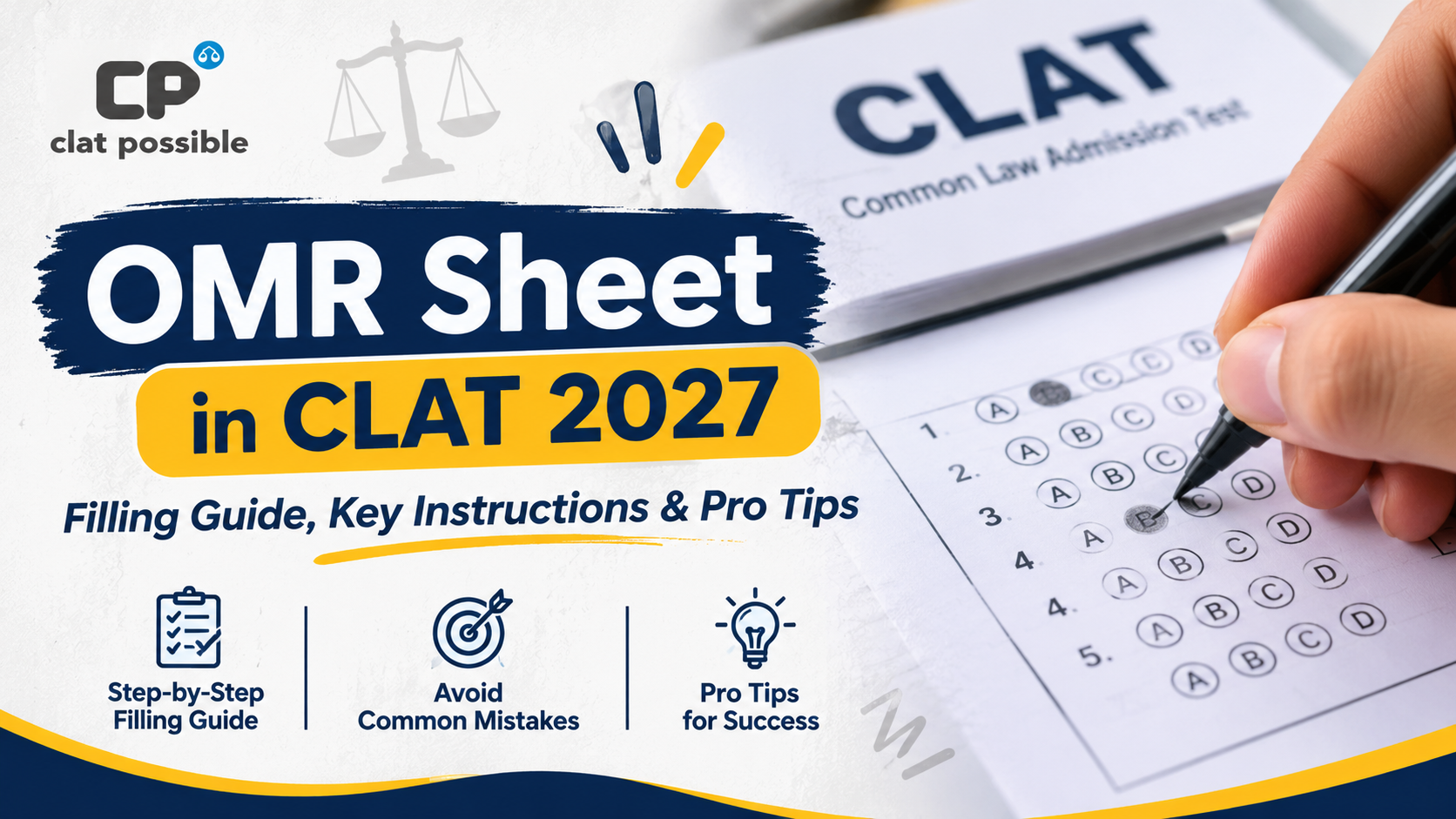
The CLAT OMR sheet is the only thing the Consortium actually marks. Your question booklet goes home with you; your OMR sheet decides your rank. And every year, some students lose marks not because they didn’t know the answer, but because they ran out of time to bubble it, shaded the wrong row, or skipped a step on the sheet. CLAT 2027 is an offline exam on Sunday, 6 December 2026, so this is worth getting right. In this blog, you’ll learn how the OMR sheet works, how to fill it without stress, and you can download a free OMR sheet for CLAT PDF to practise with at home.

CLAT 2027-2028 Courses by CLAT Possible

What You’ll Find in This Blog

What is the CLAT OMR Sheet?

OMR stands for Optical Mark Recognition. It’s a special answer sheet with a row of circles (bubbles) for every question. You darken one circle for each answer, and a machine reads the dark marks to work out your score.

In CLAT, you don’t write your answers in the question booklet. According to the Consortium of NLUs, every answer has to be marked on a separate, carbonised OMR response sheet. Carbonised means the sheet has a copy underneath, and you’re allowed to keep that candidate’s copy after the exam. So the OMR sheet is not just paperwork. It is your answer script.

CLAT 2027 Exam and OMR Sheet

Here’s what the Consortium has confirmed so far. Everything in this table comes from the official Consortium of NLUs website.

WhatDetails
Exam dateSunday, 6 December 2026
Exam time2:00 PM to 4:00 PM (2:00 PM to 4:40 PM for eligible PwD candidates)
ModeOffline
Number of questions120 compulsory multiple-choice questions
Marking+1 for each correct answer, −0.25 for each wrong answer
Answer sheetSeparate carbonised OMR response sheet
What you can take homeYour question booklet and the candidate’s copy of the OMR sheet
Admit cardDownloadable from your CLAT login; date to be announced on the Consortium website

The Consortium hasn’t released an official blank OMR sheet for CLAT 2027. So treat any “official CLAT OMR sheet PDF” you find online with care, and rely on the instructions printed on your actual sheet on exam day. For the latest notices, keep an eye on our CLAT 2027 updates.

What You’ll Find on the CLAT OMR Sheet

The exact design can change from year to year, but a CLAT 2027 OMR sheet usually has these parts:

Part of the sheetWhat it’s for
InstructionsHow to mark answers and which pen to use. The Consortium asks you to read these before you start.
Candidate detailsYour roll number and other personal details, often written and bubbled
Question booklet detailsYour booklet number and series, which tell the Consortium which answer key to use for you
Answer areaNumbered rows from 1 to 120, each with a set of bubbles for the options
SignaturesYour signature and the invigilator’s

Why the booklet series matters: CLAT question booklets come in different sets, marked by a symbol on the cover. In the last cycle, the Consortium released the answer key in four sets. If your series is wrong or missing, your answers can’t be checked against the right key. So fill it in carefully.

Take Free Demo Class

How to Fill the CLAT OMR Sheet

  1. Read the instructions on the sheet first. Check which pen is allowed and how bubbles should be marked. Your admit card and the Consortium’s test-day instructions will also say this, so read them before exam day too.
  2. Fill in your details carefully. Write and bubble your roll number exactly as it appears on your admit card.
  3. Fill in your question booklet number and series. Copy them from the cover of your booklet. Double-check them; they matter more than most students think.
  4. Write the booklet and OMR numbers on the attendance sheet. The Consortium asks you to write both numbers and sign the attendance sheet when it comes around.
  5. Check your booklet before you start. If there are missing pages or printing errors, ask the invigilator for a new booklet and a new OMR sheet. The Consortium is clear that you must not use the old OMR sheet with a fresh booklet.
  6. Darken one bubble fully for each answer. Fill the whole circle neatly. Ticks, crosses, dots or half-filled bubbles may not be read.
  7. Match the question number every time. Before shading, check that the row number matches the question you just solved.
  8. Leave skipped questions completely blank. An empty row scores zero. A wrong mark costs you 0.25.

Best CLAT Legal Reasoning Books

Download Free OMR Sheet for CLAT PDF

Since the Consortium hasn’t put out a blank OMR sheet for CLAT 2027, we’ve made a free practice one for you. It’s printed in light pink, just like a real OMR sheet, with 120 questions and A, B, C and D bubbles, roll number and booklet number grids, booklet series bubbles, signature boxes, and examples of the right and wrong way to mark.

PDFQuestionsBest used with
CLAT Practice OMR Sheet by CLAT Possible120 (A to D)Official CLAT 2027 mocks, previous year papers and full-length mock tests

Download Free CLAT 2027 OMR Sheet PDF

How to practise with it: print a few copies and use one with every full mock. Solve the Consortium’s CLAT 2027 UG Mock 1 in exactly 2 hours, bubbling every answer on the sheet before time runs out. Then check your score and see where it puts you with our free CLAT rank predictor.

Please note: this is a practice sheet made by CLAT Possible, not an official Consortium document. The real CLAT OMR sheet may look different, so always follow the instructions printed on it.

When to Fill the OMR Sheet?

There’s no single right way. What matters is that you pick one method, practise it in mocks, and don’t change it on exam day.

MethodHow it worksGood forWatch out for
After every passageSolve a passage, then bubble its 4 to 6 answers right awayMost students; our usual suggestionSwitching between booklet and sheet too often
After every sectionMark answers in the booklet, then bubble the whole section togetherFast, confident solversRunning short of time on the last section
All at the endSolve the whole paper, then bubble everything in the last few minutesWe don’t recommend itPanic, shifted rows and unmarked answers if time runs out

A good rule of thumb from our classrooms: keep about 10 to 15 minutes of your 2 hours for bubbling, spread across the paper. Time it in your mocks so you know your own number.

Things to Avoid on the CLAT 2027 OMR Sheet

1. Marking Two Options for One Question

Two dark bubbles in one row usually means the machine can’t read your answer, so you lose that question.

2. Shifting Rows

This is the scariest one. If you skip Q.45 in the booklet but shade its answer row for Q.46, every answer after it moves down by one. Always match the row number before shading.

3. Light or Half Shading

A faint or half-filled circle may not be picked up. Fill each bubble fully and neatly.

4. Using the OMR Sheet for Rough Work

Do your calculations in the question booklet, never on the OMR sheet. Stray marks can confuse the machine.

5. Folding, Crumpling or Spilling Water on It

Keep the sheet flat and away from your water bottle. A damaged sheet can be hard to read.

6. Rushing Through the Details Section

A wrong roll number or booklet series can cause far bigger trouble than one wrong answer. Take an extra minute here.

Want to see how this ties into scoring? GK is often the fastest section to fill, which frees up time for bubbling. Our free GK Genius PDF lists the top 150 current affairs topics of 2026 to help you get through it quickly.

After the Exam: Candidate Copy, Answer Key and Your Score

Keep Your Candidate’s Copy Safe

The Consortium lets you take home your question booklet and the candidate’s copy of the OMR sheet. Keep both safe. You’ll need them to check your answers against the answer key.

How the Answer Key and Objections Work

In the last cycle, the Consortium released the provisional answer key three days after the exam, in four sets matching the booklet series. Students could raise objections only through their CLAT login, for a fee of Rs. 500 per objection, which was refunded if the objection was accepted. Objections by email or phone were not accepted. The CLAT 2027 schedule will be announced on the Consortium website.

How to Work Out Your Score

Your score = (number of correct answers) − (0.25 × number of wrong answers)

For example, if you got 85 right, 20 wrong and left 15 blank, your score is 85 − 5 = 80. If two students end up with the same marks, the Consortium breaks the tie by higher marks in Legal Aptitude first, then higher age, and finally a computerised draw of lots.

Conclusion

The CLAT OMR sheet won’t test your knowledge, but it can still cost you marks if you treat it as an afterthought. Read the instructions, fill in your details carefully, shade every bubble fully, and keep checking that each row matches your question. Most of all, practise bubbling in every mock between now and 6 December, so that on exam day it feels like second nature. For more practice, try our CLAT mock tests.

Best CLAT Legal Reasoning Books for 2027 & 2028: Expert-Picked List and How to Use Them

“Which CLAT legal reasoning books should I buy?” We hear this question every single year, usually from students who already own three of them. Here’s the honest answer: you don’t need many books. You need the right one at the right time, and you need to actually finish it. Legal Reasoning is about a quarter of the CLAT paper, but it doesn’t check how much law you know. It checks whether you can read a rule, read a situation, and apply one to the other. So in this blog, we’ll tell you which books our CLAT Possible mentors suggest, what each one is good for, and how to use them so they actually add to your score.

CLAT 2027-2028 Courses by CLAT Possible

What You’ll Find in This Blog

The CLAT Legal Reasoning Section

Before you pick a book, it helps to know what you’re preparing for. Here’s how the section looks right now. For all five sections, check our CLAT syllabus 2027 guide.

WhatDetails
Number of questions28 to 32 out of 120
Share of the paperAbout 25%
FormatPassages of around 450 words, each with a set of questions
Do you need to know law?No. The rule is given to you in the passage
Where passages come fromBasic law (torts, contracts, criminal law, Constitution) and current legal news
Marking+1 for a right answer, −0.25 for a wrong one

Put Legal Reasoning and Current Affairs together and that’s almost half your CLAT score. So yes, it’s worth having a proper plan for your books.

What This Section Really Checks

A lot of students think they need to “study law” for this section. Honestly, that belief costs more marks than not knowing law ever does. What the section really wants from you is simple:

  • Find the rule. Spot the exact principle in the passage, including any conditions or exceptions.
  • Read the facts carefully. Small details matter, like who did what, when, and why.
  • Use only what’s given. Even if you know the real law is different, go with the passage.
  • Cut out wrong options. Some answers sound fair or kind but don’t follow from the rule. Drop them.

So a good legal reasoning book should do two things for you: make legal words and ideas feel familiar, and give you lots of rule-and-facts practice.

Download GK Genius (Free PDF)

Best CLAT Legal Reasoning Books: Our List

We’ve grouped these by what they’re good for. Please don’t buy all of them. Pick one from each group and stick with it.

Book / resourceAuthor / publisherGood forLevel
Legal Awareness and Legal ReasoningA.P. Bhardwaj (Pearson)Basic legal ideas and rule-based questionsBeginner to mid
Universal’s Guide to CLAT and LL.B. Entrance ExaminationUniversal / LexisNexisLots of extra practice questionsMid
Legal Reasoning WorkbookCLAT PossibleCLAT-style passage practice, made by CLAT facultyBeginner to advanced
Our ConstitutionSubhash C. Kashyap (National Book Trust)An easy, friendly start to the ConstitutionBeginner
Introduction to the Constitution of IndiaD.D. Basu (LexisNexis)Looking up topics like Fundamental Rights and writsMid to advanced
Important Judgments That Transformed IndiaAlex Andrews GeorgeBig Supreme Court cases, explained simplyBeginner to mid
CLAT previous year papers (2020 onward)Consortium of NLUsPractice that matches the real examEveryone
The Hindu or The Indian ExpressDaily newspapersCourt rulings, new laws and legal newsEveryone

1. Legal Awareness and Legal Reasoning by A.P. Bhardwaj

If you ask CLAT mentors for one legal book, most will say this one. It explains legal ideas in plain words and then gives you rule-and-facts questions to try. One tip: the older one-line questions in it are useful for warming up, but the real exam uses long passages, so don’t stop there.

2. Universal’s Guide to CLAT and LL.B. Entrance Examination

Pick this up for practice, not for theory. Once you’re comfortable with the basics, use it to get faster. You can skip questions that only ask you to remember legal facts, since CLAT doesn’t ask those anymore.

3. Legal Reasoning Workbook by CLAT Possible

Built by our own faculty, this workbook is made for the way CLAT tests legal reasoning today. Instead of one-line questions, you get CLAT-style passages with a rule, a set of facts and questions that make you apply one to the other. It’s a great bridge between reading concepts and solving real CLAT papers, and it’s what our students use for regular practice.

4. Our Constitution by Subhash C. Kashyap

The Constitution shows up in CLAT almost every year, and this is the easiest way in. It’s short, clear and written for regular readers, so it’s perfect if you’re in Class 11 or early Class 12.

5. Introduction to the Constitution of India by D.D. Basu

You don’t read this one cover to cover. Keep it on your desk and open it when you want to understand a topic better, like writs or Fundamental Rights, after it comes up in a passage or in the news.

6. Important Judgments That Transformed India by Alex Andrews George

CLAT passages are often built around famous court cases. This book tells you the story behind those cases in simple language. So when a passage brings one up, you’re not seeing it for the first time.

7. CLAT Previous Year Papers

If we could recommend only one thing, it would be this. The Consortium’s papers from 2020 onward show you exactly how passages are written and how the tricky options are set. Nothing else gets this close to the real exam.

8. Newspapers and Legal News

Recent CLAT papers have picked legal passages straight from the news, like new laws and Supreme Court rulings. Reading The Hindu or The Indian Express every day, especially the legal news and editorials, keeps you ready for them. If you need a plan for this, our 70-day current affairs plan for CLAT 2027 breaks it down day by day.

Which CLAT Legal Reasoning Book to Read and When

A good book read at the wrong time won’t help much. Here’s the order we usually suggest, based on how much time you have left.

Time leftWhat you’re working onWhat to use
More than 12 monthsGetting used to legal words and basic ideasOur Constitution; Important Judgments That Transformed India; daily newspaper
6 to 12 monthsCovering every main area of law onceA.P. Bhardwaj; D.D. Basu when needed
3 to 6 monthsGetting faster and more accurate on passagesCLAT previous year papers; Universal’s Guide; sectional tests
Last 4 to 6 weeksStaying sharp, no new booksFull mocks; your error log; legal news revision

Writing CLAT 2027 on 6 December? You’re in the last stretch, so stay with mocks and revision instead of opening a new book. Keep an eye on our CLAT 2027 updates for the latest news. Preparing for CLAT 2028? Great, you have time to follow the whole plan from the top, and our CLAT 2028 study plan shows you how to fit it into your months.

Legal Topics You Should Know for CLAT

Whichever book you go with, check that it covers these areas. They keep coming up in CLAT papers and in the official sample papers.

Area of lawTopics to know
Law of TortsNegligence, defamation, nuisance, trespass, strict and absolute liability, vicarious liability, volenti non fit injuria
Law of ContractOffer, acceptance and revocation, consideration, free consent, who can make a contract, void and voidable contracts
Criminal LawGeneral exceptions, right of private defence, theft, cheating, criminal intimidation; basics of the Bharatiya Nyaya Sanhita
Constitutional LawFundamental Rights, writs, Directive Principles, separation of powers, Centre-State relations
Other areasConsumer protection, basics of family law, environmental law, basics of intellectual property

A Quick Example of a CLAT Legal Reasoning Question

Let’s try one together. Read it the way you would in the exam hall.

Principle: If a person willingly accepts a known risk, they cannot claim money for harm that comes from that risk.

Facts: Riya buys a ticket for a cricket match and sits in the front row. During the match, a ball flies into the stands and hurts her. She sues the stadium for compensation.

Question: Will Riya win?

Answer: No. When Riya chose to watch a cricket match, she accepted the normal risk of a ball coming into the stands. So, going by the principle, she can’t claim compensation. The answer would change only if the facts showed the stadium did something careless beyond that normal risk.

See what we didn’t use? We didn’t feel sorry for Riya, and we didn’t bring in what the “real” law might say. We just matched the rule to the facts. That habit is exactly what your legal reasoning books should be building.

How to Get the Most Out of Your Legal Reasoning Books

  1. Read a chapter, then practise right away. Solve at least one passage on that topic while it’s still fresh in your head.
  2. Mark the rule first. Before you look at the options, underline the principle and any exceptions.
  3. Make a one-page note for each area of law. Write it in your own words. These become your quick revision sheets later.
  4. Go back to every wrong answer. Ask yourself: did I misread the rule, miss a fact, or use outside knowledge?
  5. Move to previous year papers early. Once you’ve covered the basics, let real CLAT papers and CLAT mock tests lead your practice.
  6. Connect the law to the news. When a court ruling makes headlines, open your book and read the related topic again

Take Free Demo Class

Things to Avoid in CLAT Legal Reasoning Preparation

1. Buying Too Many Books

One book finished twice beats five books half-read. Pick one for concepts and one for practice, and see them through. If you’d rather not juggle books at all, structured CLAT study material can cover all of it in one place.

2. Memorising Section Numbers

CLAT won’t ask you which section says what. Focus on understanding the idea instead.

3. Answering from What You Already Know

If the passage’s rule is different from the real law, the passage wins. Every single time. This is the trap students fall into most.

4. Only Practising Short Questions

Older guides are full of one-line rules, but the real exam has long passages. Most of your practice should look like the real thing.

5. Skipping the Newspaper

Many recent passages come straight from legal news. If you don’t read the paper, these passages will feel strange and take longer to solve. Short on time? Our free GK Genius PDF lists the top 150 current affairs topics of 2026.

Conclusion

The best CLAT legal reasoning books are the ones that teach you to think the way the paper wants: find the rule, read the facts, and leave your own assumptions outside. Start with one good book, read the newspaper every day, and let previous year papers and mocks do the heavy lifting as the exam gets closer. And remember, in this section, the passage is the law.

CLAT 2027 Current Affairs: Download GK Genius, Top 150 Topics Free PDF

CLAT 2027 current affairs can feel like an ocean with no shore. Nine months of news, hundreds of events, and every coaching note telling you something different. With CLAT on 6 December and AILET on 13 December, you do not need more news now; you need a shortlist. That is exactly why we built GK Genius: one free PDF with the 150 most important current affairs topics from January to September 2026, 168 GK one-liners and a Master Revision Checklist. We have done the shortlisting, so you can do what actually wins marks: revision.

CLAT 2027-2028 Courses by CLAT Possible

What This Guide Cover

What is GK Genius?

GK Genius is a free current affairs revision book by CLAT Possible for CLAT and AILET 2027. It covers the most important national and international events from January to September 2026, with one bonus topic from October. The book is edited by Aditya Wakhlu Sir, Editor in Chief of GK Genius, Vice President of CLAT Possible and AIR 29 in CLAT 2014.

Download GK Genius (Free PDF)

Think of it as a filter. Instead of re-reading every monthly magazine, you get a ranked list of what is most likely to be tested, with the facts laid out one topic per page. In short, it turns “I have to revise everything” into “I have to revise these 318 items.”

What is Inside GK Genius

FeatureWhat you getHow it helps
150 Most Important Topics68 Major and 82 Minor current affairs topics, January to September 2026Covers the events most likely to become CLAT passages
168 GK One-LinersShort, crisp facts on days, awards, sports, appointments and moreQuick wins for AILET’s direct questions and CLAT’s linked facts
Major and Minor tagsEvery topic marked by the depth of study it needsYou know where to go deep and where to skim
Static GK LinksBackground facts tied to each news topic, such as UNCLOS behind the High Seas TreatyPrepares you for the static questions CLAT builds around news
Quick Recall boxesKey facts summarised on every topic pageFast second and third revisions
Master Revision ChecklistMonth-wise list of every topic with three tick boxes eachTracks your first, second and third revision at a glance

Month-Wise Breakdown of CLAT 2027 Current Affairs in GK Genius

Here is how the 318 items in GK Genius are spread across the months. Use this table to plan your revision, since some months are heavier than others.

MonthMajorMinorOne-LinersTotal
January 20266101733
February 20269121839
March 20267131838
April 2026871934
May 20266112340
June 2026482133
July 2026882036
August 20261031629
September 20269101635
Bonus from October1001
Total6882168318

Notice that August and February carry the most Major topics. Therefore, give those months a little extra time in your first pass.

Sample Major Topics You Will Find Inside

Here is a taste of what GK Genius covers. These are just a few of the Major topics; the full list is in the PDF.

MonthSample Major topics
January 2026UN High Seas Treaty comes into force; India-EU Free Trade Agreement; Board of Peace; Republic Day
February 2026Union Budget 2026-27; New Ramsar Sites and World Wetlands Day; AI Impact Summit 2026; Project Cheetah
March 2026Uniform Civil Code; Passive Euthanasia; Naxalism-Free India; National Literary Awards
April 2026131st Amendment Bill; Gaganyaan; Artemis II; INS Aridhaman
May 2026Increase in Supreme Court Judges; Special Intensive Revision (SIR); Press Freedom; El Nino
June 2026World Environment Day; G7 Summit 2026; International Day of Yoga
July 2026FIFA World Cup; River Water Agreements; India Semiconductor; Commonwealth Games
August 202610 Years of UPI; SCO Summit 2026; Monsoon Session of Parliament; Independence Day
September 2026Indus Waters Treaty; BRICS Summit 2026; Election Commission of India; Asian Games

Get the Full List: Download GK Genius

Major, Minor and One-Liners: How to Read the Tags

Not every news item deserves the same attention. GK Genius sorts each topic by how deeply you need to study it, so you spend your time where it counts.

TagDepth of studyHow it may be tested
MajorIn-depth understanding and full revision, using the pointers givenHighly likely to appear as a full CLAT passage set
MinorRevision of key facts and detailsA CLAT set or a standalone AILET question
One-LinerSurface-level revision of core informationLinked to a bigger topic, or a direct AILET question

A small note from experience: these tags are an informed estimate, not a promise. The question paper can always surprise you. So use the tags to set priorities, but do not skip Minor topics or One-Liners completely.

How to Use GK Genius: A 3-Pass Revision Plan for CLAT 2027

Every topic in the Master Revision Checklist has three tick boxes, one for each revision. Here is a simple way to fill all three before exam day. Tick, tick, tick, and then boom, you are exam-ready.

Revision passSuggested datesWhat to do
Pass 1: Deep read11 to 21 NovemberRead every Major topic in full with its Static GK Link; read Minor topics for key facts. About 7 Major topics a day.
Pass 2: Active recall22 to 29 NovemberLook at each topic name, recall the facts aloud, then check the Quick Recall box. Add all 168 One-Liners in this pass.
Pass 3: Rapid review30 November to 5 DecemberSkim Quick Recall boxes and One-Liners only. Focus on topics you could not recall in Pass 2.
AILET top-up7 to 12 DecemberRevise One-Liners and Minor topics again, since AILET asks more direct, standalone GK questions.

For the best results, use GK Genius alongside CLAT Possible’s GK Perfect Magazine. GK Genius tells you what to revise; the magazine gives you deeper coverage when a topic needs it.

Why GK Genius Works for CLAT and AILET

After six years of building GK material for law entrance aspirants, one pattern stands out: students rarely lose GK marks because they never read a topic. They lose marks because they read it once, months ago, and never revised it. GK Genius is designed to fix exactly that problem.

  • It is shortlisted. Instead of 1,000 news items, you get 318 ranked ones, so your revision has an end point.
  • It is CLAT-shaped. CLAT builds passages around news and then asks static questions. The Static GK Links prepare you for that second step.
  • It is AILET-ready. The One-Liners suit AILET’s shorter, direct questions.
  • It is trackable. The checklist shows your progress at a glance, which also keeps exam anxiety in check.
  • It is one topic per page. No hunting through magazines; every topic has its own page.

Military exercises and defence equipment are deliberately left out, so your time goes to topics with a better chance of being tested.

Take Free Demo Class

Conclusion

CLAT 2027 current affairs do not have to be a gamble. With GK Genius, you know exactly what to revise, how deeply to revise it, and how far along you are. So download the PDF, print the checklist, and start ticking. Be a GK Genius, not a GK guesser. All the best!

CLAT 2028 Preparation: A Month-by-Month Study Plan for Beginners

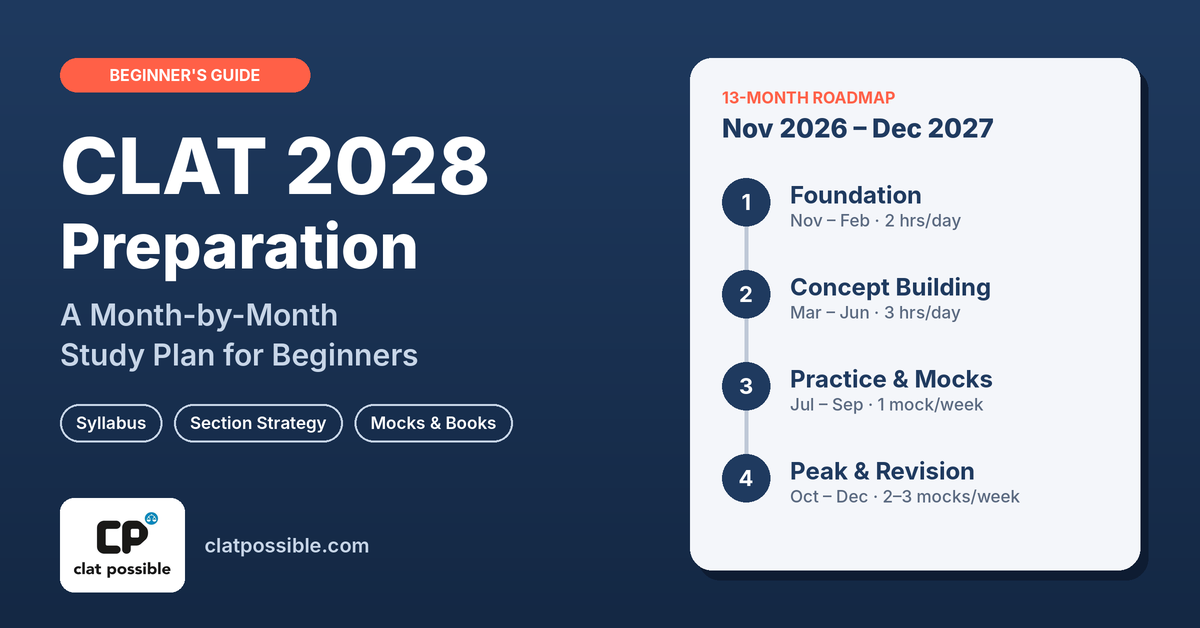
If you are in Class 11 today, you have roughly 13 months until CLAT 2028, which is expected in the first week of December 2027. That is enough time to go from complete beginner to confident test-taker, but only if those months are planned. At CLAT Possible, the students we see struggle are rarely the less talented ones. Instead, they are the ones who started without a plan, studied in bursts, and took their first mock six weeks before the exam. This guide gives you a complete CLAT 2028 study plan, from your first week to exam day.

CLAT Possible 2028 Courses

What This CLAT 2028 Preparation Guide Covers

Why CLAT 2028 Preparation Should Start Now

CLAT rewards reading stamina, reasoning habits and current affairs memory. However, all three build slowly, which is why an early start matters more in CLAT than in most entrance exams. Starting in Class 11 also means you prepare without board-exam pressure for the first few months.

You do not need to study 8 hours a day in Class 11. Instead, you need 2 to 3 focused hours, every day, for 13 months. In short, consistency beats intensity in CLAT.

CLAT 2028 at a Glance

CLAT 2028 will be the Common Law Admission Test for the 2028–29 academic year. The official date is not out yet. For reference, the Consortium has scheduled CLAT 2027 for Sunday, 6 December 2026, from 2:00 PM to 4:00 PM, and has kept the pattern unchanged. Therefore, CLAT 2028 is most likely on the first Sunday of December 2027.

Key HighlightCLAT 2028 (expected)
Conducting bodyConsortium of National Law Universities
Expected exam dateFirst week of December 2027 (tentative)
Expected registrationJuly to October 2027
ModeOffline, pen and paper
Total questions, marks, duration120 questions, 120 marks, 2 hours
Negative marking0.25 marks for every wrong answer
EligibilityClass 12 pass or appearing; 45% (40% for SC/ST); no upper age limit

Dates and pattern for CLAT 2028 are projections based on recent cycles. Always confirm on consortiumofnlus.ac.in once the notification is released.

CLAT 2028 Syllabus and Exam Pattern

The CLAT 2028 syllabus has five sections, and every question is built on a passage. In other words, there is no rote syllabus to memorise; CLAT tests how well you read, reason and apply. The breakdown below follows the current pattern confirmed for CLAT 2027.

SectionQuestionsWeightageWhat it actually tests
English Language22 to 2620%Comprehension, inference, tone, vocabulary in context
Current Affairs including GK28 to 3225%News events, legal and constitutional developments, static GK linked to news
Legal Reasoning28 to 3225%Applying a stated principle to facts; no prior law knowledge needed
Logical Reasoning22 to 2620%Arguments, assumptions, conclusions, strengthen/weaken, puzzles
Quantitative Techniques10 to 1410%Class 10 maths: percentages, ratios, averages, data interpretation
Total120100%+1 for each correct answer, −0.25 for each wrong answer

Three things beginners should notice:

  • Half the paper is GK and Legal. Current Affairs and Legal Reasoning together make up about 50% of your score, so your daily routine must protect time for both.
  • Reading is the hidden sixth section. You will read 25-plus long passages in two hours. Therefore, reading speed with comprehension decides whether you finish the paper.
  • Negative marking punishes guesswork. A wrong answer costs 0.25 marks, so four blind guesses gone wrong wipe out one correct answer.

How to Start CLAT Preparation: Your First 7 Days

Most beginners lose their first month deciding which book to buy. Skip that. Here is how to start CLAT preparation in one week.

DayTaskWhy it matters
Day 1Read the pattern and download the official sample paperYou know exactly what you are preparing for
Day 2Attempt one previous-year CLAT paper untimedYour weak spots matter more than your score
Day 3Read The Hindu or The Indian Express for 30 minutes; note three news itemsStarts your GK notebook and reading habit
Day 4Solve one legal reasoning passage; underline the principle firstThis is the core skill of the section
Day 5Revise percentages and ratios from NCERT Class 8 to 10Quant is built entirely on these basics
Day 6Fix a 2 to 3 hour daily slot around schoolA protected slot is what makes the plan work
Day 7Review the week and list what felt hardestThat list becomes your focus for Month 1

By the end of the week, you will know where you stand and have a routine in place. In fact, that is more than most aspirants have after a month.

CLAT 2028 Study Plan: Month-by-Month Roadmap (November 2026 to December 2027)

This CLAT 2028 study plan runs 13 months in four phases. It assumes you are in Class 11 now and works around school exams, which is where most plans break.

Phase 1: Foundation (November 2026 to February 2027)

Goal: Build reading, news and reasoning habits. No mocks yet. Daily time: 2 hours.

MonthFocusWhat to do
Month 1: November 2026Set the routineNewspaper daily (30 minutes) with 3 to 5 GK notes; 1 English passage a day; NCERT revision of percentages, ratios and averages
Month 2: December 2026Meet legal reasoning1 legal passage a day (principle, facts, application); logical reasoning basics; attempt the CLAT 2027 paper once released and compare with your Day 2 baseline
Month 3: January 2027Widen the baseStatic GK linked to news; recurring legal concepts (contracts, torts, criminal law, constitutional rights); profit and loss, interest, time and work
Month 4: February 2027Protect your school examsClass 11 finals come first; drop to 45 to 60 minutes a day of newspaper plus 1 passage, but do not stop completely

Phase 2: Concept Building (March to June 2027)

Goal: Cover every topic once and start timed sectional practice. Daily time: 3 hours; 5 to 6 hours in summer break.

MonthFocusWhat to do
Month 5: March 2027Restart with sectionalsOne timed sectional test a week; 2 English passages a day with inference and tone questions
Month 6: April 2027Class 12 beginsCritical reasoning (strengthen/weaken, assumptions) plus a few puzzles for speed; data interpretation from tables and graphs
Months 7 and 8: May and June 2027Summer intensive5 to 6 hours a day; solve all previous-year papers since 2020 section by section; first full-length mock at the end of May, then one every two weeks; compile 8 to 9 months of current affairs into one revision file

Phase 3: Practice and Mocks (July to September 2027)

Goal: Shift from learning to performing. Daily time: 3 hours on school days.

MonthFocusWhat to do
Month 9: July 2027Weekly mocks1 full mock a week with analysis as long as the mock itself; start an error log; watch for the CLAT 2028 notification
Month 10: August 2027Fix weak sectionsGive your two weakest sections an extra 45 minutes daily; register for CLAT 2028 early
Month 11: September 2027Build exam strategyTest section orders in mocks and settle on one; set and track time targets per section

Phase 4: Peak and Revision (October to December 2027)

Goal: Peak on exam day, not before it. Daily time: 4 hours.

MonthFocusWhat to do
Month 12: October 2027Two mocks a week2 full mocks weekly plus analysis; revise 12 months of GK, especially legal and constitutional news
Month 13: November 2027Revise and simulate2 to 3 mocks a week at 2:00 PM to train your body clock; re-read your error log weekly; no new books; download the admit card
Exam week: early December 2027Stay freshLight revision of GK notes and the error log only; sleep 7 to 8 hours; walk in rested, not crammed

CLAT 2028 Study Plan: Phase-Wise Summary

PhaseMonthsHours per dayMocks
FoundationNovember 2026 to February 20272None; baseline paper only
Concept BuildingMarch to June 20273 (5 to 6 in summer)First mock in May, then every 2 weeks
Practice and MocksJuly to September 202731 per week
Peak and RevisionOctober to December 202742 to 3 per week

Section-Wise CLAT Preparation Strategy for Beginners

A good CLAT preparation strategy for beginners gives each section a method, not just hours. Here is how our CLAT Possible mentors split the work.

1. Legal Reasoning (28 to 32 Questions)

Treat the passage as the only law that exists, because answers based on outside legal knowledge are the most common trap. Also, use a three-step read: principle, facts, application, and underline the principle before you look at the options. From Phase 2 onward, practise 2 passages a day, and follow legal news, since passages are often built on recent judgments and new laws.

2. Current Affairs including GK (28 to 32 Questions)

Read for context, not trivia: know why an event matters, who is involved and what changed. Keep one GK notebook organised by theme, such as polity, economy, international affairs, environment and legal developments. Above all, revise monthly, since news from 12 to 15 months before the exam can appear.

3. English Language (22 to 26 Questions)

Read 2 editorials a day and summarise each in two lines, which trains main-idea questions. In addition, learn vocabulary from context rather than word lists. By Phase 3, aim to finish a passage in under 6 minutes.

4. Logical Reasoning (22 to 26 Questions)

Focus on argument questions: assumptions, conclusions, strengthen/weaken and flaws. However, do not ignore puzzle-style sets, because the question style can shift from year to year. After each passage, explain in one sentence why the wrong options are wrong.

5. Quantitative Techniques (10 to 14 Questions)

Stick to Class 10 maths and data interpretation, and do not over-invest given the 10% weight. Instead, learn quick calculation tricks such as percentage-fraction equivalents and squares up to 30. Finally, aim for accuracy: eight correct out of eight beats ten attempted with three wrong.

Suggested Time Split for Beginners

SectionShare of study time
Legal Reasoning30%
Current Affairs and GK25%
English Language20%
Logical Reasoning15%
Quantitative Techniques10%

Mock Tests, Revision and Best Books for CLAT 2028

How Many Mocks Should You Take?

Plan for 40 to 50 full-length mocks between May and November 2027. However, the number matters less than the analysis. After every mock, sort your mistakes into three types (concept gap, misread passage, time pressure), re-attempt wrong questions without looking at the answer, and note one change for the next mock.

A Simple Revision Cycle

  • Daily: 15 minutes revising that day’s GK notes.
  • Weekly: A Sunday review of the week’s GK, error log and vocabulary.
  • Monthly: A full revision of the month’s current affairs compilation.

Recommended Books and Resources

SectionRecommended resource
English LanguageThe Hindu or The Indian Express editorials; Word Power Made Easy by Norman Lewis
Current Affairs and GKDaily newspaper; a monthly CLAT current affairs compilation; Lucent’s General Knowledge for static GK
Legal ReasoningPrevious-year CLAT papers (2020 onward); Legal Aptitude for CLAT by A.P. Bhardwaj
Logical ReasoningPrevious-year CLAT papers; R.S. Aggarwal’s A Modern Approach to Verbal and Non-Verbal Reasoning for basics
Quantitative TechniquesNCERT Class 8 to 10 Maths; CLAT-style data interpretation sets
Full-length mocksCLAT Possible mock test series and the official Consortium sample papers

Pick one book per section and finish it twice. After all, five half-read books help no one.

7 Mistakes Beginners Make in CLAT 2028 Preparation

1. Waiting for Class 12 to Start

The 13 months you have now are your biggest advantage. Reading speed and GK memory cannot be rushed later.

2. Collecting Books Instead of Solving Passages

CLAT is a practice exam. Therefore, previous-year papers teach more than any new guide.

3. Skipping Current Affairs for a Month

Missed months are hard to rebuild and can cost you several questions in the GK section.

4. Using Outside Legal Knowledge

In Legal Reasoning, the passage overrides what you know. In short, answer only from the principle given.

5. Taking Mocks Without Analysis

A mock without review is just a timed test. In fact, the analysis is where the score grows.

6. Guessing Blindly

With 0.25 marks lost per wrong answer, attempt a question only when you can eliminate at least two options.

7. Ignoring School

Boards matter for eligibility and for your stamina. Therefore, plan around exams; do not fight them.

How CLAT Possible Helps You Crack CLAT 2028

A plan works best with someone checking that you follow it. At CLAT Possible, our CLAT 2028 programmes are built around the same phases in this guide:

  • Foundation-first teaching for Class 11 students, starting from reading and reasoning basics.
  • Mentorship and doubt support so you never stay stuck on a legal or logical concept.
  • Current affairs material designed for CLAT’s issue-based questions.
  • Mock tests with detailed analysis to track your progress month by month.

Har Ghar Diwali Discount

Conclusion

Your CLAT 2028 preparation starts with the next hour you put in. Therefore, open today’s newspaper, solve one legal passage, and let this month-by-month plan carry you to December 2027. Overall, whether you are just starting out or already a few weeks in, the right plan and the right guidance make every step clearer.

Take Free Demo Class

CLAT 2027 Exam Day Instructions: Code of Conduct, Do’s & Don’ts and Checklist

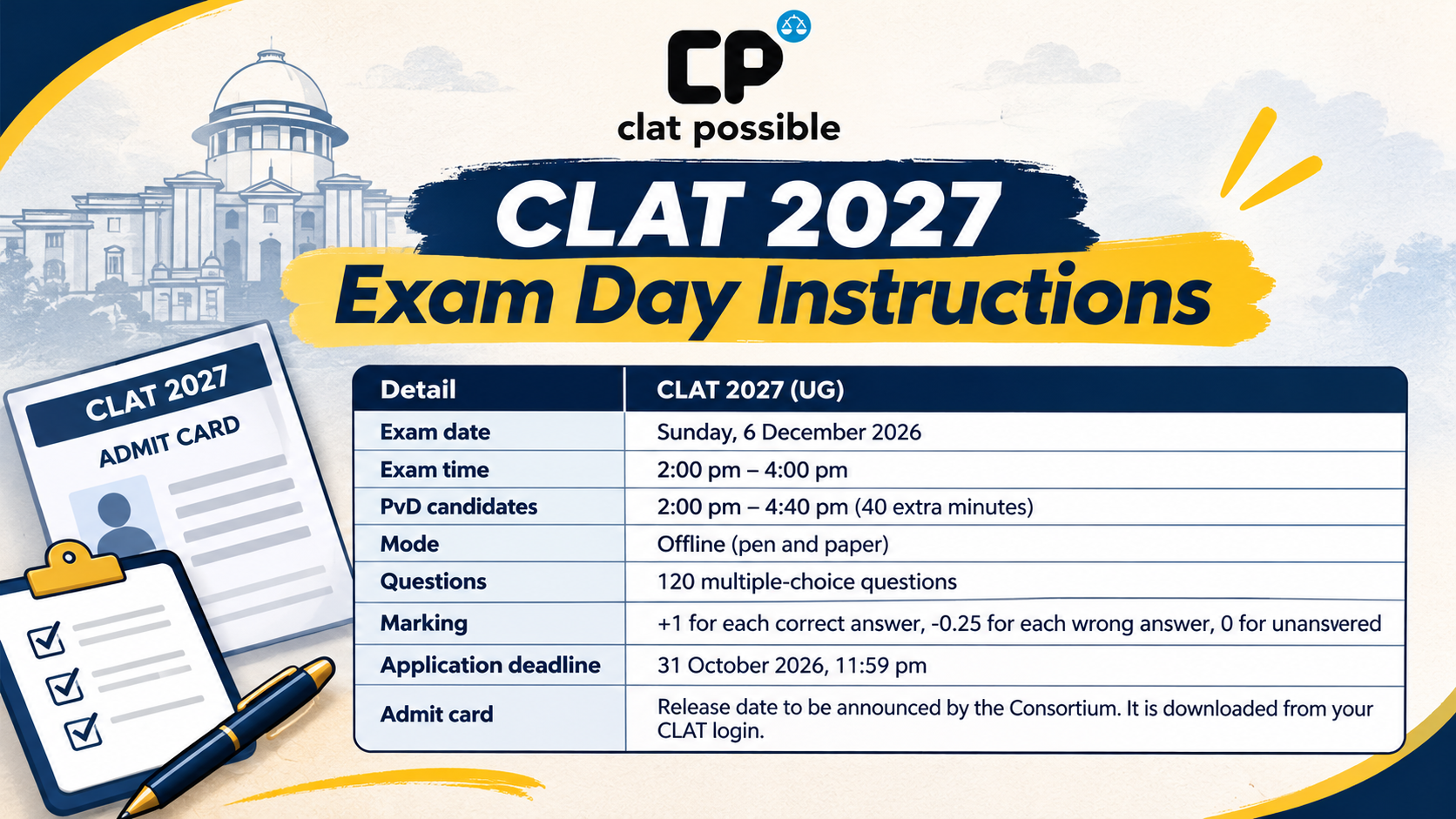
The CLAT 2027 exam is on Sunday, 6 December 2026, from 2:00 pm to 4:00 pm, in offline (pen-and-paper) mode. In the last cycle, the Consortium let candidates into the centre from 1:00 pm, required them to be seated by 1:30 pm and allowed no entry after 2:15 pm. Carry your admit card, an original government photo ID, black or blue ballpoint pens, a transparent water bottle and an analogue watch. Phones, smartwatches, calculators and bags are not allowed.

Important: As of 27 October 2026, the Consortium has not yet published the CLAT 2027 test-day instructions. The rules below come from the Consortium’s official CLAT 2025 Test Day Instructions, and the same timings were followed for CLAT 2026. The instructions printed on your CLAT 2027 admit card are final. If anything there differs from this guide, follow the admit card.

CLAT 2027 Exam at a Glance

DetailCLAT 2027 (UG)
Exam dateSunday, 6 December 2026
Exam time2:00 pm – 4:00 pm
PwD candidates2:00 pm – 4:40 pm (40 extra minutes)
ModeOffline (pen and paper)
Questions120 multiple-choice questions
Marking+1 for each correct answer, −0.25 for each wrong answer, 0 for unanswered
Application deadline31 October 2026, 11:59 pm
Admit cardRelease date to be announced by the Consortium. It is downloaded from your CLAT login.

Source: Consortium of NLUs – CLAT 2027 UG Instructions and CLAT 2027 press release.

For a section-wise breakdown of the paper, read our CLAT 2027 syllabus and exam pattern guide.

CLAT 2027 Exam Day Timeline (Bell Timings)

These timings are from the Consortium’s last official test-day instructions. Expect the same schedule for CLAT 2027, but confirm it on your admit card.

TimeBellWhat Happens
1:00 pm–Entry to the test centre opens. ID and admit card checks begin.
1:30 pmLong bellCandidates enter the exam hall and must be seated.
1:50 pmShort bellSealed envelopes are handed out. Invigilators read out instructions.
2:00 pmLong bellThe test begins. You may open the sealed envelope.
2:15 pmShort bellLast entry. No one is let into the hall after this.
2:30 / 3:00 / 3:30 pmShort bells30 minutes, 1 hour and 1.5 hours are over.
3:50 pmShort bell10 minutes left.
4:00 pmLong bellThe test ends. Stop writing on the OMR sheet and question booklet.

Two rules students often miss: once the test begins, you cannot use the washroom, and you cannot leave the hall before 4:00 pm.

CLAT 2027 Exam Day Checklist: What to Carry

ItemRequired?Notes
CLAT 2027 admit card (printed)MandatoryTake two printouts and keep one spare.
Original government photo IDMandatoryBring the original, not a photocopy or phone photo. See the accepted list below.
Self-attested passport-size photoOnly if neededNeeded if the photo on your admit card is unclear. Keep one anyway.
Black or blue ballpoint pensMandatoryCarry two or three that you’ve tested. No gel or fountain pens.
Transparent water bottleAllowedRemove the label so it is fully see-through.
Analogue watchAllowedDigital watches and smartwatches are banned.
Original disability certificatePwD candidates onlyRequired to get the extra 40 minutes.
Prescribed medicinesIf neededCarry any medication you need.

Accepted Photo ID Proofs

Under the Consortium’s last official instructions, any one of these is accepted as long as it is an original, clear document:

Aadhaar cardPassport
PAN cardVoter ID card
Driving licenceRation card / PDS photo card
Photo ID from a recognised school or collegePhoto bank ATM card
Kisan photo passbookCGHS / ECHS photo card
Department of Posts address card with photoIdentity certificate with photo from a Gazetted Officer or Tehsildar
Disability ID card or certificate issued by a State/UT authority

Tip: Aadhaar is the safest choice for most students. Check that the name on your ID matches the name on your admit card.

Items Not Allowed at the CLAT 2027 Exam Centre

Anything that is not on the permitted list is not allowed. Centres usually have no safe storage, so leave these items at home or with a parent outside.

CategoryExamples
Electronic devicesMobile phones, smartwatches, digital watches, fitness bands, earphones, Bluetooth devices
Calculation aidsCalculators of any kind
Study materialNotes, books, printed sheets, loose paper
Bags and casesBags, pouches, pencil boxes, wallets
Writing toolsPencils, gel pens, highlighters, correction fluid

Want the real exam to feel familiar? Take your CLAT mocks at 2:00 pm with only a pen, an analogue watch and a water bottle. Start with today’s Daily Mini CLAT.

Take the Daily Mini CLAT

Inside the Exam Hall: CLAT 2027 Code of Conduct

Question Booklet Rules

  • Check that the name, photo and admit card number printed on the question booklet are yours.
  • At the start, write your admit card number on the first page of the booklet.
  • The booklet has two blank pages for rough work. No extra sheets are given.
  • Do not write anywhere else in the booklet except the space marked for working.
  • You cannot ask anyone to explain a question during the test.
  • If your booklet has a printing problem, ask the invigilator for a replacement. You will get a new OMR sheet with it. Don’t use the old one.

OMR Sheet Rules

Do ✅Don’t ❌
Use only a black or blue ballpoint penUse a pencil, gel pen or correction fluid
Shade each answer circle completelyHalf-shade a circle (it counts as unanswered)
Mark only one option per questionShade two circles (counts as a wrong answer, so −0.25)
Keep the sheet flat and cleanFold, tear or crumple it, or do rough work on it
Sign it with the invigilator before detaching your copyDamage the barcode or the timing marks on the edges
Return the original (top) sheet to the invigilatorTake the original OMR sheet out of the hall

A damaged OMR sheet is invalid and can lead to disqualification. Taking the original sheet out of the hall can also lead to legal action.

Attendance and Unfair Means

  • During the test, an attendance sheet goes around. Write your question booklet number and OMR sheet number on it and sign it.
  • Copying, talking, passing material or any other unfair means leads to disqualification.
  • Impersonation and fraud may be a criminal offence, on top of disqualification.

Explore CLAT Programmes

What to Take Home After the Exam

You are allowed to keep these three things. Store them safely until admissions are over.

ItemWhy It Matters
Admit card (signed by the invigilator)You need it at the time of admission and counselling.
Question bookletUse it to check your answers against the provisional answer key.
Candidate’s copy of the OMR sheetHelps you work out your expected score and raise objections if needed.

CLAT 2027 Dress Code: What to Wear

The Consortium’s official test-day instructions do not set a dress code. Frisking at the gate is still standard, so practical choices save time.

  • Wear comfortable, simple clothes. Avoid big buttons, metal parts and lots of pockets.
  • Choose sandals or simple shoes that are easy to take off if security asks.
  • Keep jewellery and metal accessories to a minimum, because they slow down security checks.
  • December afternoons can be cold in North India. Wear a plain jacket or sweater that you’re happy to have checked.

Instructions for PwD Candidates

  • Eligible PwD candidates get 40 extra minutes, so their exam runs from 2:00 pm to 4:40 pm.
  • Carry your original disability certificate along with your admit card and photo ID.
  • Rules on scribes and other support are set out in the Consortium’s notifications. Read the CLAT 2027 notices and your admit card carefully, and contact the Consortium early if you need help.
  • If you need an isolated room for medical reasons, the last official instructions asked candidates to tell the Centre Superintendent at least 48 hours before the exam.

Do’s and Don’ts on CLAT 2027 Exam Day

Do ✅Don’t ❌
Reach the centre by 1:00 pmPlan to arrive close to 2:15 pm. Traffic on exam day is unpredictable.
Visit the centre a day or two beforeRely only on a map pin for an unfamiliar building
Keep the admit card and ID together in a clear folderCarry only a photo of your admit card on your phone
Eat a light lunch and use the washroom before 1:30 pmExpect a washroom break after 2:00 pm
Plan your section order before you enterExperiment with a new strategy on the day
Fill the OMR sheet as you go, or in planned batchesLeave all OMR shading for the last 10 minutes
Skip a question if you can’t rule out at least two optionsGuess blindly. Each wrong answer costs 0.25 marks.
Keep your question booklet and OMR copy safeThrow away your rough work before the answer key comes out

Your Final-Week Checklist Before CLAT 2027

WhenWhat to Do
As soon as the admit card is outDownload it and check your name, photo, centre and roll number. Report any error to the Consortium immediately.
Last 7 daysTake your last full mocks at 2:00 pm. Practise shading an OMR sheet within the 120 minutes.
2–3 days beforeVisit the centre and check the travel time from home at around 12:30 pm.
Saturday, 5 DecemberPack your folder: two admit card copies, original ID, photo, pens, water bottle and watch. Do a light revision and get a full night’s sleep.
Sunday, 6 DecemberHave an early lunch, leave home with a time buffer and be at the gate by 1:00 pm.

Six weeks left and not sure your mock scores are where they should be? Talk to a CLAT Possible counsellor. They will review your recent mocks and help you plan the final weeks before 6 December. If you’re targeting CLAT 2028, explore our structured CLAT programmes.

Target CLAT 2028


Final Word

The CLAT 2027 exam rewards preparation, but avoidable mistakes on the day can still cost you. Most of them come down to a late arrival, a missing ID or a careless OMR sheet. Use this checklist, rehearse the 2:00 pm routine in your mocks, and read your admit card carefully when it comes out. For official updates, keep checking the Consortium of NLUs website.