close

CLAT Official Mock Paper 2027 Released: Download PDF and Analysis

The CLAT official sample paper for 2027 is finally out. The Consortium of National Law Universities has released two official sample papers for CLAT 2027 UG, and with the exam scheduled for 6 December 2026, these papers are the closest look you will get at the Consortium’s own question-setting before exam day. In this blog, you can download both papers and read the CLAT Possible faculty’s section-wise analysis. More importantly, you will learn how to use these papers in your final weeks without reading too much into them.

CLAT 2027 Courses by CLAT Possible

What This CLAT Official Sample Paper Guide Covers

Watch: CLAT Official Sample Paper 2027 Analysis

CLAT 2027 Official Paper Highlights

The CLAT official sample paper follows the same structure as the actual exam. Here is a quick overview of what the Consortium has released and how the paper is built.

ParticularDetails
Released byConsortium of National Law Universities
Number of official mocks2 (CLAT 2027 UG)
Official websiteconsortiumofnlus.ac.in
Total questions120 multiple-choice questions
Total passages24 passages across 5 sections
Marking scheme+1 for each correct answer, −0.25 for each wrong answer
Overall difficultyEasy
CLAT 2027 exam dateSunday, 6 December 2026, 2:00 PM to 4:00 PM

Download CLAT Official Mock Papers 2027 PDF

Both CLAT official sample papers are available below. Download them, print them, and solve each one in a single 2-hour sitting, the same way you will sit the real exam.

PaperReleased byDownload
CLAT 2027 UG Mock 1Consortium of NLUsDownload PDF
CLAT 2027 UG Mock 2 (TBD)Consortium of NLUsDownload PDF

Download CLAT 2027 UG Mock 1

CLAT 2027 Official Mock 1 Analysis

Our faculty solved the CLAT official sample paper section by section. The verdict is clear: the paper is easy. Some passages are taken directly from old CLAT papers, while the new passages are of a very easy level.

Therefore, the most important takeaway is this: do not assume the actual CLAT 2027 paper will be of the same standard or pattern. Treat the sample paper as a format check, not as a difficulty benchmark.

SectionPassagesQuestionsDifficulty level
English Language525Easy to Moderate
Current Affairs including GK630Very Easy
Legal Reasoning630Easy
Logical Reasoning525Easy to Moderate
Quantitative Techniques210Easy
Total24120Easy overall

Section-Wise Analysis of the CLAT Official Paper

1. English Language: Easy to Moderate

The English section has 5 passages and 25 questions. The passages are of a reasonable length and difficulty, so a regular reader should finish them comfortably. Most questions refer directly to the passage. In addition, the section tests word meaning, the author’s tone and figures of speech.

2. Current Affairs including GK: Very Easy

This is the easiest section in the CLAT official sample paper, with 6 passages and 30 questions. In fact, many questions can be answered directly from the passage itself. The topics covered are:

  • ISRO
  • Presidential Election of India
  • Wetlands
  • Election Commission
  • UPI
  • Constitution

However, do not expect the actual exam’s GK section to be this generous. In recent CLAT papers, many GK questions have needed knowledge beyond the passage.

3. Legal Reasoning: Easy

Legal Reasoning has 6 passages and 30 questions. The passages and principles are very short. Also, there are no current legal topics; every passage is based on static law. The topics covered are:

  • Writs
  • Negligence
  • Offer, acceptance and revocation
  • Defamation
  • Consumer law
  • Right of private defence

In the actual exam, expect longer passages and topics drawn from recent judgments and new laws, so keep reading legal news alongside your practice.

4. Logical Reasoning: Easy to Moderate

The Logical Reasoning section has 5 passages and 25 questions. All of them are critical reasoning questions, and there are no analytical reasoning questions such as puzzles or arrangements. Even so, do not drop analytical reasoning from your practice, since it has appeared in past CLAT papers.

5. Quantitative Techniques: Easy

Quant has 2 short passage sets with 10 questions. Every question is based on ratio and percentage. Therefore, this section should be a quick scoring zone, but still revise averages, profit and loss and data interpretation for the actual exam.

Take Free Demo Class

Key Takeaways: What the CLAT Official Sample Paper Does and Does Not Tell You

What it confirmsWhat it does not confirm
The paper still has 120 passage-based questions across five sectionsThe difficulty level of the actual CLAT 2027 paper
How the Consortium frames questions and optionsThe length of passages in the actual exam
The section order and the number of questions per passageWhether analytical reasoning or current legal topics will be left out
Static law and core GK topics still matterHow much GK can be answered from the passage alone

In short, if you score very high on the sample paper, take it as a confidence boost, not as a predicted score. Your recent full-length mocks are still the better guide to where you stand.

How to Use the CLAT Official Sample Paper Before 6 December

With less than four weeks left for CLAT 2027, use both official papers wisely rather than casually.

  1. Solve each paper in one timed sitting. Use a 2-hour slot, ideally from 2:00 PM to 4:00 PM, to match the real exam timing.
  2. Fill a printed OMR sheet. CLAT is a pen-and-paper exam, so practise bubbling answers within the 2 hours.
  3. Analyse the paper the same day. Note whether each mistake came from a concept gap, a misread question or time pressure.
  4. Study the question style, not the difficulty. Focus on how the Consortium words its questions and builds its wrong options.
  5. Go back to tougher practice. After the sample papers, return to previous year papers and full-length mocks to stay ready for a harder actual paper.

CLAT Official Sample Paper vs Previous Year Papers vs Mocks

Practice materialBest used forLimitation
Official sample paperUnderstanding the Consortium’s format and question styleEasier than the actual exam; only two papers
Previous year papersJudging the real difficulty level and recurring topicsCurrent affairs in older papers are outdated
Full-length mocksBuilding speed, stamina and section-order strategyQuality varies, so choose a CLAT-focused series

For the best results, combine all three: the official sample papers for format, previous year papers for difficulty, and mocks for exam-day readiness.

Mistakes to Avoid While Solving the CLAT Official Sample Paper

1. Treating the Score as a Prediction

The sample paper is easy, so a high score here does not guarantee the same score in the actual exam.

2. Skipping Analytical Reasoning and Legal Current Affairs

These were missing from the sample paper. However, both have appeared in past CLAT papers, so keep practising them.

3. Solving Without a Timer

An untimed attempt hides your real speed. Always solve the full paper in 2 hours.

4. Ignoring Negative Marking

Even on an easy paper, every wrong answer costs 0.25 marks. Therefore, attempt a question only when you can eliminate at least two options.

5. Reading Too Much into the Topic List

The topics in this paper will not necessarily repeat in the actual exam. Instead, revise the full static law and current affairs syllabus.

How CLAT Possible Helps You in the Final Weeks

At CLAT Possible, our final-phase preparation is built to close the gap between an easy sample paper and a demanding actual exam:

  • Full-length mocks set at the real CLAT difficulty level, with detailed analysis.
  • Current affairs revision covering the legal and national news most likely to appear.
  • Mentorship and doubt support for last-minute questions in Legal and Logical Reasoning.
  • Exam strategy sessions on section order, time targets and smart attempts.

Conclusion

The CLAT official sample paper 2027 is a useful final-month resource, but mainly as a format check. It confirms the 120-question, five-section structure and shows how the Consortium frames its questions. However, its easy level should not set your expectations for 6 December. Solve both papers, analyse them honestly, and then return to tougher practice so that the actual exam feels familiar, not surprising.
CLAT 2028 Preparation: A Month-by-Month Study Plan for Beginners

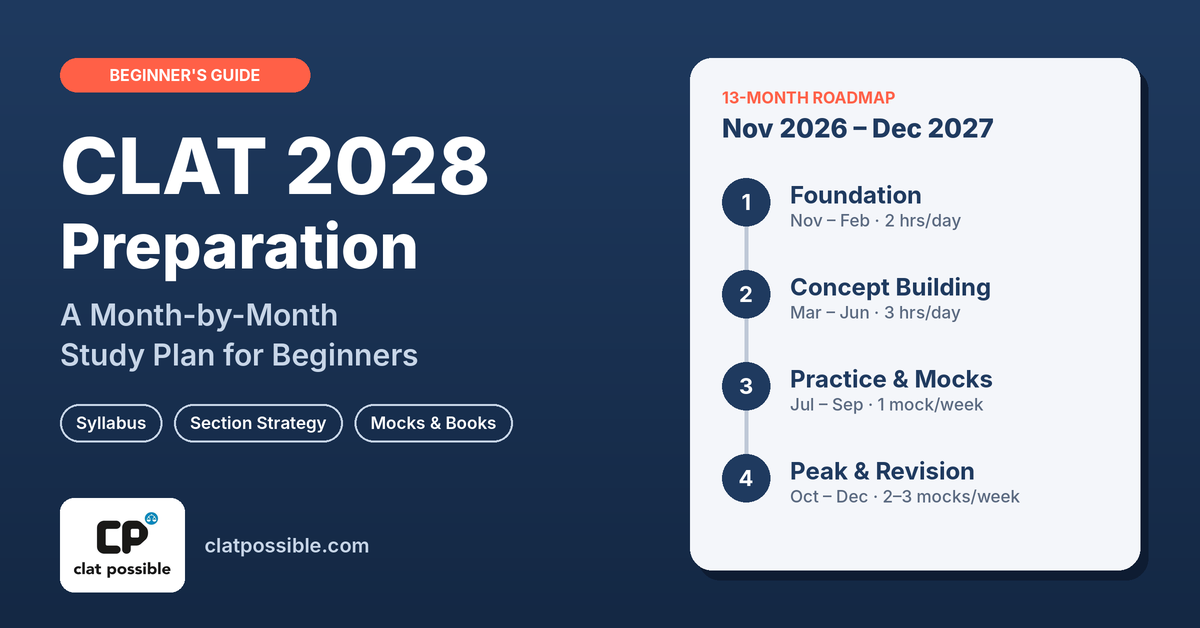
If you are in Class 11 today, you have roughly 13 months until CLAT 2028, which is expected in the first week of December 2027. That is enough time to go from complete beginner to confident test-taker, but only if those months are planned. At CLAT Possible, the students we see struggle are rarely the less talented ones. Instead, they are the ones who started without a plan, studied in bursts, and took their first mock six weeks before the exam. This guide gives you a complete CLAT 2028 study plan, from your first week to exam day.

CLAT Possible 2028 Courses

What This CLAT 2028 Preparation Guide Covers

Why CLAT 2028 Preparation Should Start Now

CLAT rewards reading stamina, reasoning habits and current affairs memory. However, all three build slowly, which is why an early start matters more in CLAT than in most entrance exams. Starting in Class 11 also means you prepare without board-exam pressure for the first few months.

You do not need to study 8 hours a day in Class 11. Instead, you need 2 to 3 focused hours, every day, for 13 months. In short, consistency beats intensity in CLAT.

CLAT 2028 at a Glance

CLAT 2028 will be the Common Law Admission Test for the 2028–29 academic year. The official date is not out yet. For reference, the Consortium has scheduled CLAT 2027 for Sunday, 6 December 2026, from 2:00 PM to 4:00 PM, and has kept the pattern unchanged. Therefore, CLAT 2028 is most likely on the first Sunday of December 2027.

Key HighlightCLAT 2028 (expected)
Conducting bodyConsortium of National Law Universities
Expected exam dateFirst week of December 2027 (tentative)
Expected registrationJuly to October 2027
ModeOffline, pen and paper
Total questions, marks, duration120 questions, 120 marks, 2 hours
Negative marking0.25 marks for every wrong answer
EligibilityClass 12 pass or appearing; 45% (40% for SC/ST); no upper age limit

Dates and pattern for CLAT 2028 are projections based on recent cycles. Always confirm on consortiumofnlus.ac.in once the notification is released.

CLAT 2028 Syllabus and Exam Pattern

The CLAT 2028 syllabus has five sections, and every question is built on a passage. In other words, there is no rote syllabus to memorise; CLAT tests how well you read, reason and apply. The breakdown below follows the current pattern confirmed for CLAT 2027.

SectionQuestionsWeightageWhat it actually tests
English Language22 to 2620%Comprehension, inference, tone, vocabulary in context
Current Affairs including GK28 to 3225%News events, legal and constitutional developments, static GK linked to news
Legal Reasoning28 to 3225%Applying a stated principle to facts; no prior law knowledge needed
Logical Reasoning22 to 2620%Arguments, assumptions, conclusions, strengthen/weaken, puzzles
Quantitative Techniques10 to 1410%Class 10 maths: percentages, ratios, averages, data interpretation
Total120100%+1 for each correct answer, −0.25 for each wrong answer

Three things beginners should notice:

  • Half the paper is GK and Legal. Current Affairs and Legal Reasoning together make up about 50% of your score, so your daily routine must protect time for both.
  • Reading is the hidden sixth section. You will read 25-plus long passages in two hours. Therefore, reading speed with comprehension decides whether you finish the paper.
  • Negative marking punishes guesswork. A wrong answer costs 0.25 marks, so four blind guesses gone wrong wipe out one correct answer.

How to Start CLAT Preparation: Your First 7 Days

Most beginners lose their first month deciding which book to buy. Skip that. Here is how to start CLAT preparation in one week.

DayTaskWhy it matters
Day 1Read the pattern and download the official sample paperYou know exactly what you are preparing for
Day 2Attempt one previous-year CLAT paper untimedYour weak spots matter more than your score
Day 3Read The Hindu or The Indian Express for 30 minutes; note three news itemsStarts your GK notebook and reading habit
Day 4Solve one legal reasoning passage; underline the principle firstThis is the core skill of the section
Day 5Revise percentages and ratios from NCERT Class 8 to 10Quant is built entirely on these basics
Day 6Fix a 2 to 3 hour daily slot around schoolA protected slot is what makes the plan work
Day 7Review the week and list what felt hardestThat list becomes your focus for Month 1

By the end of the week, you will know where you stand and have a routine in place. In fact, that is more than most aspirants have after a month.

CLAT 2028 Study Plan: Month-by-Month Roadmap (November 2026 to December 2027)

This CLAT 2028 study plan runs 13 months in four phases. It assumes you are in Class 11 now and works around school exams, which is where most plans break.

Phase 1: Foundation (November 2026 to February 2027)

Goal: Build reading, news and reasoning habits. No mocks yet. Daily time: 2 hours.

MonthFocusWhat to do
Month 1: November 2026Set the routineNewspaper daily (30 minutes) with 3 to 5 GK notes; 1 English passage a day; NCERT revision of percentages, ratios and averages
Month 2: December 2026Meet legal reasoning1 legal passage a day (principle, facts, application); logical reasoning basics; attempt the CLAT 2027 paper once released and compare with your Day 2 baseline
Month 3: January 2027Widen the baseStatic GK linked to news; recurring legal concepts (contracts, torts, criminal law, constitutional rights); profit and loss, interest, time and work
Month 4: February 2027Protect your school examsClass 11 finals come first; drop to 45 to 60 minutes a day of newspaper plus 1 passage, but do not stop completely

Phase 2: Concept Building (March to June 2027)

Goal: Cover every topic once and start timed sectional practice. Daily time: 3 hours; 5 to 6 hours in summer break.

MonthFocusWhat to do
Month 5: March 2027Restart with sectionalsOne timed sectional test a week; 2 English passages a day with inference and tone questions
Month 6: April 2027Class 12 beginsCritical reasoning (strengthen/weaken, assumptions) plus a few puzzles for speed; data interpretation from tables and graphs
Months 7 and 8: May and June 2027Summer intensive5 to 6 hours a day; solve all previous-year papers since 2020 section by section; first full-length mock at the end of May, then one every two weeks; compile 8 to 9 months of current affairs into one revision file

Phase 3: Practice and Mocks (July to September 2027)

Goal: Shift from learning to performing. Daily time: 3 hours on school days.

MonthFocusWhat to do
Month 9: July 2027Weekly mocks1 full mock a week with analysis as long as the mock itself; start an error log; watch for the CLAT 2028 notification
Month 10: August 2027Fix weak sectionsGive your two weakest sections an extra 45 minutes daily; register for CLAT 2028 early
Month 11: September 2027Build exam strategyTest section orders in mocks and settle on one; set and track time targets per section

Phase 4: Peak and Revision (October to December 2027)

Goal: Peak on exam day, not before it. Daily time: 4 hours.

MonthFocusWhat to do
Month 12: October 2027Two mocks a week2 full mocks weekly plus analysis; revise 12 months of GK, especially legal and constitutional news
Month 13: November 2027Revise and simulate2 to 3 mocks a week at 2:00 PM to train your body clock; re-read your error log weekly; no new books; download the admit card
Exam week: early December 2027Stay freshLight revision of GK notes and the error log only; sleep 7 to 8 hours; walk in rested, not crammed

CLAT 2028 Study Plan: Phase-Wise Summary

PhaseMonthsHours per dayMocks
FoundationNovember 2026 to February 20272None; baseline paper only
Concept BuildingMarch to June 20273 (5 to 6 in summer)First mock in May, then every 2 weeks
Practice and MocksJuly to September 202731 per week
Peak and RevisionOctober to December 202742 to 3 per week

Section-Wise CLAT Preparation Strategy for Beginners

A good CLAT preparation strategy for beginners gives each section a method, not just hours. Here is how our CLAT Possible mentors split the work.

1. Legal Reasoning (28 to 32 Questions)

Treat the passage as the only law that exists, because answers based on outside legal knowledge are the most common trap. Also, use a three-step read: principle, facts, application, and underline the principle before you look at the options. From Phase 2 onward, practise 2 passages a day, and follow legal news, since passages are often built on recent judgments and new laws.

2. Current Affairs including GK (28 to 32 Questions)

Read for context, not trivia: know why an event matters, who is involved and what changed. Keep one GK notebook organised by theme, such as polity, economy, international affairs, environment and legal developments. Above all, revise monthly, since news from 12 to 15 months before the exam can appear.

3. English Language (22 to 26 Questions)

Read 2 editorials a day and summarise each in two lines, which trains main-idea questions. In addition, learn vocabulary from context rather than word lists. By Phase 3, aim to finish a passage in under 6 minutes.

4. Logical Reasoning (22 to 26 Questions)

Focus on argument questions: assumptions, conclusions, strengthen/weaken and flaws. However, do not ignore puzzle-style sets, because the question style can shift from year to year. After each passage, explain in one sentence why the wrong options are wrong.

5. Quantitative Techniques (10 to 14 Questions)

Stick to Class 10 maths and data interpretation, and do not over-invest given the 10% weight. Instead, learn quick calculation tricks such as percentage-fraction equivalents and squares up to 30. Finally, aim for accuracy: eight correct out of eight beats ten attempted with three wrong.

Suggested Time Split for Beginners

SectionShare of study time
Legal Reasoning30%
Current Affairs and GK25%
English Language20%
Logical Reasoning15%
Quantitative Techniques10%

Mock Tests, Revision and Best Books for CLAT 2028

How Many Mocks Should You Take?

Plan for 40 to 50 full-length mocks between May and November 2027. However, the number matters less than the analysis. After every mock, sort your mistakes into three types (concept gap, misread passage, time pressure), re-attempt wrong questions without looking at the answer, and note one change for the next mock.

A Simple Revision Cycle

  • Daily: 15 minutes revising that day’s GK notes.
  • Weekly: A Sunday review of the week’s GK, error log and vocabulary.
  • Monthly: A full revision of the month’s current affairs compilation.

Recommended Books and Resources

SectionRecommended resource
English LanguageThe Hindu or The Indian Express editorials; Word Power Made Easy by Norman Lewis
Current Affairs and GKDaily newspaper; a monthly CLAT current affairs compilation; Lucent’s General Knowledge for static GK
Legal ReasoningPrevious-year CLAT papers (2020 onward); Legal Aptitude for CLAT by A.P. Bhardwaj
Logical ReasoningPrevious-year CLAT papers; R.S. Aggarwal’s A Modern Approach to Verbal and Non-Verbal Reasoning for basics
Quantitative TechniquesNCERT Class 8 to 10 Maths; CLAT-style data interpretation sets
Full-length mocksCLAT Possible mock test series and the official Consortium sample papers

Pick one book per section and finish it twice. After all, five half-read books help no one.

7 Mistakes Beginners Make in CLAT 2028 Preparation

1. Waiting for Class 12 to Start

The 13 months you have now are your biggest advantage. Reading speed and GK memory cannot be rushed later.

2. Collecting Books Instead of Solving Passages

CLAT is a practice exam. Therefore, previous-year papers teach more than any new guide.

3. Skipping Current Affairs for a Month

Missed months are hard to rebuild and can cost you several questions in the GK section.

4. Using Outside Legal Knowledge

In Legal Reasoning, the passage overrides what you know. In short, answer only from the principle given.

5. Taking Mocks Without Analysis

A mock without review is just a timed test. In fact, the analysis is where the score grows.

6. Guessing Blindly

With 0.25 marks lost per wrong answer, attempt a question only when you can eliminate at least two options.

7. Ignoring School

Boards matter for eligibility and for your stamina. Therefore, plan around exams; do not fight them.

How CLAT Possible Helps You Crack CLAT 2028

A plan works best with someone checking that you follow it. At CLAT Possible, our CLAT 2028 programmes are built around the same phases in this guide:

  • Foundation-first teaching for Class 11 students, starting from reading and reasoning basics.
  • Mentorship and doubt support so you never stay stuck on a legal or logical concept.
  • Current affairs material designed for CLAT’s issue-based questions.
  • Mock tests with detailed analysis to track your progress month by month.

Har Ghar Diwali Discount

Conclusion

Your CLAT 2028 preparation starts with the next hour you put in. Therefore, open today’s newspaper, solve one legal passage, and let this month-by-month plan carry you to December 2027. Overall, whether you are just starting out or already a few weeks in, the right plan and the right guidance make every step clearer.

Take Free Demo Class