close

CLAT 2027 Exam Day Instructions: Code of Conduct, Do’s & Don’ts and Checklist

The CLAT 2027 exam is on Sunday, 6 December 2026, from 2:00 pm to 4:00 pm, in offline (pen-and-paper) mode. In the last cycle, the Consortium let candidates into the centre from 1:00 pm, required them to be seated by 1:30 pm and allowed no entry after 2:15 pm. Carry your admit card, an original government photo ID, black or blue ballpoint pens, a transparent water bottle and an analogue watch. Phones, smartwatches, calculators and bags are not allowed.

Important: As of 27 October 2026, the Consortium has not yet published the CLAT 2027 test-day instructions. The rules below come from the Consortium’s official CLAT 2025 Test Day Instructions, and the same timings were followed for CLAT 2026. The instructions printed on your CLAT 2027 admit card are final. If anything there differs from this guide, follow the admit card.

CLAT 2027 Exam at a Glance

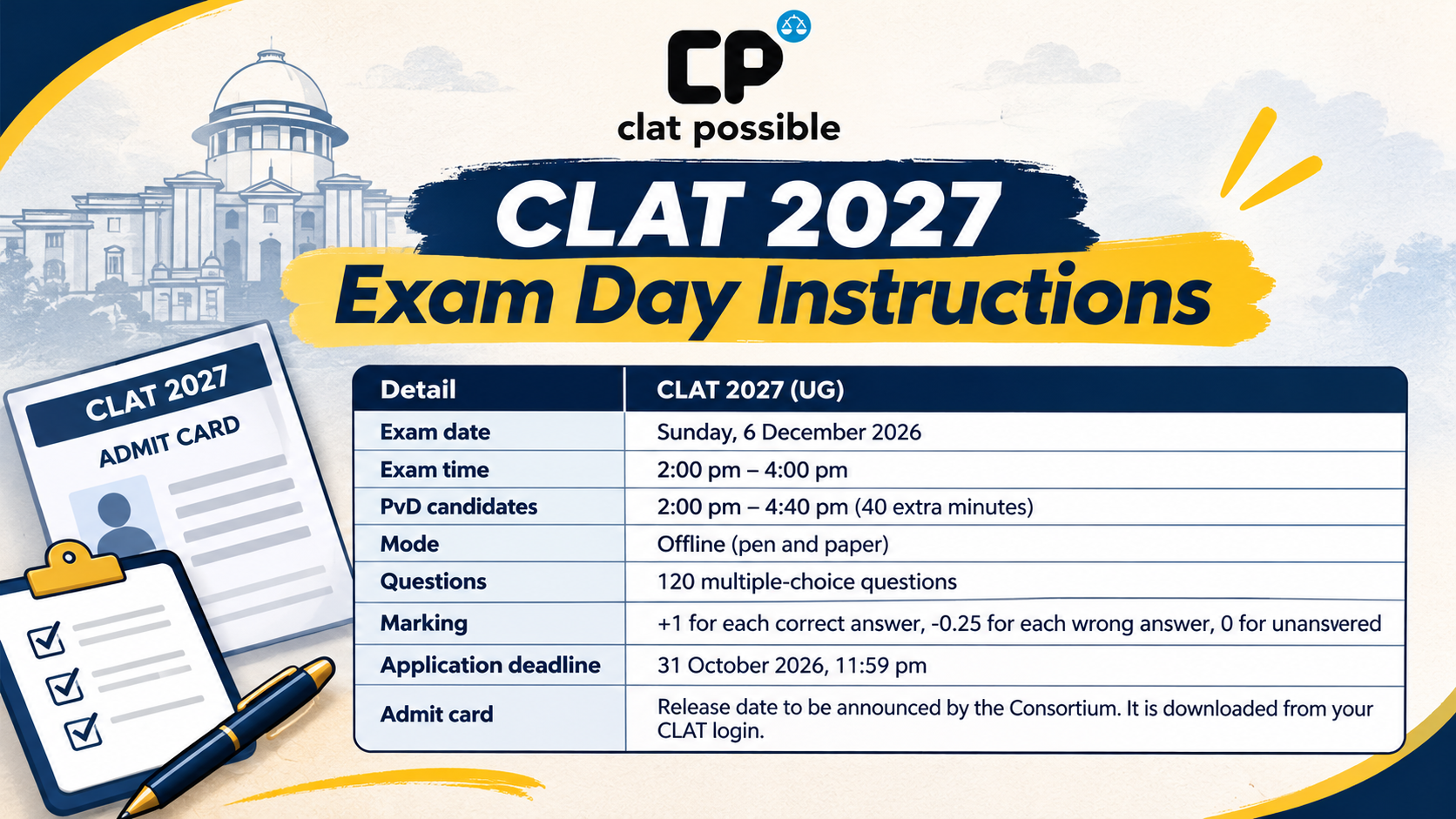
DetailCLAT 2027 (UG)
Exam dateSunday, 6 December 2026
Exam time2:00 pm – 4:00 pm
PwD candidates2:00 pm – 4:40 pm (40 extra minutes)
ModeOffline (pen and paper)
Questions120 multiple-choice questions
Marking+1 for each correct answer, −0.25 for each wrong answer, 0 for unanswered
Application deadline31 October 2026, 11:59 pm
Admit cardRelease date to be announced by the Consortium. It is downloaded from your CLAT login.

Source: Consortium of NLUs – CLAT 2027 UG Instructions and CLAT 2027 press release.

For a section-wise breakdown of the paper, read our CLAT 2027 syllabus and exam pattern guide.

CLAT 2027 Exam Day Timeline (Bell Timings)

These timings are from the Consortium’s last official test-day instructions. Expect the same schedule for CLAT 2027, but confirm it on your admit card.

TimeBellWhat Happens
1:00 pm–Entry to the test centre opens. ID and admit card checks begin.
1:30 pmLong bellCandidates enter the exam hall and must be seated.
1:50 pmShort bellSealed envelopes are handed out. Invigilators read out instructions.
2:00 pmLong bellThe test begins. You may open the sealed envelope.
2:15 pmShort bellLast entry. No one is let into the hall after this.
2:30 / 3:00 / 3:30 pmShort bells30 minutes, 1 hour and 1.5 hours are over.
3:50 pmShort bell10 minutes left.
4:00 pmLong bellThe test ends. Stop writing on the OMR sheet and question booklet.

Two rules students often miss: once the test begins, you cannot use the washroom, and you cannot leave the hall before 4:00 pm.

CLAT 2027 Exam Day Checklist: What to Carry

ItemRequired?Notes
CLAT 2027 admit card (printed)MandatoryTake two printouts and keep one spare.
Original government photo IDMandatoryBring the original, not a photocopy or phone photo. See the accepted list below.
Self-attested passport-size photoOnly if neededNeeded if the photo on your admit card is unclear. Keep one anyway.
Black or blue ballpoint pensMandatoryCarry two or three that you’ve tested. No gel or fountain pens.
Transparent water bottleAllowedRemove the label so it is fully see-through.
Analogue watchAllowedDigital watches and smartwatches are banned.
Original disability certificatePwD candidates onlyRequired to get the extra 40 minutes.
Prescribed medicinesIf neededCarry any medication you need.

Accepted Photo ID Proofs

Under the Consortium’s last official instructions, any one of these is accepted as long as it is an original, clear document:

Aadhaar cardPassport
PAN cardVoter ID card
Driving licenceRation card / PDS photo card
Photo ID from a recognised school or collegePhoto bank ATM card
Kisan photo passbookCGHS / ECHS photo card
Department of Posts address card with photoIdentity certificate with photo from a Gazetted Officer or Tehsildar
Disability ID card or certificate issued by a State/UT authority

Tip: Aadhaar is the safest choice for most students. Check that the name on your ID matches the name on your admit card.

Items Not Allowed at the CLAT 2027 Exam Centre

Anything that is not on the permitted list is not allowed. Centres usually have no safe storage, so leave these items at home or with a parent outside.

CategoryExamples
Electronic devicesMobile phones, smartwatches, digital watches, fitness bands, earphones, Bluetooth devices
Calculation aidsCalculators of any kind
Study materialNotes, books, printed sheets, loose paper
Bags and casesBags, pouches, pencil boxes, wallets
Writing toolsPencils, gel pens, highlighters, correction fluid

Want the real exam to feel familiar? Take your CLAT mocks at 2:00 pm with only a pen, an analogue watch and a water bottle. Start with today’s Daily Mini CLAT.

Take the Daily Mini CLAT

Inside the Exam Hall: CLAT 2027 Code of Conduct

Question Booklet Rules

  • Check that the name, photo and admit card number printed on the question booklet are yours.
  • At the start, write your admit card number on the first page of the booklet.
  • The booklet has two blank pages for rough work. No extra sheets are given.
  • Do not write anywhere else in the booklet except the space marked for working.
  • You cannot ask anyone to explain a question during the test.
  • If your booklet has a printing problem, ask the invigilator for a replacement. You will get a new OMR sheet with it. Don’t use the old one.

OMR Sheet Rules

Do ✅Don’t ❌
Use only a black or blue ballpoint penUse a pencil, gel pen or correction fluid
Shade each answer circle completelyHalf-shade a circle (it counts as unanswered)
Mark only one option per questionShade two circles (counts as a wrong answer, so −0.25)
Keep the sheet flat and cleanFold, tear or crumple it, or do rough work on it
Sign it with the invigilator before detaching your copyDamage the barcode or the timing marks on the edges
Return the original (top) sheet to the invigilatorTake the original OMR sheet out of the hall

A damaged OMR sheet is invalid and can lead to disqualification. Taking the original sheet out of the hall can also lead to legal action.

Attendance and Unfair Means

  • During the test, an attendance sheet goes around. Write your question booklet number and OMR sheet number on it and sign it.
  • Copying, talking, passing material or any other unfair means leads to disqualification.
  • Impersonation and fraud may be a criminal offence, on top of disqualification.

Explore CLAT Programmes

What to Take Home After the Exam

You are allowed to keep these three things. Store them safely until admissions are over.

ItemWhy It Matters
Admit card (signed by the invigilator)You need it at the time of admission and counselling.
Question bookletUse it to check your answers against the provisional answer key.
Candidate’s copy of the OMR sheetHelps you work out your expected score and raise objections if needed.

CLAT 2027 Dress Code: What to Wear

The Consortium’s official test-day instructions do not set a dress code. Frisking at the gate is still standard, so practical choices save time.

  • Wear comfortable, simple clothes. Avoid big buttons, metal parts and lots of pockets.
  • Choose sandals or simple shoes that are easy to take off if security asks.
  • Keep jewellery and metal accessories to a minimum, because they slow down security checks.
  • December afternoons can be cold in North India. Wear a plain jacket or sweater that you’re happy to have checked.

Instructions for PwD Candidates

  • Eligible PwD candidates get 40 extra minutes, so their exam runs from 2:00 pm to 4:40 pm.
  • Carry your original disability certificate along with your admit card and photo ID.
  • Rules on scribes and other support are set out in the Consortium’s notifications. Read the CLAT 2027 notices and your admit card carefully, and contact the Consortium early if you need help.
  • If you need an isolated room for medical reasons, the last official instructions asked candidates to tell the Centre Superintendent at least 48 hours before the exam.

Do’s and Don’ts on CLAT 2027 Exam Day

Do ✅Don’t ❌
Reach the centre by 1:00 pmPlan to arrive close to 2:15 pm. Traffic on exam day is unpredictable.
Visit the centre a day or two beforeRely only on a map pin for an unfamiliar building
Keep the admit card and ID together in a clear folderCarry only a photo of your admit card on your phone
Eat a light lunch and use the washroom before 1:30 pmExpect a washroom break after 2:00 pm
Plan your section order before you enterExperiment with a new strategy on the day
Fill the OMR sheet as you go, or in planned batchesLeave all OMR shading for the last 10 minutes
Skip a question if you can’t rule out at least two optionsGuess blindly. Each wrong answer costs 0.25 marks.
Keep your question booklet and OMR copy safeThrow away your rough work before the answer key comes out

Your Final-Week Checklist Before CLAT 2027

WhenWhat to Do
As soon as the admit card is outDownload it and check your name, photo, centre and roll number. Report any error to the Consortium immediately.
Last 7 daysTake your last full mocks at 2:00 pm. Practise shading an OMR sheet within the 120 minutes.
2–3 days beforeVisit the centre and check the travel time from home at around 12:30 pm.
Saturday, 5 DecemberPack your folder: two admit card copies, original ID, photo, pens, water bottle and watch. Do a light revision and get a full night’s sleep.
Sunday, 6 DecemberHave an early lunch, leave home with a time buffer and be at the gate by 1:00 pm.

Six weeks left and not sure your mock scores are where they should be? Talk to a CLAT Possible counsellor. They will review your recent mocks and help you plan the final weeks before 6 December. If you’re targeting CLAT 2028, explore our structured CLAT programmes.

Target CLAT 2028


Final Word

The CLAT 2027 exam rewards preparation, but avoidable mistakes on the day can still cost you. Most of them come down to a late arrival, a missing ID or a careless OMR sheet. Use this checklist, rehearse the 2:00 pm routine in your mocks, and read your admit card carefully when it comes out. For official updates, keep checking the Consortium of NLUs website.
CLAT 2028: Complete Guide to Exam Date, Syllabus, Eligibility and Preparation

CLAT 2028 is the Common Law Admission Test for admission to the five-year integrated LL.B. and one-year LL.M. programmes of the participating National Law Universities (NLUs) in the 2028–29 academic year. If you will write your Class 12 board exams in 2028, this is most likely your first CLAT.

This cycle is different, because the exam pattern itself is undecided. An Expert Committee has recommended a major redesign of the paper, and the Consortium of NLUs has said it will consider the proposals in preparation for CLAT 2028. As of 23 October 2026, no final decision has been announced.

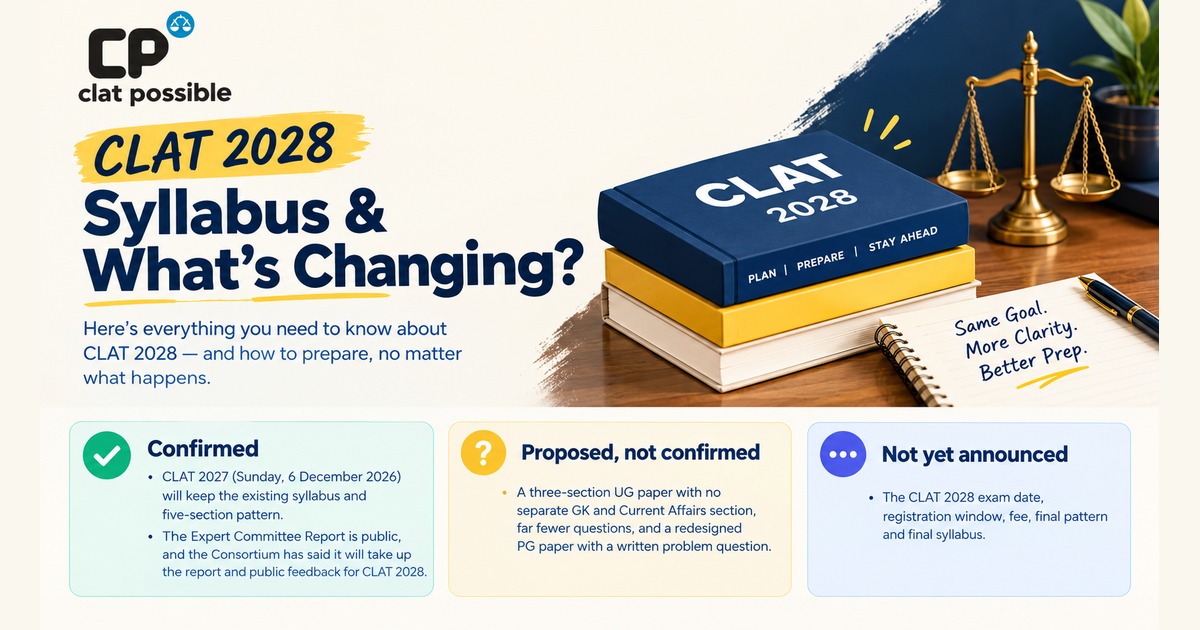
CLAT 2028 status check (as of 23 October 2026)

  • Confirmed: CLAT 2027 (Sunday, 6 December 2026) keeps the existing syllabus and five-section pattern.
  • Proposed, not confirmed: a three-section UG paper, no separate GK/Current Affairs section, fewer questions, and a redesigned PG paper with a written problem question.
  • Not announced: the CLAT 2028 exam date, registration window, fee, final pattern and syllabus.

CLAT 2027-2028 Courses by CLAT Possible

What Is CLAT 2028?

CLAT is conducted by the Consortium of National Law Universities, which was formed on 19 August 2017 and currently lists 26 member NLUs. The year in the exam’s name is the year of admission, not the year the exam is held. CLAT 2027 is being held on 6 December 2026 for admissions in 2027–28, so CLAT 2028 is for admissions in 2028–29.

CLAT UG 2028 and CLAT PG 2028

  • CLAT UG 2028 is for five-year integrated law programmes such as BA LL.B. (Hons.) and BBA LL.B. (Hons.). Programmes and seats vary from one NLU to another.
  • CLAT PG 2028 is for the one-year LL.M., for LL.B. graduates and final-year LL.B. students.

The two papers share a name and an application portal, but their eligibility and content are different. This guide focuses mainly on CLAT UG.

Is CLAT 2028 Your Exam? A Quick Check

Where you are in the 2026–27 school yearYour likely first CLATWhat this guide means for you
Class 10CLAT 2029Too early for intensive preparation; build reading and reasoning habits now.
Class 11CLAT 2028This is your cycle. CLAT 2028 will fall during your Class 12 year.
Class 12CLAT 2027 (December 2026)CLAT 2028 would be a second attempt, during a drop year or alongside college.
Class 12 passed / in collegeCLAT 2028, if you meet the eligibility rulesCLAT 2027 had no upper age limit; confirm the 2028 rule when the notice is out.

CLAT 2028 Exam Highlights

ParticularCLAT 2028 details
Exam nameCommon Law Admission Test (CLAT) 2028
Conducting authorityConsortium of National Law Universities
ProgrammesUG: five-year integrated LL.B.
PG: one-year LL.M.
NotificationNot officially announced
Application datesNot officially announced
Exam dateNot officially announced (recent CLATs have been held in December of the year before admission)
Exam modeNot officially announced for 2028 (CLAT 2027: offline, pen-and-paper)
DurationNot officially announced (CLAT 2027: 2 hours; the Expert Committee also proposes 2 hours)
Pattern and syllabusUnder review. CLAT 2027 is unchanged; Expert Committee proposals are being considered for CLAT 2028
Official websiteconsortiumofnlus.ac.in

CLAT 2028 Exam Date and Important Events

The CLAT 2028 exam date has not been announced yet. Based on recent cycles, it is sensible to plan around December 2027 as a working assumption.

Reference Point: How the CLAT 2027 Schedule Was Announced

CLAT 2027 eventOfficial date
Decision on exam date (Executive Committee and Governing Body meetings)18 July 2026
Press release with exam date and application window22 July 2026
Online applications open3 August 2026
Last date to apply31 October 2026
ExamSunday, 6 December 2026, 2:00 pm to 4:00 pm
Admit card, answer key, result, counsellingTo be notified by the Consortium

CLAT 2028 Events to Track

EventCLAT 2028 statusWhat you should do
Decision on pattern and syllabusPendingWatch for an official notice and any sample paper. The Expert Committee recommended that sample papers be made public if its proposals are accepted.
CLAT 2028 notificationNot announcedRead the eligibility, fee and syllabus sections in full on the official site.
Registration and application formNot announcedKeep documents ready; apply well before the deadline.
Admit cardNot announcedCheck your name, photo, centre and reporting time the day it is released.
ExamNot announcedVisit your centre in advance if you can.
Provisional answer key and objectionsNot announcedCalculate a rough score; raise objections only with solid reasoning.
Final answer key and resultNot announcedDownload your scorecard and note your rank.
Counselling and seat allotmentNot announcedRegister for counselling on time and plan your NLU preference list.

Always rely on the Consortium’s official notices, not social media screenshots. We will update this page as soon as the CLAT 2028 notification is released.

CLAT 2028 Eligibility Criteria

The CLAT 2028 eligibility rules have not been released yet. Until they are, the CLAT 2027 rules are the best reference.

CLAT UG Eligibility (CLAT 2027 Rules)

  • Qualification: Class 12 or equivalent.
  • Minimum marks: 45% (40% for SC/ST). Other category relaxations, including PwD, are given in each year’s notice.
  • Appearing candidates: students writing Class 12 in March/April can apply, but must show proof of passing at the time of admission.
  • Age: no upper age limit.
  • Stream: no specific stream is required. Science, Commerce and Humanities students can all apply.

CLAT PG Eligibility (CLAT 2027 Rules)

  • Qualification: LL.B. or equivalent.
  • Minimum marks: 50% (45% for SC/ST); check the notice for other relaxations.
  • Appearing candidates: final-year LL.B. students can apply, with proof at admission.
  • Age: no upper age limit.
CriteriaCLAT UGCLAT PG
Qualifying examClass 12 or equivalentLL.B. or equivalent
Minimum marks (CLAT 2027)45% (40% SC/ST)50% (45% SC/ST)
Appearing candidatesEligible, with proof at admissionEligible, with proof at admission
Upper age limitNoneNone

Good to know:

  • Your Class 12 marks decide whether you are eligible; your CLAT score decides your rank.
  • Each NLU sets its own rules for domicile, reservation, NRI and foreign-national seats.

CLAT 2028 Exam Pattern: Current Format vs Proposed Changes

There are two possibilities for CLAT 2028: the current five-section paper used for CLAT 2027, or the three-section design proposed by the Expert Committee.

The Current CLAT UG Pattern (Applies to CLAT 2027)

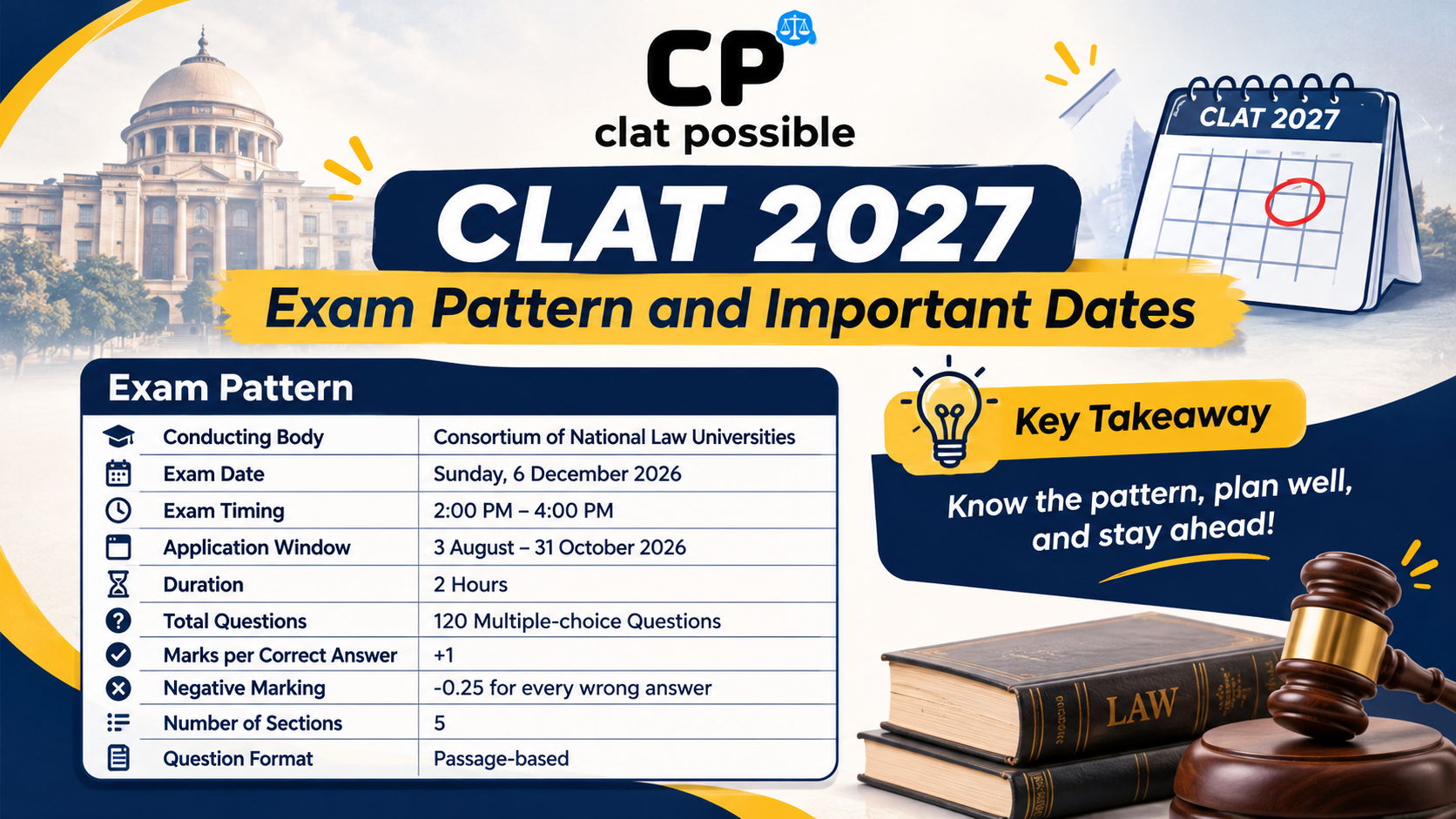
FeatureCLAT 2027 (UG)
Conducting bodyConsortium of National Law Universities
Exam dateSunday, 6 December 2026
Exam timing2:00 pm – 4:00 pm
Application window3 August – 31 October 2026
Duration2 hours
ModeOffline, pen-and-paper (OMR)
Total questions120 multiple-choice questions
Marks per correct answer+1
Negative marking−0.25 for every wrong answer; no penalty for unanswered questions
Number of sections5
SectionsEnglish Language; Current Affairs including General Knowledge; Legal Reasoning; Logical Reasoning; Quantitative Techniques
Question formatPassage-based, with passages of roughly 450 words in the reading-heavy sections

As a rough guide from earlier papers, English carries about 20% of the questions, Current Affairs about 25%, Legal Reasoning about 25%, Logical Reasoning about 20% and Quantitative Techniques about 10%.

The Proposed CLAT 2028 UG Pattern (Expert Committee)

The Expert Committee, made up of five legal academics from Oxford, LSE, Columbia, Cambridge and BML Munjal University, has proposed a three-section paper:

  1. Logical Reasoning and Legal Aptitude: merges the current Legal and Logical Reasoning sections. It would use purely hypothetical scenarios and need no prior legal knowledge.
  2. Language and Comprehension: replaces English, with a focus on inference, implication, tone and the strength of arguments rather than grammar or vocabulary.
  3. Quantitative Techniques: stays as a separate section, with more emphasis on data sufficiency, conceptual numeracy and logic puzzles.
  • There would be no separate GK/Current Affairs section.
  • Each section would have no more than 10 to 15 questions, and the total time would stay at 2 hours.
  • An essay was considered but not recommended for now; it may be revisited after about three years.

Current vs Proposed CLAT UG: Side by Side

FeatureCurrent pattern (CLAT 2027)Proposed by Expert Committee (not confirmed)
Sections53
Total questions120No more than 10 to 15 per section (roughly 30 to 45 in all)
Duration2 hours2 hours
GK and Current AffairsSeparate sectionNo separate section
Legal contentLegal Reasoning passagesHypothetical rule application and rule derivation, merged with logic
Main skill rewardedReading speed across long passagesDepth, accuracy and reasoning
EssayNoneNone for now; to be reconsidered later

CLAT PG 2028: Current Paper and Proposed Redesign

Current paper: 120 multiple-choice questions in 2 hours, with the same marking as UG and no separate sections. It covers Constitutional, Administrative, Contract, Torts, Criminal, Family, Property, Company, Public International, Tax, Environmental and Labour Law, along with Jurisprudence.

Proposed redesign:

  • Three UG-style aptitude sections carrying 50% of the weight.
  • A new Legal Knowledge MCQ section on legal developments from the previous two calendar years, focused on doctrine.
  • No more than 10 questions in each of the four MCQ sections.
  • A written Problem Question: candidates choose one of three problems (Public, Private, Commercial or International Law). NLUs would mark only shortlisted candidates’ answers.
  • Total time: 2 hours.

Where the Decision Stands: A Verified Timeline

  • 15 September 2025: the Consortium forms the Expert Committee, with reforms originally intended from 2027.
  • 15 October – 4 November 2025: public feedback is collected.
  • 11 November 2025, 14 January 2026 and 2 February 2026: interim report, final recommendations and final report.
  • 17 May 2026: meeting at the National Judicial Academy, Bhopal; the Office of the CJI is to constitute a committee to consider the recommendations further.
  • 18 July 2026: the Governing Body decides on no change for CLAT 2027; the report is published and feedback invited until 31 August 2026.
  • 21–22 July 2026: the report and press releases are published.
  • As of 23 October 2026: no official notice on the CLAT 2028 pattern.

Since the reforms have already been deferred once, CLAT 2028 may adopt them fully, partly or not at all. That is why we recommend a dual-track preparation strategy, explained below.

CLAT 2028 Syllabus

The CLAT 2028 syllabus has not been released yet. For topic-level detail on the current syllabus, read our CLAT Syllabus 2027 guide.

Current UG Syllabus (Confirmed for CLAT 2027)

  • English Language: fiction and non-fiction passages of about 450 words, testing the main idea, inference, summary, viewpoints and the meaning of words in context.
  • Current Affairs including GK: news and non-fiction passages on Indian and world events, arts and culture, international affairs and historical events of lasting importance.
  • Legal Reasoning: passages on legal, policy or moral issues. You identify the principle and apply it to the facts. No prior legal knowledge is needed, though general awareness helps.
  • Logical Reasoning: arguments, premises, conclusions, strengthening and weakening statements, inferences, analogies and contradictions.
  • Quantitative Techniques: data given in text, charts or tables, using Class 10-level maths such as ratios, proportions, basic algebra, mensuration and statistical estimation.

See the official CLAT UG syllabus on the Consortium website.

Proposed UG Syllabus (Only If Reforms Are Adopted)

Under the proposal, the paper would have three sections and no separate GK section. Until the Consortium confirms the change, do not assume that any current section will survive or be removed.

Skills That Matter Under Either Syllabus

  • Summarising the argument of a dense passage in one line.
  • Applying a stated rule to facts without using outside knowledge.
  • Spotting assumptions and what strengthens or weakens a conclusion.
  • Comfort with percentages, ratios and data given in words or tables.
  • Accuracy under time pressure, and knowing when to skip a question.

CLAT 2028 Registration and Application Form

CLAT 2028 registration is not open yet. The official notification will confirm the form, fee and deadline. Based on CLAT 2027, the process is likely to be:

  1. Visit consortiumofnlus.ac.in and open the CLAT 2028 page once it is live.
  2. Register with your mobile number and email address.
  3. Fill in your personal, academic and category details.
  4. Choose UG or PG and your test-centre preferences.
  5. Upload your photo, signature and certificates.
  6. Pay the application fee online.
  7. Submit the form and download the confirmation.

Application Fee (CLAT 2027, for Reference)

CategoryCLAT 2027 fee
General, OBC, NRI and other categories₹4,000
SC, ST and BPL (check the notice for other concessions)₹3,500
Previous years’ question papers (optional)₹500 extra

The fee is paid online only, is non-refundable, and any bank charges are borne by the candidate. The CLAT 2028 fee has not been announced.

Documents to Keep Ready

  • A digital photograph and signature.
  • Class 10 certificate (for name and date of birth) and Class 12 marksheet, if available.
  • Category, PwD, BPL or domicile certificates, if applicable.
  • An email ID and mobile number that you will keep active until admissions close.

How to Prepare for CLAT 2028

Do not wait for the final pattern to start preparing. The core skills are the same under both patterns, so every month you spend building them counts. Follow these six steps:

  1. Take a diagnostic, not a verdict: attempt one past paper or mock without a timer, then once under time. Note your weak areas, such as reading speed, misreading, maths gaps or guessing.
  2. Build foundations in the first few months: learn how each question type works. For reasoning, that means assumptions, inferences and conclusions; for maths, revisiting Classes 8 to 10; for legal reasoning, separating the rule, the facts and the question.
  3. Practise daily in small doses: do some serious reading and at least one passage-based set every day.
  4. Add timed work: only once your untimed accuracy is steady.
  5. Take mocks and analyse them: for every wrong or skipped question, record the cause and the fix.
  6. Schedule your revision: review your error log and notes every week and every month.

For a detailed month-by-month plan, see our complete CLAT 2028 study plan.

The Dual-Track Rule for an Undecided Pattern

Make reading, argument analysis, rule application and numeracy your core under both tracks. Keep current affairs as a daily habit rather than heavy memorisation. Then adjust once the pattern is confirmed:

If the Consortium confirms…Adjust your preparation like this
The current five-section patternStep up GK revision, and practise managing time across 120 questions.
The proposed three-section patternDrop GK memorisation for CLAT, go deeper on rule application and rule derivation, practise data sufficiency, and prioritise accuracy because each question will count for more.
A partial or phased changeTreat the official sample paper as your main reference, and realign your mocks to it.

A word of caution: AILET and some other law entrance exams still include GK, so check each exam’s latest notice before you drop current affairs altogether.

Try Roznama (mini CLAT) for Free

Preparation Strategy for Different Students

  • Class 10: you do not need a coaching timetable yet. Read long-form articles a few times a week, discuss the news, find out what studying law at an NLU involves, and keep your board exams first.
  • Class 11 (the core CLAT 2028 group): you have about 13 to 14 months from October 2026. Build foundations first (daily reading, basic maths, reasoning logic), start sectional practice by spring 2027, then move to mocks and pattern adaptation in the second half of 2027. Read more about starting CLAT preparation in Class 11 or Class 12.
  • Class 12: CLAT usually falls in December, before your boards. Put CLAT first from July to December, go lighter on mocks in the weeks before pre-boards, and then switch fully to boards. Board English and maths overlap with CLAT skills. See our guide on juggling CLAT and board exams.
  • Droppers and repeat aspirants: start with an honest post-mortem: was it knowledge, speed or nerves? Set monthly targets, take mocks and analyse them, and protect your health and routine. Rebuild around the shared core skills rather than repeating your 2027 plan. Read our strategies for repeat attempts.
  • Self-study without coaching: follow the official syllabus, use authentic practice material, analyse every test and keep an error log. Start with the Consortium’s documents, then add a quality newspaper and a reliable mock series. Coaching helps most with structure, feedback and doubt-solving. Compare CLAT coaching vs self-study.

Section-Wise Preparation Tips

English Language / Language and Comprehension

  • Method: read editorials and essays; for each, write a one-line summary and describe its tone in one word.
  • Routine: one passage daily, and review why each wrong option is wrong.
  • Mistakes to avoid: answering from memory instead of the passage; memorising word lists without context.

Read more on how to improve reading comprehension for CLAT.

Current Affairs and General Knowledge

  • Method: follow one daily newspaper and keep short thematic notes (polity, economy, international affairs, environment, legal developments).
  • Routine: daily headlines, a weekly recap quiz and monthly consolidation.
  • Mistakes to avoid: collecting PDFs you never revise; learning isolated facts without understanding why they matter.
  • Note: keep this light until the pattern is confirmed. Understanding the news also helps with passage reading.

Legal Reasoning

  • Method: underline the rule, list the material facts, and answer strictly within the passage.
  • Routine: two to three passages a few times a week, plus a weekly “change one fact” drill.
  • Mistakes to avoid: using outside law; skimming the facts.
  • Note: the “change one fact” drill closely matches the rule-application style in the proposed pattern.

Follow our step-by-step legal aptitude guide.

Logical Reasoning

  • Method: identify the conclusion first, then the premises, then the hidden assumption.
  • Routine: short critical reasoning sets most days, and analytical puzzles once or twice a week.
  • Mistakes to avoid: choosing options that are true in real life but do not follow from the passage; ignoring qualifiers such as “some”, “only” and “most”.

Quantitative Techniques

  • Method: rebuild percentages, ratios, averages, profit and loss, and simple algebra, then move on to data given in text and tables.
  • Routine: a short calculation warm-up plus one data set several times a week.
  • Mistakes to avoid: skipping the section entirely; spending too long on a single calculation.
  • Note: add data-sufficiency questions to prepare for the proposed pattern.

Take Free Demo Class

CLAT 2028 Study Plan and Timetable

This plan assumes the exam will be held around December 2027. If the official date is different, shift the phases accordingly.

PhaseIndicative windowFocusYou are ready to move on when…
1. FoundationNow to about March 2027Daily reading, maths basics, how each question type worksYou can summarise a 450-word passage accurately and handle basic arithmetic without hesitation.
2. Skill buildingAbout April to July 2027Sectional practice, an error log, a steady current-affairs habitYour sectional accuracy is consistent across a few weeks.
3. TestingAbout August to October 2027Full-length mocks aligned to the confirmed pattern, with detailed analysisYour mock scores are stable and you have a clear section order and time plan.
4. Final preparationNovember 2027 to the examRevision of notes and error log, fewer but sharper mocks, exam-day routineYou go into the exam with a tested plan rather than new material.

How to Adapt the Plan

  • Starting late: compress Phase 1, but do not skip it.
  • Strong reader, weak in maths: give Quantitative Techniques extra slots in Phases 1 and 2.
  • Pattern confirmed mid-year: match your Phase 3 mocks to the official sample paper and re-weight GK accordingly.

A Sample Weekly Layout (Tasks, Not Hours)

DayCLAT tasks
MondayEditorial reading + one English/comprehension passage + news notes
TuesdayTwo legal reasoning passages + one data set
WednesdayCritical reasoning set + news notes
ThursdayOne comprehension passage + maths fundamentals revision
FridayLegal reasoning “change one fact” drill + puzzle set
SaturdaySectional test or full mock (depending on your phase)
SundayMock analysis, error-log update, weekly current-affairs quiz, rest

Track the tasks you complete, not the hours you sit at your desk.

Best Books and Resources for CLAT 2028

A few resources used thoroughly will do far more for you than a pile of books you never finish.

1. Official Resources (Start Here)

  • The official CLAT UG syllabus page on the Consortium website (switch to the 2028 version once it is published).
  • Previous year papers (sold for ₹500 in the CLAT 2027 cycle).
  • The CLAT Expert Committee Report 2026, which includes sample questions in the proposed styles. These are illustrations, not an official paper.

2. Everyday Reading

  • One quality national newspaper daily, including the editorials.
  • Long-form essays and opinion writing.

3. Supplementary Books and Material

  • NCERT Maths for Classes 8 to 10.
  • One passage-based legal reasoning book and one logical reasoning book.
  • One current-affairs source that is updated every month.
  • Check that any book you buy reflects the confirmed exam structure.

See our list of recommended CLAT preparation books.

4. Practice from CLAT Possible

Our free Roznama (Daily Mini CLAT) gives you about 25 to 30 questions every day, based on that day’s newspaper, across the five current CLAT sections.

Try Roznama Free

CLAT 2028 Mock Tests and Previous Year Papers

How to Use Previous Year Papers

  • Solve the most recent papers first.
  • Attempt them under exam conditions, then analyse them slowly.
  • Remember that older papers may follow older structures. CLAT moved to a passage-based format from 2019–20, so use past papers to build skills, not to predict questions.

How to Choose CLAT 2028 Mock Tests

  • Choose mocks that follow the confirmed pattern. Until it is confirmed, focus on sectional and skill-based tests.
  • Look for detailed solutions, section-wise and question-type breakdowns, and comparison with other students.
  • Fewer mocks, analysed well, beat many mocks taken and forgotten.

A Simple Mock-Analysis Tracker

TrackAsk yourself
Wrong answersWas it a concept gap, a misread question or carelessness?
Skipped questionsDid you skip by choice or because time ran out?
Time per sectionWhere did the clock run away from you?
Repeated errorsWhich question type has gone wrong three times or more?
Next actionWhat one change will you test in the next mock?

Participating NLUs and Law Courses

The CLAT 2028 notification will confirm the participating NLUs and their seat matrices. As of October 2026, the Consortium lists 26 member NLUs:

UniversityLocation
National Law School of India University (NLSIU)Bengaluru
NALSAR University of LawHyderabad
National Law Institute University (NLIU)Bhopal
The West Bengal National University of Juridical Sciences (WBNUJS)Kolkata
National Law University, JodhpurJodhpur
Hidayatullah National Law University (HNLU)Raipur
Gujarat National Law University (GNLU)Gandhinagar
Dr. Ram Manohar Lohiya National Law University (RMLNLU)Lucknow
Rajiv Gandhi National University of Law (RGNUL)Patiala
Chanakya National Law University (CNLU)Patna
National University of Advanced Legal Studies (NUALS)Kochi
National Law University Odisha (NLUO)Cuttack
National University of Study and Research in Law (NUSRL)Ranchi
National Law University and Judicial Academy, Assam (NLUJA)Guwahati
Damodaram Sanjivayya National Law University (DSNLU)Visakhapatnam
Tamil Nadu National Law University (TNNLU)Tiruchirappalli
Maharashtra National Law University, MumbaiMumbai
Maharashtra National Law University, NagpurNagpur
Maharashtra National Law University, Chhatrapati SambhajinagarChhatrapati Sambhajinagar (Aurangabad)
Himachal Pradesh National Law University (HPNLU)Shimla
Dharmashastra National Law University (DNLU)Jabalpur
Dr. B.R. Ambedkar National Law UniversitySonipat
National Law University TripuraAgartala
Dr. Rajendra Prasad National Law UniversityPrayagraj
India International University of Legal Education and Research (IIULER)Goa
National Law University MeghalayaShillong

NLU Delhi is not part of CLAT, as it admits students through its own exam, AILET. Several other universities and organisations also use CLAT scores, so check each one’s rules. For seat numbers, see total seats in NLUs for CLAT 2026.

What to Check for Each NLU

  • Programmes: BA LL.B. is offered almost everywhere, while BBA, B.Com, B.Sc. and BSW LL.B. vary.
  • Seat matrix: the split between all-India, domicile and special-category seats differs.
  • Reservation policy: each NLU applies its own state and central rules.
  • Fees and conditions: these are set by each university.

CLAT 2028 Result, Rank, Cut-Off and Counselling

Result and Scorecard

In recent cycles, the Consortium has released a provisional answer key, invited objections, published the final key, and then declared results with scores and all-India ranks. No CLAT 2028 dates have been announced yet.

CLAT Counselling: How It Worked in the CLAT 2026 Cycle

  • Candidates completed a separate counselling registration, paid a counselling fee and submitted an NLU preference list.
  • Seats were allotted centrally over five rounds, based on rank, category, preferences and seat availability.
  • After each allotment, candidates could choose Freeze, Float (available until round four) or Exit.
  • A confirmation fee had to be paid by the deadline, followed by the balance university fee.

The rules for CLAT 2028 may differ. For more detail, read our CLAT 2026 UG counselling guide.

About Cut-Offs

No expected cut-offs for CLAT 2028 have been published. Past cut-offs must be read by year, category, domicile and counselling round, and should be treated as context, not targets. No particular score guarantees admission.

Common Preparation Mistakes to Avoid

  • Reading only now and then instead of every day.
  • Learning GK passively, without notes or recall practice.
  • Taking mocks without analysing them.
  • Spending too much time on a single passage.
  • Believing unverified claims about the “new pattern”.
  • Postponing revision.
  • Waiting for the final pattern before starting to prepare.

Why Choose CLAT Possible for CLAT 2028 Preparation?

  • Zephyr for Class 11 (CLAT 2028): an offline and online classroom programme with weekend classes.
  • Roznama (free): daily analysis of The Hindu, Words of the Day, the top five headlines and an evening test of 25 to 30 questions, in about 30 minutes a day.
  • Mock tests and test series: the Hammer IT series for CLAT, AILET and other law exams, with a wide range of question styles.
  • Mentorship and doubt-solving: personal mentoring and regular doubt sessions.
  • Study material: prepared and updated by our core teaching team.
  • Flexible formats: online, offline, correspondence and crash courses, with centres in Lucknow, Delhi NCR, Noida, Indirapuram, Chandigarh, Kanpur and Raipur. Use our centre locator to find one near you, and see our past Clat Possible results.

Start your preparation with a plan that works for either pattern.

Start Your CLAT 2028 Preparation

Conclusion

The CLAT 2028 pattern may still change, but the skills it rewards will not. Build a daily reading habit, strengthen your maths basics, practise rule application, keep up with current affairs, start an error log, and check the Consortium website regularly. Once the pattern is announced, adjust your plan, and if you want a structured, mentored path that adapts to the final pattern, explore our CLAT 2028 programmes.

Official Sources Used in This Guide

CLAT Syllabus 2027: Section-Wise Topics, Weightage and What Is Actually Tested

The CLAT syllabus 2027 has five sections: English Language, Current Affairs including General Knowledge, Legal Reasoning, Logical Reasoning and Quantitative Techniques. The paper has 120 multiple-choice questions in 2 hours. Each correct answer gets 1 mark, and each wrong answer loses 0.25 marks. The Consortium of NLUs has confirmed that the syllabus and pattern are unchanged for CLAT 2027.

CLAT 2027 is on Sunday, 6 December 2026, so you have about nine weeks left. This guide explains what each section actually tests and what you can safely skip. It also shows how to plan the time you have left.

CLAT 2027 Exam Pattern and Important Dates

FeatureCLAT 2027 (UG)
Conducting bodyConsortium of National Law Universities
Exam dateSunday, 6 December 2026
Exam timing2:00 pm – 4:00 pm
Application window3 August – 31 October 2026
Duration2 hours
Total questions120 multiple-choice questions
Marks per correct answer+1
Negative marking−0.25 for every wrong answer
Number of sections5
Question formatPassage-based
Source: Consortium of NLUs – CLAT 2027 press release (22 July 2026) and official UG syllabus page.

CLAT 2027 Section-Wise Weightage

The official CLAT 2027 syllabus page does not fix the number of questions per section. In earlier cycles, the Consortium published the distribution below, and recent papers have broadly followed it. Use it as a planning guide, not a guarantee.

SectionApprox. QuestionsApprox. SharePriority
English Language22–26~20%High
Current Affairs, including GK28–32~25%Very High
Legal Reasoning28–32~25%Very High
Logical Reasoning22–26~20%High
Quantitative Techniques10–14~10%Medium (but high-scoring)
Total120100%

CLAT Syllabus 2027: Section-by-Section Breakdown

All five sections at a glance:

SectionPassage SourceCore Skill TestedPrior Knowledge Needed?
English LanguageFiction and non-fiction, contemporary and classicComprehension and inferenceNo
Current Affairs & GKNews and journalistic writingAwareness of events and contextYes – current affairs and GK
Legal ReasoningLegal fact situations, policy and moral questionsApplying given rules to factsNo legal knowledge needed
Logical ReasoningShort argumentative passagesCritical reasoningNo
Quantitative TechniquesText-based numerical informationClass 10 maths and data readingClass 10 maths

1. English Language

Passage lengthAbout 450 words. A Class 12 student should be able to read one in roughly 5–7 minutes.
Passage sourceContemporary or historically significant fiction and non-fiction
Question types
  • Main idea and arguments
  • Inferences and conclusions
  • Summary of the passage
  • Comparing viewpoints
  • Meaning of words and phrases in context
How to prepareRead one long-form article daily and summarise it in two lines. Learn vocabulary from context, not from word lists.

2. Current Affairs, including General Knowledge

Passage lengthUp to 450 words
Passage sourceNews, journalism and other non-fiction
Areas covered
  • Significant events in India and the world
  • Arts and culture
  • International affairs
  • Historical events of continuing significance
Key pointThe passage introduces a topic, but the questions often test related facts you must already know.
How to prepareFollow the news daily and revise a monthly compilation. For every big story, note the who, what, why and background.

3. Legal Reasoning

Passage lengthAround 450 words
Passage sourceLegal fact situations, public policy questions, moral and philosophical issues
Prior legal knowledgeNot required, as stated in the official syllabus
Question types
  • Identify the rule or principle in the passage
  • Apply it to different fact situations
  • Work out how the outcome changes if the rule changes
How to prepareApply only the principle given, even if it feels unfair. Follow recent Supreme Court judgments and new laws for context.

4. Logical Reasoning

Passage lengthShort passages of about 450 words
Question types
  • Identify the argument, its premises and its conclusion
  • Strengthen or weaken an argument
  • Draw inferences and apply them to new situations
  • Spot analogies, contradictions and equivalence
  • Judge how effective an argument is
Key pointThis section tests critical reasoning, not puzzles.
How to prepareState the conclusion in one line before reading the options. Rule out options that are true but irrelevant.

5. Quantitative Techniques

FormatShort sets of facts or text-based numerical information, followed by questions
Official topicsRatios and proportions, basic algebra, mensuration, statistical estimation
LevelClass 10
Also practisePercentages, averages, profit and loss, data interpretation. These often appear inside ratio and estimation problems.
How to preparePractise caselets, where the numbers sit inside a paragraph, rather than plain formula drills.

What Is In vs NOT In the CLAT 2027 Syllabus

Many syllabus lists online add topics that the official syllabus does not mention. This table shows where to spend your time.

AreaIn the Syllabus ✅Not in the Syllabus ❌
LawApplying principles given in the passageMemorising IPC/BNS sections or Acts
EnglishComprehension, inference, vocabulary in contextStandalone grammar drills and error-spotting
Logical ReasoningArguments, assumptions, strengthen/weakenBlood relations, coding-decoding (not listed)
MathsClass 10 ratios, algebra, mensuration, estimationClass 11–12 maths, calculus, trigonometry
GKPassage-based current affairs and contextOne-line fact questions

Want to see how well you handle passage-based questions? Try today’s Daily Mini CLAT. It is a short, timed set that shows you where you stand.

Is the CLAT Syllabus Changing? CLAT 2027 vs CLAT 2028

On 18 July 2026, the Consortium’s Governing Body confirmed that CLAT 2027 will have no changes to the syllabus, pattern or sections. Paper setters will try to adopt the Expert Committee’s suggestions on question format and quality where feasible.

The CLAT Expert Committee Report 2026 recommends bigger changes. A committee constituted by the Office of the Chief Justice of India will review them ahead of CLAT 2028.

AspectCLAT 2027CLAT 2028
Syllabus statusConfirmed unchangedUnder review
Number of sections5Not decided (3 proposed)
GK / Current AffairsIncludedRemoval proposed, not confirmed
Who should careClass 12 students and droppersClass 11 students
What to doPrepare on the current patternBuild core reading and reasoning skills; follow official notices only

Class 11 students: don’t drop GK or Quant because of a recommendation. Reading, legal reasoning and critical reasoning matter under both the current and the proposed patterns.

9-Week Plan to Finish CLAT 2027 Preparation

WeeksGoalWhat to DoMocks per Week
1–2DiagnoseTake a full mock. Find your 2 weakest sections and the question types costing you marks.1
3–5Fix and buildDo daily sectional practice on weak areas and daily current affairs revision.2
6–8SimulateTake mocks at 2:00 pm, the real exam slot. Analyse each mock for as long as you took to write it.3
9ConsolidateRevise current affairs and your error log. Don’t start any new material.1–2 (light)

Common Mistakes and How to Fix Them

MistakeFix
Studying long “important topics” listsPractise passages. The exam is built on them.
Using outside legal knowledgeApply only the principle given in the passage.
Ignoring QuantSpend 20 minutes daily on caselets. It’s the easiest set of marks to secure.
Blind guessingWith −0.25 marking, attempt only when you can eliminate at least two options.
Not analysing mocksLog every error by section and question type, then review the log weekly.

Not sure your plan fits the time you have left? Book your free demo now. They will review your mock scores and plan the weeks before 6 December with you. If you’re starting early for CLAT 2028, explore our structured CLAT programmes.

Key Takeaways

The CLAT syllabus 2027 is short on paper but demanding in practice. It rewards careful reading, clear reasoning and staying current, not memorising. Use the official syllabus as your filter, and keep checking the Consortium of NLUs website for official updates.

PointWhat You Need to Know
FormatReading-and-reasoning test. Almost every question is built on a passage of about 450 words.
Legal knowledgeNot required. Legal Reasoning gives you the rule and asks you to apply it.
Maths levelClass 10 only
Highest weightageCurrent Affairs + Legal Reasoning (roughly half the paper)
Syllabus changesNone for CLAT 2027. Expert Committee proposals apply only to CLAT 2028 discussions.

Christ University Law Entrance Exam 2027: CULEE Dates, Syllabus, Pattern & Preparation

If you are planning to pursue a five-year integrated law programme at CHRIST University, the Christ University Law Entrance Exam 2027 is an important admission pathway to know about.Popularly referred to as CULEE, the entrance process is designed to assess a candidate’s aptitude, reasoning ability, general awareness, communication skills and overall suitability for the programme.This guide covers everything you need to know about the Christ University Law Entrance Exam 2027, including important dates, eligibility, application process, exam pattern, syllabus, selection process & preparation strategy.

Christ University Law Entrance Exam 2027: Highlights

Before beginning your preparation, it is useful to understand the basic details of the examination and admission process.

ParticularDetails
Exam NameChrist University Law Entrance Exam
Popular NameCULEE
Conducting UniversityCHRIST (Deemed to be University)
LevelUndergraduate
ProgrammesBA LLB (Honours) and BBA LLB (Honours)
Application ModeOnline
Selection ProcessEntrance Test, Skill Assessment, Micro Presentation and Personal Interview

Christ University Law Entrance Exam 2027: Important Dates

CHRIST University has released the important dates for its 2027 selection process. Candidates should regularly check the official admission portal for updates, changes or programme-specific instructions.

EventDate
Applications Open5 October 2026
Last Date to Apply for Entrance Test Programmes25 November 2026
Entrance Test Admit Card3 December 2026
Entrance Test5 December 2026
Skill Assessment, Micro Presentation & Personal Interview11–13 December 2026
Final Selection List21 December 2026

Dates may vary across selection processes, campuses or programmes. Candidates should verify the latest schedule on the official CHRIST University admission portal before applying.

Law Courses Offered Through CULEE

Candidates interested in pursuing an integrated law degree at CHRIST University can explore the following undergraduate law programmes:

  • BA LLB (Honours) – an integrated programme combining legal education with arts and humanities-oriented learning.
  • BBA LLB (Honours) – an integrated programme combining legal education with business and management-oriented learning.

Both programmes are designed to provide students with an interdisciplinary approach to legal education, along with opportunities to develop analytical, communication and professional skills.

Christ University Law Entrance Exam 2027 Eligibility Criteria

Candidates applying for the integrated law programmes must satisfy the eligibility conditions prescribed by CHRIST University.

For the undergraduate law programmes, candidates are required to have completed or be appearing for their qualifying Class 12 or equivalent examination from a recognised board, subject to the university’s prescribed eligibility requirements.

Students from different recognised school boards and educational backgrounds may apply, provided they meet the eligibility requirements specified by the university for the programme and admission cycle.

Since eligibility requirements can be updated, candidates should carefully check the official programme-specific eligibility criteria before submitting the application.

How to Apply for CULEE 2027?

The application process for the Christ University Law Entrance Exam is completed online. Candidates should keep their academic and personal information ready before beginning the application.

Step 1: Visit the Official Admission Portal

Visit the official CHRIST University admission portal and select the relevant undergraduate law programme.

Step 2: Register

Create your application account using the required contact details and complete the registration process.

Step 3: Fill in the Application Form

Enter your personal, academic and other required details carefully. Make sure that the information entered in the application form matches your official documents.

Step 4: Upload the Required Documents

Upload the photograph and other documents in the format and specifications prescribed by the university.

Step 5: Pay the Application Fee

Complete the application by paying the applicable fee through the available online payment options.

Step 6: Submit and Save the Application

After submitting the application, save the confirmation details and application number for future reference.

Documents Required for CULEE Application

Candidates should keep the following documents and information ready while applying:

  • Class 10 academic details
  • Class 11/12 academic details, wherever applicable
  • Recent passport-size photograph
  • Valid email address
  • Active mobile number
  • Required identity and supporting documents

The exact document requirements and specifications should be checked in the latest application instructions issued by CHRIST University.

Christ University Law Entrance Exam 2027 Pattern

The entrance test is designed to assess multiple skills that are relevant to undergraduate legal education. Based on the available CULEE information, candidates should prepare across English, reasoning, general knowledge, current affairs and quantitative/data interpretation areas.

AreaWhat It Tests
EnglishVocabulary, grammar, comprehension and language ability
ReasoningLogical thinking, analysis and problem-solving
General KnowledgeStatic general awareness and important facts
Current AffairsImportant national and international developments
Data Analysis & InterpretationNumerical data, charts, tables and basic quantitative interpretation

Candidates should always refer to the latest official CULEE 2027 information for the final question count, duration and marking scheme applicable to their programme.

Christ University Law Entrance Exam 2027 Syllabus

A strong understanding of the syllabus helps you plan your preparation efficiently. The major areas to prepare for include English, General Knowledge, Current Affairs, Reasoning and Data Analysis & Interpretation.

English

  • Grammar
  • Vocabulary
  • Synonyms and antonyms
  • One-word substitutions
  • Fill in the blanks
  • Para-jumbles
  • Idioms and phrases
  • Proverbs
  • Reading comprehension
  • Spellings

General Knowledge

  • Indian Polity
  • Books and authors
  • Important dates
  • Awards and honours
  • Important national and international events
  • Important landmarks and places

Current Affairs

  • National developments
  • International developments
  • Recent legal developments
  • Important personalities in the news
  • Major government and policy developments

Reasoning

  • Statements and conclusions
  • Syllogisms
  • Analogies
  • Coding and decoding
  • Family tree and directions
  • Logical series
  • Order and ranking
  • Cause and effect
  • Inferences
  • Strong and weak arguments
  • Implicit assumptions

Data Analysis & Interpretation

  • Tables
  • Bar graphs
  • Pie charts
  • Line graphs
  • Histograms
  • Caselets
  • Basic numerical interpretation
  • Percentage
  • Ratio and proportion
  • Profit and loss
  • Simple and compound interest

CULEE 2027 Section-Wise Preparation

1. English

Build your vocabulary and grammar gradually instead of trying to memorise large word lists at the last moment. Read newspapers, editorials and quality articles regularly. Practice comprehension and language-based questions under time limits.

2. General Knowledge & Current Affairs

Make current affairs a daily habit. Follow important national and international developments, legal developments, awards, appointments, government initiatives and significant events. Revise your notes regularly because reading current affairs once is not enough.

3. Reasoning

Reasoning improves with consistent practice. Start with basic concepts and gradually move towards timed sets. Maintain an error log so that you can identify recurring mistakes.

4. Data Analysis & Interpretation

Practice interpreting tables, charts and graphs. Focus on percentages, ratios, averages, profit and loss and other basic quantitative concepts that can help you solve data-based questions.

How to Prepare for CULEE 2027?

Preparing for CULEE requires a combination of conceptual clarity, reading, practice, current affairs awareness and mock-test analysis.

Build a Daily Reading Habit

Regular reading can improve comprehension, vocabulary and awareness of current issues. Make reading a consistent part of your preparation rather than treating it as an occasional activity.

Prepare Current Affairs Daily

Follow reliable sources and create short revision notes. Give special attention to important legal, national and international developments.

Practice Questions Regularly

Do not restrict your preparation to reading theory. Solve questions every day and gradually introduce timed practice.

Take Mock Tests

Mock tests help you understand your strengths, weaknesses and time-management issues. After every mock, spend enough time analysing your mistakes.

Revise Frequently

Revision is especially important for General Knowledge, Current Affairs and vocabulary. Use short notes, flashcards or weekly revision sheets to retain information.

Christ University Law Entrance Exam 2027 Selection Process

Clearing the entrance test is only one part of the admission process for programmes that require an Entrance Test. CHRIST University’s 2027 selection process includes multiple stages.

  1. Entrance Test (ET) – Candidates appear for the university’s entrance examination.
  2. Skill Assessment (SA) – Candidates may be assessed through a written or
    programme-specific skill assessment.
  3. Micro Presentation (MP) – Candidates are given a topic and are expected
    to present their thoughts within the prescribed time.
  4. Personal Interview (PI) – The interview assesses the candidate’s communication,
    awareness, confidence, academic interests and overall suitability.

The university may prescribe programme-specific selection requirements. Candidates should carefully check the official selection process applicable to their chosen law programme.

How to Prepare for the CULEE Personal Interview?

The Personal Interview should not be treated as an afterthought. Once your entrance preparation is underway, start developing the ability to discuss your academic interests, current affairs and reasons for choosing law.

  • Know why you want to study law.
  • Be aware of important national and international developments.
  • Read about major legal and constitutional issues.
  • Practice answering questions clearly and concisely.
  • Work on your communication and presentation skills.
  • Be honest about your interests and achievements.

How to Prepare for the CULEE Micro Presentation?

The Micro Presentation tests how effectively you can organise and communicate your thoughts within a limited time.

Practice speaking on unfamiliar topics. Try to structure your response into three parts: introduction, key argument and conclusion.

Avoid memorising complete speeches. Instead, focus on building confidence, clarity and the ability to think on your feet.

Common Mistakes to Avoid While Preparing for CULEE

  • Ignoring Current Affairs: Do not leave GK and Current Affairs for the final weeks.
  • Only Studying Theory: Concepts become useful only when you practice applying them.
  • Taking Mocks Without Analysis: A mock test is valuable only when you learn from it.
  • Ignoring Time Management: Practice solving questions within realistic time limits.
  • Overloading Yourself With Resources: Choose reliable study material and use it consistently.
  • Ignoring the Selection Process After the Test: Prepare for the Skill Assessment,
    Micro Presentation and Personal Interview as well.

Simple CULEE 2027 Preparation Plan

Preparation StageFocus
FoundationEnglish, reasoning, basic quantitative concepts and reading habit
Skill BuildingSection-wise practice and current affairs preparation
Timed PracticeSectional tests and mixed question sets
Mock PhaseFull-length mocks and detailed analysis
Final RevisionCurrent affairs, vocabulary, formulas, weak areas and previous mistakes

Final Takeaway

The Christ University Law Entrance Exam 2027 requires more than last-minute question practice. A strong preparation strategy combines reading, reasoning, current affairs, data interpretation, mock tests and regular revision.

At the same time, remember that the entrance test is only one part of the selection process. If your programme requires further stages, prepare for the Skill Assessment, Micro Presentation and Personal Interview alongside your written-test preparation.

The best approach is simple: understand the exam, build your basics, practise consistently, analyse your mistakes and revise regularly.

If you are serious about pursuing law at CHRIST University, start preparing early and keep checking the official university admission portal for the latest 2027 updates.

How to Prepare for CLAT 2028: Complete Study Plan & Preparation Strategy

If you are planning to appear for CLAT 2028, starting early can give you something extremely valuable.Instead of rushing through the syllabus, you can gradually build the reading, reasoning, analytical and quantitative skills required for the exam. You can experiment with different strategies, take regular mocks, analyse your mistakes and strengthen your weaker areas well before the final months.But starting early also comes with one challenge: knowing what to do with all that time.

This guide explains how to prepare for CLAT 2028 with a structured, long-term approach. It covers daily preparation, section-wise strategies, reading habits, mock tests, Current Affairs, revision, time management and practical 24-month, 18-month and 12-month study plans.

How to Prepare for CLAT 2028

  • Understand the official CLAT 2028 syllabus and exam pattern when released.
  • Build a strong daily reading habit.
  • Develop fundamentals across all major sections.
  • Practise passage-based questions consistently.
  • Build Current Affairs and General Knowledge gradually.
  • Start sectional tests once your fundamentals are comfortable.
  • Introduce full-length mocks progressively.
  • Analyse every mock instead of focusing only on the score.
  • Maintain an error log throughout your preparation.
  • Revise regularly instead of postponing revision until the end.

Why Start Preparing for CLAT 2028 Early?

CLAT preparation is not only about memorising information. A large part of the preparation involves developing skills such as comprehension, critical thinking, logical reasoning, application and time management.

These skills improve with consistent practice.
Starting early gives you the opportunity to build these skills gradually instead of trying to develop them in the final few months before the examination.

Early preparation also allows you to:

  • Develop a strong reading habit.
  • Strengthen your fundamentals without rushing.
  • Identify your strengths and weaknesses.
  • Experiment with different preparation strategies.
  • Build a strong Current Affairs knowledge base.
  • Take mocks without excessive pressure.
  • Improve your accuracy before focusing heavily on speed.
  • Revise important concepts multiple times.

CLAT 2028 Syllabus and Exam Pattern

Before beginning your preparation, make sure you understand the official CLAT 2028 syllabus and examination pattern released by the Consortium of National Law Universities.

The CLAT UG examination currently assesses students across five broad areas:

  • English Language
  • Current Affairs, including General Knowledge
  • Legal Reasoning
  • Logical Reasoning
  • Quantitative Techniques

Since examination patterns and official instructions can be updated, CLAT 2028 aspirants should always check the latest information published by the Consortium before finalising their preparation strategy.

The goal of your preparation should therefore be to develop the underlying skills tested by CLAT rather than relying only on an old paper pattern.

How to Prepare for CLAT 2028: Step-by-Step Strategy

A long-term CLAT preparation plan becomes much easier when you break it into a simple cycle:

1. Understand What CLAT Tests

Your first step should not be buying multiple books or attempting hundreds of questions.

First understand the skills required for CLAT. The examination is designed around comprehension, reasoning, interpretation and application.

Once you understand what the examination expects from you, you can choose your resources and practice methods more effectively.

2. Make Reading a Daily Habit

Reading should become one of the foundations of your CLAT 2028 preparation strategy.

Do not limit reading to the months immediately before the examination. Starting early allows you to develop reading speed and comprehension naturally.

While reading, practise identifying:

  • The central idea of a passage.
  • The author’s viewpoint.
  • Arguments and supporting evidence.
  • Inferences.
  • Important details.
  • The meaning of words in context.
  • Connections between different ideas.

Read newspapers, editorials, opinion articles, essays and other high-quality long-form content. The objective is not simply to increase the number of pages you read. It is to become a better reader.

3. Build Your Fundamentals

If you are starting your CLAT 2028 preparation early, do not worry about solving the most difficult questions immediately.

Spend the initial phase understanding concepts and question types.

For example, in Logical Reasoning, first understand concepts such as assumptions, conclusions, inference and arguments. In Quantitative Techniques, strengthen basic arithmetic and data interpretation skills before moving to more challenging timed sets.

4. Practise Consistently

Once your fundamentals are clear, move towards regular practice.

Begin with topic-wise sets and gradually move towards mixed and timed practice.

Quality practice matters more than simply counting the number of questions you solve.

5. Start Sectional Tests

Sectional tests help you understand how well you perform within a particular section.

They can also reveal whether a problem is related to knowledge, comprehension, accuracy or time management.

Use your sectional scores as feedback rather than treating them as a final judgement of your preparation.

6. Introduce Full-Length Mocks Gradually

Full-length mock tests should become more important as you move closer to CLAT 2028.

If you are still in the foundation phase, there is no need to take multiple full-length mocks every week. Focus first on building the skills required to perform well.

As your preparation develops, gradually increase mock frequency and use each mock to identify areas that require improvement.

7. Analyse Every Mock

One of the biggest mistakes students make is treating mock tests as score-generating exercises.

A mock is also a diagnostic tool.

After every mock, ask yourself:

  • Which questions did I get wrong?
  • Why did I get them wrong?
  • Which questions took too much time?
  • Where did I make careless mistakes?
  • Which questions did I leave despite knowing the concept?
  • Which question types repeatedly cause difficulty?
  • What will I change before my next mock?

CLAT 2028 Section-Wise Preparation Strategy

Each section requires a slightly different preparation approach. Your CLAT 2028 study plan should therefore give every section a clear role.

How to Prepare for CLAT 2028 English

English preparation should revolve around reading comprehension and language skills.

For CLAT English preparation:

  • Read every day.
  • Practise identifying the main idea of passages.
  • Work on inference-based questions.
  • Understand arguments and viewpoints.
  • Build vocabulary through context.
  • Practise Reading Comprehension regularly.
  • Introduce timed practice gradually.

How to Prepare for CLAT 2028 Current Affairs and GK

Current Affairs should not become a last-minute subject.

Since you are preparing for CLAT 2028, use the additional time to build a system that makes information easier to understand and revise.

Your GK routine can include:

  • Daily current affairs reading.
  • Short and organised notes.
  • Weekly revision.
  • Monthly consolidation.
  • Regular quizzes.
  • Revision of important national and international developments.

Instead of memorising isolated facts, understand the background, context and significance of important events.

How to Prepare for CLAT 2028 Legal Reasoning

Legal Reasoning should be approached as a reasoning and application section rather than a subject that requires you to memorise an entire law syllabus.

Prior legal education is not the objective. Your preparation should focus on reading the passage carefully, identifying the relevant principle and applying it to the facts provided.

Practise:

  • Identifying principles from passages.
  • Separating relevant facts from irrelevant information.
  • Applying principles to new situations.
  • Understanding changes in facts.
  • Reading lengthy passages carefully.

How to Prepare for CLAT 2028 Logical Reasoning

Logical Reasoning requires you to understand arguments and evaluate the relationship between different ideas.

Focus on:

  • Arguments and conclusions.
  • Assumptions.
  • Inferences.
  • Strengthen and weaken questions.
  • Cause and effect.
  • Analogies and relationships.
  • Critical reasoning.

Start without strict time pressure and focus on understanding. Once your accuracy becomes consistent, introduce timed practice.

How to Prepare for CLAT 2028 Quantitative Techniques

Quantitative Techniques becomes easier when your mathematical fundamentals are strong.

Start by strengthening basic arithmetic and gradually move towards data interpretation and timed numerical sets.

Your Quant preparation should include:

  • Basic arithmetic.
  • Ratios and proportions.
  • Percentages.
  • Data interpretation.
  • Tables and numerical information.
  • Basic algebra.
  • Regular calculation practice.

CLAT 2028 Study Plan: 24-Month Strategy

Students starting early have the advantage of being able to divide their preparation into multiple phases instead of trying to complete everything at once.

Phase 1: Foundation

Focus: Reading, fundamentals and basic question types.

  • Build a daily reading habit.
  • Understand all five areas.
  • Strengthen basic concepts.
  • Start Current Affairs preparation.
  • Practise topic-wise questions.

Phase 2: Skill Building

Focus: Regular practice and sectional improvement.

  • Increase passage-based practice.
  • Start sectional tests.
  • Maintain an error log.
  • Revise Current Affairs regularly.
  • Work specifically on weaker areas.

Phase 3: Testing

Focus: Full-length mocks and performance analysis.

  • Introduce regular full-length mocks.
  • Analyse every mock.
  • Improve question selection.
  • Work on time management.
  • Identify recurring mistakes.

Phase 4: Final Preparation

Focus: Revision, mocks and consistency.

  • Revise existing notes.
  • Continue mock practice.
  • Revise Current Affairs systematically.
  • Strengthen weak areas.
  • Practise under exam-like conditions.

CLAT 2028 12-Month Study Plan

If you have around 18 months, divide your preparation into foundation, practice and testing phases.

  • Months 1–6: Fundamentals, reading and topic-wise practice.
  • Months 7–12: Sectional tests, mixed practice and regular revision.
  • Months 13–18: Full-length mocks, detailed analysis and intensive revision.

How Many Hours Should You Study for CLAT 2028?

A one-year plan should balance concept building and testing.

  • Months 1–3: Fundamentals and daily reading.
  • Months 4–6: Topic-wise and sectional practice.
  • Months 7–9: Mixed practice and regular mocks.
  • Months 10–12: Mock analysis, revision and exam-oriented preparation.

How to Make a CLAT 2028 Timetable

There is no single number of hours that every CLAT 2028 aspirant needs to study.

Your required study time will depend on your academic schedule, preparation level, strengths and weaknesses.

Instead of asking only “How many hours should I study?”, ask:

“What should I accomplish today?”

A productive daily checklist could include:

  • 30-60 minutes of reading.
  • One or more comprehension sets.
  • Legal or Logical Reasoning practice.
  • Regular Quant practice.
  • Current Affairs revision.
  • Error-log review.

CLAT 2028 Mock Test Strategy

Your timetable should be realistic enough to follow for months, not just for a few days.

Divide your week between:

  • Concept building
  • Reading
  • Practice
  • Current Affairs
  • Sectional tests
  • Mock tests
  • Revision

Make your tasks specific. Instead of writing “Study English”, write “Complete two RC passages and analyse all incorrect answers.”

CLAT 2028 Mock Test Strategy

Mock tests become increasingly important as you approach the examination. However, the purpose of a mock is not simply to produce a score.

Your mock should help you understand your preparation.

What to TrackQuestion to Ask
Wrong AnswersWas the mistake conceptual, careless or due to misreading?
Unattempted QuestionsDid I run out of time or deliberately skip them?
Time TakenWhich section consumed the most time?
AccuracyWhich question types repeatedly cause mistakes?
Question SelectionDid I spend too much time on difficult questions?

Common CLAT 2028 Preparation Mistakes to Avoid

1. Starting With Too Many Resources
More books and more PDFs do not automatically mean better preparation. Select reliable resources and use them consistently.

2. Ignoring Reading
Reading should not be treated as an optional activity. Make it part of your everyday preparation.

3. Taking Mocks Without Analysis
Your mock score tells you where you stand. Your analysis tells you what to do next.

4. Leaving Current Affairs for the Final Months
Build your Current Affairs knowledge gradually and revise it regularly.

5. Focusing Only on Strong Sections
Your strong sections deserve maintenance, but your weak areas need deliberate attention.

6. Studying for Hours Without Clear Targets
Sitting with books for several hours does not automatically mean productive preparation. Set measurable tasks for each study session.

CLAT 2028 Preparation Tips for Beginners

If you are just beginning your CLAT 2028 journey, keep your first few weeks simple.

  1. Understand the exam.
  2. Start reading every day.
  3. Learn the fundamentals of each section.
  4. Practise consistently.
  5. Start tracking your mistakes.
  6. Gradually introduce timed practice.
  7. Do not compare your beginning with someone else’s final phase.

Your first objective should be consistency. Speed, intensity and mock frequency can increase as your preparation develops.

CLAT 2028 Preparation for Class 11 Students

Class 11 is a particularly useful time to begin building a CLAT foundation because you can focus on developing skills without immediately entering an intense final-exam phase.

Students starting in Class 11 should prioritise:

  • Reading consistently.
  • Building vocabulary through reading.
  • Developing reasoning skills.
  • Strengthening basic mathematics.
  • Following Current Affairs.
  • Understanding CLAT-style passages.
  • Developing disciplined study habits.

The objective at this stage is not to burn out early. It is to build a strong foundation that makes intensive preparation easier later.

CLAT 2028 Preparation for Class 12 Students

Students preparing alongside Class 12 need to balance board preparation with CLAT-specific practice.

Create a weekly schedule rather than trying to follow an unrealistic daily routine. Use your school and academic reading to strengthen comprehension, while reserving dedicated time for CLAT practice, Current Affairs and mocks.

The CLAT 2028 Preparation Cycle

  1. READ – Build comprehension and awareness.
  2. PRACTISE – Develop section-wise skills.
  3. TEST – Use sectional and full-length tests.
  4. ANALYSE – Understand your mistakes.
  5. REVISE – Fix the gaps.
  6. REPEAT – Keep improving.

This cycle should remain at the centre of your preparation throughout your CLAT 2028 journey.

Final Takeaway: How to Prepare for CLAT 2028

Preparing for CLAT 2028 is a long-term process. If you are starting early, do not feel pressured to do everything immediately.

Build your reading habit. Strengthen your fundamentals. Practise consistently. Follow Current Affairs. Take sectional tests. Introduce mocks gradually. Analyse every test. Revise regularly and keep working on your weak areas.

Most importantly, remember that preparation is a process of continuous improvement.