CLAT 2028 will be the Common Law Admission Test for admission to the five-year integrated LL.B. and one-year LL.M. programmes of participating National Law Universities (NLUs) in the 2028–29 academic year. If you will write your Class 12 board exams in 2028, CLAT 2028 is most likely your first attempt.
Why CLAT 2028 Is an Open Question
This cycle comes with an open question, because an Expert Committee set up by the Consortium of NLUs has recommended a major redesign of the paper. The Consortium has said it will engage with those recommendations and public feedback “in preparation for CLAT 2028”. However, no final decision had been announced as of 23 October 2026. This guide separates what is confirmed, what is only proposed and what is still unknown. It then gives you a preparation plan that holds up whichever way the decision goes.
CLAT 2028 status check (as of 23 October 2026)
- Confirmed: CLAT 2027, scheduled for Sunday, 6 December 2026, will keep the existing syllabus and five-section pattern. The Expert Committee Report is public, and the Consortium has said it will take up the report and public feedback for CLAT 2028.
- Proposed, not confirmed: a three-section UG paper with no separate GK and Current Affairs section, far fewer questions, and a redesigned PG paper with a written problem question.
- Not yet announced: the CLAT 2028 exam date, registration window, fee, final pattern and final syllabus.
In this guide
- What is CLAT 2028?
- CLAT 2028 exam highlights
- Exam date and important events
- Eligibility criteria
- Exam pattern: current vs proposed
- CLAT 2028 Syllabus
- Registration and application form
- How to prepare for CLAT 2028
- Strategy for different students
- Section-wise preparation tips
- Study plan and timetable
- Books and resources
- Mock tests and previous year papers
- Participating NLUs and courses
- Result, rank, cut-off and counselling
- Common mistakes to avoid
- Why CLAT Possible
What Is CLAT 2028?
The Common Law Admission Test is a national-level law entrance exam conducted by the Consortium of National Law Universities. This body came into being on 19 August 2017 to coordinate legal education among NLUs and to run CLAT. Currently, the Consortium’s website lists 26 member NLUs.
The year in the exam’s name is the admission year, not the year in which the test takes place. For example, CLAT 2027 is scheduled for 6 December 2026 and covers admissions that begin in the 2027–28 academic year. By the same convention, CLAT 2028 will cover admissions for 2028–29, but its exam date has not been announced.
CLAT UG 2028 and CLAT PG 2028
- CLAT UG 2028 is for the five-year integrated LL.B. programmes that students join after Class 12, such as BA LL.B. (Hons.) and BBA LL.B. (Hons.). However, the exact programmes and seats differ from one NLU to another.
- CLAT PG 2028 is for the one-year LL.M. programme. LL.B. graduates or final-year LL.B. students take it.
The two papers share a name and a portal, but their eligibility rules, content and (if the reforms are adopted) their structures differ. Unless stated otherwise, this guide focuses on CLAT UG.
Is CLAT 2028 your exam? A quick check
| Where you are in the 2026–27 school year | Your likely first CLAT | What this guide means for you |
|---|---|---|
| Class 10 | CLAT 2029 | Too early for intensive preparation; build reading and reasoning habits now. |
| Class 11 | CLAT 2028 | This is your cycle. CLAT 2028 will fall during your Class 12 year. |
| Class 12 | CLAT 2027 (December 2026) | CLAT 2028 would be a second attempt, during a drop year or alongside college. |
| Class 12 passed / in college | CLAT 2028, if you meet the eligibility rules | CLAT 2027 had no upper age limit; confirm the 2028 rule when the notice is out. |
CLAT 2028 Exam Highlights
| Particular | CLAT 2028 details |
|---|---|
| Exam name | Common Law Admission Test (CLAT) 2028 |
| Conducting authority | Consortium of National Law Universities |
| Programmes | UG: five-year integrated LL.B. · PG: one-year LL.M. |
| Notification | Not officially announced |
| Application dates | Not officially announced |
| Exam date | Not officially announced (recent CLATs have been held in December of the year before admission) |
| Exam mode | Not officially announced for 2028 (CLAT 2027: offline, pen-and-paper) |
| Duration | Not officially announced (CLAT 2027: 2 hours; the Expert Committee also proposes 2 hours) |
| Pattern and syllabus | Under review. CLAT 2027 is unchanged; Expert Committee proposals are being considered for CLAT 2028 |
| Official website | consortiumofnlus.ac.in |
CLAT 2028 Exam Date and Important Events
The CLAT 2028 exam date has not been announced, so anyone quoting an exact date today is guessing. Instead, you can plan around how the Consortium ran the most recent cycle.
Reference point: how the CLAT 2027 schedule was announced
| CLAT 2027 event | Official date |
|---|---|
| Decision on exam date (Executive Committee and Governing Body meetings) | 18 July 2026 |
| Press release with exam date and application window | 22 July 2026 |
| Online applications open | 3 August 2026 |
| Last date to apply | 31 October 2026 |
| Exam | Sunday, 6 December 2026, 2:00 pm to 4:00 pm |
| Admit card, answer key, result, counselling | To be notified by the Consortium |
If CLAT 2028 follows the same convention, the exam would fall around December 2027, with the notification and applications in the months before. Still, treat that as a planning assumption, not a date.
CLAT 2028 events to track
| Event | CLAT 2028 status | What you should do |
|---|---|---|
| Decision on pattern and syllabus | Pending | Watch for an official notice and any sample paper. The Expert Committee recommended that sample papers be made public if its proposals are accepted. |
| CLAT 2028 notification | Not announced | Read the eligibility, fee and syllabus sections in full on the official site. |
| Registration and application form | Not announced | Keep documents ready; apply well before the deadline. |
| Admit card | Not announced | Check your name, photo, centre and reporting time the day it is released. |
| Exam | Not announced | Visit your centre in advance if you can. |
| Provisional answer key and objections | Not announced | Calculate a rough score; raise objections only with solid reasoning. |
| Final answer key and result | Not announced | Download your scorecard and note your rank. |
| Counselling and seat allotment | Not announced | Register for counselling on time and plan your NLU preference list. |
Bookmark the Consortium’s official website and rely on its notices instead of social-media screenshots. We will update this page when the Consortium releases the CLAT 2028 notification.
CLAT 2028 Eligibility Criteria
The official notification will confirm the CLAT 2028 eligibility criteria. Meanwhile, the rules below come from CLAT 2027 and are the best reference available today. Because UG and PG rules differ, read the one that applies to you.
CLAT UG eligibility (CLAT 2027 rules, for reference)
- Qualification: Class 12 (10+2) or an equivalent examination.
- Minimum marks: 45% or an equivalent grade; 40% for SC/ST candidates. Each year’s notice sets out category relaxations, including for PwD candidates, so check the exact wording there.
- Appearing candidates: students who take their qualifying exam in March/April of the admission year can apply, but they must show proof of passing at the time of admission.
- Age: no upper age limit.
- Stream: no specific subject stream is required, so Science, Commerce and Humanities students can all apply.
CLAT PG eligibility (CLAT 2027 rules, for reference)
- Qualification: an LL.B. degree or an equivalent examination.
- Minimum marks: 50% or an equivalent grade; 45% for SC/ST candidates (check the notice for other category relaxations).
- Appearing candidates: final-year LL.B. students can apply if they give proof of passing at admission.
- Age: no upper age limit.
| Criteria | CLAT UG | CLAT PG |
|---|---|---|
| Qualifying exam | Class 12 or equivalent | LL.B. or equivalent |
| Minimum marks (CLAT 2027) | 45% (40% SC/ST) | 50% (45% SC/ST) |
| Appearing candidates | Eligible, with proof at admission | Eligible, with proof at admission |
| Upper age limit | None | None |
Good to know: your Class 12 marks only decide whether you are eligible, while your CLAT score determines your rank. Each NLU’s own rules govern seats for domicile, reservation, NRI and foreign-national categories, so read the NLU-wise details in the admission notice.
CLAT 2028 Exam Pattern: Current Format vs Proposed Changes
This is the most important section for CLAT 2028 aspirants. The Consortium has not finalised the CLAT 2028 exam pattern. Two possibilities are on the table: the current five-section paper, which CLAT 2027 will use, and the three-section design that the Expert Committee recommended.
The current CLAT UG pattern (applies to CLAT 2027)
| Feature | CLAT 2027 (UG) |
|---|---|
| Conducting body | Consortium of National Law Universities |
| Exam date | Sunday, 6 December 2026 |
| Exam timing | 2:00 pm – 4:00 pm |
| Application window | 3 August – 31 October 2026 |
| Duration | 2 hours |
| Mode | Offline, pen-and-paper (OMR) |
| Total questions | 120 multiple-choice questions |
| Marks per correct answer | +1 |
| Negative marking | −0.25 for every wrong answer; no penalty for unanswered questions |
| Number of sections | 5 |
| Sections | English Language; Current Affairs including General Knowledge; Legal Reasoning; Logical Reasoning; Quantitative Techniques |
| Question format | Passage-based, with passages of roughly 450 words in the reading-heavy sections |
The CLAT 2027 syllabus page lists the five sections without fixing question counts. However, earlier Consortium guides gave approximate shares of about 20% for English, 25% each for Current Affairs and Legal Reasoning, 20% for Logical Reasoning and 10% for Quantitative Techniques. Use those figures as a rough guide only.
The proposed CLAT 2028 UG pattern (Expert Committee recommendation)
Five legal academics from Oxford, LSE, Columbia, Cambridge and BML Munjal University wrote the CLAT Expert Committee Report 2026. They recommend that the UG paper move to three sections:
- Logical Reasoning and Legal Aptitude: the current Legal Reasoning and Logical Reasoning sections would merge into one. Questions would ask you to apply given rules to facts and to work out rules from facts, using purely hypothetical scenarios. Because of this, you would not need prior legal knowledge.
- Language and Comprehension: this would replace English Language, and it would focus on inference, implication, tone and how well an argument holds up, rather than on grammar or vocabulary for their own sake.
- Quantitative Techniques: the Committee keeps this as a separate section, but it puts more emphasis on reasoning with numbers, such as data sufficiency, conceptual numeracy and logic puzzles, rather than long calculations.
The Committee also recommends removing Current Affairs and General Knowledge as a separate section. In addition, it suggests capping each section at 10 to 15 questions and keeping the total time at 2 hours, so that the test rewards careful thinking over speed. It considered an essay but did not recommend introducing one immediately. Instead, it suggested revisiting the idea after about three years.
Current vs proposed CLAT UG: side by side
| Feature | Current pattern (CLAT 2027) | Proposed by Expert Committee (not confirmed) |
|---|---|---|
| Sections | 5 | 3 |
| Total questions | 120 | No more than 10 to 15 per section (roughly 30 to 45 in all) |
| Duration | 2 hours | 2 hours |
| GK and Current Affairs | Separate section | No separate section |
| Legal content | Legal Reasoning passages | Hypothetical rule application and rule derivation, merged with logic |
| Main skill rewarded | Reading speed across long passages | Depth, accuracy and reasoning |
| Essay | None | None for now; to be reconsidered later |
CLAT PG 2028: current paper and proposed redesign
The current PG paper has 120 multiple-choice questions in 2 hours, with the same marking scheme as UG and no sectional division. It draws on subjects such as Constitutional Law, Jurisprudence, Administrative Law, Contract, Torts, Criminal Law, Family Law, Property Law, Company Law, Public International Law, Tax, Environmental Law and Labour Law.
The Expert Committee proposes a different structure for CLAT PG:
- The three UG-style aptitude sections, which together carry 50% of the weight.
- A new Legal Knowledge multiple-choice section that covers important legal developments from the two calendar years before the exam and focuses on doctrine rather than trivia.
- No more than 10 questions in each of these four multiple-choice sections.
- A written Problem Question in which you choose one of three legal problems from Public, Private, Commercial or International Law. The NLUs themselves would mark only the shortlisted candidates’ answers.
- A total time of 2 hours for the whole paper.
Where the decision stands: a verified timeline
- 15 September 2025: the Consortium constitutes the Expert Committee. Its brief covered reforms for implementation from 2027.
- 15 October to 4 November 2025: the Consortium collects public feedback.
- 11 November 2025, 14 January 2026 and 2 February 2026: the interim report, final recommendations and final report arrive in turn.
- 17 May 2026: a meeting at the National Judicial Academy, Bhopal, resolves that the Office of the Chief Justice of India will constitute a committee to consider the recommendations further.
- 18 July 2026: the Consortium’s Governing Body decides that CLAT 2027 will see no change to the syllabus or sections, and that it will publish the report and invite feedback until 31 August 2026.
- 21 to 22 July 2026: the Consortium publishes the report and press releases on its website.
- As of 23 October 2026: no official notice confirming the CLAT 2028 pattern has appeared.
Our reading as mentors: the reforms were originally meant for 2027, but the Consortium has already deferred them once. CLAT 2028 may adopt them in full, in part or later. That is why we recommend preparing on two tracks (explained below) instead of betting on either outcome.
CLAT 2028 Syllabus
The CLAT 2028 syllabus has not been released. Below, you will find the confirmed CLAT 2027 syllabus, followed by what the Expert Committee has proposed. For a topic-level breakdown of the current paper, see our CLAT Syllabus 2027 guide.
Current UG syllabus (confirmed for CLAT 2027)
- English Language: passages of about 450 words from fiction and non-fiction that a Class 12 student can read in 5 to 7 minutes. Questions test the main idea, inference, summary, comparison of viewpoints, and the meaning of words in context.
- Current Affairs including General Knowledge: passages from news and other non-fiction, with questions on significant events in India and the world, arts and culture, international affairs and historical events that still matter.
- Legal Reasoning: passages on legal, public-policy or moral questions. You identify the principle in the passage and then apply it to facts. Although no prior legal knowledge is required, general awareness of legal and moral issues helps.
- Logical Reasoning: short passages in which you identify arguments, premises and conclusions, judge what strengthens or weakens them, draw inferences and spot analogies and contradictions.
- Quantitative Techniques: questions present numerical information in text, charts or tables, and you solve them with Class 10-level maths such as ratios and proportions, basic algebra, mensuration and statistical estimation.
Proposed UG syllabus (only if the reforms are adopted)
If the Consortium accepts the Expert Committee’s design, the syllabus would shrink to the three sections described in the exam pattern section above, with no separate GK paper. However, do not assume every current section will survive in 2028, and do not assume any will disappear either. Both outcomes are possible until the Consortium confirms one.
Skills that matter under either syllabus
- Reading a dense passage and stating its argument in one line.
- Applying a stated rule to facts without importing outside knowledge.
- Spotting assumptions, and knowing what would strengthen or weaken a conclusion.
- Staying comfortable with percentages, ratios and data presented in words or tables.
- Keeping accuracy under time pressure, and knowing when to skip a question.
CLAT 2028 Registration and Application Form
CLAT 2028 registration is not open yet, and the official notification will announce the application form, fee and deadline. The steps below describe how CLAT 2027 applications worked. Expect a similar process, but follow the 2028 instructions exactly.
- Go to consortiumofnlus.ac.in and open the CLAT 2028 page once it is live.
- Register with your mobile number and email ID, and then create your login.
- Fill in personal, academic and category details carefully.
- Select UG or PG, and choose your test-centre preferences.
- Upload your photograph, signature and any category or other certificates in the required format.
- Pay the application fee online.
- Finally, submit the form and download the confirmation page.
Application fee (CLAT 2027, for reference)
| Category | CLAT 2027 fee |
|---|---|
| General, OBC, NRI and other categories | ₹4,000 |
| SC, ST and BPL (check the notice for other concessions) | ₹3,500 |
| Previous years’ question papers (optional) | ₹500 extra |
Candidates could pay the CLAT 2027 fee online only. The fee was non-refundable, and candidates bore the bank charges. Meanwhile, the Consortium has not yet announced the CLAT 2028 application fee.
Documents to keep ready
- A recent photograph and signature in digital form.
- Class 10 certificate (for name and date of birth) and Class 12 marksheet, if you have it.
- Category, PwD, BPL or domicile certificates, if they apply to you.
- An email ID and mobile number that you will keep using until admissions close.
How to Prepare for CLAT 2028
A good CLAT 2028 preparation strategy has to cope with one unusual fact: you may be preparing for a paper whose structure is not yet fixed. However, the answer is not to wait. Because the skills that both patterns reward overlap heavily, most of your work now is useful either way. Follow this six-step cycle.
Step 1: Take a diagnostic, not a verdict
Attempt one past CLAT paper or full-length mock untimed, and then attempt it once more under time. Note where you lose marks: reading speed, misreading the question, gaps in maths fundamentals, or guessing. This is your baseline, not a prediction of your result.
Step 2: Build foundations in the first months
Learn how each question type works before you chase speed. In reasoning, understand assumptions, inferences and conclusions. Maths needs a revisit of Class 8 to 10 arithmetic. For legal reasoning, learn to separate the rule, the facts and the question.
Step 3: Practise daily, in small doses
Consistency beats long weekend sessions. So, build a daily routine of serious reading plus at least one passage-based set, and keep every skill moving.
Step 4: Add timed work
Once your accuracy is steady on untimed sets, practise against the clock. Speed built on shaky accuracy only produces faster mistakes.
Step 5: Take mocks and analyse them properly
A mock is a diagnostic tool. For every wrong or skipped question, record why it happened and what you will do differently. Our guide to mistakes students make in CLAT mock tests covers this in detail.
Step 6: Revise on a schedule
Revisit your error log and notes weekly and monthly, because revision left to the last month rarely happens properly.
The dual-track rule for an undecided pattern
Spend most of your effort on the shared core: reading, argument analysis, rule application and numeracy. Also keep current affairs as a steady daily habit rather than heavy memorisation. Then adjust when the Consortium announces its decision:
| If the Consortium confirms… | Adjust your preparation like this |
|---|---|
| The current five-section pattern | Step up GK revision, and practise managing time across 120 questions. |
| The proposed three-section pattern | Drop GK memorisation for CLAT, go deeper on rule application and rule derivation, practise data sufficiency, and prioritise accuracy because each question will count for more. |
| A partial or phased change | Treat the official sample paper as your main reference, and realign your mocks to it. |
Keep in mind that other law entrance exams many CLAT aspirants also take, such as AILET, currently include a GK component. So check each exam’s latest notice before you drop current affairs entirely. For a deeper month-by-month version of this framework, read our complete CLAT 2028 study plan.
Preparation Strategy for Different Students
Class 10 students exploring law
If you are in Class 10 now, your first CLAT will most likely be CLAT 2029. You do not need a coaching timetable yet. Instead, read one good long-form article a few times a week, discuss the news at home, and notice how arguments are built. Also find out what studying law at an NLU involves before you commit. Your board exams come first.
Class 11 students building a foundation
This is the core CLAT 2028 group. If the exam follows the usual December timing, you have roughly 13 to 14 months from October 2026. Use the rest of Class 11 for foundations: daily reading, basic maths and the logic of reasoning questions. Then start sectional practice by spring 2027, which leaves the second half of 2027 for mocks and for adapting to whatever pattern the Consortium confirms. Our guide on starting CLAT preparation in Class 11 or Class 12 goes further.
Class 12 students balancing boards and CLAT
For CLAT 2028 candidates, Class 12 is the 2027–28 session. Because CLAT usually takes place in December, before board exams in February and March, you should plan two distinct seasons. From July to December, put CLAT first while keeping up with school, and keep pre-board weeks lighter on mocks. After CLAT, switch fully to boards. Where you can, overlap your work: board English and humanities reading builds comprehension, and board maths supports Quantitative Techniques. See our guide on juggling CLAT and board exams.
Droppers and repeat aspirants
If you write CLAT 2027 in December 2026 and plan another attempt, start with an honest post-mortem of your paper: which sections cost you marks, and was it knowledge, speed or nerves? A drop year works when it has structure, so set monthly targets, take regular mocks with analysis, and protect your health and routine. Because the 2028 pattern may change, do not simply repeat your 2027 plan. Rebuild around the shared core skills instead. Our article on strategies for repeat attempts can help.
Students preparing without coaching
Self-study can work if you are disciplined about three things: following the official syllabus, using authentic practice material, and analysing every test. First, start with the Consortium’s own documents. Then add a quality newspaper and a reliable mock series, and keep an error log. Coaching tends to help most with structure, feedback and doubt-solving, so if you find yourself drifting or stuck on the same mistakes, that is the gap to fill. For a balanced view, read CLAT coaching vs self-study.
Section-Wise Preparation Tips
English Language / Language and Comprehension
- Method: read editorials and long-form essays. After each, write a one-line summary and the author’s tone in a single word.
- Sample routine: attempt one passage a day, and then review why each wrong option is wrong.
- Common mistakes: answering from memory of the passage instead of the text, and memorising word lists without context.
- Further reading: how to improve reading comprehension for CLAT.
Current Affairs and General Knowledge
- Method: follow one newspaper daily and keep short notes organised by theme (polity, economy, international affairs, environment, legal developments).
- Sample routine: do a daily headline review, a weekly recap quiz and a monthly consolidation of notes.
- Common mistakes: collecting PDFs you never revise, and memorising isolated facts without knowing why an event matters.
- CLAT 2028 note: keep this light and steady until the Consortium confirms the pattern. Also, understanding the news improves your reading of passages in every section.
Legal Reasoning
- Method: for every passage, underline the rule, list the material facts, and then answer strictly within the passage.
- Sample routine: do two to three passages a few times a week. Once a week, change one fact in a solved problem and ask whether the answer changes.
- Common mistakes: using outside legal knowledge when the passage says otherwise, or skimming the facts.
- CLAT 2028 note: the “change one fact” drill directly matches the rule-application style that the Expert Committee proposes. Read our step-by-step legal aptitude guide.
Logical Reasoning
- Method: for each argument, identify the conclusion first, then the premises, then the hidden assumption.
- Sample routine: do a short set of critical reasoning questions on most days, and add analytical puzzles once or twice a week.
- Common mistakes: choosing an option that is true in real life but does not follow from the passage, or ignoring qualifiers such as “some”, “only” and “most”.
Quantitative Techniques
- Method: rebuild fundamentals in percentages, ratios, averages, profit and loss, and simple algebra, then move to data presented in text and tables.
- Sample routine: do a short calculation warm-up plus one data set, several times a week.
- Common mistakes: skipping the section entirely, or spending too long on one heavy calculation.
- CLAT 2028 note: add a few data-sufficiency questions (decide whether you have enough information, without solving fully), because this style features in the proposed pattern.
CLAT 2028 Study Plan and Timetable
The CLAT 2028 study plan below assumes an exam around December 2027, in line with recent cycles. If the official date differs, shift the phases. The timings are a framework, not fixed rules.
| Phase | Indicative window | Focus | You are ready to move on when… |
|---|---|---|---|
| 1. Foundation | Now to about March 2027 | Daily reading, maths basics, how each question type works | You can summarise a 450-word passage accurately and handle basic arithmetic without hesitation. |
| 2. Skill building | About April to July 2027 | Sectional practice, an error log, a steady current-affairs habit | Your sectional accuracy is consistent across a few weeks. |
| 3. Testing | About August to October 2027 | Full-length mocks aligned to the confirmed pattern, with detailed analysis | Your mock scores are stable and you have a clear section order and time plan. |
| 4. Final preparation | November 2027 to the exam | Revision of notes and error log, fewer but sharper mocks, exam-day routine | You go into the exam with a tested plan rather than new material. |
How to adapt the plan
- Starting late? Compress Phase 1, but do not skip it, because weak foundations show up in mocks later.
- Strong reader, weak in maths? Give Quantitative Techniques extra slots in Phases 1 and 2 instead of the same share as everything else.
- Pattern confirmed mid-year? Reset the Phase 3 mock style to match the official sample paper, and then re-weight GK.
A sample weekly layout (tasks, not hours)
| Day | CLAT tasks |
|---|---|
| Monday | Editorial reading + one English/comprehension passage + news notes |
| Tuesday | Two legal reasoning passages + one data set |
| Wednesday | Critical reasoning set + news notes |
| Thursday | One comprehension passage + maths fundamentals revision |
| Friday | Legal reasoning “change one fact” drill + puzzle set |
| Saturday | Sectional test or full mock (depending on your phase) |
| Sunday | Mock analysis, error-log update, weekly current-affairs quiz, rest |
How long each task takes depends on your school schedule and current level, so track completed tasks rather than hours spent.
Best Books and Resources for CLAT 2028
Choose a few reliable resources and use them thoroughly. Piling up material is one of the most common traps.
1. Official resources (start here)
- The official CLAT UG syllabus on the Consortium website (switch to the 2028 version once the Consortium publishes it).
- Past CLAT papers. In the CLAT 2027 cycle, the Consortium sold previous years’ papers for ₹500 alongside the application.
- The CLAT Expert Committee Report 2026, which includes sample questions in the proposed styles. However, these are illustrations, not an official CLAT 2028 paper.
2. Everyday reading
- One quality national newspaper, read daily, editorials included.
- Long-form essays and opinion writing for comprehension and argument practice.
3. Supplementary books and material
- NCERT Mathematics textbooks for Classes 8 to 10 to rebuild fundamentals.
- A dedicated legal reasoning practice book and a logical reasoning book that use passage-based questions.
- One current-affairs source that updates monthly.
For specific titles, see our list of CLAT preparation books every aspirant should have. If the pattern changes, check that any book you buy reflects the confirmed structure.
4. Practice from CLAT Possible
Our free Roznama (Daily Mini CLAT) turns the day’s newspaper into a short test of around 25 to 30 questions across all five current sections. It is a simple way to make daily reading active.
CLAT 2028 Mock Tests and Previous Year Papers
How to use previous year papers
- Solve the most recent papers first, because they best reflect the current style.
- Attempt them under exam conditions, and then analyse them slowly.
- Remember that older papers may reflect a different structure. CLAT switched to its passage-based format from the 2019–20 cycle, and if CLAT 2028 adopts the three-section design, even recent papers will match it only partly. So use them for skills, not for predicting questions.
How to choose CLAT 2028 mock tests
- Mocks should follow the officially confirmed pattern. Until then, sectional and skill-based tests are more useful than chasing one predicted format.
- Look for detailed solutions, a breakdown by section and question type, and comparison with a large peer group.
- Prefer fewer mocks that you analyse well over many mocks that you take and forget.
A simple mock-analysis tracker
| Track | Ask yourself |
|---|---|
| Wrong answers | Was it a concept gap, a misread question or carelessness? |
| Skipped questions | Did you skip by choice or because time ran out? |
| Time per section | Where did the clock run away from you? |
| Repeated errors | Which question type has gone wrong three times or more? |
| Next action | What one change will you test in the next mock? |
Participating NLUs and Law Courses
The admission notification will confirm the CLAT 2028 participating NLUs, their programmes and seat matrices. As of October 2026, the Consortium’s website lists these 26 member NLUs:
| University | Location |
|---|---|
| National Law School of India University (NLSIU) | Bengaluru |
| NALSAR University of Law | Hyderabad |
| National Law Institute University (NLIU) | Bhopal |
| The West Bengal National University of Juridical Sciences (WBNUJS) | Kolkata |
| National Law University, Jodhpur | Jodhpur |
| Hidayatullah National Law University (HNLU) | Raipur |
| Gujarat National Law University (GNLU) | Gandhinagar |
| Dr. Ram Manohar Lohiya National Law University (RMLNLU) | Lucknow |
| Rajiv Gandhi National University of Law (RGNUL) | Patiala |
| Chanakya National Law University (CNLU) | Patna |
| National University of Advanced Legal Studies (NUALS) | Kochi |
| National Law University Odisha (NLUO) | Cuttack |
| National University of Study and Research in Law (NUSRL) | Ranchi |
| National Law University and Judicial Academy, Assam (NLUJA) | Guwahati |
| Damodaram Sanjivayya National Law University (DSNLU) | Visakhapatnam |
| Tamil Nadu National Law University (TNNLU) | Tiruchirappalli |
| Maharashtra National Law University, Mumbai | Mumbai |
| Maharashtra National Law University, Nagpur | Nagpur |
| Maharashtra National Law University, Chhatrapati Sambhajinagar | Chhatrapati Sambhajinagar (Aurangabad) |
| Himachal Pradesh National Law University (HPNLU) | Shimla |
| Dharmashastra National Law University (DNLU) | Jabalpur |
| Dr. B.R. Ambedkar National Law University | Sonipat |
| National Law University Tripura | Agartala |
| Dr. Rajendra Prasad National Law University | Prayagraj |
| India International University of Legal Education and Research (IIULER) | Goa |
| National Law University Meghalaya | Shillong |
National Law University Delhi is not part of this list, because it admits students through its own exam, AILET. According to the CLAT notice, several affiliated universities and organisations also use CLAT scores, so check each institution’s own admission rules.
What to check for each NLU
- Programmes offered: BA LL.B. is common, while BBA, B.Com, B.Sc. and BSW LL.B. variants depend on the university.
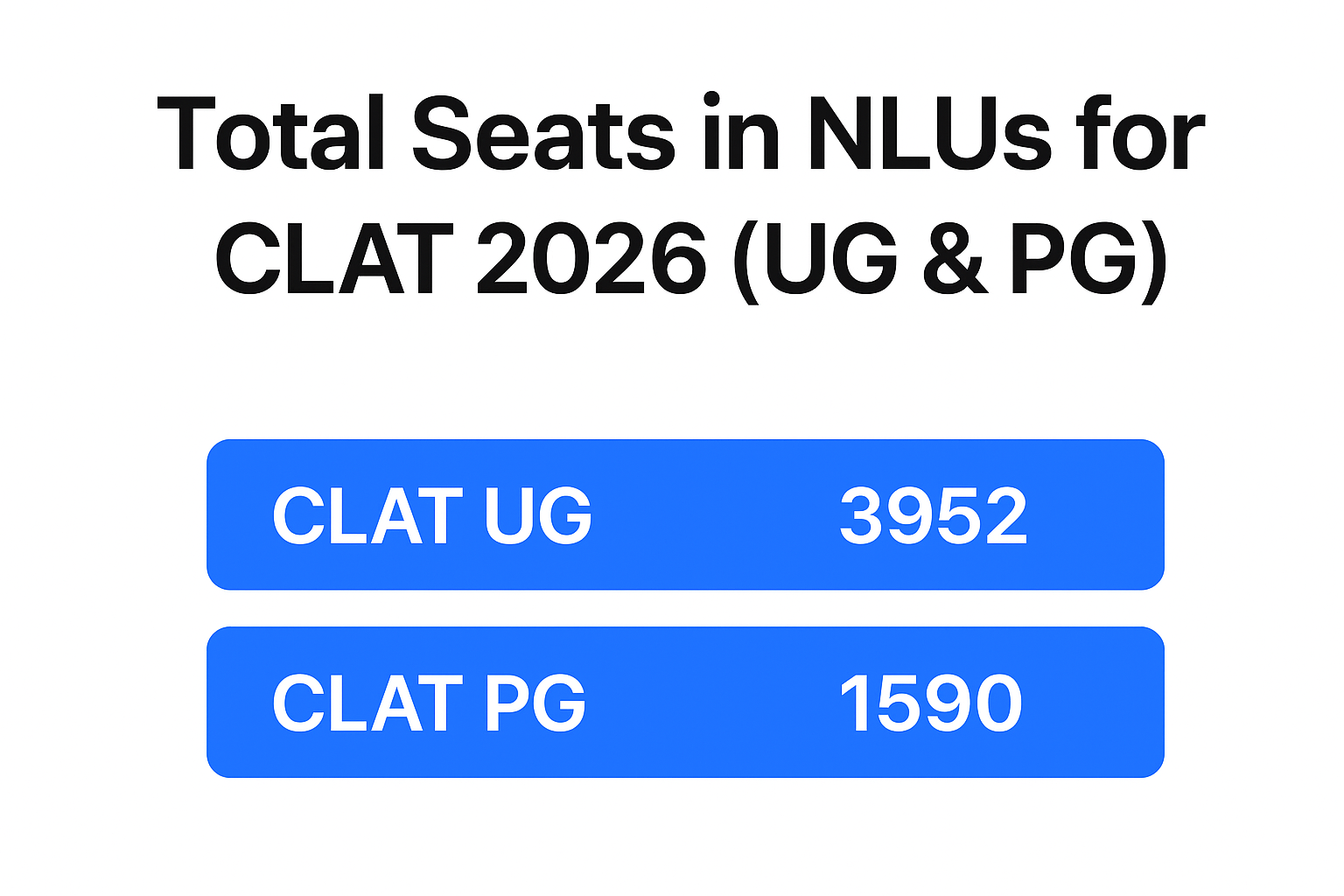
- Seat matrix: all-India, state domicile and special-category seats differ widely. Our breakdown of total seats in NLUs for CLAT 2026 shows how varied they are.
- Reservation policy: each NLU applies its own state and central reservation rules.
- Fees and other conditions: each university sets these, not the Consortium.
CLAT 2028 Result, Rank, Cut-Off and Counselling
Result and scorecard
In recent cycles, the Consortium has released a provisional answer key after the exam, invited objections, published a final key and then declared results with scores and all-India ranks. However, it has not yet announced CLAT 2028 dates for these steps.
CLAT counselling: how it worked in the CLAT 2026 cycle
- Candidates registered separately for counselling, paid a counselling fee and listed their NLU preferences.
- The Consortium allotted seats centrally over five rounds, based on rank, category, preferences and seat availability.
- Candidates who received a seat chose to Freeze (accept it and leave later rounds), Float (hold it while staying in the running for a higher preference) or Exit. The Float option stayed open until the fourth round.
- To hold a seat, candidates had to pay a confirmation fee by the deadline, and then pay the balance university fee to the NLU.
The CLAT 2028 counselling rules may differ, so read that year’s instructions in full. Our CLAT 2026 UG counselling guide explains the last cycle step by step.
About cut-offs
We do not publish “expected” cut-offs for CLAT 2028, because no one can predict them responsibly before the paper, the pattern and the applicant numbers are known. A new structure would make past cut-offs even less comparable. When you look at historical cut-offs, check the year, category, domicile status and counselling round, and treat them as context, not a target. Also remember that no score guarantees admission.
Common Preparation Mistakes to Avoid
- Reading inconsistently: comprehension improves with daily practice, not occasional bursts.
- Learning GK passively: scrolling news without notes or recall tests rarely sticks.
- Skipping mock analysis: the score tells you where you stand, but the analysis tells you what to fix.
- Poor time allocation: spending too long on one passage costs easier marks elsewhere.
- Trusting unverified updates: treat any CLAT 2028 “new pattern” claim as a proposal until it appears on the Consortium’s website.
- Postponing revision: schedule it weekly from the start.
- Waiting for the final pattern before starting: you need the core skills either way.
Why Choose CLAT Possible for CLAT 2028 Preparation?
Whether you study on your own or with us, the steps above are what matter. If you want structure, mentorship and regular feedback, here is what CLAT Possible offers CLAT 2028 aspirants:
- Zephyr for Class 11 (CLAT 2028): a classroom programme for Class 11 students, available both offline and online, with classes on Saturdays and Sundays.
- Roznama, the Daily Mini CLAT (free): analysis of The Hindu, Words of the Day, the top five headlines and an evening test of around 25 to 30 questions based on that day’s newspaper. It takes about 30 minutes a day.
- Mock tests and test series: the Hammer IT test series range includes CLAT, AILET and other law-entrance mocks. We build them with varied question styles, so surprises in the paper are less of a shock. See the courses page for the current editions.
- Mentorship and doubt-solving: personal mentoring in both classroom and online programmes, with doubt-clearing sessions that run periodically.
- Study material: our core teaching team prepares it and updates it regularly, which matters in a cycle where the pattern may change.
- Flexible formats: online, offline, correspondence and crash courses, with centres in Lucknow, Delhi NCR, Noida, Indirapuram, Chandigarh, Kanpur and Raipur. Use the centre locator for the latest list.
To see how our students have done in past cycles, visit our results page.
Start your CLAT 2028 preparation with a plan that works for either pattern.
Explore CLAT Possible Courses
Try Roznama Free
Book a Free Demo
Conclusion: What to Do Right Now
CLAT 2028 is the first attempt for most students who will finish Class 12 in 2028, and it may also be the first CLAT run under a new design. However, you do not need to wait for that decision to start. Build a daily reading habit, strengthen your maths basics, practise applying rules to facts, keep current affairs steady, and start an error log now. Also check the Consortium’s website regularly, and adjust your mocks and GK effort the day the Consortium announces the official pattern.
If you would like a structured path with mentorship and pattern-aligned practice, explore our CLAT 2028 programmes.