close

CLAT 2027 Admit Card: Release Date, Download Link & Instructions

The CLAT admit card 2027 is the one document you can’t walk into the exam hall without. No admit card, no entry, no matter how well you’ve prepared. CLAT 2027 is on Sunday, 6 December 2026, and the Consortium of NLUs is expected to release the hall ticket on its website between 20 and 30 November 2026. In this blog, we’ll tell you when to expect it, how to download it, what to check on it, and exactly what to carry on exam day, in plain and simple steps.

CLAT 2027-2028 Courses by CLAT Possible

What You’ll Find in This Blog

CLAT Admit Card 2027

Before we get into the steps, here’s a quick summary of everything you need to know about the CLAT 2027 admit card. Save this table for later; it has all the key dates in one place.

WhatDetails
ExamCommon Law Admission Test (CLAT) 2027
Conducted byConsortium of National Law Universities
Admit card release dateExpected between 20 and 30 November 2026 (not yet officially announced)
Where to downloadYour CLAT login on consortiumofnlus.ac.in
Mode of admit cardOnline only; no admit card is sent by post
Exam dateSunday, 6 December 2026
Exam time2:00 PM to 4:00 PM (2:00 PM to 4:40 PM for eligible PwD candidates)
Exam modeOffline (pen and paper, OMR-based)

CLAT Admit Card 2027 Release Date

The Consortium has said the CLAT 2027 admit card will be available through your login, and the exact date will be shared on its website. It hasn’t announced that date yet.

Going by recent years, the CLAT hall ticket usually comes out one to two weeks before the exam. For CLAT 2027, that points to between 20 and 30 November 2026. Treat this as an estimate, not an official date, and check the Consortium website and our CLAT 2027 exam instructions every day from 18 November onward.

EventDate
CLAT admit card 2027 releaseExpected between 20 and 30 November 2026
Last day to downloadUsually available until exam day; download early anyway
CLAT 2027 exam6 December 2026, 2:00 PM to 4:00 PM

How to Download the CLAT Admit Card 2027

Only students who completed their CLAT 2027 application can download the admit card. Once it’s out, it takes about two minutes.

  1. Go to the official website. Open consortiumofnlus.ac.in and click on the CLAT 2027 section.
  2. Use the CLAT hall ticket login. Sign in with the registered mobile number and password you used while applying.
  3. Open your dashboard. Look for the admit card link once it has been released.
  4. Check every detail. Before you download, read your name, photo, roll number, date and centre carefully.
  5. Download and save. Save the PDF on your phone and laptop, and email a copy to yourself.
  6. Print it. Take at least two clear printouts on plain A4 paper. Keep one in your exam folder and one as a spare.

Our tip: download it on the first day itself. The website often gets slow as the exam gets closer.

Take Free Demo Class

Details Printed on Your CLAT Hall Ticket

Your CLAT admit card has a lot of important information on it. Check each item the moment you download it.

DetailWhat to check
Your nameSpelling should match your ID proof exactly
Photograph and signatureClear, correct and clearly yours
Roll number and application numberYou’ll need the roll number for your OMR sheet, so note it down
Exam date and time6 December 2026, 2:00 PM to 4:00 PM
Reporting timeThe latest time you can enter the centre; plan to arrive well before it
Exam centre name and addressLook it up on a map and check the travel time
Category and PwD statusShould match what you filled in your application
Exam day instructionsRead them fully, including what you can and can’t bring

Your roll number goes on your OMR sheet on exam day. If you haven’t practised bubbling it yet, our CLAT OMR sheet guide has a free practice sheet you can print.

Check Everything About CLAT OMR Sheet

What to Do If There’s an Error on Your Admit Card

Small errors happen, and they can be fixed if you act quickly. Don’t wait until exam week.

  1. Take a screenshot of the error on your admit card.
  2. Contact the CLAT helpdesk right away by email at clat@consortiumofnlus.ac.in or by phone at 080-47162020 (working days, 10:00 AM to 5:00 PM).
  3. Explain the error clearly and attach proof of the correct detail, such as your ID card or class 10 certificate.
  4. Keep a record of your email and any reference number you receive.
  5. Download the corrected admit card once the Consortium confirms the change.

Can’t Download Your CLAT Admit Card? Try This

Every year, some students struggle to download their hall ticket on the first day. Don’t panic if it happens to you; most problems have a simple fix.

ProblemWhat to do
Forgot your passwordClick “Forgot Password” on the login page, verify with the OTP sent to your registered mobile or email, and set a new one
Website is very slowTry early morning or late at night, when fewer people are online
Page won’t load or PDF won’t openSwitch to Chrome or Firefox, use an incognito window, or clear your browser cache
Admit card link not showingCheck that your application was fully submitted and the fee was paid; if it still doesn’t show, contact the helpdesk

What to Carry to the CLAT Exam Centre

Pack your exam folder the night before, so you’re not searching for anything on Sunday morning.

  • Your printed CLAT admit card 2027. This is a must. A soft copy on your phone won’t be accepted.
  • A valid original photo ID. For example, your Aadhaar card, passport, driving licence or school ID. Carry the original, not a photocopy.
  • The pen mentioned in your admit card. Read the instructions and carry the right one, plus a spare.
  • A transparent water bottle, only if the instructions on your admit card allow it.
  • Any other document the admit card asks for, such as a PwD certificate if it applies to you.

What Not to Carry to the CLAT Exam Centre

  • Mobile phones, smartwatches, earphones or any electronic device
  • Calculators or log tables
  • Books, notes or loose sheets of paper
  • Bags, wallets or anything not allowed by your admit card

If you’re not sure about something, leave it at home. It’s not worth the risk.

CLAT 2027 Exam Day Guidelines

Exam day goes much more smoothly when you know exactly what to do and when. Here’s a simple timeline to follow, from a few days before the exam to the moment you walk out of the hall.

WhenWhat to do
A few days beforeVisit or map your exam centre and check how long it takes to get there
The night beforePack your admit card, photo ID and pens; sleep on time
Exam day morningHave a light meal, skip any new topics, and leave home early
At the centreReach well before the reporting time on your admit card; late entry may not be allowed
In the exam hallSit at your allotted seat, sign the attendance sheet, and follow every instruction from the invigilator
2:00 PM to 4:00 PMWrite the exam; you can’t leave before the exam ends
After the examKeep your admit card, question booklet and OMR candidate copy safe for the answer key and counselling

Still have a couple of weeks before your admit card arrives? Use them well. Check where your latest mock score puts you with our free CLAT rank predictor, and revise GK with our free GK Genius PDF.

Conclusion

Your CLAT admit card 2027 takes only a few minutes to download, but it’s worth giving it proper attention. Download it as soon as it’s out, check every detail, fix errors quickly, and keep two printouts with your photo ID in your exam folder. Then put the paperwork aside and use your last few days for revision and mocks. You’ve done the hard work; now just make sure nothing small gets in the way on 6 December.

CLAT 2027 Current Affairs: Download GK Genius, Top 150 Topics Free PDF

CLAT 2027 current affairs can feel like an ocean with no shore. Nine months of news, hundreds of events, and every coaching note telling you something different. With CLAT on 6 December and AILET on 13 December, you do not need more news now; you need a shortlist. That is exactly why we built GK Genius: one free PDF with the 150 most important current affairs topics from January to September 2026, 168 GK one-liners and a Master Revision Checklist. We have done the shortlisting, so you can do what actually wins marks: revision.

CLAT 2027-2028 Courses by CLAT Possible

What This Guide Cover

What is GK Genius?

GK Genius is a free current affairs revision book by CLAT Possible for CLAT and AILET 2027. It covers the most important national and international events from January to September 2026, with one bonus topic from October. The book is edited by Aditya Wakhlu Sir, Editor in Chief of GK Genius, Vice President of CLAT Possible and AIR 29 in CLAT 2014.

Download GK Genius (Free PDF)

Think of it as a filter. Instead of re-reading every monthly magazine, you get a ranked list of what is most likely to be tested, with the facts laid out one topic per page. In short, it turns “I have to revise everything” into “I have to revise these 318 items.”

What is Inside GK Genius

FeatureWhat you getHow it helps
150 Most Important Topics68 Major and 82 Minor current affairs topics, January to September 2026Covers the events most likely to become CLAT passages
168 GK One-LinersShort, crisp facts on days, awards, sports, appointments and moreQuick wins for AILET’s direct questions and CLAT’s linked facts
Major and Minor tagsEvery topic marked by the depth of study it needsYou know where to go deep and where to skim
Static GK LinksBackground facts tied to each news topic, such as UNCLOS behind the High Seas TreatyPrepares you for the static questions CLAT builds around news
Quick Recall boxesKey facts summarised on every topic pageFast second and third revisions
Master Revision ChecklistMonth-wise list of every topic with three tick boxes eachTracks your first, second and third revision at a glance

Month-Wise Breakdown of CLAT 2027 Current Affairs in GK Genius

Here is how the 318 items in GK Genius are spread across the months. Use this table to plan your revision, since some months are heavier than others.

MonthMajorMinorOne-LinersTotal
January 20266101733
February 20269121839
March 20267131838
April 2026871934
May 20266112340
June 2026482133
July 2026882036
August 20261031629
September 20269101635
Bonus from October1001
Total6882168318

Notice that August and February carry the most Major topics. Therefore, give those months a little extra time in your first pass.

Sample Major Topics You Will Find Inside

Here is a taste of what GK Genius covers. These are just a few of the Major topics; the full list is in the PDF.

MonthSample Major topics
January 2026UN High Seas Treaty comes into force; India-EU Free Trade Agreement; Board of Peace; Republic Day
February 2026Union Budget 2026-27; New Ramsar Sites and World Wetlands Day; AI Impact Summit 2026; Project Cheetah
March 2026Uniform Civil Code; Passive Euthanasia; Naxalism-Free India; National Literary Awards
April 2026131st Amendment Bill; Gaganyaan; Artemis II; INS Aridhaman
May 2026Increase in Supreme Court Judges; Special Intensive Revision (SIR); Press Freedom; El Nino
June 2026World Environment Day; G7 Summit 2026; International Day of Yoga
July 2026FIFA World Cup; River Water Agreements; India Semiconductor; Commonwealth Games
August 202610 Years of UPI; SCO Summit 2026; Monsoon Session of Parliament; Independence Day
September 2026Indus Waters Treaty; BRICS Summit 2026; Election Commission of India; Asian Games

Get the Full List: Download GK Genius

Major, Minor and One-Liners: How to Read the Tags

Not every news item deserves the same attention. GK Genius sorts each topic by how deeply you need to study it, so you spend your time where it counts.

TagDepth of studyHow it may be tested
MajorIn-depth understanding and full revision, using the pointers givenHighly likely to appear as a full CLAT passage set
MinorRevision of key facts and detailsA CLAT set or a standalone AILET question
One-LinerSurface-level revision of core informationLinked to a bigger topic, or a direct AILET question

A small note from experience: these tags are an informed estimate, not a promise. The question paper can always surprise you. So use the tags to set priorities, but do not skip Minor topics or One-Liners completely.

How to Use GK Genius: A 3-Pass Revision Plan for CLAT 2027

Every topic in the Master Revision Checklist has three tick boxes, one for each revision. Here is a simple way to fill all three before exam day. Tick, tick, tick, and then boom, you are exam-ready.

Revision passSuggested datesWhat to do
Pass 1: Deep read11 to 21 NovemberRead every Major topic in full with its Static GK Link; read Minor topics for key facts. About 7 Major topics a day.
Pass 2: Active recall22 to 29 NovemberLook at each topic name, recall the facts aloud, then check the Quick Recall box. Add all 168 One-Liners in this pass.
Pass 3: Rapid review30 November to 5 DecemberSkim Quick Recall boxes and One-Liners only. Focus on topics you could not recall in Pass 2.
AILET top-up7 to 12 DecemberRevise One-Liners and Minor topics again, since AILET asks more direct, standalone GK questions.

For the best results, use GK Genius alongside CLAT Possible’s GK Perfect Magazine. GK Genius tells you what to revise; the magazine gives you deeper coverage when a topic needs it.

Why GK Genius Works for CLAT and AILET

After six years of building GK material for law entrance aspirants, one pattern stands out: students rarely lose GK marks because they never read a topic. They lose marks because they read it once, months ago, and never revised it. GK Genius is designed to fix exactly that problem.

  • It is shortlisted. Instead of 1,000 news items, you get 318 ranked ones, so your revision has an end point.
  • It is CLAT-shaped. CLAT builds passages around news and then asks static questions. The Static GK Links prepare you for that second step.
  • It is AILET-ready. The One-Liners suit AILET’s shorter, direct questions.
  • It is trackable. The checklist shows your progress at a glance, which also keeps exam anxiety in check.
  • It is one topic per page. No hunting through magazines; every topic has its own page.

Military exercises and defence equipment are deliberately left out, so your time goes to topics with a better chance of being tested.

Take Free Demo Class

Conclusion

CLAT 2027 current affairs do not have to be a gamble. With GK Genius, you know exactly what to revise, how deeply to revise it, and how far along you are. So download the PDF, print the checklist, and start ticking. Be a GK Genius, not a GK guesser. All the best!

CLAT Official Mock Paper 2027 Released: Download PDF and Analysis

The CLAT official sample paper for 2027 is finally out. The Consortium of National Law Universities has released two official sample papers for CLAT 2027 UG, and with the exam scheduled for 6 December 2026, these papers are the closest look you will get at the Consortium’s own question-setting before exam day. In this blog, you can download both papers and read the CLAT Possible faculty’s section-wise analysis. More importantly, you will learn how to use these papers in your final weeks without reading too much into them.

CLAT 2027 Courses by CLAT Possible

What This CLAT Official Sample Paper Guide Covers

Watch: CLAT Official Sample Paper 2027 Analysis

Download GK Genius (Free PDF)

CLAT 2027 Official Paper Highlights

The CLAT official sample paper follows the same structure as the actual exam. Here is a quick overview of what the Consortium has released and how the paper is built.

ParticularDetails
Released byConsortium of National Law Universities
Number of official mocks2 (CLAT 2027 UG)
Official websiteconsortiumofnlus.ac.in
Total questions120 multiple-choice questions
Total passages24 passages across 5 sections
Marking scheme+1 for each correct answer, −0.25 for each wrong answer
Overall difficultyEasy
CLAT 2027 exam dateSunday, 6 December 2026, 2:00 PM to 4:00 PM

Download CLAT Official Mock Papers 2027 PDF

Both CLAT official sample papers are available below. Download them, print them, and solve each one in a single 2-hour sitting, the same way you will sit the real exam.

PaperReleased byDownload
CLAT 2027 UG Mock 1Consortium of NLUsDownload PDF
CLAT 2027 UG Mock 2 (TBD)Consortium of NLUsDownload PDF

Download CLAT 2027 UG Mock 1

CLAT 2027 Official Mock 1 Analysis

Our faculty solved the CLAT official sample paper section by section. The verdict is clear: the paper is easy. Some passages are taken directly from old CLAT papers, while the new passages are of a very easy level.

Therefore, the most important takeaway is this: do not assume the actual CLAT 2027 paper will be of the same standard or pattern. Treat the sample paper as a format check, not as a difficulty benchmark.

SectionPassagesQuestionsDifficulty level
English Language525Easy to Moderate
Current Affairs including GK630Very Easy
Legal Reasoning630Easy
Logical Reasoning525Easy to Moderate
Quantitative Techniques210Easy
Total24120Easy overall

Section-Wise Analysis of the CLAT Official Paper

1. English Language: Easy to Moderate

The English section has 5 passages and 25 questions. The passages are of a reasonable length and difficulty, so a regular reader should finish them comfortably. Most questions refer directly to the passage. In addition, the section tests word meaning, the author’s tone and figures of speech.

2. Current Affairs including GK: Very Easy

This is the easiest section in the CLAT official sample paper, with 6 passages and 30 questions. In fact, many questions can be answered directly from the passage itself. The topics covered are:

  • ISRO
  • Presidential Election of India
  • Wetlands
  • Election Commission
  • UPI
  • Constitution

However, do not expect the actual exam’s GK section to be this generous. In recent CLAT papers, many GK questions have needed knowledge beyond the passage.

3. Legal Reasoning: Easy

Legal Reasoning has 6 passages and 30 questions. The passages and principles are very short. Also, there are no current legal topics; every passage is based on static law. The topics covered are:

  • Writs
  • Negligence
  • Offer, acceptance and revocation
  • Defamation
  • Consumer law
  • Right of private defence

In the actual exam, expect longer passages and topics drawn from recent judgments and new laws, so keep reading legal news alongside your practice.

4. Logical Reasoning: Easy to Moderate

The Logical Reasoning section has 5 passages and 25 questions. All of them are critical reasoning questions, and there are no analytical reasoning questions such as puzzles or arrangements. Even so, do not drop analytical reasoning from your practice, since it has appeared in past CLAT papers.

5. Quantitative Techniques: Easy

Quant has 2 short passage sets with 10 questions. Every question is based on ratio and percentage. Therefore, this section should be a quick scoring zone, but still revise averages, profit and loss and data interpretation for the actual exam.

Take Free Demo Class

Key Takeaways: What the CLAT Official Sample Paper Does and Does Not Tell You

What it confirmsWhat it does not confirm
The paper still has 120 passage-based questions across five sectionsThe difficulty level of the actual CLAT 2027 paper
How the Consortium frames questions and optionsThe length of passages in the actual exam
The section order and the number of questions per passageWhether analytical reasoning or current legal topics will be left out
Static law and core GK topics still matterHow much GK can be answered from the passage alone

In short, if you score very high on the sample paper, take it as a confidence boost, not as a predicted score. Your recent full-length mocks are still the better guide to where you stand.

How to Use the CLAT Official Sample Paper Before 6 December

With less than four weeks left for CLAT 2027, use both official papers wisely rather than casually.

  1. Solve each paper in one timed sitting. Use a 2-hour slot, ideally from 2:00 PM to 4:00 PM, to match the real exam timing.
  2. Fill a printed OMR sheet. CLAT is a pen-and-paper exam, so practise bubbling answers within the 2 hours.
  3. Analyse the paper the same day. Note whether each mistake came from a concept gap, a misread question or time pressure.
  4. Study the question style, not the difficulty. Focus on how the Consortium words its questions and builds its wrong options.
  5. Go back to tougher practice. After the sample papers, return to previous year papers and full-length mocks to stay ready for a harder actual paper.

CLAT Official Sample Paper vs Previous Year Papers vs Mocks

Practice materialBest used forLimitation
Official sample paperUnderstanding the Consortium’s format and question styleEasier than the actual exam; only two papers
Previous year papersJudging the real difficulty level and recurring topicsCurrent affairs in older papers are outdated
Full-length mocksBuilding speed, stamina and section-order strategyQuality varies, so choose a CLAT-focused series

For the best results, combine all three: the official sample papers for format, previous year papers for difficulty, and mocks for exam-day readiness.

Mistakes to Avoid While Solving the CLAT Official Sample Paper

1. Treating the Score as a Prediction

The sample paper is easy, so a high score here does not guarantee the same score in the actual exam.

2. Skipping Analytical Reasoning and Legal Current Affairs

These were missing from the sample paper. However, both have appeared in past CLAT papers, so keep practising them.

3. Solving Without a Timer

An untimed attempt hides your real speed. Always solve the full paper in 2 hours.

4. Ignoring Negative Marking

Even on an easy paper, every wrong answer costs 0.25 marks. Therefore, attempt a question only when you can eliminate at least two options.

5. Reading Too Much into the Topic List

The topics in this paper will not necessarily repeat in the actual exam. Instead, revise the full static law and current affairs syllabus.

How CLAT Possible Helps You in the Final Weeks

At CLAT Possible, our final-phase preparation is built to close the gap between an easy sample paper and a demanding actual exam:

  • Full-length mocks set at the real CLAT difficulty level, with detailed analysis.
  • Current affairs revision covering the legal and national news most likely to appear.
  • Mentorship and doubt support for last-minute questions in Legal and Logical Reasoning.
  • Exam strategy sessions on section order, time targets and smart attempts.

Conclusion

The CLAT official sample paper 2027 is a useful final-month resource, but mainly as a format check. It confirms the 120-question, five-section structure and shows how the Consortium frames its questions. However, its easy level should not set your expectations for 6 December. Solve both papers, analyse them honestly, and then return to tougher practice so that the actual exam feels familiar, not surprising.

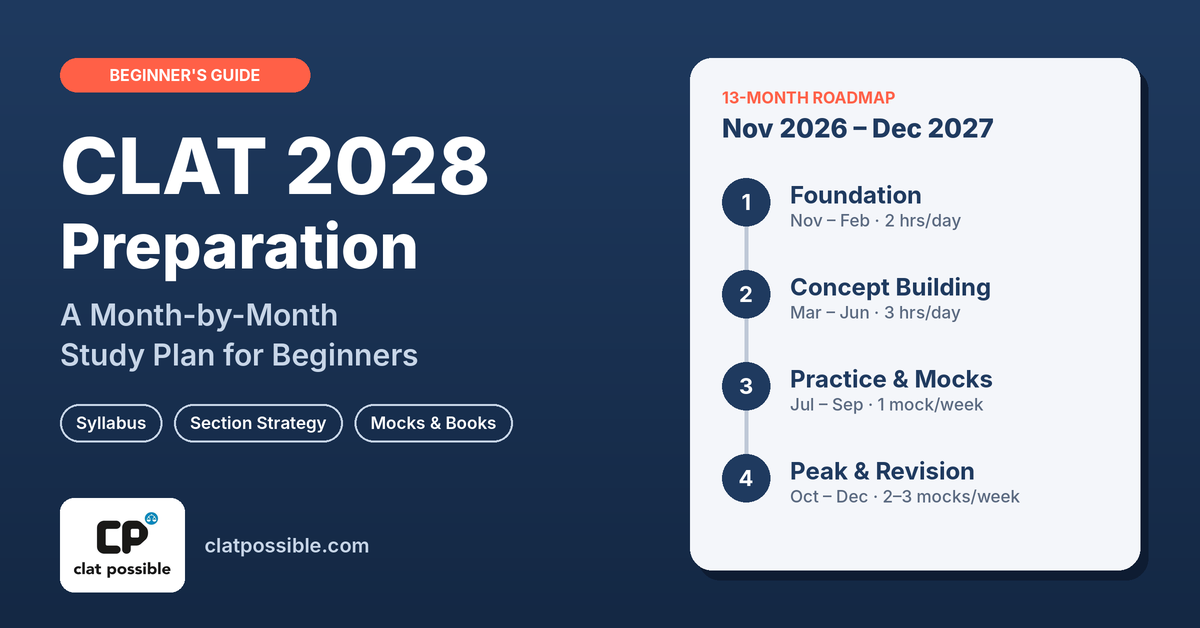
CLAT 2028 Preparation: A Month-by-Month Study Plan for Beginners

If you are in Class 11 today, you have roughly 13 months until CLAT 2028, which is expected in the first week of December 2027. That is enough time to go from complete beginner to confident test-taker, but only if those months are planned. At CLAT Possible, the students we see struggle are rarely the less talented ones. Instead, they are the ones who started without a plan, studied in bursts, and took their first mock six weeks before the exam. This guide gives you a complete CLAT 2028 study plan, from your first week to exam day.

CLAT Possible 2028 Courses

What This CLAT 2028 Preparation Guide Covers

Why CLAT 2028 Preparation Should Start Now

CLAT rewards reading stamina, reasoning habits and current affairs memory. However, all three build slowly, which is why an early start matters more in CLAT than in most entrance exams. Starting in Class 11 also means you prepare without board-exam pressure for the first few months.

You do not need to study 8 hours a day in Class 11. Instead, you need 2 to 3 focused hours, every day, for 13 months. In short, consistency beats intensity in CLAT.

CLAT 2028 at a Glance

CLAT 2028 will be the Common Law Admission Test for the 2028–29 academic year. The official date is not out yet. For reference, the Consortium has scheduled CLAT 2027 for Sunday, 6 December 2026, from 2:00 PM to 4:00 PM, and has kept the pattern unchanged. Therefore, CLAT 2028 is most likely on the first Sunday of December 2027.

Key HighlightCLAT 2028 (expected)
Conducting bodyConsortium of National Law Universities
Expected exam dateFirst week of December 2027 (tentative)
Expected registrationJuly to October 2027
ModeOffline, pen and paper
Total questions, marks, duration120 questions, 120 marks, 2 hours
Negative marking0.25 marks for every wrong answer
EligibilityClass 12 pass or appearing; 45% (40% for SC/ST); no upper age limit

Dates and pattern for CLAT 2028 are projections based on recent cycles. Always confirm on consortiumofnlus.ac.in once the notification is released.

CLAT 2028 Syllabus and Exam Pattern

The CLAT 2028 syllabus has five sections, and every question is built on a passage. In other words, there is no rote syllabus to memorise; CLAT tests how well you read, reason and apply. The breakdown below follows the current pattern confirmed for CLAT 2027.

SectionQuestionsWeightageWhat it actually tests
English Language22 to 2620%Comprehension, inference, tone, vocabulary in context
Current Affairs including GK28 to 3225%News events, legal and constitutional developments, static GK linked to news
Legal Reasoning28 to 3225%Applying a stated principle to facts; no prior law knowledge needed
Logical Reasoning22 to 2620%Arguments, assumptions, conclusions, strengthen/weaken, puzzles
Quantitative Techniques10 to 1410%Class 10 maths: percentages, ratios, averages, data interpretation
Total120100%+1 for each correct answer, −0.25 for each wrong answer

Three things beginners should notice:

  • Half the paper is GK and Legal. Current Affairs and Legal Reasoning together make up about 50% of your score, so your daily routine must protect time for both.
  • Reading is the hidden sixth section. You will read 25-plus long passages in two hours. Therefore, reading speed with comprehension decides whether you finish the paper.
  • Negative marking punishes guesswork. A wrong answer costs 0.25 marks, so four blind guesses gone wrong wipe out one correct answer.

How to Start CLAT Preparation: Your First 7 Days

Most beginners lose their first month deciding which book to buy. Skip that. Here is how to start CLAT preparation in one week.

DayTaskWhy it matters
Day 1Read the pattern and download the official sample paperYou know exactly what you are preparing for
Day 2Attempt one previous-year CLAT paper untimedYour weak spots matter more than your score
Day 3Read The Hindu or The Indian Express for 30 minutes; note three news itemsStarts your GK notebook and reading habit
Day 4Solve one legal reasoning passage; underline the principle firstThis is the core skill of the section
Day 5Revise percentages and ratios from NCERT Class 8 to 10Quant is built entirely on these basics
Day 6Fix a 2 to 3 hour daily slot around schoolA protected slot is what makes the plan work
Day 7Review the week and list what felt hardestThat list becomes your focus for Month 1

By the end of the week, you will know where you stand and have a routine in place. In fact, that is more than most aspirants have after a month.

CLAT 2028 Study Plan: Month-by-Month Roadmap (November 2026 to December 2027)

This CLAT 2028 study plan runs 13 months in four phases. It assumes you are in Class 11 now and works around school exams, which is where most plans break.

Phase 1: Foundation (November 2026 to February 2027)

Goal: Build reading, news and reasoning habits. No mocks yet. Daily time: 2 hours.

MonthFocusWhat to do
Month 1: November 2026Set the routineNewspaper daily (30 minutes) with 3 to 5 GK notes; 1 English passage a day; NCERT revision of percentages, ratios and averages
Month 2: December 2026Meet legal reasoning1 legal passage a day (principle, facts, application); logical reasoning basics; attempt the CLAT 2027 paper once released and compare with your Day 2 baseline
Month 3: January 2027Widen the baseStatic GK linked to news; recurring legal concepts (contracts, torts, criminal law, constitutional rights); profit and loss, interest, time and work
Month 4: February 2027Protect your school examsClass 11 finals come first; drop to 45 to 60 minutes a day of newspaper plus 1 passage, but do not stop completely

Phase 2: Concept Building (March to June 2027)

Goal: Cover every topic once and start timed sectional practice. Daily time: 3 hours; 5 to 6 hours in summer break.

MonthFocusWhat to do
Month 5: March 2027Restart with sectionalsOne timed sectional test a week; 2 English passages a day with inference and tone questions
Month 6: April 2027Class 12 beginsCritical reasoning (strengthen/weaken, assumptions) plus a few puzzles for speed; data interpretation from tables and graphs
Months 7 and 8: May and June 2027Summer intensive5 to 6 hours a day; solve all previous-year papers since 2020 section by section; first full-length mock at the end of May, then one every two weeks; compile 8 to 9 months of current affairs into one revision file

Phase 3: Practice and Mocks (July to September 2027)

Goal: Shift from learning to performing. Daily time: 3 hours on school days.

MonthFocusWhat to do
Month 9: July 2027Weekly mocks1 full mock a week with analysis as long as the mock itself; start an error log; watch for the CLAT 2028 notification
Month 10: August 2027Fix weak sectionsGive your two weakest sections an extra 45 minutes daily; register for CLAT 2028 early
Month 11: September 2027Build exam strategyTest section orders in mocks and settle on one; set and track time targets per section

Phase 4: Peak and Revision (October to December 2027)

Goal: Peak on exam day, not before it. Daily time: 4 hours.

MonthFocusWhat to do
Month 12: October 2027Two mocks a week2 full mocks weekly plus analysis; revise 12 months of GK, especially legal and constitutional news
Month 13: November 2027Revise and simulate2 to 3 mocks a week at 2:00 PM to train your body clock; re-read your error log weekly; no new books; download the admit card
Exam week: early December 2027Stay freshLight revision of GK notes and the error log only; sleep 7 to 8 hours; walk in rested, not crammed

CLAT 2028 Study Plan: Phase-Wise Summary

PhaseMonthsHours per dayMocks
FoundationNovember 2026 to February 20272None; baseline paper only
Concept BuildingMarch to June 20273 (5 to 6 in summer)First mock in May, then every 2 weeks
Practice and MocksJuly to September 202731 per week
Peak and RevisionOctober to December 202742 to 3 per week

Section-Wise CLAT Preparation Strategy for Beginners

A good CLAT preparation strategy for beginners gives each section a method, not just hours. Here is how our CLAT Possible mentors split the work.

1. Legal Reasoning (28 to 32 Questions)

Treat the passage as the only law that exists, because answers based on outside legal knowledge are the most common trap. Also, use a three-step read: principle, facts, application, and underline the principle before you look at the options. From Phase 2 onward, practise 2 passages a day, and follow legal news, since passages are often built on recent judgments and new laws.

2. Current Affairs including GK (28 to 32 Questions)

Read for context, not trivia: know why an event matters, who is involved and what changed. Keep one GK notebook organised by theme, such as polity, economy, international affairs, environment and legal developments. Above all, revise monthly, since news from 12 to 15 months before the exam can appear.

3. English Language (22 to 26 Questions)

Read 2 editorials a day and summarise each in two lines, which trains main-idea questions. In addition, learn vocabulary from context rather than word lists. By Phase 3, aim to finish a passage in under 6 minutes.

4. Logical Reasoning (22 to 26 Questions)

Focus on argument questions: assumptions, conclusions, strengthen/weaken and flaws. However, do not ignore puzzle-style sets, because the question style can shift from year to year. After each passage, explain in one sentence why the wrong options are wrong.

5. Quantitative Techniques (10 to 14 Questions)

Stick to Class 10 maths and data interpretation, and do not over-invest given the 10% weight. Instead, learn quick calculation tricks such as percentage-fraction equivalents and squares up to 30. Finally, aim for accuracy: eight correct out of eight beats ten attempted with three wrong.

Suggested Time Split for Beginners

SectionShare of study time
Legal Reasoning30%
Current Affairs and GK25%
English Language20%
Logical Reasoning15%
Quantitative Techniques10%

Mock Tests, Revision and Best Books for CLAT 2028

How Many Mocks Should You Take?

Plan for 40 to 50 full-length mocks between May and November 2027. However, the number matters less than the analysis. After every mock, sort your mistakes into three types (concept gap, misread passage, time pressure), re-attempt wrong questions without looking at the answer, and note one change for the next mock.

A Simple Revision Cycle

  • Daily: 15 minutes revising that day’s GK notes.
  • Weekly: A Sunday review of the week’s GK, error log and vocabulary.
  • Monthly: A full revision of the month’s current affairs compilation.

Recommended Books and Resources

SectionRecommended resource
English LanguageThe Hindu or The Indian Express editorials; Word Power Made Easy by Norman Lewis
Current Affairs and GKDaily newspaper; a monthly CLAT current affairs compilation; Lucent’s General Knowledge for static GK
Legal ReasoningPrevious-year CLAT papers (2020 onward); Legal Aptitude for CLAT by A.P. Bhardwaj
Logical ReasoningPrevious-year CLAT papers; R.S. Aggarwal’s A Modern Approach to Verbal and Non-Verbal Reasoning for basics
Quantitative TechniquesNCERT Class 8 to 10 Maths; CLAT-style data interpretation sets
Full-length mocksCLAT Possible mock test series and the official Consortium sample papers

Pick one book per section and finish it twice. After all, five half-read books help no one.

7 Mistakes Beginners Make in CLAT 2028 Preparation

1. Waiting for Class 12 to Start

The 13 months you have now are your biggest advantage. Reading speed and GK memory cannot be rushed later.

2. Collecting Books Instead of Solving Passages

CLAT is a practice exam. Therefore, previous-year papers teach more than any new guide.

3. Skipping Current Affairs for a Month

Missed months are hard to rebuild and can cost you several questions in the GK section.

4. Using Outside Legal Knowledge

In Legal Reasoning, the passage overrides what you know. In short, answer only from the principle given.

5. Taking Mocks Without Analysis

A mock without review is just a timed test. In fact, the analysis is where the score grows.

6. Guessing Blindly

With 0.25 marks lost per wrong answer, attempt a question only when you can eliminate at least two options.

7. Ignoring School

Boards matter for eligibility and for your stamina. Therefore, plan around exams; do not fight them.

How CLAT Possible Helps You Crack CLAT 2028

A plan works best with someone checking that you follow it. At CLAT Possible, our CLAT 2028 programmes are built around the same phases in this guide:

  • Foundation-first teaching for Class 11 students, starting from reading and reasoning basics.
  • Mentorship and doubt support so you never stay stuck on a legal or logical concept.
  • Current affairs material designed for CLAT’s issue-based questions.
  • Mock tests with detailed analysis to track your progress month by month.

Har Ghar Diwali Discount

Conclusion

Your CLAT 2028 preparation starts with the next hour you put in. Therefore, open today’s newspaper, solve one legal passage, and let this month-by-month plan carry you to December 2027. Overall, whether you are just starting out or already a few weeks in, the right plan and the right guidance make every step clearer.

Take Free Demo Class

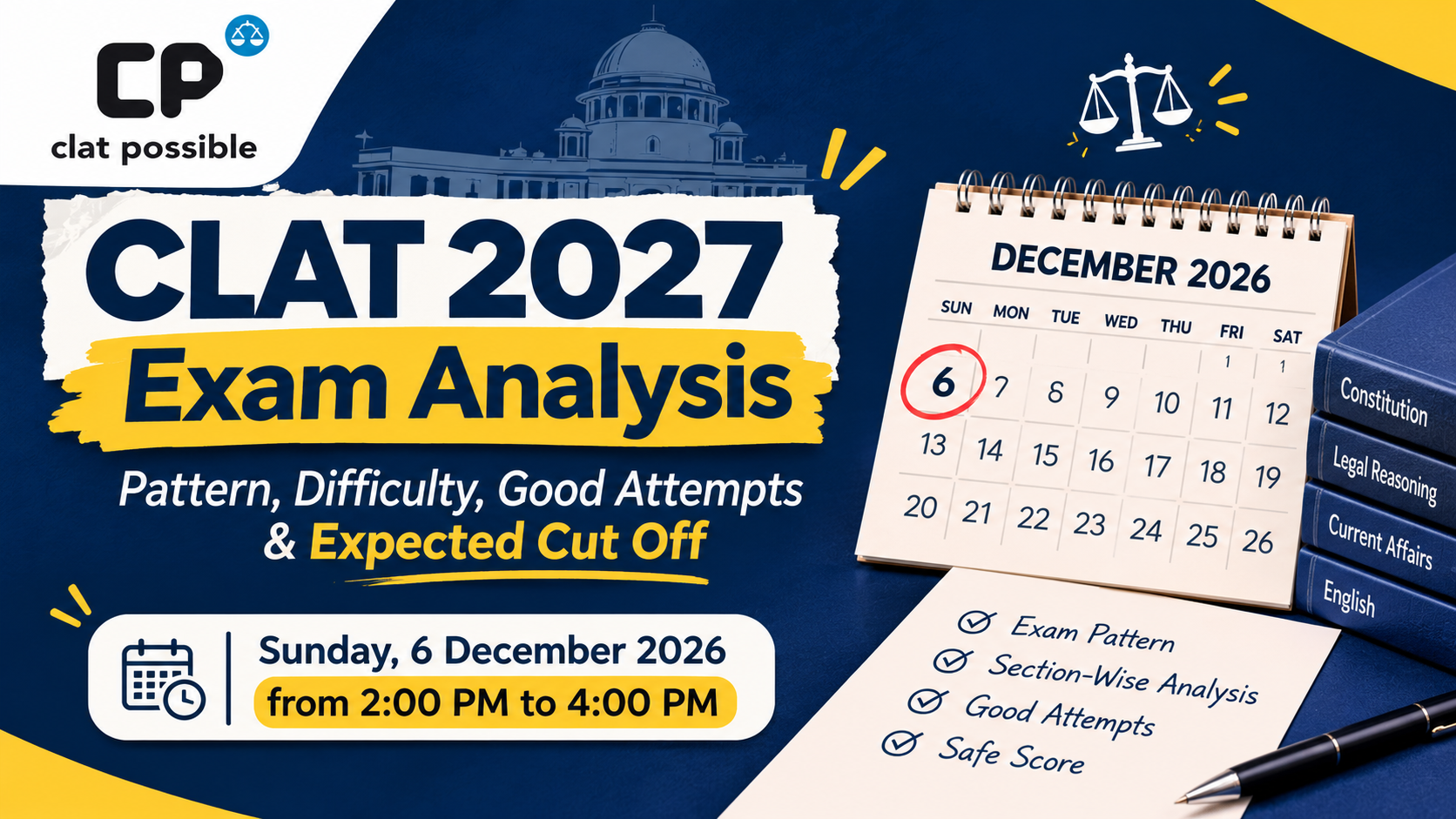
CLAT 2027 Exam Analysis: Overall Difficulty Level, Expected Cut-Off & Student Reviews

CLAT 2027 is scheduled for Sunday, 6 December 2026, from 2:00 PM to 4:00 PM. This page is for every aspirant who wants a clear breakdown of how the paper actually went, so we have kept it simple. Until the exam, it gives you the official pattern, what each section is likely to test, how to judge a “good attempt” with negative marking, and what CLAT 2026 taught us. After the exam, however, our CLATpossible faculty will update every table with the real section-wise difficulty, good attempts and safe scores.

Take Free Demo Class

What This CLAT 2027 Exam Analysis Covers

CLAT 2027 Exam Analysis at a Glance

Key HighlightDetails
Exam date and time6 December 2026, 2:00 PM to 4:00 PM
Conducting bodyConsortium of National Law Universities
Total questions, marks, duration120 questions, 120 marks, 2 hours
Negative marking0.25 marks for every wrong answer
Overall difficultyTo be updated [UPDATE AFTER EXAM]
Good attempts (overall)To be updated [UPDATE AFTER EXAM]
Safe score rangeTo be updated [UPDATE AFTER EXAM]
Toughest sectionTo be updated [UPDATE AFTER EXAM]
Most scoring sectionTo be updated [UPDATE AFTER EXAM]

CLAT 2027 Exam Pattern and Marking Scheme

The Consortium announced no change in the CLAT 2027 syllabus or exam pattern, so the structure below is what you will face on 6 December. Also, every section is passage-based.

SectionQuestions (official range)Core skill
English Language22 to 26Comprehension, inference, tone, vocabulary in context
Current Affairs including GK28 to 32Awareness of current events, policy, international affairs, static GK
Legal Reasoning28 to 32Applying legal principles to facts, legal awareness
Logical Reasoning28 to 32Critical reasoning and analytical reasoning
Quantitative Techniques10 to 14Basic arithmetic and data interpretation from short sets
Total120+1 for each correct answer, −0.25 for each wrong answer

Section-Wise CLAT 2027 Exam Analysis

For each section, the middle column shows what we expect going in, based on the official pattern and recent trends. Meanwhile, the last column is the actual CLAT 2027 verdict, which our faculty fill in after the paper.

English Language: Detailed CLAT 2027 Analysis

ParameterPre-exam expectationCLAT 2027 actual
Overall difficulty levelEasy to moderate, in line with recent years[UPDATE AFTER EXAM]
Nature of questionsContextual and inference-based, with vocabulary tested in context[UPDATE AFTER EXAM]
Type of passagesNarrative, literary and thematic writing alongside non-fiction[UPDATE AFTER EXAM]
Total questions22 to 26[UPDATE AFTER EXAM]
Passage lengthMedium[UPDATE AFTER EXAM]
Dominant skill testedTone, theme and inference[UPDATE AFTER EXAM]
Standalone grammar questionsUnlikely[UPDATE AFTER EXAM]
Time-consuming?Manageable for decent reading speed[UPDATE AFTER EXAM]
Surprise elementsNone expected[UPDATE AFTER EXAM]
Ideal attempt rangeTo be set by paper difficulty[UPDATE AFTER EXAM]
Expected safe scoreTo be set by paper difficulty[UPDATE AFTER EXAM]
CLATpossible verdictA confidence-builder for steady readers[UPDATE AFTER EXAM]

Current Affairs and General Knowledge: Detailed CLAT 2027 Analysis

ParameterPre-exam expectationCLAT 2027 actual
Overall difficulty levelEasy to moderate, though GK is the least predictable section[UPDATE AFTER EXAM]
Nature of questionsPassage-based, driven by current affairs[UPDATE AFTER EXAM]
Month and year range of current affairsRoughly the 12 months before the exam[UPDATE AFTER EXAM]
Dominant areasInternational affairs, economy, government policy, legal developments[UPDATE AFTER EXAM]
Static GK vs current affairsHeavily current-affairs driven[UPDATE AFTER EXAM]
Total questions28 to 32[UPDATE AFTER EXAM]
Time-consuming?Usually quick if you know the topic[UPDATE AFTER EXAM]
Surprise elementsPossible one or two unexpected topics[UPDATE AFTER EXAM]
Ideal attempt rangeTo be set by paper difficulty[UPDATE AFTER EXAM]
Expected safe scoreTo be set by paper difficulty[UPDATE AFTER EXAM]
CLATpossible verdictRewards regular revision, not last-week cramming[UPDATE AFTER EXAM]

Legal Reasoning: Detailed CLAT 2027 Analysis

ParameterPre-exam expectationCLAT 2027 actual
Overall difficulty levelEasy to moderate[UPDATE AFTER EXAM]
Nature of questionsPrinciple-and-facts questions plus some legal-awareness questions[UPDATE AFTER EXAM]
Type of passagesConstitutional issues, landmark cases, governance and social-legal topics[UPDATE AFTER EXAM]
Total questions28 to 32[UPDATE AFTER EXAM]
Prior legal knowledge needed?Helpful but not essential[UPDATE AFTER EXAM]
Dominant skill testedApplying a stated principle to a fact situation[UPDATE AFTER EXAM]
Time-consuming?Passages can be long; reading speed matters[UPDATE AFTER EXAM]
Surprise elementsPossible direct questions on recent legal developments[UPDATE AFTER EXAM]
Ideal attempt rangeTo be set by paper difficulty[UPDATE AFTER EXAM]
Expected safe scoreTo be set by paper difficulty[UPDATE AFTER EXAM]
CLATpossible verdictScoring for consistent practisers[UPDATE AFTER EXAM]

Logical Reasoning: Detailed CLAT 2027 Analysis

ParameterPre-exam expectationCLAT 2027 actual
Overall difficulty levelModerate; historically the biggest differentiator[UPDATE AFTER EXAM]
Critical vs analytical reasoning mixEither could dominate; prepare for both[UPDATE AFTER EXAM]
Main question typesInference, assumption, strengthen/weaken, puzzles, arrangements, relations, coding-decoding[UPDATE AFTER EXAM]
Total questions28 to 32[UPDATE AFTER EXAM]
Dominant skill testedMulti-step logic and handling several rules at once[UPDATE AFTER EXAM]
Trap questionsPossible; careful reading beats speed[UPDATE AFTER EXAM]
Time-consuming?Likely the section that eats the most time[UPDATE AFTER EXAM]
Surprise elementsA shift in question style from last year is possible[UPDATE AFTER EXAM]
Ideal attempt rangeTo be set by paper difficulty[UPDATE AFTER EXAM]
Expected safe scoreTo be set by paper difficulty[UPDATE AFTER EXAM]
CLATpossible verdictLikely to decide the cut-off band[UPDATE AFTER EXAM]

Quantitative Techniques: Detailed CLAT 2027 Analysis

ParameterPre-exam expectationCLAT 2027 actual
Overall difficulty levelEasy to moderate, calculation-driven[UPDATE AFTER EXAM]
Nature of questionsShort caselets and data sets built on class 10 maths[UPDATE AFTER EXAM]
Dominant topicsPercentages, ratios, averages, profit and loss, data interpretation[UPDATE AFTER EXAM]
Total questions10 to 14[UPDATE AFTER EXAM]
Calculation intensityModerate[UPDATE AFTER EXAM]
Approximation useful?Yes, to save time[UPDATE AFTER EXAM]
Time-consuming?Can be, if you chase every question[UPDATE AFTER EXAM]
Surprise elementsPossible odd question or lengthy data set[UPDATE AFTER EXAM]
Ideal attempt rangeTo be set by paper difficulty[UPDATE AFTER EXAM]
Expected safe scoreTo be set by paper difficulty[UPDATE AFTER EXAM]
CLATpossible verdictShort section, high return for solid arithmetic[UPDATE AFTER EXAM]

Section-Wise Good Attempts and Difficulty: CLAT 2027 Summary

SectionGood attemptsDifficulty level
English Language[UPDATE AFTER EXAM][UPDATE AFTER EXAM]
Current Affairs including GK[UPDATE AFTER EXAM][UPDATE AFTER EXAM]
Legal Reasoning[UPDATE AFTER EXAM][UPDATE AFTER EXAM]
Logical Reasoning[UPDATE AFTER EXAM][UPDATE AFTER EXAM]
Quantitative Techniques[UPDATE AFTER EXAM][UPDATE AFTER EXAM]
Total[UPDATE AFTER EXAM][UPDATE AFTER EXAM]

Good Attempts in CLAT: How to Read Them with Negative Marking

A “good attempt” number means nothing without accuracy, because your score is the number of correct answers minus 0.25 for each wrong one. Therefore, here is what different attempt-and-accuracy combinations are worth, using that formula.

AttemptsAccuracyCorrectWrongScore
9095%85.54.584.4
10090%901087.5
10590%94.510.591.9
11085%93.516.589.4
11092%101.28.899.0
11580%922386.3

Notice the last two rows from the top. For example, a student who attempts 115 questions at 80% accuracy scores less than one who attempts 110 at 92%. In short, extra attempts only help when accuracy holds, although the figures are rounded to one decimal place.

A Simple Time Plan for the 120-Minute Paper

SectionSuggested timeWhy
Current Affairs and GK15 to 18 minutesQuick if you know it; do not linger on unknown topics
English Language20 to 22 minutesRead actively; avoid re-reading whole passages
Legal Reasoning25 to 28 minutesLong passages, so reading speed pays
Logical Reasoning30 to 32 minutesThe section most likely to run over; cap each set
Quantitative Techniques12 to 15 minutesPick the easy sets first
Review3 to 5 minutesCheck marked questions only

This is a starting framework, not a rule. Therefore, test it in your mocks and adjust to your own strengths.

CLAT 2026 Exam Analysis: What the Last Paper Told Us

CLAT 2026 was held on 7 December 2025. Education portals broadly agreed on the paper’s overall feel: moderate in difficulty, with Logical Reasoning reported as the trickiest section and Current Affairs and GK as one of the more scoring ones. Meanwhile, Legal Reasoning leaned on constitutional topics and landmark judgments, while English tested comprehension, tone and vocabulary. Finally, Quantitative Techniques centred on data interpretation and basic arithmetic.

The good-attempt ranges below are approximate figures drawn from post-exam analyses of CLAT 2026. However, institutes report slightly different numbers because attempts depend on each student’s strategy and accuracy, so treat these as a guide, not a rule. For CLAT 2027, our faculty will also publish ranges based on our own students’ papers.

CLAT 2026 Section-Wise Snapshot

SectionDifficultyWhat stood outGood attempts (CLAT 2026)
English LanguageEasy to moderateComprehension, inference, tone and theme, with vocabulary woven in18 to 21
Current Affairs and GKEasy to moderateIndia-centric and international current affairs, treaties, sports22 to 25
Legal ReasoningEasy to moderateConstitutional provisions, amendments, landmark cases20 to 23
Logical ReasoningModerate to difficultPuzzle-style sets, family relations, coding-decoding, timelines16 to 19
Quantitative TechniquesEasy to moderate, calculation-heavyData interpretation, ratios and percentages; calculation load mattered8 to 11
Overall (sum of section ranges)Moderate, with a tough Logical Reasoning sectionFour sections felt manageable; Logical Reasoning slowed many students84 to 99

Year-Wise Difficulty Trend

ExamOverall difficulty (as widely reported)
CLAT 2024Easy to moderate
CLAT 2025Easy to moderate; many analyses called it easy
CLAT 2026Moderate, with a tough Logical Reasoning section

CLAT 2027 Student Reactions

[UPDATE AFTER EXAM: add 3 to 5 short, real reactions from CLATpossible students, with their permission, plus a line on which section surprised them most. Embed the post-exam video here if you record one.]

Key Takeaways from CLAT 2027 Exam Analysis

These are the big lessons from the paper, in plain language. Therefore, our CLATpossible faculty will fill in each one right after the exam on 6 December 2026.

1. The Section That Decided the Paper

[UPDATE AFTER EXAM: name the section that separated high scorers from the rest, and why, in 2 to 3 lines.]

2. Where Aspirants Scored Easily

[UPDATE AFTER EXAM: name the most scoring sections and what made them straightforward.]

3. What English Tested This Year

[UPDATE AFTER EXAM: passage types, vocabulary weightage, and whether tone and inference dominated.]

4. How Predictable Current Affairs Was

[UPDATE AFTER EXAM: topics asked, month range covered, and any surprise questions.]

5. How Legal Reasoning Compared with 2026

[UPDATE AFTER EXAM: principle-based vs legal-awareness split, passage length, and notable topics.]

6. What Quant Demanded: Speed or Concepts?

[UPDATE AFTER EXAM: topics, calculation load, and which sets were worth attempting first.]

7. Will Logical Reasoning Set the Cut-Off?

[UPDATE AFTER EXAM: critical vs analytical mix, time taken, and the impact on the score range.]

8. Overall Difficulty and Good Attempts

[UPDATE AFTER EXAM: overall difficulty rating, good-attempt range, and the safe score band.]

Learnings for CLAT 2028 Aspirants

Whatever the CLAT 2027 paper turns out to be, these habits will still serve you for the next attempt.

1. Make Current Affairs a Daily Habit

Monthly PDFs help, but daily reading is what makes events stick. For example, keep a running notebook and link each event to its background and impact. Above all, prioritise international affairs, economy and policy, government schemes, and legal developments.

2. Read for Meaning, Not Just Words

English rewards readers who can follow tone, argument flow and implied meaning. Therefore, read editorials and long-form writing every day, and summarise each piece in two lines.

3. Treat Legal Reasoning as Application

Questions give you a principle and a fact situation. Also, practise applying the stated rule only, even when it differs from the real law. Instead of memorising sections, learn the logic of principles.

4. Train Both Kinds of Logical Reasoning

Do not bet on critical reasoning alone, because the style can change. Therefore, practise argument-based sets and puzzle-style sets, and cap how long you spend on any single set in mocks.

5. Do a Little Quant Every Day

Fifteen minutes of percentages, ratios, averages and data interpretation keeps the section manageable. In fact, speed comes from practice rather than from extra theory.

6. Respect Negative Marking

Each wrong answer costs 0.25 marks, so attempt a question only when you can eliminate options with a reason. Build accuracy first, and then your attempts will rise on their own.

7. Take Timed Mocks and Review Each One

Mocks teach you pacing, while the review teaches you what to fix. Also, keep an error log and revisit it weekly. Aim for a steady stream of full-length mocks rather than a last-month rush.

8. Stay Calm on Exam Day

Every paper has a section that feels harder than expected. However, aspirants who stay calm and skip smartly protect their score. Therefore, practise this in mocks by deliberately skipping a hard set.

9. Choose Consistency Over Intensity

Two to three focused hours every day beat random eight-hour bursts. After all, small, steady gains compound.

Explore CLAT 2028 Courses

Why CLAT Exam Analysis Matters

  • It shows how you really performed. Raw marks mean little until you know whether the paper was easy, moderate or tough.
  • It helps you estimate your NLU chances. Therefore, safe scores and section-wise attempts let you judge top NLUs against mid-tier ones.
  • It reveals strengths and weak spots. Also, comparing your attempts with the analysis shows where you were solid and where you lost marks.
  • It guides your next step. Instead of guessing when the result is not what you wanted, a clear analysis tells you whether to repeat, try other law entrances, or plan a backup.
  • It shows pattern shifts. Indeed, new question styles and weightage changes are the most useful clues for the next cycle.
  • It reduces overthinking. In short, objective numbers calm both false hope and unnecessary panic.

Conclusion

A good CLAT exam analysis is a report card, a map and a reality check in one. Therefore, use this page before the exam to plan your attempt, and then come back on 6 December for the full CLATpossible section-wise breakdown. Overall, whether you are waiting for your result or starting your CLAT 2028 journey, the right guidance makes the next step clearer.

CLAT 2027 Exam Day Instructions: Code of Conduct, Do’s & Don’ts and Checklist

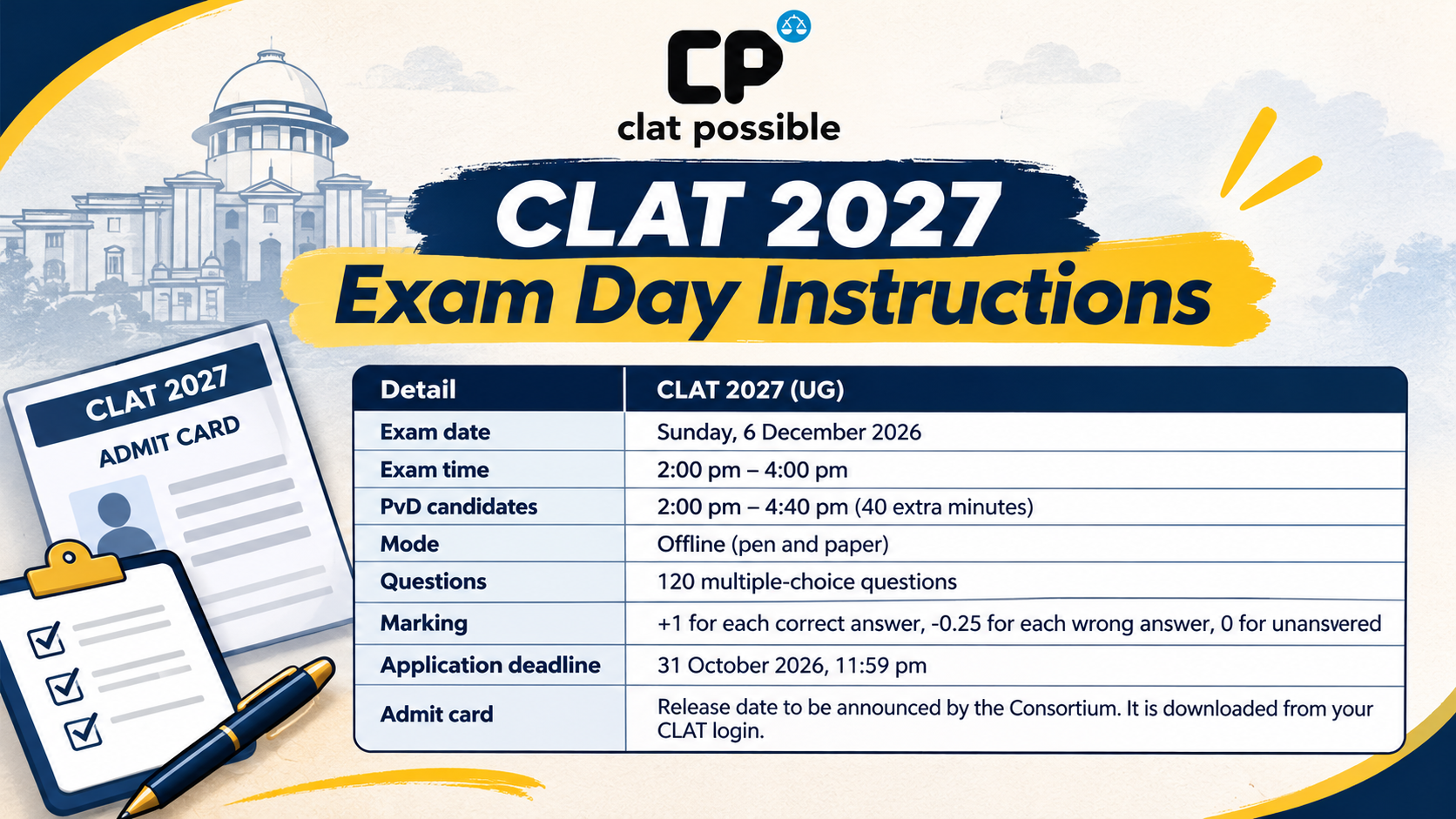
The CLAT 2027 exam is on Sunday, 6 December 2026, from 2:00 pm to 4:00 pm, in offline (pen-and-paper) mode. In the last cycle, the Consortium let candidates into the centre from 1:00 pm, required them to be seated by 1:30 pm and allowed no entry after 2:15 pm. Carry your admit card, an original government photo ID, black or blue ballpoint pens, a transparent water bottle and an analogue watch. Phones, smartwatches, calculators and bags are not allowed.

Important: As of 27 October 2026, the Consortium has not yet published the CLAT 2027 test-day instructions. The rules below come from the Consortium’s official CLAT 2025 Test Day Instructions, and the same timings were followed for CLAT 2026. The instructions printed on your CLAT 2027 admit card are final. If anything there differs from this guide, follow the admit card.

CLAT 2027 Exam at a Glance

DetailCLAT 2027 (UG)
Exam dateSunday, 6 December 2026
Exam time2:00 pm – 4:00 pm
PwD candidates2:00 pm – 4:40 pm (40 extra minutes)
ModeOffline (pen and paper)
Questions120 multiple-choice questions
Marking+1 for each correct answer, −0.25 for each wrong answer, 0 for unanswered
Application deadline31 October 2026, 11:59 pm
Admit cardRelease date to be announced by the Consortium. It is downloaded from your CLAT login.

Source: Consortium of NLUs – CLAT 2027 UG Instructions and CLAT 2027 press release.

For a section-wise breakdown of the paper, read our CLAT 2027 syllabus and exam pattern guide.

CLAT 2027 Exam Day Timeline (Bell Timings)

These timings are from the Consortium’s last official test-day instructions. Expect the same schedule for CLAT 2027, but confirm it on your admit card.

TimeBellWhat Happens
1:00 pm–Entry to the test centre opens. ID and admit card checks begin.
1:30 pmLong bellCandidates enter the exam hall and must be seated.
1:50 pmShort bellSealed envelopes are handed out. Invigilators read out instructions.
2:00 pmLong bellThe test begins. You may open the sealed envelope.
2:15 pmShort bellLast entry. No one is let into the hall after this.
2:30 / 3:00 / 3:30 pmShort bells30 minutes, 1 hour and 1.5 hours are over.
3:50 pmShort bell10 minutes left.
4:00 pmLong bellThe test ends. Stop writing on the OMR sheet and question booklet.

Two rules students often miss: once the test begins, you cannot use the washroom, and you cannot leave the hall before 4:00 pm.

CLAT 2027 Exam Day Checklist: What to Carry

ItemRequired?Notes
CLAT 2027 admit card (printed)MandatoryTake two printouts and keep one spare.
Original government photo IDMandatoryBring the original, not a photocopy or phone photo. See the accepted list below.
Self-attested passport-size photoOnly if neededNeeded if the photo on your admit card is unclear. Keep one anyway.
Black or blue ballpoint pensMandatoryCarry two or three that you’ve tested. No gel or fountain pens.
Transparent water bottleAllowedRemove the label so it is fully see-through.
Analogue watchAllowedDigital watches and smartwatches are banned.
Original disability certificatePwD candidates onlyRequired to get the extra 40 minutes.
Prescribed medicinesIf neededCarry any medication you need.

Accepted Photo ID Proofs

Under the Consortium’s last official instructions, any one of these is accepted as long as it is an original, clear document:

Aadhaar cardPassport
PAN cardVoter ID card
Driving licenceRation card / PDS photo card
Photo ID from a recognised school or collegePhoto bank ATM card
Kisan photo passbookCGHS / ECHS photo card
Department of Posts address card with photoIdentity certificate with photo from a Gazetted Officer or Tehsildar
Disability ID card or certificate issued by a State/UT authority

Tip: Aadhaar is the safest choice for most students. Check that the name on your ID matches the name on your admit card.

Items Not Allowed at the CLAT 2027 Exam Centre

Anything that is not on the permitted list is not allowed. Centres usually have no safe storage, so leave these items at home or with a parent outside.

CategoryExamples
Electronic devicesMobile phones, smartwatches, digital watches, fitness bands, earphones, Bluetooth devices
Calculation aidsCalculators of any kind
Study materialNotes, books, printed sheets, loose paper
Bags and casesBags, pouches, pencil boxes, wallets
Writing toolsPencils, gel pens, highlighters, correction fluid

Want the real exam to feel familiar? Take your CLAT mocks at 2:00 pm with only a pen, an analogue watch and a water bottle. Start with today’s Daily Mini CLAT.

Take the Daily Mini CLAT

Inside the Exam Hall: CLAT 2027 Code of Conduct

Question Booklet Rules

  • Check that the name, photo and admit card number printed on the question booklet are yours.
  • At the start, write your admit card number on the first page of the booklet.
  • The booklet has two blank pages for rough work. No extra sheets are given.
  • Do not write anywhere else in the booklet except the space marked for working.
  • You cannot ask anyone to explain a question during the test.
  • If your booklet has a printing problem, ask the invigilator for a replacement. You will get a new OMR sheet with it. Don’t use the old one.

OMR Sheet Rules

Do ✅Don’t ❌
Use only a black or blue ballpoint penUse a pencil, gel pen or correction fluid
Shade each answer circle completelyHalf-shade a circle (it counts as unanswered)
Mark only one option per questionShade two circles (counts as a wrong answer, so −0.25)
Keep the sheet flat and cleanFold, tear or crumple it, or do rough work on it
Sign it with the invigilator before detaching your copyDamage the barcode or the timing marks on the edges
Return the original (top) sheet to the invigilatorTake the original OMR sheet out of the hall

A damaged OMR sheet is invalid and can lead to disqualification. Taking the original sheet out of the hall can also lead to legal action.

Attendance and Unfair Means

  • During the test, an attendance sheet goes around. Write your question booklet number and OMR sheet number on it and sign it.
  • Copying, talking, passing material or any other unfair means leads to disqualification.
  • Impersonation and fraud may be a criminal offence, on top of disqualification.

Explore CLAT Programmes

What to Take Home After the Exam

You are allowed to keep these three things. Store them safely until admissions are over.

ItemWhy It Matters
Admit card (signed by the invigilator)You need it at the time of admission and counselling.
Question bookletUse it to check your answers against the provisional answer key.
Candidate’s copy of the OMR sheetHelps you work out your expected score and raise objections if needed.

CLAT 2027 Dress Code: What to Wear

The Consortium’s official test-day instructions do not set a dress code. Frisking at the gate is still standard, so practical choices save time.

  • Wear comfortable, simple clothes. Avoid big buttons, metal parts and lots of pockets.
  • Choose sandals or simple shoes that are easy to take off if security asks.
  • Keep jewellery and metal accessories to a minimum, because they slow down security checks.
  • December afternoons can be cold in North India. Wear a plain jacket or sweater that you’re happy to have checked.

Instructions for PwD Candidates

  • Eligible PwD candidates get 40 extra minutes, so their exam runs from 2:00 pm to 4:40 pm.
  • Carry your original disability certificate along with your admit card and photo ID.
  • Rules on scribes and other support are set out in the Consortium’s notifications. Read the CLAT 2027 notices and your admit card carefully, and contact the Consortium early if you need help.
  • If you need an isolated room for medical reasons, the last official instructions asked candidates to tell the Centre Superintendent at least 48 hours before the exam.

Do’s and Don’ts on CLAT 2027 Exam Day

Do ✅Don’t ❌
Reach the centre by 1:00 pmPlan to arrive close to 2:15 pm. Traffic on exam day is unpredictable.
Visit the centre a day or two beforeRely only on a map pin for an unfamiliar building
Keep the admit card and ID together in a clear folderCarry only a photo of your admit card on your phone
Eat a light lunch and use the washroom before 1:30 pmExpect a washroom break after 2:00 pm
Plan your section order before you enterExperiment with a new strategy on the day
Fill the OMR sheet as you go, or in planned batchesLeave all OMR shading for the last 10 minutes
Skip a question if you can’t rule out at least two optionsGuess blindly. Each wrong answer costs 0.25 marks.
Keep your question booklet and OMR copy safeThrow away your rough work before the answer key comes out

Your Final-Week Checklist Before CLAT 2027

WhenWhat to Do
As soon as the admit card is outDownload it and check your name, photo, centre and roll number. Report any error to the Consortium immediately.
Last 7 daysTake your last full mocks at 2:00 pm. Practise shading an OMR sheet within the 120 minutes.
2–3 days beforeVisit the centre and check the travel time from home at around 12:30 pm.
Saturday, 5 DecemberPack your folder: two admit card copies, original ID, photo, pens, water bottle and watch. Do a light revision and get a full night’s sleep.
Sunday, 6 DecemberHave an early lunch, leave home with a time buffer and be at the gate by 1:00 pm.

Six weeks left and not sure your mock scores are where they should be? Talk to a CLAT Possible counsellor. They will review your recent mocks and help you plan the final weeks before 6 December. If you’re targeting CLAT 2028, explore our structured CLAT programmes.

Target CLAT 2028


Final Word

The CLAT 2027 exam rewards preparation, but avoidable mistakes on the day can still cost you. Most of them come down to a late arrival, a missing ID or a careless OMR sheet. Use this checklist, rehearse the 2:00 pm routine in your mocks, and read your admit card carefully when it comes out. For official updates, keep checking the Consortium of NLUs website.

CLAT Syllabus 2027: Section-Wise Topics, Weightage and What Is Actually Tested

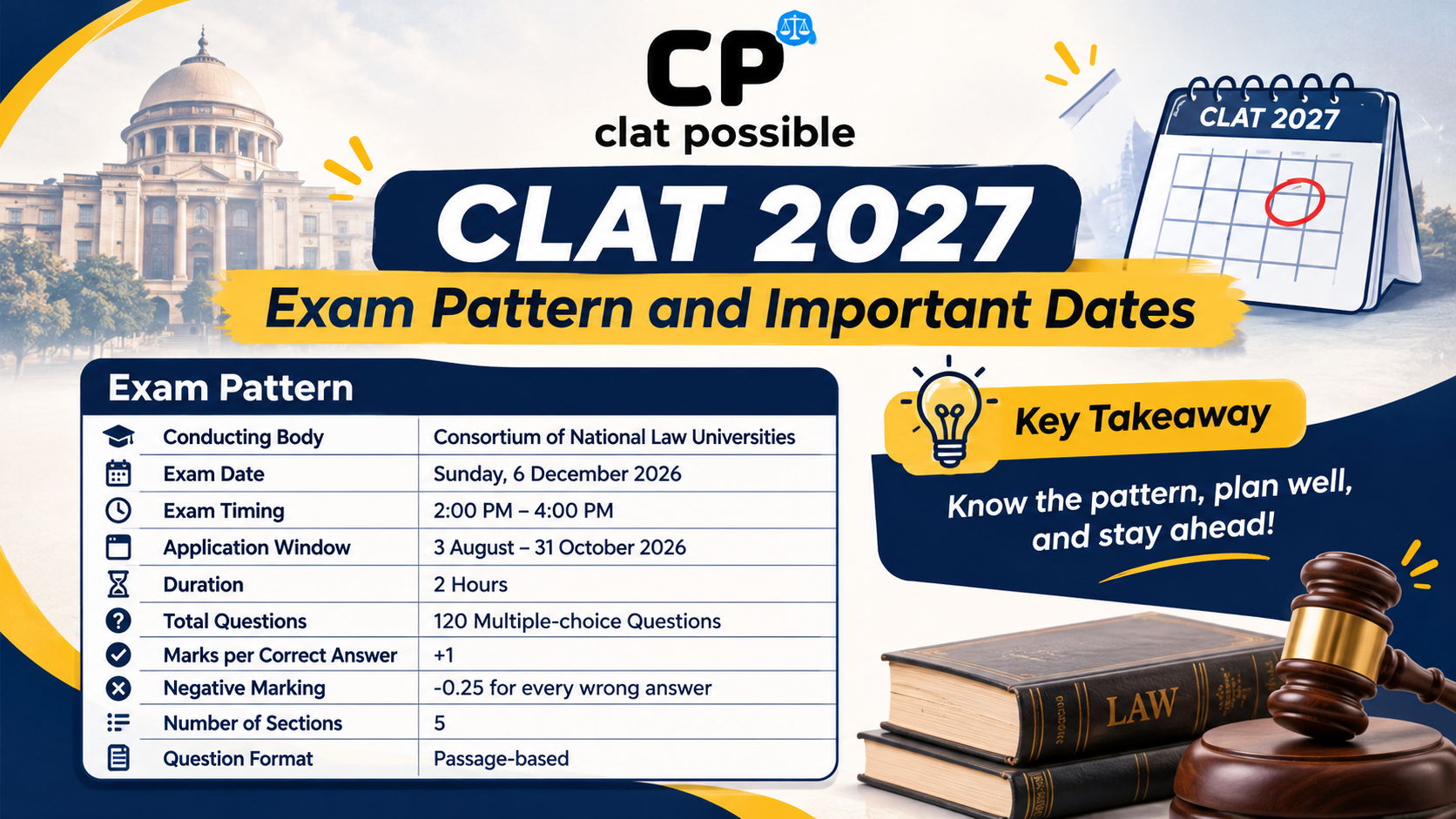
The CLAT syllabus 2027 has five sections: English Language, Current Affairs including General Knowledge, Legal Reasoning, Logical Reasoning and Quantitative Techniques. The paper has 120 multiple-choice questions in 2 hours. Each correct answer gets 1 mark, and each wrong answer loses 0.25 marks. The Consortium of NLUs has confirmed that the syllabus and pattern are unchanged for CLAT 2027.

CLAT 2027 is on Sunday, 6 December 2026, so you have about nine weeks left. This guide explains what each section actually tests and what you can safely skip. It also shows how to plan the time you have left.

CLAT 2027 Exam Pattern and Important Dates

FeatureCLAT 2027 (UG)
Conducting bodyConsortium of National Law Universities
Exam dateSunday, 6 December 2026
Exam timing2:00 pm – 4:00 pm
Application window3 August – 31 October 2026
Duration2 hours
Total questions120 multiple-choice questions
Marks per correct answer+1
Negative marking−0.25 for every wrong answer
Number of sections5
Question formatPassage-based
Source: Consortium of NLUs – CLAT 2027 press release (22 July 2026) and official UG syllabus page.

CLAT 2027 Section-Wise Weightage

The official CLAT 2027 syllabus page does not fix the number of questions per section. In earlier cycles, the Consortium published the distribution below, and recent papers have broadly followed it. Use it as a planning guide, not a guarantee.

SectionApprox. QuestionsApprox. SharePriority
English Language22–26~20%High
Current Affairs, including GK28–32~25%Very High
Legal Reasoning28–32~25%Very High
Logical Reasoning22–26~20%High
Quantitative Techniques10–14~10%Medium (but high-scoring)
Total120100%

CLAT Syllabus 2027: Section-by-Section Breakdown

All five sections at a glance:

SectionPassage SourceCore Skill TestedPrior Knowledge Needed?
English LanguageFiction and non-fiction, contemporary and classicComprehension and inferenceNo
Current Affairs & GKNews and journalistic writingAwareness of events and contextYes – current affairs and GK
Legal ReasoningLegal fact situations, policy and moral questionsApplying given rules to factsNo legal knowledge needed
Logical ReasoningShort argumentative passagesCritical reasoningNo
Quantitative TechniquesText-based numerical informationClass 10 maths and data readingClass 10 maths

1. English Language

Passage lengthAbout 450 words. A Class 12 student should be able to read one in roughly 5–7 minutes.
Passage sourceContemporary or historically significant fiction and non-fiction
Question types
  • Main idea and arguments
  • Inferences and conclusions
  • Summary of the passage
  • Comparing viewpoints
  • Meaning of words and phrases in context
How to prepareRead one long-form article daily and summarise it in two lines. Learn vocabulary from context, not from word lists.

2. Current Affairs, including General Knowledge

Passage lengthUp to 450 words
Passage sourceNews, journalism and other non-fiction
Areas covered
  • Significant events in India and the world
  • Arts and culture
  • International affairs
  • Historical events of continuing significance
Key pointThe passage introduces a topic, but the questions often test related facts you must already know.
How to prepareFollow the news daily and revise a monthly compilation. For every big story, note the who, what, why and background.

3. Legal Reasoning

Passage lengthAround 450 words
Passage sourceLegal fact situations, public policy questions, moral and philosophical issues
Prior legal knowledgeNot required, as stated in the official syllabus
Question types
  • Identify the rule or principle in the passage
  • Apply it to different fact situations
  • Work out how the outcome changes if the rule changes
How to prepareApply only the principle given, even if it feels unfair. Follow recent Supreme Court judgments and new laws for context.

4. Logical Reasoning

Passage lengthShort passages of about 450 words
Question types
  • Identify the argument, its premises and its conclusion
  • Strengthen or weaken an argument
  • Draw inferences and apply them to new situations
  • Spot analogies, contradictions and equivalence
  • Judge how effective an argument is
Key pointThis section tests critical reasoning, not puzzles.
How to prepareState the conclusion in one line before reading the options. Rule out options that are true but irrelevant.

5. Quantitative Techniques

FormatShort sets of facts or text-based numerical information, followed by questions
Official topicsRatios and proportions, basic algebra, mensuration, statistical estimation
LevelClass 10
Also practisePercentages, averages, profit and loss, data interpretation. These often appear inside ratio and estimation problems.
How to preparePractise caselets, where the numbers sit inside a paragraph, rather than plain formula drills.

What Is In vs NOT In the CLAT 2027 Syllabus

Many syllabus lists online add topics that the official syllabus does not mention. This table shows where to spend your time.

AreaIn the Syllabus ✅Not in the Syllabus ❌
LawApplying principles given in the passageMemorising IPC/BNS sections or Acts
EnglishComprehension, inference, vocabulary in contextStandalone grammar drills and error-spotting
Logical ReasoningArguments, assumptions, strengthen/weakenBlood relations, coding-decoding (not listed)
MathsClass 10 ratios, algebra, mensuration, estimationClass 11–12 maths, calculus, trigonometry
GKPassage-based current affairs and contextOne-line fact questions

Want to see how well you handle passage-based questions? Try today’s Daily Mini CLAT. It is a short, timed set that shows you where you stand.

Is the CLAT Syllabus Changing? CLAT 2027 vs CLAT 2028

On 18 July 2026, the Consortium’s Governing Body confirmed that CLAT 2027 will have no changes to the syllabus, pattern or sections. Paper setters will try to adopt the Expert Committee’s suggestions on question format and quality where feasible.

The CLAT Expert Committee Report 2026 recommends bigger changes. A committee constituted by the Office of the Chief Justice of India will review them ahead of CLAT 2028.

AspectCLAT 2027CLAT 2028
Syllabus statusConfirmed unchangedUnder review
Number of sections5Not decided (3 proposed)
GK / Current AffairsIncludedRemoval proposed, not confirmed
Who should careClass 12 students and droppersClass 11 students
What to doPrepare on the current patternBuild core reading and reasoning skills; follow official notices only

Class 11 students: don’t drop GK or Quant because of a recommendation. Reading, legal reasoning and critical reasoning matter under both the current and the proposed patterns.

9-Week Plan to Finish CLAT 2027 Preparation

WeeksGoalWhat to DoMocks per Week
1–2DiagnoseTake a full mock. Find your 2 weakest sections and the question types costing you marks.1
3–5Fix and buildDo daily sectional practice on weak areas and daily current affairs revision.2
6–8SimulateTake mocks at 2:00 pm, the real exam slot. Analyse each mock for as long as you took to write it.3
9ConsolidateRevise current affairs and your error log. Don’t start any new material.1–2 (light)

Common Mistakes and How to Fix Them

MistakeFix
Studying long “important topics” listsPractise passages. The exam is built on them.
Using outside legal knowledgeApply only the principle given in the passage.
Ignoring QuantSpend 20 minutes daily on caselets. It’s the easiest set of marks to secure.
Blind guessingWith −0.25 marking, attempt only when you can eliminate at least two options.
Not analysing mocksLog every error by section and question type, then review the log weekly.

Not sure your plan fits the time you have left? Book your free demo now. They will review your mock scores and plan the weeks before 6 December with you. If you’re starting early for CLAT 2028, explore our structured CLAT programmes.

Key Takeaways

The CLAT syllabus 2027 is short on paper but demanding in practice. It rewards careful reading, clear reasoning and staying current, not memorising. Use the official syllabus as your filter, and keep checking the Consortium of NLUs website for official updates.

PointWhat You Need to Know
FormatReading-and-reasoning test. Almost every question is built on a passage of about 450 words.
Legal knowledgeNot required. Legal Reasoning gives you the rule and asks you to apply it.
Maths levelClass 10 only
Highest weightageCurrent Affairs + Legal Reasoning (roughly half the paper)
Syllabus changesNone for CLAT 2027. Expert Committee proposals apply only to CLAT 2028 discussions.

Christ University Law Entrance Exam 2027: CULEE Dates, Syllabus, Pattern & Preparation

If you are planning to pursue a five-year integrated law programme at CHRIST University, the Christ University Law Entrance Exam 2027 is an important admission pathway to know about.Popularly referred to as CULEE, the entrance process is designed to assess a candidate’s aptitude, reasoning ability, general awareness, communication skills and overall suitability for the programme.This guide covers everything you need to know about the Christ University Law Entrance Exam 2027, including important dates, eligibility, application process, exam pattern, syllabus, selection process & preparation strategy.

Christ University Law Entrance Exam 2027: Highlights

Before beginning your preparation, it is useful to understand the basic details of the examination and admission process.

ParticularDetails
Exam NameChrist University Law Entrance Exam
Popular NameCULEE
Conducting UniversityCHRIST (Deemed to be University)
LevelUndergraduate
ProgrammesBA LLB (Honours) and BBA LLB (Honours)
Application ModeOnline
Selection ProcessEntrance Test, Skill Assessment, Micro Presentation and Personal Interview

Christ University Law Entrance Exam 2027: Important Dates

CHRIST University has released the important dates for its 2027 selection process. Candidates should regularly check the official admission portal for updates, changes or programme-specific instructions.

EventDate
Applications Open5 October 2026
Last Date to Apply for Entrance Test Programmes25 November 2026
Entrance Test Admit Card3 December 2026
Entrance Test5 December 2026
Skill Assessment, Micro Presentation & Personal Interview11–13 December 2026
Final Selection List21 December 2026

Dates may vary across selection processes, campuses or programmes. Candidates should verify the latest schedule on the official CHRIST University admission portal before applying.

Law Courses Offered Through CULEE

Candidates interested in pursuing an integrated law degree at CHRIST University can explore the following undergraduate law programmes:

  • BA LLB (Honours) – an integrated programme combining legal education with arts and humanities-oriented learning.
  • BBA LLB (Honours) – an integrated programme combining legal education with business and management-oriented learning.

Both programmes are designed to provide students with an interdisciplinary approach to legal education, along with opportunities to develop analytical, communication and professional skills.

Christ University Law Entrance Exam 2027 Eligibility Criteria

Candidates applying for the integrated law programmes must satisfy the eligibility conditions prescribed by CHRIST University.

For the undergraduate law programmes, candidates are required to have completed or be appearing for their qualifying Class 12 or equivalent examination from a recognised board, subject to the university’s prescribed eligibility requirements.

Students from different recognised school boards and educational backgrounds may apply, provided they meet the eligibility requirements specified by the university for the programme and admission cycle.

Since eligibility requirements can be updated, candidates should carefully check the official programme-specific eligibility criteria before submitting the application.

How to Apply for CULEE 2027?

The application process for the Christ University Law Entrance Exam is completed online. Candidates should keep their academic and personal information ready before beginning the application.

Step 1: Visit the Official Admission Portal

Visit the official CHRIST University admission portal and select the relevant undergraduate law programme.

Step 2: Register

Create your application account using the required contact details and complete the registration process.

Step 3: Fill in the Application Form

Enter your personal, academic and other required details carefully. Make sure that the information entered in the application form matches your official documents.

Step 4: Upload the Required Documents

Upload the photograph and other documents in the format and specifications prescribed by the university.

Step 5: Pay the Application Fee

Complete the application by paying the applicable fee through the available online payment options.

Step 6: Submit and Save the Application

After submitting the application, save the confirmation details and application number for future reference.

Documents Required for CULEE Application

Candidates should keep the following documents and information ready while applying:

  • Class 10 academic details
  • Class 11/12 academic details, wherever applicable
  • Recent passport-size photograph
  • Valid email address
  • Active mobile number
  • Required identity and supporting documents

The exact document requirements and specifications should be checked in the latest application instructions issued by CHRIST University.

Christ University Law Entrance Exam 2027 Pattern

The entrance test is designed to assess multiple skills that are relevant to undergraduate legal education. Based on the available CULEE information, candidates should prepare across English, reasoning, general knowledge, current affairs and quantitative/data interpretation areas.

AreaWhat It Tests
EnglishVocabulary, grammar, comprehension and language ability
ReasoningLogical thinking, analysis and problem-solving
General KnowledgeStatic general awareness and important facts
Current AffairsImportant national and international developments
Data Analysis & InterpretationNumerical data, charts, tables and basic quantitative interpretation

Candidates should always refer to the latest official CULEE 2027 information for the final question count, duration and marking scheme applicable to their programme.

Christ University Law Entrance Exam 2027 Syllabus

A strong understanding of the syllabus helps you plan your preparation efficiently. The major areas to prepare for include English, General Knowledge, Current Affairs, Reasoning and Data Analysis & Interpretation.

English

  • Grammar
  • Vocabulary
  • Synonyms and antonyms
  • One-word substitutions
  • Fill in the blanks
  • Para-jumbles
  • Idioms and phrases
  • Proverbs
  • Reading comprehension
  • Spellings

General Knowledge

  • Indian Polity
  • Books and authors
  • Important dates
  • Awards and honours
  • Important national and international events
  • Important landmarks and places

Current Affairs

  • National developments
  • International developments
  • Recent legal developments
  • Important personalities in the news
  • Major government and policy developments

Reasoning

  • Statements and conclusions
  • Syllogisms
  • Analogies
  • Coding and decoding
  • Family tree and directions
  • Logical series
  • Order and ranking
  • Cause and effect
  • Inferences
  • Strong and weak arguments
  • Implicit assumptions

Data Analysis & Interpretation

  • Tables
  • Bar graphs
  • Pie charts
  • Line graphs
  • Histograms
  • Caselets
  • Basic numerical interpretation
  • Percentage
  • Ratio and proportion
  • Profit and loss
  • Simple and compound interest

CULEE 2027 Section-Wise Preparation

1. English

Build your vocabulary and grammar gradually instead of trying to memorise large word lists at the last moment. Read newspapers, editorials and quality articles regularly. Practice comprehension and language-based questions under time limits.

2. General Knowledge & Current Affairs

Make current affairs a daily habit. Follow important national and international developments, legal developments, awards, appointments, government initiatives and significant events. Revise your notes regularly because reading current affairs once is not enough.

3. Reasoning

Reasoning improves with consistent practice. Start with basic concepts and gradually move towards timed sets. Maintain an error log so that you can identify recurring mistakes.

4. Data Analysis & Interpretation

Practice interpreting tables, charts and graphs. Focus on percentages, ratios, averages, profit and loss and other basic quantitative concepts that can help you solve data-based questions.

How to Prepare for CULEE 2027?

Preparing for CULEE requires a combination of conceptual clarity, reading, practice, current affairs awareness and mock-test analysis.

Build a Daily Reading Habit

Regular reading can improve comprehension, vocabulary and awareness of current issues. Make reading a consistent part of your preparation rather than treating it as an occasional activity.

Prepare Current Affairs Daily

Follow reliable sources and create short revision notes. Give special attention to important legal, national and international developments.

Practice Questions Regularly

Do not restrict your preparation to reading theory. Solve questions every day and gradually introduce timed practice.

Take Mock Tests

Mock tests help you understand your strengths, weaknesses and time-management issues. After every mock, spend enough time analysing your mistakes.

Revise Frequently

Revision is especially important for General Knowledge, Current Affairs and vocabulary. Use short notes, flashcards or weekly revision sheets to retain information.

Christ University Law Entrance Exam 2027 Selection Process

Clearing the entrance test is only one part of the admission process for programmes that require an Entrance Test. CHRIST University’s 2027 selection process includes multiple stages.

  1. Entrance Test (ET) – Candidates appear for the university’s entrance examination.
  2. Skill Assessment (SA) – Candidates may be assessed through a written or
    programme-specific skill assessment.
  3. Micro Presentation (MP) – Candidates are given a topic and are expected
    to present their thoughts within the prescribed time.
  4. Personal Interview (PI) – The interview assesses the candidate’s communication,
    awareness, confidence, academic interests and overall suitability.

The university may prescribe programme-specific selection requirements. Candidates should carefully check the official selection process applicable to their chosen law programme.

How to Prepare for the CULEE Personal Interview?

The Personal Interview should not be treated as an afterthought. Once your entrance preparation is underway, start developing the ability to discuss your academic interests, current affairs and reasons for choosing law.

  • Know why you want to study law.
  • Be aware of important national and international developments.
  • Read about major legal and constitutional issues.
  • Practice answering questions clearly and concisely.
  • Work on your communication and presentation skills.
  • Be honest about your interests and achievements.

How to Prepare for the CULEE Micro Presentation?

The Micro Presentation tests how effectively you can organise and communicate your thoughts within a limited time.

Practice speaking on unfamiliar topics. Try to structure your response into three parts: introduction, key argument and conclusion.

Avoid memorising complete speeches. Instead, focus on building confidence, clarity and the ability to think on your feet.

Common Mistakes to Avoid While Preparing for CULEE

  • Ignoring Current Affairs: Do not leave GK and Current Affairs for the final weeks.
  • Only Studying Theory: Concepts become useful only when you practice applying them.
  • Taking Mocks Without Analysis: A mock test is valuable only when you learn from it.
  • Ignoring Time Management: Practice solving questions within realistic time limits.
  • Overloading Yourself With Resources: Choose reliable study material and use it consistently.
  • Ignoring the Selection Process After the Test: Prepare for the Skill Assessment,
    Micro Presentation and Personal Interview as well.

Simple CULEE 2027 Preparation Plan

Preparation StageFocus
FoundationEnglish, reasoning, basic quantitative concepts and reading habit
Skill BuildingSection-wise practice and current affairs preparation
Timed PracticeSectional tests and mixed question sets
Mock PhaseFull-length mocks and detailed analysis
Final RevisionCurrent affairs, vocabulary, formulas, weak areas and previous mistakes

Final Takeaway

The Christ University Law Entrance Exam 2027 requires more than last-minute question practice. A strong preparation strategy combines reading, reasoning, current affairs, data interpretation, mock tests and regular revision.

At the same time, remember that the entrance test is only one part of the selection process. If your programme requires further stages, prepare for the Skill Assessment, Micro Presentation and Personal Interview alongside your written-test preparation.

The best approach is simple: understand the exam, build your basics, practise consistently, analyse your mistakes and revise regularly.

If you are serious about pursuing law at CHRIST University, start preparing early and keep checking the official university admission portal for the latest 2027 updates.

How to Prepare for CLAT 2028: Complete Study Plan & Preparation Strategy

If you are planning to appear for CLAT 2028, starting early can give you something extremely valuable.Instead of rushing through the syllabus, you can gradually build the reading, reasoning, analytical and quantitative skills required for the exam. You can experiment with different strategies, take regular mocks, analyse your mistakes and strengthen your weaker areas well before the final months.But starting early also comes with one challenge: knowing what to do with all that time.

This guide explains how to prepare for CLAT 2028 with a structured, long-term approach. It covers daily preparation, section-wise strategies, reading habits, mock tests, Current Affairs, revision, time management and practical 24-month, 18-month and 12-month study plans.

How to Prepare for CLAT 2028

  • Understand the official CLAT 2028 syllabus and exam pattern when released.
  • Build a strong daily reading habit.
  • Develop fundamentals across all major sections.
  • Practise passage-based questions consistently.
  • Build Current Affairs and General Knowledge gradually.
  • Start sectional tests once your fundamentals are comfortable.
  • Introduce full-length mocks progressively.
  • Analyse every mock instead of focusing only on the score.
  • Maintain an error log throughout your preparation.
  • Revise regularly instead of postponing revision until the end.

Why Start Preparing for CLAT 2028 Early?

CLAT preparation is not only about memorising information. A large part of the preparation involves developing skills such as comprehension, critical thinking, logical reasoning, application and time management.

These skills improve with consistent practice.
Starting early gives you the opportunity to build these skills gradually instead of trying to develop them in the final few months before the examination.

Early preparation also allows you to:

  • Develop a strong reading habit.
  • Strengthen your fundamentals without rushing.
  • Identify your strengths and weaknesses.
  • Experiment with different preparation strategies.
  • Build a strong Current Affairs knowledge base.
  • Take mocks without excessive pressure.
  • Improve your accuracy before focusing heavily on speed.
  • Revise important concepts multiple times.

CLAT 2028 Syllabus and Exam Pattern

Before beginning your preparation, make sure you understand the official CLAT 2028 syllabus and examination pattern released by the Consortium of National Law Universities.

The CLAT UG examination currently assesses students across five broad areas:

  • English Language
  • Current Affairs, including General Knowledge
  • Legal Reasoning
  • Logical Reasoning
  • Quantitative Techniques

Since examination patterns and official instructions can be updated, CLAT 2028 aspirants should always check the latest information published by the Consortium before finalising their preparation strategy.

The goal of your preparation should therefore be to develop the underlying skills tested by CLAT rather than relying only on an old paper pattern.

How to Prepare for CLAT 2028: Step-by-Step Strategy

A long-term CLAT preparation plan becomes much easier when you break it into a simple cycle:

1. Understand What CLAT Tests

Your first step should not be buying multiple books or attempting hundreds of questions.

First understand the skills required for CLAT. The examination is designed around comprehension, reasoning, interpretation and application.

Once you understand what the examination expects from you, you can choose your resources and practice methods more effectively.

2. Make Reading a Daily Habit

Reading should become one of the foundations of your CLAT 2028 preparation strategy.

Do not limit reading to the months immediately before the examination. Starting early allows you to develop reading speed and comprehension naturally.

While reading, practise identifying:

  • The central idea of a passage.
  • The author’s viewpoint.
  • Arguments and supporting evidence.
  • Inferences.
  • Important details.
  • The meaning of words in context.
  • Connections between different ideas.

Read newspapers, editorials, opinion articles, essays and other high-quality long-form content. The objective is not simply to increase the number of pages you read. It is to become a better reader.

3. Build Your Fundamentals

If you are starting your CLAT 2028 preparation early, do not worry about solving the most difficult questions immediately.

Spend the initial phase understanding concepts and question types.

For example, in Logical Reasoning, first understand concepts such as assumptions, conclusions, inference and arguments. In Quantitative Techniques, strengthen basic arithmetic and data interpretation skills before moving to more challenging timed sets.

4. Practise Consistently

Once your fundamentals are clear, move towards regular practice.

Begin with topic-wise sets and gradually move towards mixed and timed practice.

Quality practice matters more than simply counting the number of questions you solve.

5. Start Sectional Tests

Sectional tests help you understand how well you perform within a particular section.

They can also reveal whether a problem is related to knowledge, comprehension, accuracy or time management.

Use your sectional scores as feedback rather than treating them as a final judgement of your preparation.

6. Introduce Full-Length Mocks Gradually

Full-length mock tests should become more important as you move closer to CLAT 2028.

If you are still in the foundation phase, there is no need to take multiple full-length mocks every week. Focus first on building the skills required to perform well.

As your preparation develops, gradually increase mock frequency and use each mock to identify areas that require improvement.

7. Analyse Every Mock

One of the biggest mistakes students make is treating mock tests as score-generating exercises.

A mock is also a diagnostic tool.

After every mock, ask yourself:

  • Which questions did I get wrong?
  • Why did I get them wrong?
  • Which questions took too much time?
  • Where did I make careless mistakes?
  • Which questions did I leave despite knowing the concept?
  • Which question types repeatedly cause difficulty?
  • What will I change before my next mock?

CLAT 2028 Section-Wise Preparation Strategy

Each section requires a slightly different preparation approach. Your CLAT 2028 study plan should therefore give every section a clear role.

How to Prepare for CLAT 2028 English

English preparation should revolve around reading comprehension and language skills.

For CLAT English preparation:

  • Read every day.
  • Practise identifying the main idea of passages.
  • Work on inference-based questions.
  • Understand arguments and viewpoints.
  • Build vocabulary through context.
  • Practise Reading Comprehension regularly.
  • Introduce timed practice gradually.

How to Prepare for CLAT 2028 Current Affairs and GK

Current Affairs should not become a last-minute subject.

Since you are preparing for CLAT 2028, use the additional time to build a system that makes information easier to understand and revise.

Your GK routine can include:

  • Daily current affairs reading.
  • Short and organised notes.
  • Weekly revision.
  • Monthly consolidation.
  • Regular quizzes.
  • Revision of important national and international developments.

Instead of memorising isolated facts, understand the background, context and significance of important events.

How to Prepare for CLAT 2028 Legal Reasoning

Legal Reasoning should be approached as a reasoning and application section rather than a subject that requires you to memorise an entire law syllabus.

Prior legal education is not the objective. Your preparation should focus on reading the passage carefully, identifying the relevant principle and applying it to the facts provided.

Practise:

  • Identifying principles from passages.
  • Separating relevant facts from irrelevant information.
  • Applying principles to new situations.
  • Understanding changes in facts.
  • Reading lengthy passages carefully.

How to Prepare for CLAT 2028 Logical Reasoning

Logical Reasoning requires you to understand arguments and evaluate the relationship between different ideas.

Focus on:

  • Arguments and conclusions.
  • Assumptions.
  • Inferences.
  • Strengthen and weaken questions.
  • Cause and effect.
  • Analogies and relationships.
  • Critical reasoning.

Start without strict time pressure and focus on understanding. Once your accuracy becomes consistent, introduce timed practice.

How to Prepare for CLAT 2028 Quantitative Techniques

Quantitative Techniques becomes easier when your mathematical fundamentals are strong.

Start by strengthening basic arithmetic and gradually move towards data interpretation and timed numerical sets.

Your Quant preparation should include:

  • Basic arithmetic.
  • Ratios and proportions.
  • Percentages.
  • Data interpretation.
  • Tables and numerical information.
  • Basic algebra.
  • Regular calculation practice.

CLAT 2028 Study Plan: 24-Month Strategy

Students starting early have the advantage of being able to divide their preparation into multiple phases instead of trying to complete everything at once.

Phase 1: Foundation

Focus: Reading, fundamentals and basic question types.

  • Build a daily reading habit.
  • Understand all five areas.
  • Strengthen basic concepts.
  • Start Current Affairs preparation.
  • Practise topic-wise questions.

Phase 2: Skill Building

Focus: Regular practice and sectional improvement.

  • Increase passage-based practice.
  • Start sectional tests.
  • Maintain an error log.
  • Revise Current Affairs regularly.
  • Work specifically on weaker areas.

Phase 3: Testing

Focus: Full-length mocks and performance analysis.

  • Introduce regular full-length mocks.
  • Analyse every mock.
  • Improve question selection.
  • Work on time management.
  • Identify recurring mistakes.

Phase 4: Final Preparation

Focus: Revision, mocks and consistency.

  • Revise existing notes.
  • Continue mock practice.
  • Revise Current Affairs systematically.
  • Strengthen weak areas.
  • Practise under exam-like conditions.

CLAT 2028 12-Month Study Plan

If you have around 18 months, divide your preparation into foundation, practice and testing phases.

  • Months 1–6: Fundamentals, reading and topic-wise practice.
  • Months 7–12: Sectional tests, mixed practice and regular revision.
  • Months 13–18: Full-length mocks, detailed analysis and intensive revision.

How Many Hours Should You Study for CLAT 2028?

A one-year plan should balance concept building and testing.

  • Months 1–3: Fundamentals and daily reading.
  • Months 4–6: Topic-wise and sectional practice.
  • Months 7–9: Mixed practice and regular mocks.
  • Months 10–12: Mock analysis, revision and exam-oriented preparation.

How to Make a CLAT 2028 Timetable

There is no single number of hours that every CLAT 2028 aspirant needs to study.

Your required study time will depend on your academic schedule, preparation level, strengths and weaknesses.

Instead of asking only “How many hours should I study?”, ask:

“What should I accomplish today?”

A productive daily checklist could include:

  • 30-60 minutes of reading.
  • One or more comprehension sets.
  • Legal or Logical Reasoning practice.
  • Regular Quant practice.
  • Current Affairs revision.
  • Error-log review.

CLAT 2028 Mock Test Strategy

Your timetable should be realistic enough to follow for months, not just for a few days.

Divide your week between:

  • Concept building
  • Reading
  • Practice
  • Current Affairs
  • Sectional tests
  • Mock tests
  • Revision

Make your tasks specific. Instead of writing “Study English”, write “Complete two RC passages and analyse all incorrect answers.”

CLAT 2028 Mock Test Strategy

Mock tests become increasingly important as you approach the examination. However, the purpose of a mock is not simply to produce a score.

Your mock should help you understand your preparation.

What to TrackQuestion to Ask
Wrong AnswersWas the mistake conceptual, careless or due to misreading?
Unattempted QuestionsDid I run out of time or deliberately skip them?
Time TakenWhich section consumed the most time?
AccuracyWhich question types repeatedly cause mistakes?
Question SelectionDid I spend too much time on difficult questions?

Common CLAT 2028 Preparation Mistakes to Avoid

1. Starting With Too Many Resources
More books and more PDFs do not automatically mean better preparation. Select reliable resources and use them consistently.

2. Ignoring Reading
Reading should not be treated as an optional activity. Make it part of your everyday preparation.

3. Taking Mocks Without Analysis
Your mock score tells you where you stand. Your analysis tells you what to do next.

4. Leaving Current Affairs for the Final Months
Build your Current Affairs knowledge gradually and revise it regularly.

5. Focusing Only on Strong Sections
Your strong sections deserve maintenance, but your weak areas need deliberate attention.

6. Studying for Hours Without Clear Targets
Sitting with books for several hours does not automatically mean productive preparation. Set measurable tasks for each study session.

CLAT 2028 Preparation Tips for Beginners

If you are just beginning your CLAT 2028 journey, keep your first few weeks simple.

  1. Understand the exam.
  2. Start reading every day.
  3. Learn the fundamentals of each section.
  4. Practise consistently.
  5. Start tracking your mistakes.
  6. Gradually introduce timed practice.
  7. Do not compare your beginning with someone else’s final phase.

Your first objective should be consistency. Speed, intensity and mock frequency can increase as your preparation develops.

CLAT 2028 Preparation for Class 11 Students

Class 11 is a particularly useful time to begin building a CLAT foundation because you can focus on developing skills without immediately entering an intense final-exam phase.

Students starting in Class 11 should prioritise:

  • Reading consistently.
  • Building vocabulary through reading.
  • Developing reasoning skills.
  • Strengthening basic mathematics.
  • Following Current Affairs.
  • Understanding CLAT-style passages.
  • Developing disciplined study habits.

The objective at this stage is not to burn out early. It is to build a strong foundation that makes intensive preparation easier later.

CLAT 2028 Preparation for Class 12 Students

Students preparing alongside Class 12 need to balance board preparation with CLAT-specific practice.

Create a weekly schedule rather than trying to follow an unrealistic daily routine. Use your school and academic reading to strengthen comprehension, while reserving dedicated time for CLAT practice, Current Affairs and mocks.

The CLAT 2028 Preparation Cycle

  1. READ – Build comprehension and awareness.
  2. PRACTISE – Develop section-wise skills.
  3. TEST – Use sectional and full-length tests.
  4. ANALYSE – Understand your mistakes.
  5. REVISE – Fix the gaps.
  6. REPEAT – Keep improving.

This cycle should remain at the centre of your preparation throughout your CLAT 2028 journey.

Final Takeaway: How to Prepare for CLAT 2028

Preparing for CLAT 2028 is a long-term process. If you are starting early, do not feel pressured to do everything immediately.

Build your reading habit. Strengthen your fundamentals. Practise consistently. Follow Current Affairs. Take sectional tests. Introduce mocks gradually. Analyse every test. Revise regularly and keep working on your weak areas.

Most importantly, remember that preparation is a process of continuous improvement.