close

CLAT English Syllabus 2028: Topics, Question Types & Preparation Plan

If you are in Class 11 right now, CLAT 2028 is most likely your first attempt. And the English section is the best place to start preparing, because the skill it tests, reading a dense passage quickly and accurately, takes months to build and helps you in every other section of the paper.

CLAT English is not a grammar test. It is a reading test. In this blog, we break down the CLAT English syllabus for 2028, explain each question type, cover the possible pattern change, and give you a month-by-month plan to prepare.

CLAT 2027-2028 Courses by CLAT Possible

CLAT English Syllabus 2028 at a Glance

ParticularDetails
Section nameEnglish Language
Approximate share of the paperAbout 20% (roughly 22 to 24 of 120 questions in recent papers)
FormatPassage-based multiple-choice questions
Passage lengthAbout 450 words each
Reading time per passageRoughly 5 to 7 minutes for a Class 12 student, as per the official syllabus
Passage sourcesContemporary or historically significant fiction and non-fiction writing
Marking+1 for a correct answer, −0.25 for a wrong answer, 0 for unanswered
Status for CLAT 2028Current syllabus applies to CLAT 2027; an Expert Committee proposal to redesign the section is under consideration for CLAT 2028

For the full paper structure, see our complete CLAT 2028 guide.

What the Official Syllabus Says

According to the official CLAT UG syllabus published by the Consortium of NLUs, you will read passages of about 450 words and be expected to:

  • Identify the main point of the passage, along with the arguments and viewpoints in it.
  • Draw inferences and conclusions from the text.
  • Summarise the passage.
  • Compare and contrast the different arguments or viewpoints presented.
  • Work out the meaning of words and phrases from how they are used in the passage.

Notice what is missing from this list: there is no separate grammar section, no list of words to memorise, and no fill-in-the-blanks test on rules. Every question comes from a passage, and almost every question checks whether you truly understood what you read.

Will the English Section Change for CLAT 2028?

Possibly. CLAT 2027 (6 December 2026) keeps the current five-section pattern. However, an Expert Committee has recommended a redesigned three-section paper, and the Consortium has said it will consider the proposals for CLAT 2028. No final decision had been announced as of October 2026.

FeatureCurrent English section (CLAT 2027)Proposed: Language and Comprehension (not confirmed)
Section nameEnglish LanguageLanguage and Comprehension
FocusReading comprehension, inference, vocabulary in contextInference, implication, tone and the strength of arguments
Grammar and vocabularyTested through passagesLess emphasis on grammar and vocabulary
Number of questionsAbout 22 to 24No more than 10 to 15 per section
Skill rewardedReading speed across long passagesDepth and accuracy of understanding

What this means for you: the core skill is the same either way. Under both patterns, you need to read carefully, understand the author’s argument, and choose the option the passage actually supports. Prepare for that, and you are ready for whichever pattern the Consortium confirms.

CLAT English Syllabus 2028: Topic-Wise Breakdown

1. Reading Comprehension

This is the heart of the section. Every question is linked to a passage, so your reading speed and accuracy decide your score.

  • Main idea and central argument
  • Supporting arguments and evidence
  • Author’s viewpoint and purpose
  • Comparing different viewpoints within a passage

2. Inference and Conclusions

These questions ask what follows from the passage, even though it is not stated directly. They are often the trickiest in the section.

  • What can be inferred from a line or paragraph
  • Which conclusion the author would agree with
  • Underlying assumptions in an argument

3. Tone and Author’s Attitude

You need to judge how the author feels about the subject, based only on the words used.

  • Tone words such as critical, sarcastic, optimistic, nostalgic, objective
  • Whether the author supports, opposes or remains neutral

4. Vocabulary in Context

CLAT does not test word lists. It asks what a word or phrase means as used in the passage.

  • Meaning of words and phrases in context
  • Idioms and phrases used in the passage
  • Synonyms and antonyms based on context

5. Summary and Title

You may be asked to pick the best summary of a passage or paragraph, or the most suitable title.

  • Best summary of the passage
  • Most suitable title
  • The author’s main purpose in writing

6. Grammar in Use

Grammar is not tested on its own, but you need it to read accurately. Occasionally, questions may test correct usage within a sentence from the passage.

  • Tenses, subject-verb agreement and modifiers
  • Connectors and how they change meaning (“however”, “therefore”, “despite”)
  • Sentence correction based on passage lines

7. Literary Devices

Fiction and literary non-fiction passages sometimes include figurative language.

  • Metaphor, simile, personification, irony
  • What a figurative line actually means

Question Types in CLAT English (and How to Approach Them)

Question typeWhat it asksHow to approach it
Main ideaWhat is the passage mainly about?Read the first and last paragraphs closely; eliminate options that are too narrow or too broad.
InferenceWhat can be concluded from the passage?Choose only what the passage supports. If an option needs outside knowledge, it is wrong.
Tone / attitudeHow does the author feel about the subject?Underline opinion words and adjectives as you read.
Vocabulary in contextWhat does a word mean as used here?Reread the full sentence and test each option in place of the word.
Summary / titleWhich option best captures the passage?Pick the option that covers the whole passage, not one paragraph.
Strengthen / weakenWhich statement supports or undermines the author’s argument?Identify the author’s main claim first, then test each option against it.
Fact-basedWhat does the passage say about a detail?Go back to the exact line; do not rely on memory.

Take Free Demo Class

Where CLAT English Passages Come From

The official syllabus says passages are drawn from contemporary or historically significant fiction and non-fiction writing. In practice, that covers a wide range:

Passage typeExamples of what you might read
Literary fictionExtracts from novels and short stories, classic and modern
Opinion and editorialsNewspaper editorials and opinion columns on social or political issues
Essays and non-fictionLong-form essays on philosophy, history, science, technology or economics
Social issuesWriting on education, gender, environment, inequality and public policy
Biography and memoirExtracts from autobiographies, memoirs and speeches

The wider your reading, the fewer surprises you will face in the exam. Make sure you read a mix of fiction and non-fiction, not just newspapers.

CLAT 2028 English Preparation Plan

This plan assumes CLAT 2028 will be held around December 2027, based on recent cycles. If you are in Class 11 now, you have about a year, which is plenty of time if you start building the reading habit today.

PhaseTime windowFocusGoal
1. Reading foundationNow to March 2027Daily reading of editorials, essays and fiction; one passage a day without a timerSummarise any 450-word passage in two lines
2. Question typesApril to July 2027Practise each question type; keep a vocabulary-in-context notebook and an error logSteady accuracy on untimed passage sets
3. Speed and accuracyAugust to October 2027Timed sectional tests; full mocks aligned to the confirmed patternFinish each passage in 6 to 7 minutes without losing accuracy
4. Final revisionNovember 2027 to the examRevise your error log and notebook; fewer, sharper mocksA tested time plan for the English section

For the full plan across all sections, read our complete CLAT 2028 study plan.

A Daily English Routine for CLAT 2028

  1. Read one editorial or essay (15 minutes): write a one-line summary and one word for the author’s tone.
  2. Solve one CLAT-style passage (10 minutes): untimed at first, timed once your accuracy is steady.
  3. Review every wrong option (10 minutes): understand why each wrong answer is wrong, not just why the right one is right.
  4. Add 3 to 5 words to your notebook: note each word with the sentence you found it in.
  5. Once a week: read one piece of fiction or a long-form essay outside your comfort zone.

Try Roznama (CLAT mini) Free

Best Resources for CLAT 2028 English

  • Newspapers: The Hindu or The Indian Express, especially the editorial and opinion pages.
  • Long-form reading: essays and features from quality magazines and websites, plus classic and contemporary fiction.
  • Official material: the official CLAT UG syllabus and CLAT previous year papers from 2020 onward.
  • Roznama (Daily Mini CLAT): our free daily practice of about 25 to 30 questions based on the day’s newspaper. Learn more about Roznama.
  • Books: one passage-based English book is enough. See our list of CLAT preparation books.

For more reading tips, see our guide on how to improve reading comprehension for CLAT.

Conclusion

The CLAT English syllabus for 2028 comes down to one skill: reading a passage carefully and answering only from what it says. Whether the Consortium keeps the current English section or moves to Language and Comprehension, that skill will carry you through. Start reading every day, practise each question type, analyse your mistakes, and keep checking the Consortium website for the official CLAT 2028 pattern.
CLAT Subjects 2028: Complete List, Weightage and What Each Section Tests

CLAT subjects are not like your school subjects. There’s no textbook to memorise and no “law” chapter to learn before the exam. Instead, CLAT tests five skills through passages: reading, staying aware of the world, legal reasoning, logical thinking and basic maths. The Consortium of NLUs has officially confirmed that the syllabus and sections for CLAT 2028 will stay the same.

So in this blog, we’ll walk you through all the CLAT exam subjects using the official CLAT 2028 UG syllabus: how many questions each one has, what it really tests, and how to prepare for it.

CLAT 2027-2028 Courses by CLAT Possible

What You’ll Find in This Blog

CLAT Subjects List and Weightage

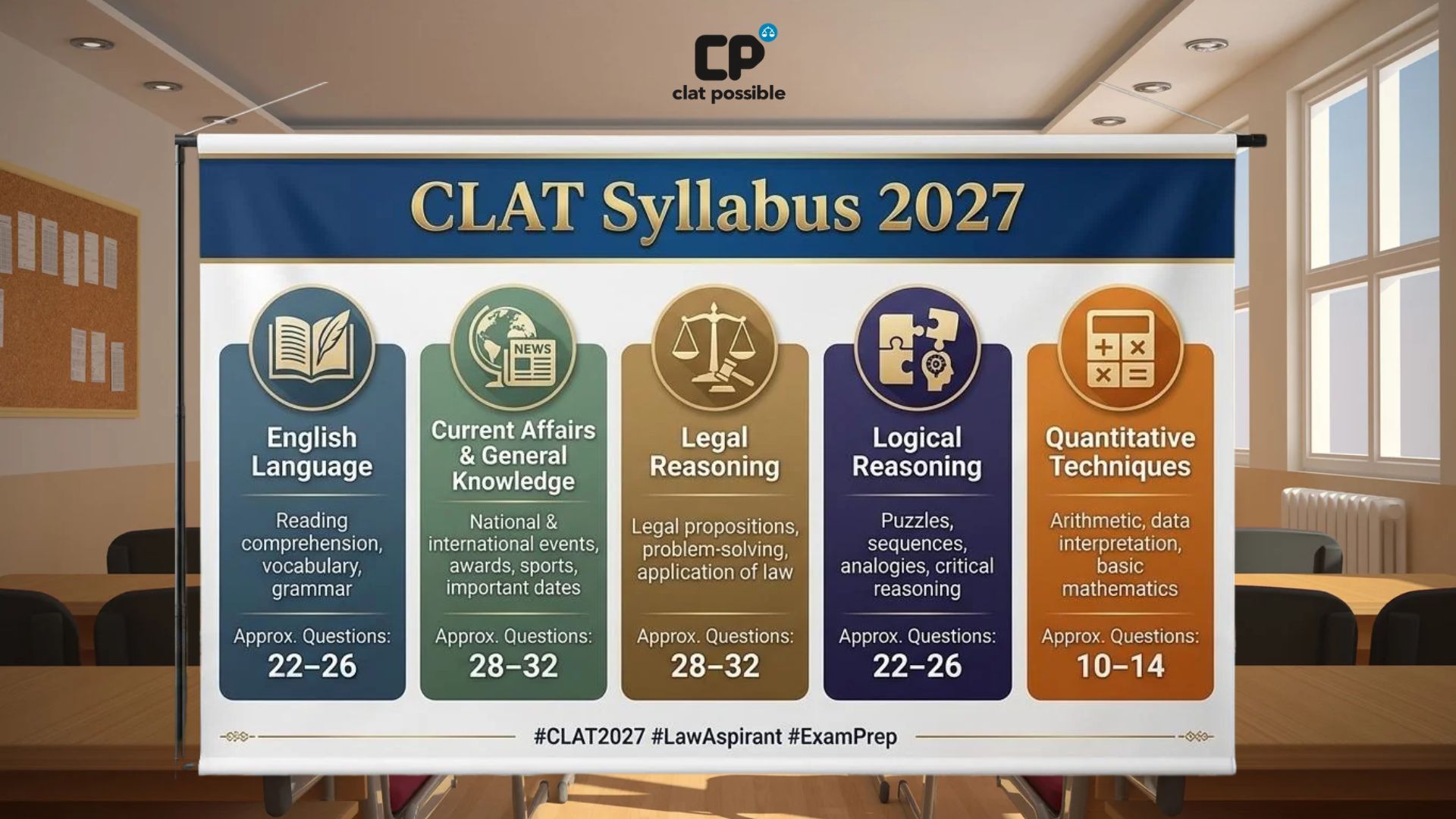
CLAT UG has five subjects, and every one of them is passage-based. Here’s the subject-wise breakdown from the official CLAT 2028 paper pattern, with the approximate number of questions and share of the paper for each.

CLAT subjectApprox. questionsShare of the paperWhat it tests in one line
English Language22 to 2620%How well you understand what you read
Current Affairs including General Knowledge28 to 3225%How aware you are of the world around you
Legal Reasoning28 to 3225%How well you apply a given rule to facts
Logical Reasoning22 to 2620%How well you judge arguments
Quantitative Techniques10 to 1410%How comfortable you are with Class 10 maths

Look at the middle two rows. Current Affairs and Legal Reasoning together make up about half your CLAT score. That alone should shape how you plan your preparation.


CLAT 2028 Exam Pattern

Before going subject by subject, here are the basics of the paper itself, all taken from the Consortium’s official information for CLAT 2028.

WhatDetails
Exam date and timeSunday, 6 December 2026, 2:00 PM to 4:00 PM (2:00 PM to 4:40 PM for eligible PwD candidates)
ModeOffline
Duration2 hours
Total questions and marks120 multiple-choice questions, 1 mark each, 120 marks in total
Negative marking0.25 marks deducted for every wrong answer
Number of subjects5
Changes for CLAT 2028None. The Consortium has confirmed no change to the syllabus, pattern or sections

The Consortium also says the paper tests comprehension and reasoning, and that no prior knowledge is needed, though it can help with current affairs. For a deeper look at the topics, read our CLAT syllabus 2028 guide.

CLAT Subject 1: English Language

English carries about 22 to 26 questions, or 20% of the paper. You’ll get passages of about 450 words each, taken from fiction and non-fiction, both modern and classic. According to the Consortium, a Class 12 student should be able to read each passage in about 5 to 7 minutes.

Under each subject below, we’ve added one short sample question written by our faculty in CLAT style, so you can see what the subject actually feels like. Real CLAT passages are longer, about 450 words.

Here’s what the questions ask you to do:

  • Find the main idea, arguments and viewpoints in the passage
  • Draw inferences and conclusions from it
  • Summarise the passage
  • Compare and contrast different arguments or viewpoints
  • Work out the meaning of words and phrases as they’re used in the passage
Sample English questionPassage extract: The city’s new library opened without any celebration, yet within a month its reading rooms were full before noon. Officials had expected students. They had not expected retired workers, street vendors and young mothers to arrive just as regularly.

Q. Which of the following best states the main point of the extract?
(A) The library is popular only with students
(B) The library drew a much wider range of people than expected
(C) The officials planned the library badly
(D) The library’s opening was poorly publicised

Answer: (B). The passage contrasts who officials expected with the wide mix of people who actually came.

Our tip: read one editorial a day and write its main point in a single line. That one habit trains almost every question type in this section.

CLAT Subject 2: Current Affairs including General Knowledge

This is one of the two heaviest CLAT subjects, with about 28 to 32 questions, or 25% of the paper. The passages are up to 450 words long and come from news, journalism and other non-fiction writing. Some questions may touch on legal information linked to the passage, but you won’t need legal knowledge beyond it.

The Consortium lists these areas:

  • Important events in India and around the world
  • Arts and culture
  • International affairs
  • Historical events that still matter today
Sample Current Affairs questionPassage extract: India added more sites to its list of wetlands of international importance this year, taking the country’s total under the Ramsar Convention to a new high.

Q. The Ramsar Convention, mentioned in the passage, is an international treaty for the conservation of:
(A) Wetlands
(B) Deserts
(C) Coral reefs only
(D) Mountain forests

Answer: (A). The Ramsar Convention, signed in Ramsar, Iran, in 1971, protects wetlands. Notice how the question uses the news to test a static fact.

Our tip: read for context, not trivia. Know why an event matters, who is involved and what changed. If you’re short on time, our free GK Genius PDF lists the top 150 current affairs topics of 2026.

Take Free Demo Class

Legal Reasoning also carries about 28 to 32 questions, or 25% of the paper. The passages are around 450 words each and may describe real situations, legal issues, public policy questions or moral and philosophical questions.

The good news: you don’t need to know any law beforehand. The Consortium says general awareness of current legal and moral issues helps, but the rule you need is always in the passage. The questions ask you to:

  • Identify the rules and principles set out in the passage
  • Apply those rules to different sets of facts
  • Understand how a change in the rule would change the outcome
Sample Legal Reasoning questionPrinciple: A person is liable for negligence if they fail to take reasonable care towards someone they owe a duty of care, and that failure causes harm.
Facts: A shopkeeper mops the floor of his shop during business hours but puts up no warning sign. A customer walks in, slips on the wet floor and breaks her wrist.

Q. Is the shopkeeper liable?
(A) No, because the customer should have looked where she was walking
(B) No, because mopping a floor is a normal activity
(C) Yes, because he failed to take reasonable care to warn customers, and this caused the injury
(D) Yes, because every shopkeeper is responsible for any injury in the shop

Answer: (C). The shopkeeper owed customers a duty of care, failed to warn them, and that failure caused the harm. Option (D) goes beyond the principle given.

Our tip: underline the principle before you look at the options, and answer only from what the passage says, even if you know the real law is different. For the right books to build this skill, see our guide to the best CLAT legal reasoning books.

CLAT Subject 4: Logical Reasoning

Logical Reasoning has about 22 to 26 questions, or 20% of the paper. You’ll get short passages of about 450 words, each followed by one or more questions. This section is all about arguments: spotting them, testing them and seeing where they break.

According to the Consortium, you’ll be asked to:

  • Recognise an argument, its premises and its conclusion
  • Identify the arguments made in a passage
  • Analyse patterns of reasoning and see how conclusions depend on evidence
  • Judge how a conclusion gets stronger or weaker when the facts change
  • Work out what follows from a passage and apply it to new situations
  • Spot relationships, analogies, contradictions and equivalences, and judge how effective an argument is
Sample Logical Reasoning questionArgument: Students who sleep at least seven hours a night score higher in mock tests. Therefore, every CLAT aspirant should sleep at least seven hours before a mock.

Q. Which of the following, if true, most weakens the argument?
(A) Students who already score well feel less stressed, and so they sleep longer
(B) Sleep is known to help memory
(C) Most mock tests are held in the morning
(D) Many CLAT toppers sleep eight hours a night

Answer: (A). It suggests that high scores may cause better sleep, not the other way round, which weakens the conclusion.

Our tip: after every passage you solve, explain in one sentence why each wrong option is wrong. It feels slow at first, but it’s the fastest way to improve accuracy.

CLAT Subject 5: Quantitative Techniques

Quant is the smallest CLAT subject, with about 10 to 14 questions, or 10% of the paper. Instead of long passages, you’ll get short sets of facts, graphs or other number-based information, followed by questions. The maths is at Class 10 level.

The Consortium lists these areas:

  • Ratios and proportions
  • Basic algebra
  • Mensuration
  • Statistical estimation
Sample Quantitative Techniques questionQ. In a class of 60 students, the ratio of boys to girls is 7 : 5. If 5 more girls join the class, what is the new ratio of boys to girls?
(A) 7 : 6
(B) 7 : 5
(C) 6 : 7
(D) 5 : 7

Answer: (A). Boys = 35 and girls = 25. After 5 girls join, girls = 30, so the ratio is 35 : 30, or 7 : 6.

Our tip: don’t skip Quant just because it’s small. These questions are often the quickest marks in the paper if your basics like percentages and ratios are strong.

How to Split Your 2 Hours Across CLAT Subjects

There’s no fixed time limit for each section, so time management is up to you. Here’s a split many of our students find comfortable. Treat it as a starting point and adjust it in your mocks.

CLAT subjectSuggested timeWhy
Current Affairs including GK15 to 18 minutesYou either know it or you don’t; many students start here to settle in
Legal Reasoning32 to 35 minutesHeavy weightage and long passages that need careful reading
English Language20 to 22 minutesAbout 5 to 7 minutes of reading per passage, plus answering
Logical Reasoning25 to 28 minutesTricky options need time to eliminate
Quantitative Techniques10 to 12 minutesFewer questions, quick if your basics are strong
Buffer for OMR and review5 to 10 minutesTo bubble answers and check the OMR sheet

Bubbling answers takes more time than most students expect. Our CLAT OMR sheet guide has a free practice sheet so you can build it into your mocks.

Which CLAT Subject Should You Focus on Most?

All five matter, but not equally. Here’s how we’d think about it:

  • Legal Reasoning and Current Affairs: together they’re about half the paper, so they deserve the biggest share of your time.
  • English and Logical Reasoning: both depend on strong reading. If you read well, you’ll gain in both at once.
  • Quantitative Techniques: small, but often the easiest marks to protect. Don’t leave it for the last week.

Also remember that every mark matters. The ranks in CLAT are packed tightly, and a few extra marks in your strongest subject can move you hundreds of places. See how in our CLAT marks vs rank analysis, and check where your current mock score stands with our free CLAT rank predictor.

What About CLAT PG Subjects?

Everything above is for CLAT UG, the exam for the 5-year integrated law programme. CLAT PG, for the LLM programme, is very different. According to the CLAT PG 2028 syllabus, it has 120 objective questions in 120 minutes, with 0.25 marks deducted for each wrong answer, and it tests the core subjects of an undergraduate law degree:

  • Constitutional Law, Jurisprudence and Administrative Law
  • Law of Contract, Torts and Family Law
  • Criminal Law and Property Law
  • Company Law, Public International Law and Tax Law
  • Environmental Law and Labour and Industrial Law

So if you’re a Class 11 or 12 student, you only need to prepare for the five UG subjects covered in this blog.

Conclusion

CLAT subjects aren’t about how much you memorise; they’re about how well you read, think and apply. Five subjects, 120 questions, 2 hours, and the same pattern as last year. Spend the most time on Legal Reasoning and Current Affairs, read every day for English and Logical Reasoning, and keep your Class 10 maths sharp. Then let your CLAT mock tests tell you which subject to work on next.

CLAT Marks vs Rank 2027: Expected Rank, NLU Cut-Offs and OBC Analysis

CLAT marks vs rank is the question every aspirant asks the moment they finish a mock: “If I score this much, which rank will I get, and which NLU does that open?” The honest answer is that it depends on the year. But past data gives us a very clear picture.

In this blog, we’ve put together the CLAT marks vs rank trend from the last cycle, the closing ranks of top NLUs for General and OBC students, and the marks those ranks roughly needed. We’ll also show you how many ranks a few extra marks can buy you, which matters more than ever with CLAT 2027 on 6 December.

CLAT 2027-2028 Courses by CLAT Possible

What You’ll Find in This Blog

How Your CLAT Rank Is Decided

Your CLAT rank is simply your position among everyone who wrote the exam, based on your final marks out of 120. The Consortium of NLUs gives +1 for every correct answer and takes away 0.25 for every wrong one. So a few careless guesses can quietly move your rank back by hundreds of places.

When two students end up with the same marks, the Consortium breaks the tie in this order:

  1. Higher marks in the Legal Aptitude section
  2. Higher age
  3. A computerised draw of lots

Everyone gets an All India Rank (AIR). If you belong to a reserved category such as OBC, you’re also considered for seats reserved for that category, which is why the closing ranks for OBC seats are often much higher than for General seats.

CLAT Marks vs Rank Table

The table below shows roughly which rank range each band of marks fell into in the last CLAT cycle. The topper scored 112.75 out of 120 in CLAT 2026. Use this as a guide to read your own mock scores, not as a promise for CLAT 2027.

Marks (out of 120)Approximate rank range
110 to 1151 to 9
105 to 11010 to 43
100 to 10543 to 180
95 to 100180 to 552
90 to 95569 to 1,228
85 to 901,285 to 2,413
80 to 852,444 to 4,092
75 to 804,138 to 6,567
70 to 756,620 to 9,729
65 to 709,861 to 13,726
60 to 6513,849 to 18,578
55 to 6018,651 to 23,358
50 to 5524,352 to 29,464
45 to 5030,082 to 35,287
40 to 4535,626 to 40,787
Below 4041,000 and above

Notice how crowded the middle is. Between 85 and 90 marks, more than 1,100 students sit inside just 5 marks. That’s why every single mark counts in CLAT.

What is a Good Score in CLAT?

“Good” depends on which NLU you’re aiming for. Based on last year’s closing ranks, here’s a simple way to think about it for General category, All India seats.

Score (out of 120)What it usually means
100 and aboveA strong chance at NLSIU Bengaluru and NALSAR Hyderabad
95 to 100Top 5 to 8 NLUs, such as WBNUJS, NLU Jodhpur, GNLU and NLIU Bhopal
90 to 95Well-known NLUs such as RMLNLU, HNLU, NLU Odisha, RGNUL and NUALS
85 to 90A good range of newer NLUs, depending on the counselling round
Below 85General All India seats get tough; category and domicile seats can still open doors

NLU-Wise Closing Ranks and Marks Needed (General)

This is where marks vs rank gets really useful. Below are the closing ranks for General category in the final (fifth) allotment list of the last two years. Next to each, we’ve worked out roughly how many marks that closing rank needed in CLAT 2026, using the marks vs rank table above.

NLUClosing rank 2026Closing rank 2025Approx. marks needed (2026)
NLSIU Bengaluru108102About 103
NALSAR Hyderabad164155About 101
WBNUJS Kolkata (BA LLB)343285About 98
NLU Jodhpur364357About 98
GNLU Gandhinagar398402About 97
NLIU Bhopal (BA LLB)459458About 96
MNLU Mumbai500536About 96
RMLNLU Lucknow798721About 93
HNLU Raipur806765About 93
NLU Odisha (BA LLB)848943About 93
RGNUL Punjab1,1411,146About 91
NUALS Kochi1,1561,175About 91
CNLU Patna (BA LLB)1,2351,278About 90
DSNLU Visakhapatnam1,4001,489About 89
NUSRL Ranchi (BA LLB)1,4401,476About 89
TNNLU Tiruchirappalli (BA LLB)1,5281,516About 89
DBRANLU Sonepat1,8101,621About 88
MPDNLU Jabalpur2,0451,762About 87

Two quick takeaways. First, the closing ranks of most top NLUs barely moved between 2025 and 2026, so they’re a reliable guide. Second, just 16 marks separate NLSIU’s last seat from MPDNLU’s last seat. Small gains really do change your college.

Check Your Likely CLAT Rank

CLAT Marks vs Rank for OBC

If you’re an OBC candidate, here’s the good news: you’re considered for both General seats and seats reserved for OBC. Because of that, OBC seats at many NLUs close at a much higher All India Rank than General seats, which means fewer marks are needed.

The table below shows OBC closing ranks (All India Rank) in the final allotment list of the last two years, and roughly how many marks that rank needed in CLAT 2026. Some NLUs reserve OBC seats only for students from their own state; those aren’t included here.

NLUOBC closing rank 2026OBC closing rank 2025Approx. marks needed (2026)
NALSAR Hyderabad8311,219About 93
NLSIU Bengaluru1,0271,324About 92
NLU Jodhpur1,4271,699About 89
GNLU Gandhinagar1,9522,138About 87
NLIU Bhopal (BA LLB)1,9661,757About 87
HNLU Raipur2,1522,385About 86
DSNLU Visakhapatnam2,7313,612About 84
NUSRL Ranchi (BA LLB)2,8292,923About 84
TNNLU Tiruchirappalli (BA LLB)3,2523,090About 83
MPDNLU Jabalpur3,4763,926About 82
DBRANLU Sonepat3,7483,856About 81

So, as an OBC candidate, a score of around 92 to 93 gave a real shot at NLSIU or NALSAR last year, roughly 10 marks fewer than a General candidate needed. Remember to keep your OBC certificate ready in the format your NLU asks for, since you’ll need it at counselling.

How Many Ranks Can 5 Extra Marks Get You?

This is the part most students miss. The same 5 marks are worth very different amounts depending on where you are.

If you move fromYou jump roughly
80 to 85 marksAbout 1,650 ranks
85 to 90 marksAbout 1,100 ranks
90 to 95 marksAbout 650 ranks
95 to 100 marksAbout 370 ranks

In other words, if you’re scoring in the 80s, five more marks can take you from “no NLU yet” to “a good NLU”. And five marks is just five more right answers out of 120, or a few more right answers plus fewer blind guesses. That’s very doable in the time you have left.

Take Free Demo Class

Why CLAT Marks vs Rank Changes Every Year

The same score can mean a different rank in a different year. Here’s why:

  • Paper difficulty: an easy paper pushes scores up, so you need more marks for the same rank. A tough paper does the opposite.
  • Number of candidates: more students means more competition in each marks band.
  • Seats and NLUs: new NLUs or extra seats can push closing ranks further down.
  • Counselling choices: when top scorers choose other colleges, seats open up in later rounds, and closing ranks move.

That’s why we always say: focus on your rank range, not one exact number. And keep checking our CLAT 2027 updates for result and counselling news.

CLAT Marks vs Rank Predictor

Want to know where your own score stands? Our free CLAT rank predictor does the work for you. Enter your score in the Consortium’s Official Mock 1, and it shows your likely rank, the NLUs within reach and the marks you need to move up to the next one.

Here’s how to use it well:

  1. Solve the official mock in one 2-hour sitting, using an OMR sheet. You can print our free practice sheet from the CLAT OMR sheet guide.
  2. Work out your score honestly: correct answers minus 0.25 for each wrong one.
  3. Enter it in the predictor and look at your “next jump” target.
  4. Spend your next few days on the section where those marks are easiest to win back.

For many students, GK is the fastest place to pick up those marks. Our free GK Genius PDF covers the top 150 current affairs topics of 2026.

Conclusion

CLAT marks vs rank isn’t a mystery once you see the data. A score above 100 usually opens the top two NLUs, the mid-90s open the next group, and around 90 still gives you many good options, especially if you’re an OBC candidate. Most importantly, the ranks are packed so tightly that every mark you add between now and 6 December can move you hundreds of places up. Use your mocks, check your rank, and chase your next 5 marks.

CLAT Official Mock Paper 2027 Released: Download PDF and Analysis

The CLAT official sample paper for 2027 is finally out. The Consortium of National Law Universities has released two official sample papers for CLAT 2027 UG, and with the exam scheduled for 6 December 2026, these papers are the closest look you will get at the Consortium’s own question-setting before exam day. In this blog, you can download both papers and read the CLAT Possible faculty’s section-wise analysis. More importantly, you will learn how to use these papers in your final weeks without reading too much into them.

CLAT 2027 Courses by CLAT Possible

What This CLAT Official Sample Paper Guide Covers

Watch: CLAT Official Sample Paper 2027 Analysis

Download GK Genius (Free PDF)

CLAT 2027 Official Paper Highlights

The CLAT official sample paper follows the same structure as the actual exam. Here is a quick overview of what the Consortium has released and how the paper is built.

ParticularDetails
Released byConsortium of National Law Universities
Number of official mocks2 (CLAT 2027 UG)
Official websiteconsortiumofnlus.ac.in
Total questions120 multiple-choice questions
Total passages24 passages across 5 sections
Marking scheme+1 for each correct answer, −0.25 for each wrong answer
Overall difficultyEasy
CLAT 2027 exam dateSunday, 6 December 2026, 2:00 PM to 4:00 PM

Download CLAT Official Mock Papers 2027 PDF

Both CLAT official sample papers are available below. Download them, print them, and solve each one in a single 2-hour sitting, the same way you will sit the real exam.

PaperReleased byDownload
CLAT 2027 UG Mock 1Consortium of NLUsDownload PDF
CLAT 2027 UG Mock 2 (TBD)Consortium of NLUsDownload PDF

Download CLAT 2027 UG Mock 1

CLAT 2027 Official Mock 1 Analysis

Our faculty solved the CLAT official sample paper section by section. The verdict is clear: the paper is easy. Some passages are taken directly from old CLAT papers, while the new passages are of a very easy level.

Therefore, the most important takeaway is this: do not assume the actual CLAT 2027 paper will be of the same standard or pattern. Treat the sample paper as a format check, not as a difficulty benchmark.

SectionPassagesQuestionsDifficulty level
English Language525Easy to Moderate
Current Affairs including GK630Very Easy
Legal Reasoning630Easy
Logical Reasoning525Easy to Moderate
Quantitative Techniques210Easy
Total24120Easy overall

Section-Wise Analysis of the CLAT Official Paper

1. English Language: Easy to Moderate

The English section has 5 passages and 25 questions. The passages are of a reasonable length and difficulty, so a regular reader should finish them comfortably. Most questions refer directly to the passage. In addition, the section tests word meaning, the author’s tone and figures of speech.

2. Current Affairs including GK: Very Easy

This is the easiest section in the CLAT official sample paper, with 6 passages and 30 questions. In fact, many questions can be answered directly from the passage itself. The topics covered are:

  • ISRO
  • Presidential Election of India
  • Wetlands
  • Election Commission
  • UPI
  • Constitution

However, do not expect the actual exam’s GK section to be this generous. In recent CLAT papers, many GK questions have needed knowledge beyond the passage.

3. Legal Reasoning: Easy

Legal Reasoning has 6 passages and 30 questions. The passages and principles are very short. Also, there are no current legal topics; every passage is based on static law. The topics covered are:

  • Writs
  • Negligence
  • Offer, acceptance and revocation
  • Defamation
  • Consumer law
  • Right of private defence

In the actual exam, expect longer passages and topics drawn from recent judgments and new laws, so keep reading legal news alongside your practice.

4. Logical Reasoning: Easy to Moderate

The Logical Reasoning section has 5 passages and 25 questions. All of them are critical reasoning questions, and there are no analytical reasoning questions such as puzzles or arrangements. Even so, do not drop analytical reasoning from your practice, since it has appeared in past CLAT papers.

5. Quantitative Techniques: Easy

Quant has 2 short passage sets with 10 questions. Every question is based on ratio and percentage. Therefore, this section should be a quick scoring zone, but still revise averages, profit and loss and data interpretation for the actual exam.

Take Free Demo Class

Key Takeaways: What the CLAT Official Sample Paper Does and Does Not Tell You

What it confirmsWhat it does not confirm
The paper still has 120 passage-based questions across five sectionsThe difficulty level of the actual CLAT 2027 paper
How the Consortium frames questions and optionsThe length of passages in the actual exam
The section order and the number of questions per passageWhether analytical reasoning or current legal topics will be left out
Static law and core GK topics still matterHow much GK can be answered from the passage alone

In short, if you score very high on the sample paper, take it as a confidence boost, not as a predicted score. Your recent full-length mocks are still the better guide to where you stand.

How to Use the CLAT Official Sample Paper Before 6 December

With less than four weeks left for CLAT 2027, use both official papers wisely rather than casually.

  1. Solve each paper in one timed sitting. Use a 2-hour slot, ideally from 2:00 PM to 4:00 PM, to match the real exam timing.
  2. Fill a printed OMR sheet. CLAT is a pen-and-paper exam, so practise bubbling answers within the 2 hours.
  3. Analyse the paper the same day. Note whether each mistake came from a concept gap, a misread question or time pressure.
  4. Study the question style, not the difficulty. Focus on how the Consortium words its questions and builds its wrong options.
  5. Go back to tougher practice. After the sample papers, return to previous year papers and full-length mocks to stay ready for a harder actual paper.

CLAT Official Sample Paper vs Previous Year Papers vs Mocks

Practice materialBest used forLimitation
Official sample paperUnderstanding the Consortium’s format and question styleEasier than the actual exam; only two papers
Previous year papersJudging the real difficulty level and recurring topicsCurrent affairs in older papers are outdated
Full-length mocksBuilding speed, stamina and section-order strategyQuality varies, so choose a CLAT-focused series

For the best results, combine all three: the official sample papers for format, previous year papers for difficulty, and mocks for exam-day readiness.

Mistakes to Avoid While Solving the CLAT Official Sample Paper

1. Treating the Score as a Prediction

The sample paper is easy, so a high score here does not guarantee the same score in the actual exam.

2. Skipping Analytical Reasoning and Legal Current Affairs

These were missing from the sample paper. However, both have appeared in past CLAT papers, so keep practising them.

3. Solving Without a Timer

An untimed attempt hides your real speed. Always solve the full paper in 2 hours.

4. Ignoring Negative Marking

Even on an easy paper, every wrong answer costs 0.25 marks. Therefore, attempt a question only when you can eliminate at least two options.

5. Reading Too Much into the Topic List

The topics in this paper will not necessarily repeat in the actual exam. Instead, revise the full static law and current affairs syllabus.

How CLAT Possible Helps You in the Final Weeks

At CLAT Possible, our final-phase preparation is built to close the gap between an easy sample paper and a demanding actual exam:

  • Full-length mocks set at the real CLAT difficulty level, with detailed analysis.
  • Current affairs revision covering the legal and national news most likely to appear.
  • Mentorship and doubt support for last-minute questions in Legal and Logical Reasoning.
  • Exam strategy sessions on section order, time targets and smart attempts.

Conclusion

The CLAT official sample paper 2027 is a useful final-month resource, but mainly as a format check. It confirms the 120-question, five-section structure and shows how the Consortium frames its questions. However, its easy level should not set your expectations for 6 December. Solve both papers, analyse them honestly, and then return to tougher practice so that the actual exam feels familiar, not surprising.

CLAT 2028 Preparation: A Month-by-Month Study Plan for Beginners

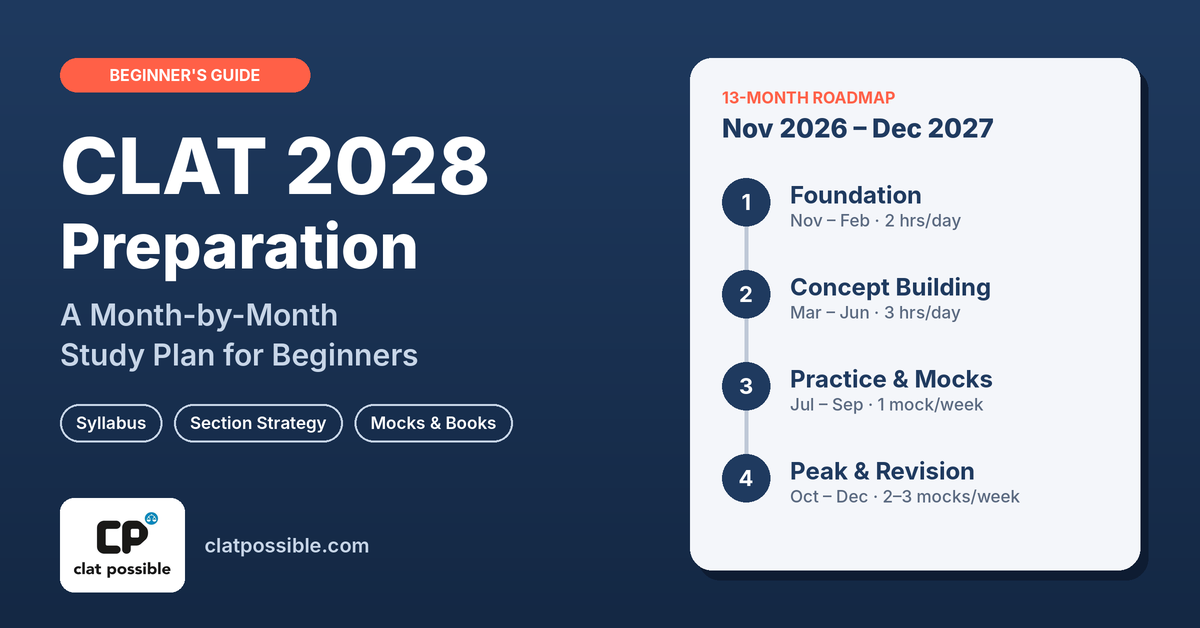
If you are in Class 11 today, you have roughly 13 months until CLAT 2028, which is expected in the first week of December 2027. That is enough time to go from complete beginner to confident test-taker, but only if those months are planned. At CLAT Possible, the students we see struggle are rarely the less talented ones. Instead, they are the ones who started without a plan, studied in bursts, and took their first mock six weeks before the exam. This guide gives you a complete CLAT 2028 study plan, from your first week to exam day.

CLAT Possible 2028 Courses

What This CLAT 2028 Preparation Guide Covers

Why CLAT 2028 Preparation Should Start Now

CLAT rewards reading stamina, reasoning habits and current affairs memory. However, all three build slowly, which is why an early start matters more in CLAT than in most entrance exams. Starting in Class 11 also means you prepare without board-exam pressure for the first few months.

You do not need to study 8 hours a day in Class 11. Instead, you need 2 to 3 focused hours, every day, for 13 months. In short, consistency beats intensity in CLAT.

CLAT 2028 at a Glance

CLAT 2028 will be the Common Law Admission Test for the 2028–29 academic year. The official date is not out yet. For reference, the Consortium has scheduled CLAT 2027 for Sunday, 6 December 2026, from 2:00 PM to 4:00 PM, and has kept the pattern unchanged. Therefore, CLAT 2028 is most likely on the first Sunday of December 2027.

Key HighlightCLAT 2028 (expected)
Conducting bodyConsortium of National Law Universities
Expected exam dateFirst week of December 2027 (tentative)
Expected registrationJuly to October 2027
ModeOffline, pen and paper
Total questions, marks, duration120 questions, 120 marks, 2 hours
Negative marking0.25 marks for every wrong answer
EligibilityClass 12 pass or appearing; 45% (40% for SC/ST); no upper age limit

Dates and pattern for CLAT 2028 are projections based on recent cycles. Always confirm on consortiumofnlus.ac.in once the notification is released.

CLAT 2028 Syllabus and Exam Pattern

The CLAT 2028 syllabus has five sections, and every question is built on a passage. In other words, there is no rote syllabus to memorise; CLAT tests how well you read, reason and apply. The breakdown below follows the current pattern confirmed for CLAT 2027.

SectionQuestionsWeightageWhat it actually tests
English Language22 to 2620%Comprehension, inference, tone, vocabulary in context
Current Affairs including GK28 to 3225%News events, legal and constitutional developments, static GK linked to news
Legal Reasoning28 to 3225%Applying a stated principle to facts; no prior law knowledge needed
Logical Reasoning22 to 2620%Arguments, assumptions, conclusions, strengthen/weaken, puzzles
Quantitative Techniques10 to 1410%Class 10 maths: percentages, ratios, averages, data interpretation
Total120100%+1 for each correct answer, −0.25 for each wrong answer

Three things beginners should notice:

  • Half the paper is GK and Legal. Current Affairs and Legal Reasoning together make up about 50% of your score, so your daily routine must protect time for both.
  • Reading is the hidden sixth section. You will read 25-plus long passages in two hours. Therefore, reading speed with comprehension decides whether you finish the paper.
  • Negative marking punishes guesswork. A wrong answer costs 0.25 marks, so four blind guesses gone wrong wipe out one correct answer.

How to Start CLAT Preparation: Your First 7 Days

Most beginners lose their first month deciding which book to buy. Skip that. Here is how to start CLAT preparation in one week.

DayTaskWhy it matters
Day 1Read the pattern and download the official sample paperYou know exactly what you are preparing for
Day 2Attempt one previous-year CLAT paper untimedYour weak spots matter more than your score
Day 3Read The Hindu or The Indian Express for 30 minutes; note three news itemsStarts your GK notebook and reading habit
Day 4Solve one legal reasoning passage; underline the principle firstThis is the core skill of the section
Day 5Revise percentages and ratios from NCERT Class 8 to 10Quant is built entirely on these basics
Day 6Fix a 2 to 3 hour daily slot around schoolA protected slot is what makes the plan work
Day 7Review the week and list what felt hardestThat list becomes your focus for Month 1

By the end of the week, you will know where you stand and have a routine in place. In fact, that is more than most aspirants have after a month.

CLAT 2028 Study Plan: Month-by-Month Roadmap (November 2026 to December 2027)

This CLAT 2028 study plan runs 13 months in four phases. It assumes you are in Class 11 now and works around school exams, which is where most plans break.

Phase 1: Foundation (November 2026 to February 2027)

Goal: Build reading, news and reasoning habits. No mocks yet. Daily time: 2 hours.

MonthFocusWhat to do
Month 1: November 2026Set the routineNewspaper daily (30 minutes) with 3 to 5 GK notes; 1 English passage a day; NCERT revision of percentages, ratios and averages
Month 2: December 2026Meet legal reasoning1 legal passage a day (principle, facts, application); logical reasoning basics; attempt the CLAT 2027 paper once released and compare with your Day 2 baseline
Month 3: January 2027Widen the baseStatic GK linked to news; recurring legal concepts (contracts, torts, criminal law, constitutional rights); profit and loss, interest, time and work
Month 4: February 2027Protect your school examsClass 11 finals come first; drop to 45 to 60 minutes a day of newspaper plus 1 passage, but do not stop completely

Phase 2: Concept Building (March to June 2027)

Goal: Cover every topic once and start timed sectional practice. Daily time: 3 hours; 5 to 6 hours in summer break.

MonthFocusWhat to do
Month 5: March 2027Restart with sectionalsOne timed sectional test a week; 2 English passages a day with inference and tone questions
Month 6: April 2027Class 12 beginsCritical reasoning (strengthen/weaken, assumptions) plus a few puzzles for speed; data interpretation from tables and graphs
Months 7 and 8: May and June 2027Summer intensive5 to 6 hours a day; solve all previous-year papers since 2020 section by section; first full-length mock at the end of May, then one every two weeks; compile 8 to 9 months of current affairs into one revision file

Phase 3: Practice and Mocks (July to September 2027)

Goal: Shift from learning to performing. Daily time: 3 hours on school days.

MonthFocusWhat to do
Month 9: July 2027Weekly mocks1 full mock a week with analysis as long as the mock itself; start an error log; watch for the CLAT 2028 notification
Month 10: August 2027Fix weak sectionsGive your two weakest sections an extra 45 minutes daily; register for CLAT 2028 early
Month 11: September 2027Build exam strategyTest section orders in mocks and settle on one; set and track time targets per section

Phase 4: Peak and Revision (October to December 2027)

Goal: Peak on exam day, not before it. Daily time: 4 hours.

MonthFocusWhat to do
Month 12: October 2027Two mocks a week2 full mocks weekly plus analysis; revise 12 months of GK, especially legal and constitutional news
Month 13: November 2027Revise and simulate2 to 3 mocks a week at 2:00 PM to train your body clock; re-read your error log weekly; no new books; download the admit card
Exam week: early December 2027Stay freshLight revision of GK notes and the error log only; sleep 7 to 8 hours; walk in rested, not crammed

CLAT 2028 Study Plan: Phase-Wise Summary

PhaseMonthsHours per dayMocks
FoundationNovember 2026 to February 20272None; baseline paper only
Concept BuildingMarch to June 20273 (5 to 6 in summer)First mock in May, then every 2 weeks
Practice and MocksJuly to September 202731 per week
Peak and RevisionOctober to December 202742 to 3 per week

Section-Wise CLAT Preparation Strategy for Beginners

A good CLAT preparation strategy for beginners gives each section a method, not just hours. Here is how our CLAT Possible mentors split the work.

1. Legal Reasoning (28 to 32 Questions)

Treat the passage as the only law that exists, because answers based on outside legal knowledge are the most common trap. Also, use a three-step read: principle, facts, application, and underline the principle before you look at the options. From Phase 2 onward, practise 2 passages a day, and follow legal news, since passages are often built on recent judgments and new laws.

2. Current Affairs including GK (28 to 32 Questions)

Read for context, not trivia: know why an event matters, who is involved and what changed. Keep one GK notebook organised by theme, such as polity, economy, international affairs, environment and legal developments. Above all, revise monthly, since news from 12 to 15 months before the exam can appear.

3. English Language (22 to 26 Questions)

Read 2 editorials a day and summarise each in two lines, which trains main-idea questions. In addition, learn vocabulary from context rather than word lists. By Phase 3, aim to finish a passage in under 6 minutes.

4. Logical Reasoning (22 to 26 Questions)

Focus on argument questions: assumptions, conclusions, strengthen/weaken and flaws. However, do not ignore puzzle-style sets, because the question style can shift from year to year. After each passage, explain in one sentence why the wrong options are wrong.

5. Quantitative Techniques (10 to 14 Questions)

Stick to Class 10 maths and data interpretation, and do not over-invest given the 10% weight. Instead, learn quick calculation tricks such as percentage-fraction equivalents and squares up to 30. Finally, aim for accuracy: eight correct out of eight beats ten attempted with three wrong.

Suggested Time Split for Beginners

SectionShare of study time
Legal Reasoning30%
Current Affairs and GK25%
English Language20%
Logical Reasoning15%
Quantitative Techniques10%

Mock Tests, Revision and Best Books for CLAT 2028

How Many Mocks Should You Take?

Plan for 40 to 50 full-length mocks between May and November 2027. However, the number matters less than the analysis. After every mock, sort your mistakes into three types (concept gap, misread passage, time pressure), re-attempt wrong questions without looking at the answer, and note one change for the next mock.

A Simple Revision Cycle

  • Daily: 15 minutes revising that day’s GK notes.
  • Weekly: A Sunday review of the week’s GK, error log and vocabulary.
  • Monthly: A full revision of the month’s current affairs compilation.

Recommended Books and Resources

SectionRecommended resource
English LanguageThe Hindu or The Indian Express editorials; Word Power Made Easy by Norman Lewis
Current Affairs and GKDaily newspaper; a monthly CLAT current affairs compilation; Lucent’s General Knowledge for static GK
Legal ReasoningPrevious-year CLAT papers (2020 onward); Legal Aptitude for CLAT by A.P. Bhardwaj
Logical ReasoningPrevious-year CLAT papers; R.S. Aggarwal’s A Modern Approach to Verbal and Non-Verbal Reasoning for basics
Quantitative TechniquesNCERT Class 8 to 10 Maths; CLAT-style data interpretation sets
Full-length mocksCLAT Possible mock test series and the official Consortium sample papers

Pick one book per section and finish it twice. After all, five half-read books help no one.

7 Mistakes Beginners Make in CLAT 2028 Preparation

1. Waiting for Class 12 to Start

The 13 months you have now are your biggest advantage. Reading speed and GK memory cannot be rushed later.

2. Collecting Books Instead of Solving Passages

CLAT is a practice exam. Therefore, previous-year papers teach more than any new guide.

3. Skipping Current Affairs for a Month

Missed months are hard to rebuild and can cost you several questions in the GK section.

4. Using Outside Legal Knowledge

In Legal Reasoning, the passage overrides what you know. In short, answer only from the principle given.

5. Taking Mocks Without Analysis

A mock without review is just a timed test. In fact, the analysis is where the score grows.

6. Guessing Blindly

With 0.25 marks lost per wrong answer, attempt a question only when you can eliminate at least two options.

7. Ignoring School

Boards matter for eligibility and for your stamina. Therefore, plan around exams; do not fight them.

How CLAT Possible Helps You Crack CLAT 2028

A plan works best with someone checking that you follow it. At CLAT Possible, our CLAT 2028 programmes are built around the same phases in this guide:

  • Foundation-first teaching for Class 11 students, starting from reading and reasoning basics.
  • Mentorship and doubt support so you never stay stuck on a legal or logical concept.
  • Current affairs material designed for CLAT’s issue-based questions.
  • Mock tests with detailed analysis to track your progress month by month.

Har Ghar Diwali Discount

Conclusion

Your CLAT 2028 preparation starts with the next hour you put in. Therefore, open today’s newspaper, solve one legal passage, and let this month-by-month plan carry you to December 2027. Overall, whether you are just starting out or already a few weeks in, the right plan and the right guidance make every step clearer.

Take Free Demo Class