
CLAT subjects are not like your school subjects. There’s no textbook to memorise and no “law” chapter to learn before the exam. Instead, CLAT tests five skills through passages: reading, staying aware of the world, legal reasoning, logical thinking and basic maths. The Consortium of NLUs has officially confirmed that the syllabus and sections for CLAT 2028 will stay the same.
So in this blog, we’ll walk you through all the CLAT exam subjects using the official CLAT 2028 UG syllabus: how many questions each one has, what it really tests, and how to prepare for it.
CLAT 2027-2028 Courses by CLAT Possible
What You’ll Find in This Blog
CLAT Subjects List and Weightage
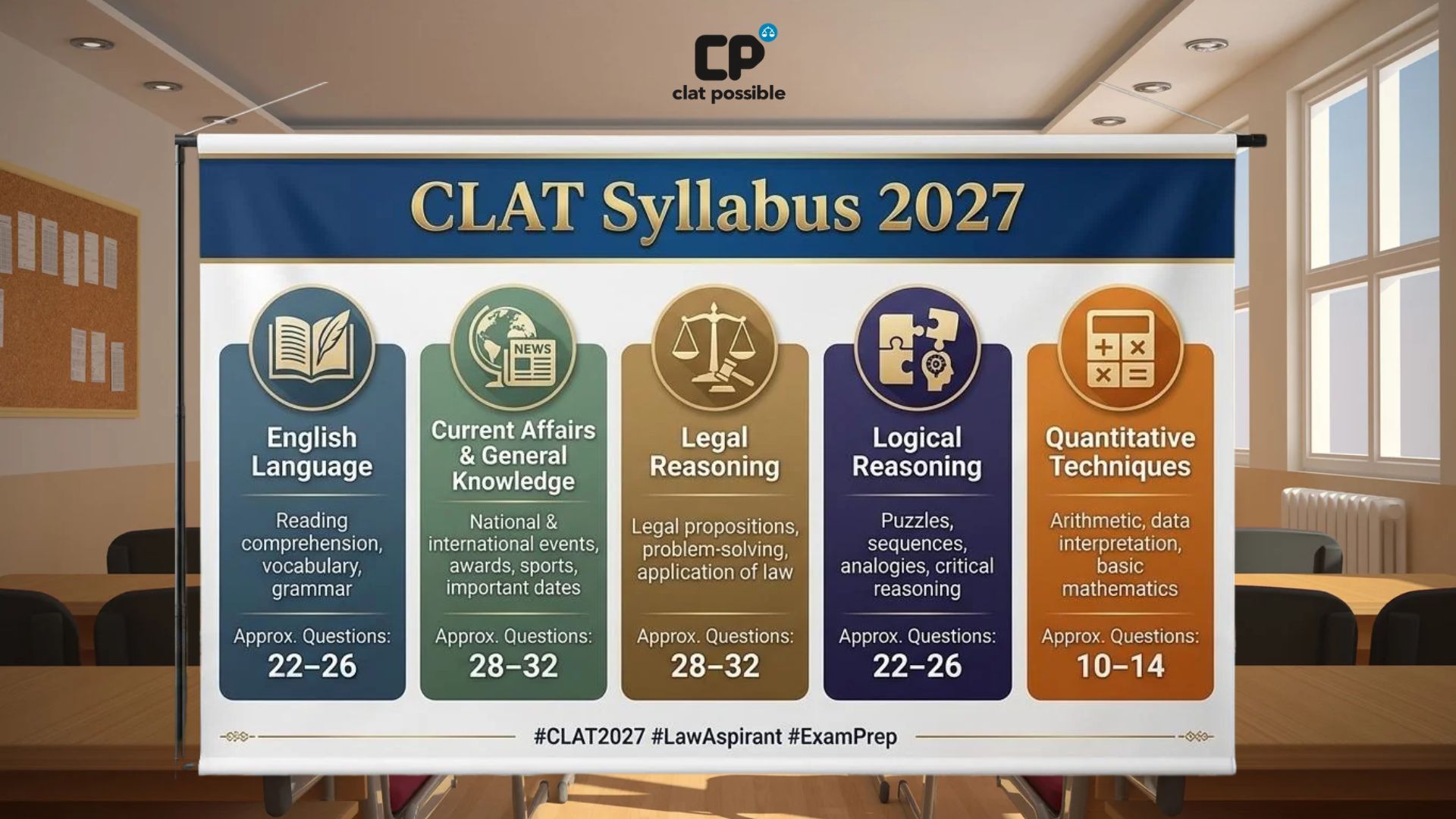
CLAT UG has five subjects, and every one of them is passage-based. Here’s the subject-wise breakdown from the official CLAT 2028 paper pattern, with the approximate number of questions and share of the paper for each.
| CLAT subject | Approx. questions | Share of the paper | What it tests in one line |
|---|---|---|---|
| English Language | 22 to 26 | 20% | How well you understand what you read |
| Current Affairs including General Knowledge | 28 to 32 | 25% | How aware you are of the world around you |
| Legal Reasoning | 28 to 32 | 25% | How well you apply a given rule to facts |
| Logical Reasoning | 22 to 26 | 20% | How well you judge arguments |
| Quantitative Techniques | 10 to 14 | 10% | How comfortable you are with Class 10 maths |
Look at the middle two rows. Current Affairs and Legal Reasoning together make up about half your CLAT score. That alone should shape how you plan your preparation.
CLAT 2028 Exam Pattern
Before going subject by subject, here are the basics of the paper itself, all taken from the Consortium’s official information for CLAT 2028.
| What | Details |
|---|---|
| Exam date and time | Sunday, 6 December 2026, 2:00 PM to 4:00 PM (2:00 PM to 4:40 PM for eligible PwD candidates) |
| Mode | Offline |
| Duration | 2 hours |
| Total questions and marks | 120 multiple-choice questions, 1 mark each, 120 marks in total |
| Negative marking | 0.25 marks deducted for every wrong answer |
| Number of subjects | 5 |
| Changes for CLAT 2028 | None. The Consortium has confirmed no change to the syllabus, pattern or sections |
The Consortium also says the paper tests comprehension and reasoning, and that no prior knowledge is needed, though it can help with current affairs. For a deeper look at the topics, read our CLAT syllabus 2028 guide.
CLAT Subject 1: English Language
English carries about 22 to 26 questions, or 20% of the paper. You’ll get passages of about 450 words each, taken from fiction and non-fiction, both modern and classic. According to the Consortium, a Class 12 student should be able to read each passage in about 5 to 7 minutes.
Under each subject below, we’ve added one short sample question written by our faculty in CLAT style, so you can see what the subject actually feels like. Real CLAT passages are longer, about 450 words.
Here’s what the questions ask you to do:
- Find the main idea, arguments and viewpoints in the passage
- Draw inferences and conclusions from it
- Summarise the passage
- Compare and contrast different arguments or viewpoints
- Work out the meaning of words and phrases as they’re used in the passage
Q. Which of the following best states the main point of the extract?
(A) The library is popular only with students
(B) The library drew a much wider range of people than expected
(C) The officials planned the library badly
(D) The library’s opening was poorly publicised
Answer: (B). The passage contrasts who officials expected with the wide mix of people who actually came.
Our tip: read one editorial a day and write its main point in a single line. That one habit trains almost every question type in this section.
CLAT Subject 2: Current Affairs including General Knowledge
This is one of the two heaviest CLAT subjects, with about 28 to 32 questions, or 25% of the paper. The passages are up to 450 words long and come from news, journalism and other non-fiction writing. Some questions may touch on legal information linked to the passage, but you won’t need legal knowledge beyond it.
The Consortium lists these areas:
- Important events in India and around the world
- Arts and culture
- International affairs
- Historical events that still matter today
Q. The Ramsar Convention, mentioned in the passage, is an international treaty for the conservation of:
(A) Wetlands
(B) Deserts
(C) Coral reefs only
(D) Mountain forests
Answer: (A). The Ramsar Convention, signed in Ramsar, Iran, in 1971, protects wetlands. Notice how the question uses the news to test a static fact.
Our tip: read for context, not trivia. Know why an event matters, who is involved and what changed. If you’re short on time, our free GK Genius PDF lists the top 150 current affairs topics of 2026.
CLAT Subject 3: Legal Reasoning
Legal Reasoning also carries about 28 to 32 questions, or 25% of the paper. The passages are around 450 words each and may describe real situations, legal issues, public policy questions or moral and philosophical questions.
The good news: you don’t need to know any law beforehand. The Consortium says general awareness of current legal and moral issues helps, but the rule you need is always in the passage. The questions ask you to:
- Identify the rules and principles set out in the passage
- Apply those rules to different sets of facts
- Understand how a change in the rule would change the outcome
Facts: A shopkeeper mops the floor of his shop during business hours but puts up no warning sign. A customer walks in, slips on the wet floor and breaks her wrist.
Q. Is the shopkeeper liable?
(A) No, because the customer should have looked where she was walking
(B) No, because mopping a floor is a normal activity
(C) Yes, because he failed to take reasonable care to warn customers, and this caused the injury
(D) Yes, because every shopkeeper is responsible for any injury in the shop
Answer: (C). The shopkeeper owed customers a duty of care, failed to warn them, and that failure caused the harm. Option (D) goes beyond the principle given.
Our tip: underline the principle before you look at the options, and answer only from what the passage says, even if you know the real law is different. For the right books to build this skill, see our guide to the best CLAT legal reasoning books.
CLAT Subject 4: Logical Reasoning
Logical Reasoning has about 22 to 26 questions, or 20% of the paper. You’ll get short passages of about 450 words, each followed by one or more questions. This section is all about arguments: spotting them, testing them and seeing where they break.
According to the Consortium, you’ll be asked to:
- Recognise an argument, its premises and its conclusion
- Identify the arguments made in a passage
- Analyse patterns of reasoning and see how conclusions depend on evidence
- Judge how a conclusion gets stronger or weaker when the facts change
- Work out what follows from a passage and apply it to new situations
- Spot relationships, analogies, contradictions and equivalences, and judge how effective an argument is
Q. Which of the following, if true, most weakens the argument?
(A) Students who already score well feel less stressed, and so they sleep longer
(B) Sleep is known to help memory
(C) Most mock tests are held in the morning
(D) Many CLAT toppers sleep eight hours a night
Answer: (A). It suggests that high scores may cause better sleep, not the other way round, which weakens the conclusion.
Our tip: after every passage you solve, explain in one sentence why each wrong option is wrong. It feels slow at first, but it’s the fastest way to improve accuracy.
CLAT Subject 5: Quantitative Techniques
Quant is the smallest CLAT subject, with about 10 to 14 questions, or 10% of the paper. Instead of long passages, you’ll get short sets of facts, graphs or other number-based information, followed by questions. The maths is at Class 10 level.
The Consortium lists these areas:
- Ratios and proportions
- Basic algebra
- Mensuration
- Statistical estimation
(A) 7 : 6
(B) 7 : 5
(C) 6 : 7
(D) 5 : 7
Answer: (A). Boys = 35 and girls = 25. After 5 girls join, girls = 30, so the ratio is 35 : 30, or 7 : 6.
Our tip: don’t skip Quant just because it’s small. These questions are often the quickest marks in the paper if your basics like percentages and ratios are strong.
How to Split Your 2 Hours Across CLAT Subjects
There’s no fixed time limit for each section, so time management is up to you. Here’s a split many of our students find comfortable. Treat it as a starting point and adjust it in your mocks.
| CLAT subject | Suggested time | Why |
|---|---|---|
| Current Affairs including GK | 15 to 18 minutes | You either know it or you don’t; many students start here to settle in |
| Legal Reasoning | 32 to 35 minutes | Heavy weightage and long passages that need careful reading |
| English Language | 20 to 22 minutes | About 5 to 7 minutes of reading per passage, plus answering |
| Logical Reasoning | 25 to 28 minutes | Tricky options need time to eliminate |
| Quantitative Techniques | 10 to 12 minutes | Fewer questions, quick if your basics are strong |
| Buffer for OMR and review | 5 to 10 minutes | To bubble answers and check the OMR sheet |
Bubbling answers takes more time than most students expect. Our CLAT OMR sheet guide has a free practice sheet so you can build it into your mocks.
Which CLAT Subject Should You Focus on Most?
All five matter, but not equally. Here’s how we’d think about it:
- Legal Reasoning and Current Affairs: together they’re about half the paper, so they deserve the biggest share of your time.
- English and Logical Reasoning: both depend on strong reading. If you read well, you’ll gain in both at once.
- Quantitative Techniques: small, but often the easiest marks to protect. Don’t leave it for the last week.
Also remember that every mark matters. The ranks in CLAT are packed tightly, and a few extra marks in your strongest subject can move you hundreds of places. See how in our CLAT marks vs rank analysis, and check where your current mock score stands with our free CLAT rank predictor.
What About CLAT PG Subjects?
Everything above is for CLAT UG, the exam for the 5-year integrated law programme. CLAT PG, for the LLM programme, is very different. According to the CLAT PG 2028 syllabus, it has 120 objective questions in 120 minutes, with 0.25 marks deducted for each wrong answer, and it tests the core subjects of an undergraduate law degree:
- Constitutional Law, Jurisprudence and Administrative Law
- Law of Contract, Torts and Family Law
- Criminal Law and Property Law
- Company Law, Public International Law and Tax Law
- Environmental Law and Labour and Industrial Law
So if you’re a Class 11 or 12 student, you only need to prepare for the five UG subjects covered in this blog.
Conclusion
CLAT subjects aren’t about how much you memorise; they’re about how well you read, think and apply. Five subjects, 120 questions, 2 hours, and the same pattern as last year. Spend the most time on Legal Reasoning and Current Affairs, read every day for English and Logical Reasoning, and keep your Class 10 maths sharp. Then let your CLAT mock tests tell you which subject to work on next.