close

Best CLAT Legal Reasoning Books for 2027 & 2028: Expert-Picked List and How to Use Them

Many CLAT aspirants own three or four legal reasoning books and finish none of them. That is a costly habit, because Legal Reasoning makes up roughly a quarter of the CLAT paper. The good news is that this section does not test how much law you know. It tests whether you can take a rule from a passage and apply it correctly to a set of facts.

In this blog, we list the best CLAT legal reasoning books for 2027 and 2028, explain what each one is good for, and show you how to use them so they actually improve your score.

CLAT 2027-2028 Courses by CLAT Possible

The CLAT Legal Reasoning Section

Here is a quick look at how the section works:

WhatDetails
Number of questions28 to 32 out of 120
Share of the paperAbout 25%
FormatPassages of around 450 words, each with a set of questions
Do you need to know law?No. The rule is given to you in the passage
Where passages come fromBasic law (torts, contracts, criminal law, Constitution) and current legal news
Marking+1 for a right answer, −0.25 for a wrong one

Together, Legal Reasoning and Current Affairs account for nearly half of your CLAT score. For the full section-wise breakdown, read our CLAT syllabus 2027 guide.

What This Section Really Checks

Every legal reasoning passage tests the same four skills:

  • Finding the exact rule: including its conditions and exceptions.
  • Reading the facts carefully: who did what, when, and why.
  • Using only the passage’s rule: even if the real law is different.
  • Eliminating tempting options: answers that sound fair but do not follow from the rule.

So a good legal reasoning book should do two things: make you comfortable with legal terms, and give you plenty of rule-and-facts practice.

Download GK Genius (Free PDF)

Best CLAT Legal Reasoning Books: Our List

You do not need every book on this list. Pick one from each group and finish it properly.

Book / resourceAuthor / publisherGood forLevel
Legal Awareness and Legal ReasoningA.P. Bhardwaj (Pearson)Basic legal ideas and rule-based questionsBeginner to mid
Universal’s Guide to CLAT and LL.B. Entrance ExaminationUniversal / LexisNexisLots of extra practice questionsMid
Legal Reasoning WorkbookCLAT PossibleCLAT-style passage practice, made by CLAT facultyBeginner to advanced
Our ConstitutionSubhash C. Kashyap (National Book Trust)An easy, friendly start to the ConstitutionBeginner
Introduction to the Constitution of IndiaD.D. Basu (LexisNexis)Looking up topics like Fundamental Rights and writsMid to advanced
Important Judgments That Transformed IndiaAlex Andrews GeorgeBig Supreme Court cases, explained simplyBeginner to mid
CLAT previous year papers (2020 onward)Consortium of NLUsPractice that matches the real examEveryone
The Hindu or The Indian ExpressDaily newspapersCourt rulings, new laws and legal newsEveryone

1. Legal Awareness and Legal Reasoning by A.P. Bhardwaj

Publisher: Pearson | Level: Beginner to mid

This is the first book most mentors suggest. It explains basic legal ideas in plain language and follows them with rule-and-facts questions. One caution: many of its questions are one-liners. Treat them as warm-ups, because the actual exam uses long passages.

2. Universal’s Guide to CLAT and LL.B. Entrance Examination

Publisher: Universal / LexisNexis | Level: Mid

Use this book for extra practice, not for theory. It is useful for building speed. Skip the pure fact-recall questions, since CLAT no longer tests law that way.

3. Legal Reasoning Workbook by CLAT Possible

Level: Beginner to advanced

Written by CLAT Possible faculty, this workbook is built around CLAT-style passages: a rule, a set of facts, and application questions. It bridges the gap between reading concepts and attempting full CLAT papers, and our students use it for regular practice.

4. Our Constitution by Subhash C. Kashyap

Publisher: National Book Trust | Level: Beginner

An easy, readable introduction to the Constitution. It suits students in Class 11 or early Class 12 who are starting from scratch.

5. Introduction to the Constitution of India by D.D. Basu

Publisher: LexisNexis | Level: Mid to advanced

Use this as a reference book, not something to read cover to cover. Turn to it when topics like Fundamental Rights or writs come up in a passage or in the news.

6. Important Judgments That Transformed India by Alex Andrews George

Level: Beginner to mid

This book tells the stories behind famous Supreme Court cases in simple language. It helps a great deal when a CLAT passage is built around a well-known judgment.

7. CLAT Previous Year Papers

Publisher: Consortium of NLUs | Level: Everyone

If you use only one resource, make it this one. Papers from 2020 onward show you the real passage style and how the tricky options are built.

8. Newspapers and Legal News

Sources: The Hindu or The Indian Express

Follow court rulings, new laws and legal editorials. Recent CLAT papers have included passages based directly on legal news. Our 70-day current affairs plan for CLAT 2027 can help you stay on track.

Take Free Demo Class

Which CLAT Legal Reasoning Book to Read and When

What you should read depends on how much time you have left:

Time leftWhat you’re working onWhat to use
More than 12 monthsGetting used to legal words and basic ideasOur Constitution; Important Judgments That Transformed India; daily newspaper
6 to 12 monthsCovering every main area of law onceA.P. Bhardwaj; D.D. Basu when needed
3 to 6 monthsGetting faster and more accurate on passagesCLAT previous year papers; Universal’s Guide; sectional tests
Last 4 to 6 weeksStaying sharp, no new booksFull mocks; your error log; legal news revision

CLAT 2027 is scheduled for 6 December. Keep up with the latest CLAT 2027 updates, and if you are starting early, see our CLAT 2028 study plan.

Area of lawTopics to know
Law of TortsNegligence, defamation, nuisance, trespass, strict and absolute liability, vicarious liability, volenti non fit injuria
Law of ContractOffer, acceptance and revocation, consideration, free consent, who can make a contract, void and voidable contracts
Criminal LawGeneral exceptions, right of private defence, theft, cheating, criminal intimidation; basics of the Bharatiya Nyaya Sanhita
Constitutional LawFundamental Rights, writs, Directive Principles, separation of powers, Centre-State relations
Other areasConsumer protection, basics of family law, environmental law, basics of intellectual property

A Quick Example of a CLAT Legal Reasoning Question

Principle: A person who willingly accepts a known risk cannot claim compensation for harm caused by that risk.

Facts: Riya buys a ticket to a cricket match and sits in the front row. A ball flies into the stands and injures her. She sues the stadium for compensation.

Question: Will Riya succeed?

Answer: No. By choosing to watch the match, Riya accepted the normal risk of a ball entering the stands. The answer would change only if the stadium had been careless beyond that normal risk.

Why: The answer applies only the given rule to the facts and ignores sympathy and real-world law. That is exactly the habit your legal reasoning books should build.

How to Get the Most Out of Your Legal Reasoning Books

  1. Read, then practise straight away: after each chapter, solve a passage on that topic.
  2. Mark the rule first: underline the rule and any exceptions before you look at the options.
  3. Make one-page notes: write a single page per area of law in your own words.
  4. Review every wrong answer: did you misread the rule, miss a fact, or use outside knowledge?
  5. Move to real papers early: start previous year papers and CLAT mock tests sooner rather than later.
  6. Link the news to your books: connect court rulings you read about to the related topic in your book.

Things to Avoid in CLAT Legal Reasoning Preparation

  1. Buying too many books: finishing one book twice beats reading five halfway. Structured CLAT study material keeps you focused.
  2. Memorising section numbers: CLAT tests ideas, not provisions.
  3. Answering from what you already know: the rule in the passage always wins.
  4. Practising only short questions: most of your practice should match the long-passage format.
  5. Skipping the newspaper: recent passages come straight from legal news. Our free GK Genius PDF covers the top 150 topics of 2026.

Download GK Genius (Free PDF)

Conclusion

You do not need a shelf full of law books to do well in CLAT Legal Reasoning. Start with one good book, read the newspaper every day, and shift to previous year papers and mocks as the exam gets closer. Above all, remember the golden rule of this section: the passage is the law.
CLAT 2028: Complete Guide to Exam Date, Syllabus, Eligibility and Preparation

CLAT 2028 is the Common Law Admission Test for admission to the five-year integrated LL.B. and one-year LL.M. programmes of the participating National Law Universities (NLUs) in the 2028–29 academic year. If you will write your Class 12 board exams in 2028, this is most likely your first CLAT.

This cycle is different, because the exam pattern itself is undecided. An Expert Committee has recommended a major redesign of the paper, and the Consortium of NLUs has said it will consider the proposals in preparation for CLAT 2028. As of 23 October 2026, no final decision has been announced.

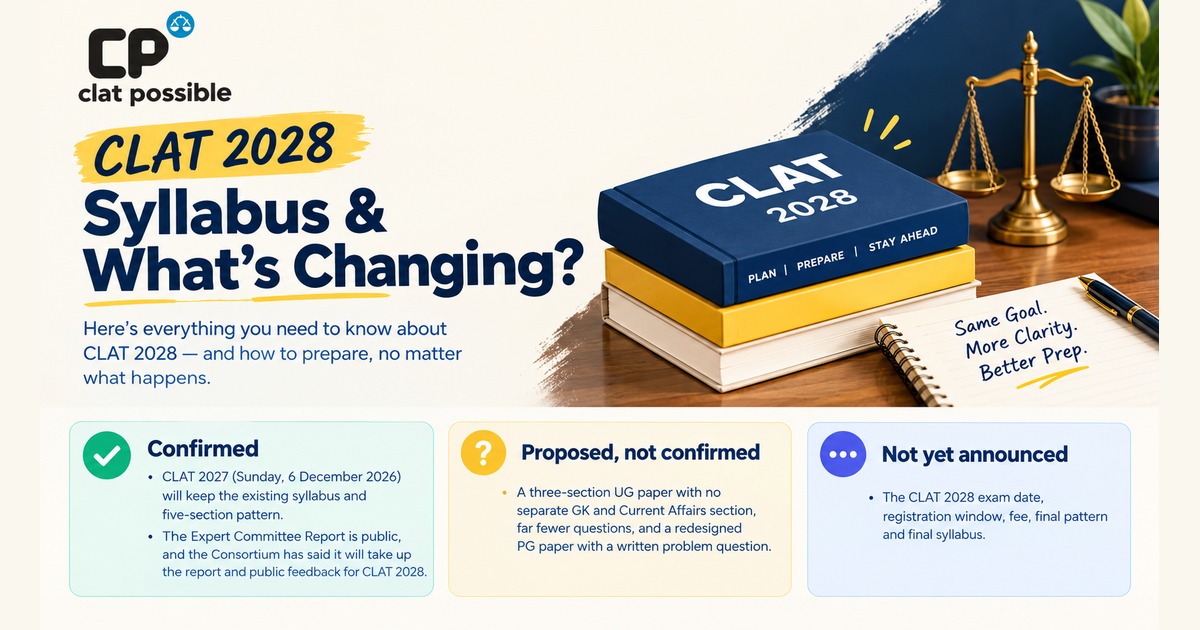
CLAT 2028 status check (as of 23 October 2026)

  • Confirmed: CLAT 2027 (Sunday, 6 December 2026) keeps the existing syllabus and five-section pattern.
  • Proposed, not confirmed: a three-section UG paper, no separate GK/Current Affairs section, fewer questions, and a redesigned PG paper with a written problem question.
  • Not announced: the CLAT 2028 exam date, registration window, fee, final pattern and syllabus.

CLAT 2027-2028 Courses by CLAT Possible

What Is CLAT 2028?

CLAT is conducted by the Consortium of National Law Universities, which was formed on 19 August 2017 and currently lists 26 member NLUs. The year in the exam’s name is the year of admission, not the year the exam is held. CLAT 2027 is being held on 6 December 2026 for admissions in 2027–28, so CLAT 2028 is for admissions in 2028–29.

CLAT UG 2028 and CLAT PG 2028

  • CLAT UG 2028 is for five-year integrated law programmes such as BA LL.B. (Hons.) and BBA LL.B. (Hons.). Programmes and seats vary from one NLU to another.
  • CLAT PG 2028 is for the one-year LL.M., for LL.B. graduates and final-year LL.B. students.

The two papers share a name and an application portal, but their eligibility and content are different. This guide focuses mainly on CLAT UG.

Is CLAT 2028 Your Exam? A Quick Check

Where you are in the 2026–27 school yearYour likely first CLATWhat this guide means for you
Class 10CLAT 2029Too early for intensive preparation; build reading and reasoning habits now.
Class 11CLAT 2028This is your cycle. CLAT 2028 will fall during your Class 12 year.
Class 12CLAT 2027 (December 2026)CLAT 2028 would be a second attempt, during a drop year or alongside college.
Class 12 passed / in collegeCLAT 2028, if you meet the eligibility rulesCLAT 2027 had no upper age limit; confirm the 2028 rule when the notice is out.

CLAT 2028 Exam Highlights

ParticularCLAT 2028 details
Exam nameCommon Law Admission Test (CLAT) 2028
Conducting authorityConsortium of National Law Universities
ProgrammesUG: five-year integrated LL.B.
PG: one-year LL.M.
NotificationNot officially announced
Application datesNot officially announced
Exam dateNot officially announced (recent CLATs have been held in December of the year before admission)
Exam modeNot officially announced for 2028 (CLAT 2027: offline, pen-and-paper)
DurationNot officially announced (CLAT 2027: 2 hours; the Expert Committee also proposes 2 hours)
Pattern and syllabusUnder review. CLAT 2027 is unchanged; Expert Committee proposals are being considered for CLAT 2028
Official websiteconsortiumofnlus.ac.in

CLAT 2028 Exam Date and Important Events

The CLAT 2028 exam date has not been announced yet. Based on recent cycles, it is sensible to plan around December 2027 as a working assumption.

Reference Point: How the CLAT 2027 Schedule Was Announced

CLAT 2027 eventOfficial date
Decision on exam date (Executive Committee and Governing Body meetings)18 July 2026
Press release with exam date and application window22 July 2026
Online applications open3 August 2026
Last date to apply31 October 2026
ExamSunday, 6 December 2026, 2:00 pm to 4:00 pm
Admit card, answer key, result, counsellingTo be notified by the Consortium

CLAT 2028 Events to Track

EventCLAT 2028 statusWhat you should do
Decision on pattern and syllabusPendingWatch for an official notice and any sample paper. The Expert Committee recommended that sample papers be made public if its proposals are accepted.
CLAT 2028 notificationNot announcedRead the eligibility, fee and syllabus sections in full on the official site.
Registration and application formNot announcedKeep documents ready; apply well before the deadline.
Admit cardNot announcedCheck your name, photo, centre and reporting time the day it is released.
ExamNot announcedVisit your centre in advance if you can.
Provisional answer key and objectionsNot announcedCalculate a rough score; raise objections only with solid reasoning.
Final answer key and resultNot announcedDownload your scorecard and note your rank.
Counselling and seat allotmentNot announcedRegister for counselling on time and plan your NLU preference list.

Always rely on the Consortium’s official notices, not social media screenshots. We will update this page as soon as the CLAT 2028 notification is released.

CLAT 2028 Eligibility Criteria

The CLAT 2028 eligibility rules have not been released yet. Until they are, the CLAT 2027 rules are the best reference.

CLAT UG Eligibility (CLAT 2027 Rules)

  • Qualification: Class 12 or equivalent.
  • Minimum marks: 45% (40% for SC/ST). Other category relaxations, including PwD, are given in each year’s notice.
  • Appearing candidates: students writing Class 12 in March/April can apply, but must show proof of passing at the time of admission.
  • Age: no upper age limit.
  • Stream: no specific stream is required. Science, Commerce and Humanities students can all apply.

CLAT PG Eligibility (CLAT 2027 Rules)

  • Qualification: LL.B. or equivalent.
  • Minimum marks: 50% (45% for SC/ST); check the notice for other relaxations.
  • Appearing candidates: final-year LL.B. students can apply, with proof at admission.
  • Age: no upper age limit.
CriteriaCLAT UGCLAT PG
Qualifying examClass 12 or equivalentLL.B. or equivalent
Minimum marks (CLAT 2027)45% (40% SC/ST)50% (45% SC/ST)
Appearing candidatesEligible, with proof at admissionEligible, with proof at admission
Upper age limitNoneNone

Good to know:

  • Your Class 12 marks decide whether you are eligible; your CLAT score decides your rank.
  • Each NLU sets its own rules for domicile, reservation, NRI and foreign-national seats.

CLAT 2028 Exam Pattern: Current Format vs Proposed Changes

There are two possibilities for CLAT 2028: the current five-section paper used for CLAT 2027, or the three-section design proposed by the Expert Committee.

The Current CLAT UG Pattern (Applies to CLAT 2027)

FeatureCLAT 2027 (UG)
Conducting bodyConsortium of National Law Universities
Exam dateSunday, 6 December 2026
Exam timing2:00 pm – 4:00 pm
Application window3 August – 31 October 2026
Duration2 hours
ModeOffline, pen-and-paper (OMR)
Total questions120 multiple-choice questions
Marks per correct answer+1
Negative marking−0.25 for every wrong answer; no penalty for unanswered questions
Number of sections5
SectionsEnglish Language; Current Affairs including General Knowledge; Legal Reasoning; Logical Reasoning; Quantitative Techniques
Question formatPassage-based, with passages of roughly 450 words in the reading-heavy sections

As a rough guide from earlier papers, English carries about 20% of the questions, Current Affairs about 25%, Legal Reasoning about 25%, Logical Reasoning about 20% and Quantitative Techniques about 10%.

The Proposed CLAT 2028 UG Pattern (Expert Committee)

The Expert Committee, made up of five legal academics from Oxford, LSE, Columbia, Cambridge and BML Munjal University, has proposed a three-section paper:

  1. Logical Reasoning and Legal Aptitude: merges the current Legal and Logical Reasoning sections. It would use purely hypothetical scenarios and need no prior legal knowledge.
  2. Language and Comprehension: replaces English, with a focus on inference, implication, tone and the strength of arguments rather than grammar or vocabulary.
  3. Quantitative Techniques: stays as a separate section, with more emphasis on data sufficiency, conceptual numeracy and logic puzzles.
  • There would be no separate GK/Current Affairs section.
  • Each section would have no more than 10 to 15 questions, and the total time would stay at 2 hours.
  • An essay was considered but not recommended for now; it may be revisited after about three years.

Current vs Proposed CLAT UG: Side by Side

FeatureCurrent pattern (CLAT 2027)Proposed by Expert Committee (not confirmed)
Sections53
Total questions120No more than 10 to 15 per section (roughly 30 to 45 in all)
Duration2 hours2 hours
GK and Current AffairsSeparate sectionNo separate section
Legal contentLegal Reasoning passagesHypothetical rule application and rule derivation, merged with logic
Main skill rewardedReading speed across long passagesDepth, accuracy and reasoning
EssayNoneNone for now; to be reconsidered later

CLAT PG 2028: Current Paper and Proposed Redesign

Current paper: 120 multiple-choice questions in 2 hours, with the same marking as UG and no separate sections. It covers Constitutional, Administrative, Contract, Torts, Criminal, Family, Property, Company, Public International, Tax, Environmental and Labour Law, along with Jurisprudence.

Proposed redesign:

  • Three UG-style aptitude sections carrying 50% of the weight.
  • A new Legal Knowledge MCQ section on legal developments from the previous two calendar years, focused on doctrine.
  • No more than 10 questions in each of the four MCQ sections.
  • A written Problem Question: candidates choose one of three problems (Public, Private, Commercial or International Law). NLUs would mark only shortlisted candidates’ answers.
  • Total time: 2 hours.

Where the Decision Stands: A Verified Timeline

  • 15 September 2025: the Consortium forms the Expert Committee, with reforms originally intended from 2027.
  • 15 October – 4 November 2025: public feedback is collected.
  • 11 November 2025, 14 January 2026 and 2 February 2026: interim report, final recommendations and final report.
  • 17 May 2026: meeting at the National Judicial Academy, Bhopal; the Office of the CJI is to constitute a committee to consider the recommendations further.
  • 18 July 2026: the Governing Body decides on no change for CLAT 2027; the report is published and feedback invited until 31 August 2026.
  • 21–22 July 2026: the report and press releases are published.
  • As of 23 October 2026: no official notice on the CLAT 2028 pattern.

Since the reforms have already been deferred once, CLAT 2028 may adopt them fully, partly or not at all. That is why we recommend a dual-track preparation strategy, explained below.

CLAT 2028 Syllabus

The CLAT 2028 syllabus has not been released yet. For topic-level detail on the current syllabus, read our CLAT Syllabus 2027 guide.

Current UG Syllabus (Confirmed for CLAT 2027)

  • English Language: fiction and non-fiction passages of about 450 words, testing the main idea, inference, summary, viewpoints and the meaning of words in context.
  • Current Affairs including GK: news and non-fiction passages on Indian and world events, arts and culture, international affairs and historical events of lasting importance.
  • Legal Reasoning: passages on legal, policy or moral issues. You identify the principle and apply it to the facts. No prior legal knowledge is needed, though general awareness helps.
  • Logical Reasoning: arguments, premises, conclusions, strengthening and weakening statements, inferences, analogies and contradictions.
  • Quantitative Techniques: data given in text, charts or tables, using Class 10-level maths such as ratios, proportions, basic algebra, mensuration and statistical estimation.

See the official CLAT UG syllabus on the Consortium website.

Proposed UG Syllabus (Only If Reforms Are Adopted)

Under the proposal, the paper would have three sections and no separate GK section. Until the Consortium confirms the change, do not assume that any current section will survive or be removed.

Skills That Matter Under Either Syllabus

  • Summarising the argument of a dense passage in one line.
  • Applying a stated rule to facts without using outside knowledge.
  • Spotting assumptions and what strengthens or weakens a conclusion.
  • Comfort with percentages, ratios and data given in words or tables.
  • Accuracy under time pressure, and knowing when to skip a question.

CLAT 2028 Registration and Application Form

CLAT 2028 registration is not open yet. The official notification will confirm the form, fee and deadline. Based on CLAT 2027, the process is likely to be:

  1. Visit consortiumofnlus.ac.in and open the CLAT 2028 page once it is live.
  2. Register with your mobile number and email address.
  3. Fill in your personal, academic and category details.
  4. Choose UG or PG and your test-centre preferences.
  5. Upload your photo, signature and certificates.
  6. Pay the application fee online.
  7. Submit the form and download the confirmation.

Application Fee (CLAT 2027, for Reference)

CategoryCLAT 2027 fee
General, OBC, NRI and other categories₹4,000
SC, ST and BPL (check the notice for other concessions)₹3,500
Previous years’ question papers (optional)₹500 extra

The fee is paid online only, is non-refundable, and any bank charges are borne by the candidate. The CLAT 2028 fee has not been announced.

Documents to Keep Ready

  • A digital photograph and signature.
  • Class 10 certificate (for name and date of birth) and Class 12 marksheet, if available.
  • Category, PwD, BPL or domicile certificates, if applicable.
  • An email ID and mobile number that you will keep active until admissions close.

How to Prepare for CLAT 2028

Do not wait for the final pattern to start preparing. The core skills are the same under both patterns, so every month you spend building them counts. Follow these six steps:

  1. Take a diagnostic, not a verdict: attempt one past paper or mock without a timer, then once under time. Note your weak areas, such as reading speed, misreading, maths gaps or guessing.
  2. Build foundations in the first few months: learn how each question type works. For reasoning, that means assumptions, inferences and conclusions; for maths, revisiting Classes 8 to 10; for legal reasoning, separating the rule, the facts and the question.
  3. Practise daily in small doses: do some serious reading and at least one passage-based set every day.
  4. Add timed work: only once your untimed accuracy is steady.
  5. Take mocks and analyse them: for every wrong or skipped question, record the cause and the fix.
  6. Schedule your revision: review your error log and notes every week and every month.

For a detailed month-by-month plan, see our complete CLAT 2028 study plan.

The Dual-Track Rule for an Undecided Pattern

Make reading, argument analysis, rule application and numeracy your core under both tracks. Keep current affairs as a daily habit rather than heavy memorisation. Then adjust once the pattern is confirmed:

If the Consortium confirms…Adjust your preparation like this
The current five-section patternStep up GK revision, and practise managing time across 120 questions.
The proposed three-section patternDrop GK memorisation for CLAT, go deeper on rule application and rule derivation, practise data sufficiency, and prioritise accuracy because each question will count for more.
A partial or phased changeTreat the official sample paper as your main reference, and realign your mocks to it.

A word of caution: AILET and some other law entrance exams still include GK, so check each exam’s latest notice before you drop current affairs altogether.

Try Roznama (mini CLAT) for Free

Preparation Strategy for Different Students

  • Class 10: you do not need a coaching timetable yet. Read long-form articles a few times a week, discuss the news, find out what studying law at an NLU involves, and keep your board exams first.
  • Class 11 (the core CLAT 2028 group): you have about 13 to 14 months from October 2026. Build foundations first (daily reading, basic maths, reasoning logic), start sectional practice by spring 2027, then move to mocks and pattern adaptation in the second half of 2027. Read more about starting CLAT preparation in Class 11 or Class 12.
  • Class 12: CLAT usually falls in December, before your boards. Put CLAT first from July to December, go lighter on mocks in the weeks before pre-boards, and then switch fully to boards. Board English and maths overlap with CLAT skills. See our guide on juggling CLAT and board exams.
  • Droppers and repeat aspirants: start with an honest post-mortem: was it knowledge, speed or nerves? Set monthly targets, take mocks and analyse them, and protect your health and routine. Rebuild around the shared core skills rather than repeating your 2027 plan. Read our strategies for repeat attempts.
  • Self-study without coaching: follow the official syllabus, use authentic practice material, analyse every test and keep an error log. Start with the Consortium’s documents, then add a quality newspaper and a reliable mock series. Coaching helps most with structure, feedback and doubt-solving. Compare CLAT coaching vs self-study.

Section-Wise Preparation Tips

English Language / Language and Comprehension

  • Method: read editorials and essays; for each, write a one-line summary and describe its tone in one word.
  • Routine: one passage daily, and review why each wrong option is wrong.
  • Mistakes to avoid: answering from memory instead of the passage; memorising word lists without context.

Read more on how to improve reading comprehension for CLAT.

Current Affairs and General Knowledge

  • Method: follow one daily newspaper and keep short thematic notes (polity, economy, international affairs, environment, legal developments).
  • Routine: daily headlines, a weekly recap quiz and monthly consolidation.
  • Mistakes to avoid: collecting PDFs you never revise; learning isolated facts without understanding why they matter.
  • Note: keep this light until the pattern is confirmed. Understanding the news also helps with passage reading.

Legal Reasoning

  • Method: underline the rule, list the material facts, and answer strictly within the passage.
  • Routine: two to three passages a few times a week, plus a weekly “change one fact” drill.
  • Mistakes to avoid: using outside law; skimming the facts.
  • Note: the “change one fact” drill closely matches the rule-application style in the proposed pattern.

Follow our step-by-step legal aptitude guide.

Logical Reasoning

  • Method: identify the conclusion first, then the premises, then the hidden assumption.
  • Routine: short critical reasoning sets most days, and analytical puzzles once or twice a week.
  • Mistakes to avoid: choosing options that are true in real life but do not follow from the passage; ignoring qualifiers such as “some”, “only” and “most”.

Quantitative Techniques

  • Method: rebuild percentages, ratios, averages, profit and loss, and simple algebra, then move on to data given in text and tables.
  • Routine: a short calculation warm-up plus one data set several times a week.
  • Mistakes to avoid: skipping the section entirely; spending too long on a single calculation.
  • Note: add data-sufficiency questions to prepare for the proposed pattern.

Take Free Demo Class

CLAT 2028 Study Plan and Timetable

This plan assumes the exam will be held around December 2027. If the official date is different, shift the phases accordingly.

PhaseIndicative windowFocusYou are ready to move on when…
1. FoundationNow to about March 2027Daily reading, maths basics, how each question type worksYou can summarise a 450-word passage accurately and handle basic arithmetic without hesitation.
2. Skill buildingAbout April to July 2027Sectional practice, an error log, a steady current-affairs habitYour sectional accuracy is consistent across a few weeks.
3. TestingAbout August to October 2027Full-length mocks aligned to the confirmed pattern, with detailed analysisYour mock scores are stable and you have a clear section order and time plan.
4. Final preparationNovember 2027 to the examRevision of notes and error log, fewer but sharper mocks, exam-day routineYou go into the exam with a tested plan rather than new material.

How to Adapt the Plan

  • Starting late: compress Phase 1, but do not skip it.
  • Strong reader, weak in maths: give Quantitative Techniques extra slots in Phases 1 and 2.
  • Pattern confirmed mid-year: match your Phase 3 mocks to the official sample paper and re-weight GK accordingly.

A Sample Weekly Layout (Tasks, Not Hours)

DayCLAT tasks
MondayEditorial reading + one English/comprehension passage + news notes
TuesdayTwo legal reasoning passages + one data set
WednesdayCritical reasoning set + news notes
ThursdayOne comprehension passage + maths fundamentals revision
FridayLegal reasoning “change one fact” drill + puzzle set
SaturdaySectional test or full mock (depending on your phase)
SundayMock analysis, error-log update, weekly current-affairs quiz, rest

Track the tasks you complete, not the hours you sit at your desk.

Best Books and Resources for CLAT 2028

A few resources used thoroughly will do far more for you than a pile of books you never finish.

1. Official Resources (Start Here)

  • The official CLAT UG syllabus page on the Consortium website (switch to the 2028 version once it is published).
  • Previous year papers (sold for ₹500 in the CLAT 2027 cycle).
  • The CLAT Expert Committee Report 2026, which includes sample questions in the proposed styles. These are illustrations, not an official paper.

2. Everyday Reading

  • One quality national newspaper daily, including the editorials.
  • Long-form essays and opinion writing.

3. Supplementary Books and Material

  • NCERT Maths for Classes 8 to 10.
  • One passage-based legal reasoning book and one logical reasoning book.
  • One current-affairs source that is updated every month.
  • Check that any book you buy reflects the confirmed exam structure.

See our list of recommended CLAT preparation books.

4. Practice from CLAT Possible

Our free Roznama (Daily Mini CLAT) gives you about 25 to 30 questions every day, based on that day’s newspaper, across the five current CLAT sections.

Try Roznama Free

CLAT 2028 Mock Tests and Previous Year Papers

How to Use Previous Year Papers

  • Solve the most recent papers first.
  • Attempt them under exam conditions, then analyse them slowly.
  • Remember that older papers may follow older structures. CLAT moved to a passage-based format from 2019–20, so use past papers to build skills, not to predict questions.

How to Choose CLAT 2028 Mock Tests

  • Choose mocks that follow the confirmed pattern. Until it is confirmed, focus on sectional and skill-based tests.
  • Look for detailed solutions, section-wise and question-type breakdowns, and comparison with other students.
  • Fewer mocks, analysed well, beat many mocks taken and forgotten.

A Simple Mock-Analysis Tracker

TrackAsk yourself
Wrong answersWas it a concept gap, a misread question or carelessness?
Skipped questionsDid you skip by choice or because time ran out?
Time per sectionWhere did the clock run away from you?
Repeated errorsWhich question type has gone wrong three times or more?
Next actionWhat one change will you test in the next mock?

Participating NLUs and Law Courses

The CLAT 2028 notification will confirm the participating NLUs and their seat matrices. As of October 2026, the Consortium lists 26 member NLUs:

UniversityLocation
National Law School of India University (NLSIU)Bengaluru
NALSAR University of LawHyderabad
National Law Institute University (NLIU)Bhopal
The West Bengal National University of Juridical Sciences (WBNUJS)Kolkata
National Law University, JodhpurJodhpur
Hidayatullah National Law University (HNLU)Raipur
Gujarat National Law University (GNLU)Gandhinagar
Dr. Ram Manohar Lohiya National Law University (RMLNLU)Lucknow
Rajiv Gandhi National University of Law (RGNUL)Patiala
Chanakya National Law University (CNLU)Patna
National University of Advanced Legal Studies (NUALS)Kochi
National Law University Odisha (NLUO)Cuttack
National University of Study and Research in Law (NUSRL)Ranchi
National Law University and Judicial Academy, Assam (NLUJA)Guwahati
Damodaram Sanjivayya National Law University (DSNLU)Visakhapatnam
Tamil Nadu National Law University (TNNLU)Tiruchirappalli
Maharashtra National Law University, MumbaiMumbai
Maharashtra National Law University, NagpurNagpur
Maharashtra National Law University, Chhatrapati SambhajinagarChhatrapati Sambhajinagar (Aurangabad)
Himachal Pradesh National Law University (HPNLU)Shimla
Dharmashastra National Law University (DNLU)Jabalpur
Dr. B.R. Ambedkar National Law UniversitySonipat
National Law University TripuraAgartala
Dr. Rajendra Prasad National Law UniversityPrayagraj
India International University of Legal Education and Research (IIULER)Goa
National Law University MeghalayaShillong

NLU Delhi is not part of CLAT, as it admits students through its own exam, AILET. Several other universities and organisations also use CLAT scores, so check each one’s rules. For seat numbers, see total seats in NLUs for CLAT 2026.

What to Check for Each NLU

  • Programmes: BA LL.B. is offered almost everywhere, while BBA, B.Com, B.Sc. and BSW LL.B. vary.
  • Seat matrix: the split between all-India, domicile and special-category seats differs.
  • Reservation policy: each NLU applies its own state and central rules.
  • Fees and conditions: these are set by each university.

CLAT 2028 Result, Rank, Cut-Off and Counselling

Result and Scorecard

In recent cycles, the Consortium has released a provisional answer key, invited objections, published the final key, and then declared results with scores and all-India ranks. No CLAT 2028 dates have been announced yet.

CLAT Counselling: How It Worked in the CLAT 2026 Cycle

  • Candidates completed a separate counselling registration, paid a counselling fee and submitted an NLU preference list.
  • Seats were allotted centrally over five rounds, based on rank, category, preferences and seat availability.
  • After each allotment, candidates could choose Freeze, Float (available until round four) or Exit.
  • A confirmation fee had to be paid by the deadline, followed by the balance university fee.

The rules for CLAT 2028 may differ. For more detail, read our CLAT 2026 UG counselling guide.

About Cut-Offs

No expected cut-offs for CLAT 2028 have been published. Past cut-offs must be read by year, category, domicile and counselling round, and should be treated as context, not targets. No particular score guarantees admission.

Common Preparation Mistakes to Avoid

  • Reading only now and then instead of every day.
  • Learning GK passively, without notes or recall practice.
  • Taking mocks without analysing them.
  • Spending too much time on a single passage.
  • Believing unverified claims about the “new pattern”.
  • Postponing revision.
  • Waiting for the final pattern before starting to prepare.

Why Choose CLAT Possible for CLAT 2028 Preparation?

  • Zephyr for Class 11 (CLAT 2028): an offline and online classroom programme with weekend classes.
  • Roznama (free): daily analysis of The Hindu, Words of the Day, the top five headlines and an evening test of 25 to 30 questions, in about 30 minutes a day.
  • Mock tests and test series: the Hammer IT series for CLAT, AILET and other law exams, with a wide range of question styles.
  • Mentorship and doubt-solving: personal mentoring and regular doubt sessions.
  • Study material: prepared and updated by our core teaching team.
  • Flexible formats: online, offline, correspondence and crash courses, with centres in Lucknow, Delhi NCR, Noida, Indirapuram, Chandigarh, Kanpur and Raipur. Use our centre locator to find one near you, and see our past Clat Possible results.

Start your preparation with a plan that works for either pattern.

Start Your CLAT 2028 Preparation

Conclusion

The CLAT 2028 pattern may still change, but the skills it rewards will not. Build a daily reading habit, strengthen your maths basics, practise rule application, keep up with current affairs, start an error log, and check the Consortium website regularly. Once the pattern is announced, adjust your plan, and if you want a structured, mentored path that adapts to the final pattern, explore our CLAT 2028 programmes.

Official Sources Used in This Guide

Crafting Your CLAT 2025 Study Plan: A Comprehensive Guide

CLAT 2025 Study Plan

The Common Law Admission Test (CLAT) is a critical step for aspiring law students in India. Given its competitive nature, it’s essential to start your preparation early and follow a meticulously structured study plan. This guide will help you craft a comprehensive study plan for CLAT 2025, ensuring you cover all necessary topics efficiently. Additionally, we’ll address some frequently asked questions to help clarify common concerns.

Understanding the CLAT Exam Structure

Before diving into the preparation strategy, it’s crucial to understand the exam format.

  • Exam Sections: CLAT consists of five sections:
    • English Language: Focuses on comprehension, grammar, and vocabulary.
    • Current Affairs including General Knowledge: Covers recent events, history, geography, general science, economics, and civics.
    • Legal Reasoning: Tests your understanding of legal principles and their application.
    • Logical Reasoning: Involves critical thinking, logical sequences, and arguments.
    • Quantitative Techniques: Basic mathematical ability, primarily class 10th level.
  • Exam Duration: The exam is 120 minutes long.
  • Question Format: Primarily multiple-choice questions (MCQs) with one mark for each correct answer and a negative marking of 0.25 for each incorrect answer.

Step-by-Step Guide to Craft Your CLAT 2025 Study Plan

1. Assess Your Current Knowledge

  • Diagnostic Test: Start by taking a diagnostic test to evaluate your current level in each section. This will help you identify your strengths and areas that need improvement.
  • Self-Assessment: Reflect on your previous academic performance and your comfort level with each subject area.

2. Set Clear Goals

  • Define Your Targets: Set specific, measurable, achievable, relevant, and time-bound (SMART) goals for your CLAT preparation.
  • Daily and Weekly Goals: Break down your targets into manageable daily and weekly goals to ensure consistent progress.

3. Create a Study Schedule

  • Daily Study Plan: Allocate specific time slots for each subject. Ensure a balanced approach, giving more time to weaker areas.
  • Weekly Review Sessions: Dedicate time each week to review what you’ve studied. This helps reinforce your learning and identify areas needing revision.
  • Mock Tests and Practice Papers: Integrate regular mock tests into your schedule. They help simulate exam conditions and improve time management.

4. Focus on Each Section

  • English Language:
    • Reading Comprehension: Practice reading diverse materials like newspapers, novels, and journals.
    • Vocabulary: Use flashcards, word lists, and vocabulary apps to enhance your word power.
    • Grammar: Review basic grammar rules and practice through exercises and quizzes.
  • Current Affairs and General Knowledge:
    • Daily News: Read newspapers and follow reliable news sources daily.
    • Monthly Magazines: Subscribe to current affairs magazines.
    • Static GK: Study history, geography, and general science from standard books.
  • Legal Reasoning:
    • Principles and Concepts: Understand basic legal principles and their applications.
    • Case Laws: Familiarize yourself with landmark judgments and legal terms.
    • Practice: Solve previous years’ question papers and mock tests.
  • Logical Reasoning:
    • Critical Thinking: Engage in puzzles, brainteasers, and logical games.
    • Practice Questions: Regularly solve logical reasoning questions to improve speed and accuracy.
  • Quantitative Techniques:
    • Basic Mathematics: Strengthen your fundamentals in arithmetic, algebra, and geometry.
    • Practice: Solve quantitative aptitude questions from various sources.

5. Regular Revision

  • Revision Plan: Have a dedicated revision plan. Regularly revisit topics to ensure retention.
  • Notes and Summaries: Create concise notes and summaries for quick revisions.

6. Stay Healthy and Positive

  • Healthy Lifestyle: Maintain a balanced diet, get adequate sleep, and exercise regularly.
  • Mental Health: Practice mindfulness, meditation, or yoga to reduce stress and stay focused.

Frequently Asked Questions (FAQs)

1. How many hours should I study daily for CLAT 2025?

  • It’s recommended to study for 4-6 hours daily, but the key is consistency and focused study. Quality matters more than quantity.

2. When should I start preparing for CLAT 2025?

  • Starting your preparation at least a year in advance is ideal. This gives you ample time to cover all topics and revise thoroughly.

3. How important are mock tests in CLAT preparation?

  • Mock tests are crucial as they simulate the actual exam environment, help you manage time effectively, and identify your strengths and weaknesses.

4. What are some good resources for CLAT preparation?

  • Books: Universal’s CLAT Guide, Pearson’s Guide to the CLAT, and books by R.S. Aggarwal for quantitative and logical reasoning.
  • Online Platforms: Websites like CLATapult, Career Launcher, and TestFunda offer excellent resources and practice tests.
  • Newspapers: The Hindu, The Indian Express for current affairs and reading comprehension practice.

5. How do I stay motivated during my preparation?

  • Set short-term goals and reward yourself for achieving them.
  • Join study groups or online forums to stay connected with fellow aspirants.
  • Keep reminding yourself of your ultimate goal and visualize your success.

Conclusion

Crafting a well-structured study plan is the first step towards acing CLAT 2025. By understanding the exam pattern, setting clear goals, and following a disciplined study routine, you can enhance your chances of success. Remember, consistency and perseverance are key. Stay focused, practice regularly, and take care of your mental and physical health. Good luck!

For more informative blogs on CLAT 2025 preparation, Click Here!!

Deep Dive into CLAT Logical Reasoning: Tips and Tricks

CLAT Logical Reasoning

Introduction to CLAT Logical Reasoning

The Common Law Admission Test (CLAT) is a gateway for students aspiring to enter the prestigious law schools of India. The Logical Reasoning section, in particular, is a critical component of the exam, designed to test the analytical abilities that are essential for a successful law career. This section not only examines your ability to reason logically but also your proficiency in understanding complex texts and deriving conclusions effectively.

Understanding the Structure of CLAT Logical Reasoning

The Significance of Logical Reasoning in CLAT

In the context of law, logical reasoning is paramount as it simulates the kind of thinking and problem-solving required in legal situations. The section typically represents about 20% of the total exam score, highlighting its importance.

Overview of Question Types

Questions in this section range across various formats including but not limited to:

  • Syllogisms: Testing the ability to derive conclusions from given premises.
  • Logical Puzzles: Evaluating the ability to understand and organize information.
  • Cause and Effect Reasoning: Identifying the relationship between different statements or events.
  • Analogies and Classification: Testing the ability to identify relationships or categorize items based on common characteristics.
  • Deductive Reasoning: Applying general rules to specific cases to derive conclusions.

Each type of question demands specific strategies and a deep understanding of logic principles.

Preparative Strategies for Logical Reasoning

Developing a Study Plan

Effective preparation starts with a well-structured study plan tailored to the demands of the CLAT exam. This plan should include:

  • Theory Review: Deep dive into logical reasoning principles and theories.
  • Practice Sessions: Regular practice with a variety of question types.
  • Mock Tests: Simulated exams under timed conditions to build exam-day readiness.

Critical Reading and Analysis Skills

Developing proficiency in reading quickly and comprehensively is essential. Practicing with dense legal texts or complex logical reasoning scenarios can enhance your ability to extract relevant information swiftly and accurately.

Problem-Solving Techniques

Identifying Argument Structures

Understanding how arguments are constructed is fundamental. Practice identifying the various elements of arguments, such as premises, conclusions, and hidden assumptions, which are often tested.

Pattern Recognition and Deduction

Mastering pattern recognition involves a lot of practice with sequence questions, classification tests, and logical matrix puzzles. These skills are not only crucial for the CLAT but are also valuable in legal studies and practice.

Tips and Tricks for Enhancing Accuracy

Time Management

Time is a critical factor in the CLAT. Develop the ability to judge the time each question requires and decide quickly whether it’s worth pursuing immediately or marking for review.

Elimination Techniques

Mastering the art of elimination can drastically increase your test accuracy. Learn to identify and discard options that are clearly inconsistent with the information provided or logically impossible.

Common Pitfalls and How to Avoid Them

Overlooking Details

One common mistake is glossing over details that are critical for answering the question correctly. Practicing mindfulness and attention to detail during your study sessions can mitigate this risk.

Falling for Traps

CLAT examiners often set traps within logical reasoning questions to test your depth of understanding. Be vigilant and think critically about each answer choice.

Example Questions and Solutions

Analyzing a Sample Logical Deduction Question

Example: “All apples are fruits. All fruits are tasty. What conclusion follows?”

  1. All apples are tasty.
  2. Some tasty things are apples.

The correct answer is 1, which directly follows from applying the transitive property of the given statements.

Breaking Down a Logical Puzzle

Example: “Four friends — A, B, C, D — each wear a different colored shirt — red, blue, green, yellow — not necessarily in that order. Given certain clues, you must determine who wears what.”

Solving this type of question involves drawing logical conclusions from the clues, systematically testing possibilities, and using a process of elimination.

Advanced Techniques and Recent Trends

Incorporating Technology in Preparation

Leveraging technology, such as CLAT preparation apps and online tutoring, can provide adaptive practice scenarios and insights into your performance trends.

Awareness of Recent Changes in Question Patterns

Keeping up to date with the latest exam patterns is crucial. Regularly reviewing the past year’s papers and updates from the exam board can provide critical insights into what to expect and how to prepare effectively.

FAQs on CLAT Logical Reasoning

What is the best method to improve speed in the Logical Reasoning section?

  • Regular timed practice focusing on different question types can help improve both speed and accuracy.

How important are mock tests in preparing for CLAT Logical Reasoning?

  • Mock tests are vital as they simulate the exam environment, helping you manage time and stress effectively.

Can Logical Reasoning skills be improved in a short time?

  • Yes, with focused and intensive practice, especially on weak areas, significant improvement can be achieved quickly.

What are some recommended resources for CLAT Logical Reasoning?

  • Top recommended resources include official CLAT preparation books, online courses, and mock test series that offer a comprehensive array of practice questions and solutions.

How to stay calm during the exam while solving complex puzzles?

  • Regular practice under timed conditions is essential. Also, developing a strategy to tackle easier questions first can help build confidence during the exam.

Conclusion

Mastering the Logical Reasoning section in the CLAT exam requires a blend of analytical skills, strategic preparation, and rigorous practice. By understanding the section’s structure, focusing on effective problem-solving techniques, and staying updated with exam trends, candidates can significantly enhance their performance. Remember, consistent practice and a clear understanding of logical principles are the keys to success. Best of luck with your preparations!

For more informative blogs on CLAT 2025 preparation, Click Here!!

How to Start Preparing for CLAT Exam Like a Pro: Comprehensive Strategy & Tips

Preparing for CLAT Exam Like a Pro

Introduction

Preparing for the Common Law Admission Test (CLAT) is a journey that demands strategy, dedication, and a clear understanding of the exam pattern. With thousands of aspirants vying for admission to the top National Law Universities (NLUs) in India, a strategic approach can make all the difference. This guide will provide you with a comprehensive roadmap to start preparing for CLAT exam like a pro. Let’s delve into an exhaustive plan, covering everything from understanding the exam to practical preparation strategies.

Table of Contents

Headings

Sub-Topics

Understanding the CLAT Exam

Exam Overview, Eligibility Criteria, Syllabus & Subjects

CLAT Exam Pattern & Structure

Exam Format, Marking Scheme, Question Distribution

Importance of CLAT in Legal Education

NLUs Admission, Career Opportunities

Setting Clear CLAT Preparation Goals

Identifying Strengths & Weaknesses, Score Targets

Crafting a CLAT Study Schedule

Weekly Timetable, Study Sessions, Mock Tests

Resources for CLAT Preparation

Recommended Books, Online Platforms, Coaching Centers

Subject-Wise CLAT Preparation Tips

English, Legal Aptitude, Logical Reasoning, GK & Current Affairs, Mathematics

Mock Tests & Previous Year Papers

Benefits of Mock Tests, Solving Previous Year Papers

Time Management Strategies for CLAT Exam

Time Allocation, Practice Techniques, Effective Question-Solving

Analyzing Mock Test Results

Score Analysis, Identifying Improvement Areas

CLAT Coaching vs. Self-Study

Pros & Cons, Choosing the Right Approach

Online CLAT Preparation: How to Leverage It

Online Resources, Practice Platforms, Video Lectures

Handling Exam Day Anxiety

Stress Management, Exam Day Routine, Mental Health

Dos and Don’ts During CLAT Exam

Effective Attempt Strategies, Avoiding Common Pitfalls

FAQs on CLAT Exam Preparation

FAQs, Common Doubts, Effective Solutions

Conclusion: Road to Success in CLAT

Summing Up Strategies, Final Tips & Motivation

Understanding the CLAT Exam

Exam Overview: The Common Law Admission Test (CLAT) is a national-level entrance exam conducted by the Consortium of NLUs. It opens doors to undergraduate (UG) and postgraduate (PG) law programs at top law schools in India.

Eligibility Criteria:

  • UG Program: 10+2 or equivalent with a minimum of 45% (40% for SC/ST).
  • PG Program: LL.B. degree or equivalent with a minimum of 50% (45% for SC/ST).

Syllabus & Subjects:

  • UG Exam: English, Current Affairs, Legal Reasoning, Logical Reasoning, Quantitative Techniques.
  • PG Exam: Constitutional Law, Jurisprudence, other Law Subjects.

CLAT Exam Pattern & Structure

Exam Format:

  • UG Exam: 150 multiple-choice questions (MCQs) with a 2-hour duration.
  • PG Exam: 120 MCQs and two subjective questions.

Marking Scheme:

  • UG Exam: +1 for correct answers, -0.25 for incorrect answers.
  • PG Exam: +1 for correct answers, -0.25 for incorrect answers in MCQs.

Question Distribution:

  • UG Exam:
    • English: 28-32 questions
    • Current Affairs & GK: 35-39 questions
    • Legal Reasoning: 35-39 questions
    • Logical Reasoning: 28-32 questions
    • Quantitative Techniques: 13-17 questions

Importance of CLAT in Legal Education

  1. Admission to NLUs: CLAT is a gateway to 22 prestigious NLUs, offering undergraduate and postgraduate law programs.
  2. Career Opportunities: Graduating from an NLU enhances career prospects in law firms, corporate legal departments, judiciary, and more.
  3. Legal Network Building: An NLU environment provides exposure to internships, research opportunities, and a strong network.

Setting Clear CLAT Preparation Goals

  1. Identifying Strengths & Weaknesses: Take a diagnostic test to assess your initial level in each subject.
  2. Score Targets: Research previous cutoffs to set realistic score targets for admission into your preferred NLU.
  3. Subject Prioritization: Allocate more time to weaker subjects while maintaining proficiency in strengths.

For more informative blogs on CLAT 2025 preparation, Click Here!!

Ace the CLAT Exam with Personalized Coaching: Your Ultimate Guide

Ace the CLAT Exam

Table of Contents

  • Introduction
    • Importance of the CLAT Exam
    • Need for Personalized Coaching
  • Understanding the CLAT
    • Exam Structure
    • Subjects Covered
    • Scoring Pattern
    • Application Procedure
  • Why Personalized CLAT Coaching Matters
    • Identifying Strengths and Weaknesses
    • Customized Study Plans
    • Flexible Scheduling
  • Advantages of Personalized CLAT Coaching
    • Individual Attention
    • Targeted Improvement
    • Effective Study Material
    • Enhanced Confidence and Motivation
  • Key Features of Personalized CLAT Coaching
    • Tailored Mock Tests
    • Regular Assessments
    • Adaptive Learning Approach
    • Focused Guidance
    • Time Management Techniques
  • Customized Study Plans
    • Developing Efficient Strategies
    • Scheduling Study Hours
    • Incorporating Revision
  • Focused Mentorship
    • Identifying Problem Areas
    • Regular Feedback
    • Boosting Confidence
  • Effective Test Strategies
    • Time Management
    • Prioritizing Sections
    • Dealing with Negative Marking
    • Simulating Exam Environment
  • How to Choose the Right Personalized CLAT Coaching
    • Researching Options
    • Evaluating Reviews
    • Consulting Peers
    • Assessing Flexibility
    • Cost vs. Value
  • Maximizing the Benefits of Personalized Coaching
    • Communication
    • Regular Assessment
    • Consistency
    • Self-Reflection
  • Common Myths about Personalized CLAT Coaching
    • “Expensive”
    • “One-size-fits-all”
    • “Limited Resources”
    • “Only for Beginners”
  • FAQs about Personalized CLAT Coaching
  • Conclusion

Introduction

The Common Law Admission Test (CLAT) is one of India’s most competitive exams for students aspiring to join prestigious law schools. With thousands of aspirants vying for limited seats, personalized CLAT coaching can make a world of difference. In this comprehensive guide, we delve into how personalized CLAT coaching can help you ace the CLAT exam.

Importance of the CLAT Exam

The CLAT is not just another entrance test; it’s a gateway to prestigious National Law Universities (NLUs) and other top law schools. It opens doors to promising careers in law firms, the judiciary, corporate legal departments, and beyond. Hence, excelling in CLAT is crucial for those aiming to make a mark in the legal field.

Need for Personalized Coaching

Every student is unique, with different strengths, weaknesses, learning styles, and study requirements. Traditional coaching classes often fail to cater to these individual needs, leading to suboptimal performance. Personalized coaching, on the other hand, addresses these unique requirements through tailored strategies, enabling students to maximize their potential.

Understanding the CLAT

To fully comprehend the benefits of personalized coaching, it’s essential to understand the CLAT exam structure, scoring pattern, and application process.

Exam Structure

The CLAT exam consists of five sections, each designed to test different aspects of a student’s knowledge and analytical skills:

  1. English Language: This section includes comprehension passages, vocabulary, grammar, and sentence correction. The comprehension passages assess the student’s ability to understand and interpret written content.
  2. Current Affairs, including General Knowledge: This section tests the candidate’s awareness of current events and general knowledge, including historical and contemporary issues.
  3. Legal Reasoning: This section involves problem-solving through legal principles and maxims, testing the aspirant’s legal aptitude.
  4. Logical Reasoning: Analytical puzzles, logical arguments, and data interpretation form the crux of this section, assessing a student’s analytical and logical thinking.
  5. Quantitative Techniques: Elementary mathematics, data interpretation, and data sufficiency are tested here to gauge a candidate’s quantitative aptitude.

Scoring Pattern

  • Total Questions: 120
  • Total Marks: 120
  • Negative Marking: 0.25 marks deducted for each incorrect answer
  • Duration: 2 hours

Application Procedure

  1. Registration: Candidates need to visit the official CLAT website to register.
  2. Filling the Form: Fill in the required details, upload relevant documents, and choose the preferred exam center.
  3. Fee Payment: Pay the application fee through the available online payment methods.
  4. Admit Card: Download the admit card once it’s available.

Why Personalized CLAT Coaching Matters

Personalized CLAT coaching provides aspirants with a tailor-made study plan that identifies their strengths and weaknesses. Here’s how it makes a difference:

Identifying Strengths and Weaknesses

An in-depth diagnostic test helps coaches identify specific areas of improvement. Understanding the strengths and weaknesses of each student allows for focused coaching, ensuring time and effort are directed where they are needed most.

Customized Study Plans

Students receive individualized study plans based on their unique needs and learning pace. This eliminates the ‘one-size-fits-all’ problem of traditional coaching. Personalized plans help students cover the syllabus systematically while leaving ample time for practice and revision.

Flexible Scheduling

With flexible schedules, students can study at their convenience, allowing them to balance school and preparation. This flexibility helps minimize stress and ensures consistent preparation.

Advantages of Personalized CLAT Coaching

Personalized CLAT coaching brings several advantages to the table:

Individual Attention

One-on-one attention ensures that students receive detailed feedback and support. This direct mentorship allows coaches to clarify doubts immediately and provide practical tips for improvement.

Targeted Improvement

Instead of a general curriculum, students focus on areas where they need the most improvement. This approach maximizes study efficiency and ensures balanced progress across all subjects.

Effective Study Material

Coaches provide updated study materials aligned with the latest CLAT syllabus. Personalized coaching ensures that students focus only on relevant content, saving time and effort.

Enhanced Confidence and Motivation

Regular feedback and progress assessments boost students’ confidence, while positive reinforcement from mentors motivates them to stay consistent with their preparation.

Key Features of Personalized CLAT Coaching

Tailored Mock Tests

Mock tests mimic the real exam environment and are adapted to suit individual progress levels. Tailored mock tests are crucial in helping students identify their weak areas, practice time management, and develop effective test-taking strategies.

Regular Assessments

Periodic assessments gauge progress and adjust the study plan accordingly. These assessments include practice quizzes, section-wise tests, and comprehensive mocks to monitor improvement.

Adaptive Learning Approach

As students progress, coaching methods adapt to their evolving needs. For instance, a student struggling with logical reasoning might receive extra sessions or specialized assignments focused on that section.

Focused Guidance

Personalized coaching offers focused guidance on every section, from English comprehension techniques to legal reasoning strategies, ensuring holistic preparation.

Time Management Techniques

Time management is crucial in a time-bound exam like CLAT. Personalized coaching equips students with strategies to manage time effectively, ensuring all sections are completed with confidence.

Customized Study Plans

Developing Efficient Strategies

Personalized CLAT coaching helps students develop a comprehensive and efficient preparation strategy. Coaches help students:

  • Create a realistic study timetable that aligns with school schedules and personal commitments.
  • Prioritize high-weightage sections based on strengths and weaknesses.
  • Allocate specific study hours for each section and subtopic.

Scheduling Study Hours

Balancing school, hobbies, and CLAT preparation can be challenging. Personalized coaching provides practical advice on how to:

  • Utilize morning hours for revision or practice tests.
  • Dedicate weekends to comprehensive study sessions.
  • Include daily breaks to prevent burnout.

Incorporating Revision

Revision is integral to effective preparation. Coaches help students incorporate periodic revision into their schedules, ensuring long-term retention of concepts.

Focused Mentorship

Identifying Problem Areas

Focused mentorship helps identify specific problem areas for each student. Through diagnostic tests and regular assessments, mentors gain insights into topics where the student needs extra attention.

Regular Feedback

Mentors provide detailed feedback on each assessment, highlighting areas that require improvement. This feedback includes suggestions for resources, techniques, and study habits.

Boosting Confidence

A mentor’s encouragement can make a significant difference in a student’s performance. Regular interactions help students clarify doubts, discuss test strategies, and build their confidence for the big day.

Effective Test Strategies

Personalized CLAT coaching emphasizes effective test strategies:

Time Management

Students learn to divide their time wisely across sections. Coaches advise:

  • Prioritizing Sections: Attempting strong sections first boosts confidence and helps maximize scores.
  • Section-wise Timing: Set strict time limits for each section to avoid overrunning.
  • Skipping Difficult Questions: Don’t waste time on overly difficult questions; revisit them later if time permits.

Prioritizing Sections

Each student has unique strengths. Personalized coaching helps identify strong sections and devise a strategy to maximize scores.

Dealing with Negative Marking

  • Strategic Guesswork: If unsure about an answer, strategic guesswork can minimize negative marking.
  • Eliminating Options: Eliminate obviously wrong options to improve the chances of guessing correctly.
  • Confident Answering: Answer only those questions you’re confident about to avoid unnecessary deductions.

Simulating Exam Environment

Practicing in a simulated exam environment prepares students mentally and physically for the actual test. Personalized coaching often includes full-length mocks under timed conditions.

How to Choose the Right Personalized CLAT Coaching

Researching Options

  • Explore different coaching institutes and compare their offerings.
  • Look for specialized coaches with experience in CLAT preparation.

Evaluating Reviews

  • Read reviews and testimonials from previous students.
  • Consult online forums and social media groups for honest opinions.

Consulting Peers

  • Talk to friends or acquaintances who have previously taken the CLAT.
  • Attend demo classes or webinars to gauge the teaching quality.

Assessing Flexibility

  • Ensure the coaching institute offers flexible schedules.
  • Verify whether they can tailor the curriculum based on individual needs.

Cost vs. Value

  • Consider the coaching fees in relation to the value provided.
  • Look for institutes offering installment payment options or discounts.

Maximizing the Benefits of Personalized Coaching

Communication

  • Maintain open communication with your coach to clarify doubts promptly.
  • Regularly update them on your progress and challenges.

Regular Assessment

  • Take every assessment seriously, even if it’s a practice quiz.
  • Analyze each test to understand where improvement is needed.

Consistency

  • Stick to the study schedule provided by the coach.
  • Ensure consistent preparation, even if it’s just for a short period daily.

Self-Reflection

  • Reflect on your progress periodically.
  • Discuss any roadblocks with your coach to adjust the study plan.

Common Myths about Personalized CLAT Coaching

“Expensive”

While personalized coaching can seem expensive, the value it provides in terms of targeted improvement and efficient study plans often outweighs the cost.

“One-size-fits-all”

Personalized coaching is inherently customizable. The study plans, feedback, and test strategies are all adapted to suit individual needs.

“Limited Resources”

Many believe personalized coaching offers fewer resources than group classes. In reality, students receive access to comprehensive study materials and a wealth of online resources.

“Only for Beginners”

Personalized coaching benefits all students, whether beginners or advanced. It helps beginners establish a solid foundation and guides advanced learners toward mastering specific sections.

FAQs about Personalized CLAT Coaching

How does personalized CLAT coaching differ from traditional coaching?

  • Personalized coaching offers tailored study plans, one-on-one mentorship, and flexible scheduling, unlike traditional coaching’s standardized curriculum.

Is personalized coaching suitable for working professionals?

  • Yes, personalized coaching offers flexible schedules, making it ideal for working professionals and students with busy school schedules.

Can personalized coaching guarantee success in CLAT?

  • While it doesn’t guarantee success, personalized coaching maximizes your potential by identifying weak areas and providing targeted improvement strategies.

How early should I start with personalized CLAT coaching?

  • Ideally, you should start at least 8-12 months before the exam. However, even 4-6 months of focused preparation can yield significant results.

Is personalized coaching more effective than self-study?

  • Personalized coaching provides structured guidance, regular assessments, and expert feedback, making it more effective than self-study for many students.

Are online personalized coaching options effective?

  • Yes, online personalized coaching is effective if the coaching institute provides comprehensive study materials, interactive classes, and regular assessments.

Conclusion

The CLAT exam requires strategic preparation, discipline, and effective test-taking strategies. Personalized CLAT coaching offers tailored study plans, focused mentorship, and adaptive strategies to help you ace the exam. By understanding your strengths, weaknesses, and learning style, a personalized coach can guide you to maximize your score and secure a place in your dream law school.

For more informative blogs on CLAT 2025 preparation, Click Here!!

CLAT 2025 EXAM DATE ANNOUNCED: Everything You Need to Know About CLAT 2025

CLAT 2025 EXAM DATE ANNOUNCED

Introduction

The Common Law Admission Test (CLAT) is an all-important exam for those aspiring to pursue a career in law in India. Scheduled for December 1, 2024, CLAT 2025 is set to open doors to several prestigious law universities. This comprehensive guide will cover the key details you need to know as you prepare for the exam.

Main Content

What is CLAT?

The Common Law Admission Test (CLAT) is a centralized national level entrance test for admissions to undergraduate (UG) and postgraduate (PG) law programs offered by 22 National Law Universities around India. CLAT is conducted by the Consortium of National Law Universities, which consists of representative universities.

CLAT 2025: The Essentials

  • Date and Time: December 1, 2024, from 2 PM to 4 PM.
  • Format: Details about the format will be released shortly but it typically includes sections on Logical Reasoning, Legal Aptitude, English, General Knowledge, and Quantitative Techniques.

Preparing for CLAT 2025

To successfully prepare for CLAT 2025, candidates should begin by understanding the syllabus and exam pattern, which will be detailed in the upcoming official release. Meanwhile, prospective test-takers are advised to:

  • Review Past Papers: Practicing previous years’ papers helps in understanding the type of questions that appear in the exam.
  • Join Coaching Centers: Several reputable coaching centers offer specialized training for CLAT.
  • Study Groups: Collaborate with peers to enhance your learning experience.

Application and Counselling Process

The application process for CLAT 2025 is expected to start soon after the syllabus and other details are officially released. The counselling process will follow the results declaration, guiding successful candidates through their university admissions.

FAQ Section

  1. When will the CLAT 2025 application process begin?
    • The exact dates will be announced shortly by the Consortium of National Law Universities.
  2. What are the eligibility criteria for CLAT 2025?
    • Candidates need to meet certain academic and age criteria, details of which will be specified in the official notification.
  3. How can I best prepare for the CLAT exam?
    • Focus on the core sections of the exam, join a coaching class, and regularly solve past papers.

Conclusion

CLAT 2025 is your gateway to becoming part of India’s esteemed legal fraternity. With careful preparation and a clear understanding of the exam’s structure, you can aim for success. Stay tuned for more updates and start your preparations early to gain an edge!

External Links

  • CLAT Official Website for registration and updates.
  • Best Practices for CLAT Preparation – a comprehensive guide.
  • Law Schools in India – explore your options post-CLAT.

For more informative blogs on CLAT 2025, Click Here!!

CLAT 2025 Counseling Process Updates: What Aspirants Need to Know

CLAT 2025 Counseling Process

Navigating the Common Law Admission Test (CLAT) counseling process can be as challenging as the exam itself. The Consortium of National Law Universities regularly updates its procedures to refine and enhance the admissions process. For CLAT 2025, several significant updates have been introduced that could impact your strategy for law school admission. This article provides a detailed analysis of these updates, breaking down complex information into a manageable guide for law school aspirants.

Revised Counseling Mechanics for CLAT 2025

Introduction to Changes

The latest corrigendum issued by the Consortium of National Law Universities outlines crucial adjustments to the counseling rounds for CLAT 2025. These modifications are designed to streamline the admissions process and provide clearer guidelines for candidates.

Detailed Analysis of Counseling Rounds

Freezing and Floating Options

  • Freeze Option: This option allows candidates to secure their seat in a given round of counseling. Once a candidate opts to freeze their seat, they are no longer eligible to participate in subsequent rounds, reinforcing the finality of their decision. Candidates must pay a non-refundable Confirmation Fee of INR 20,000 to secure their choice.
  • Float Option: The float option gives candidates the flexibility to keep their options open for future rounds of counseling, should they wish to shift to a better-preferred law university as per subsequent allotments. Notably, the float option is not available in the fifth and final round, emphasizing the need for decisiveness as the process concludes.

Important Dates and Deadlines

The Consortium has set specific timelines for each action within the counseling process:

  1. Payment Schedules: Candidates opting for the freeze must ensure they meet the payment deadlines to confirm their seats. Missing these deadlines could result in losing the secured seat and any fees paid.
  2. Allotment Announcements: The dates for the publication of allotment lists are critical. For example, the fourth allotment list is scheduled for release at 10:00 AM on May 20, 2024. Such precise timing helps candidates plan their actions and responses without confusion.
  3. Refund Policies: Understanding the refund policy is crucial. Candidates exiting the counseling process by May 23, 2024, before 1:00 PM can receive a full refund. However, a deduction is applicable for exits made post this deadline.

Strategic Advice for Aspirants

Given these updates, candidates should consider the following strategies:

  • Early Decision-Making: Decide in advance whether to opt for the freeze or float options based on your law school preferences and the likelihood of improving your allotment in subsequent rounds.
  • Financial Planning: Be prepared with the necessary funds to pay the Confirmation Fee promptly to avoid any last-minute hurdles that could jeopardize your seat allotment.
  • Stay Informed: Keep an eye on official announcements from the Consortium to avoid missing critical updates or deadlines.

How These Changes Affect Your CLAT Preparation

The modifications in the CLAT counseling process are designed to enhance fairness and efficiency. Aspirants must adapt their preparation and decision-making strategies not only for the exam but also for the subsequent counseling rounds. By understanding the nuances of these changes, candidates can better manage their expectations and increase their chances of securing admission to their preferred National Law University.

REGISTER FOR FREE GK QUIZ IN CHANDIGARH, 1st Prize Rs.15,000/- 2nd Prize Rs.10,000/- 3rd Prize Rs.5,000/-

FAQs

  • What is the confirmation fee for CLAT 2025 counseling? The confirmation fee is INR 20,000, which is non-refundable once paid to secure either the freeze or float option.
  • Can I change my allotted college after choosing the freeze option? No, once you choose to freeze your seat, your decision is final, and you cannot participate in further rounds.
  • What happens if I miss the payment deadline after choosing the freeze option? Missing the payment deadline after opting to freeze will result in the forfeiture of the seat and the confirmation fee, emphasizing the importance of timely payments.
  • Is there any financial aid or waiver for the confirmation fee? Currently, there is no provision for a waiver of the confirmation fee; all candidates must pay the full amount to confirm their participation in the counseling rounds.

By keeping these details in mind, CLAT aspirants can navigate the updated counseling process more effectively, ensuring they make well-informed decisions that enhance their chances of entering a top law school.

For more informative blogs on CLAT 2025, Click Here!!

Online vs Classroom Coaching for CLAT 2025: What’s Best for You?

 Online vs Classroom Coaching for CLAT 2025

Choosing the right coaching method for the Common Law Admission Test (CLAT) can be a pivotal decision in your law career journey. With CLAT 2025 on the horizon, aspirants face the ever-pressing question: Is online coaching better than traditional classroom coaching? This article explores various facets of both coaching methods, helping you decide which is best suited for your preparation needs.

Online Coaching for CLAT 2025

Flexibility and Accessibility

Online coaching offers unprecedented flexibility. Aspirants can access study materials and lectures at any time, making it ideal for those who may be juggling school or work. This mode of learning caters especially to those who prefer self-paced study or reside in areas where access to quality classroom coaching is limited.

Cost-Effectiveness

Generally, online courses tend to be less expensive than their classroom counterparts. The reduction in costs is due to the absence of physical space and related overhead expenses. For students on a tight budget, online coaching can provide a more financially viable option.

Technological Integration

The use of advanced technology in online coaching allows for innovative learning tools, such as interactive simulations, real-time quizzes, and AI-driven analytics that help track progress and identify areas of improvement.

Interaction and Peer Learning

While online platforms may seem isolating, many offer robust forums and discussion boards. These tools can foster a sense of community, allowing for peer interaction and knowledge sharing, albeit virtually.

Classroom Coaching for CLAT 2025

Structured Learning Environment

Classroom coaching provides a structured environment that many students find beneficial. Regular classes along with peer interaction ensures a disciplined approach to studying, which can be beneficial for students who thrive under direct supervision.

Immediate Doubt Resolution

The immediate resolution of doubts is a significant advantage of classroom learning. The presence of instructors ensures that queries are addressed promptly, which can streamline the learning process and enhance understanding.

Motivation and Competition

Classroom settings inherently foster a sense of competition among students, which can be a motivator for many. Observing peers’ progress can inspire students to work harder and perform better.

Hands-on Guidance

The direct access to experienced educators and mentors in classroom coaching provides students with hands-on guidance tailored to their learning needs, which can be crucial for complex subjects like law.

Comparing the Effectiveness of Both Methods

Adaptability to Learning Styles

Both online and classroom coaching have their merits depending on individual learning styles. Visual learners may benefit more from online resources like videos and interactive content, whereas kinesthetic learners might find classroom activities more effective.

Performance Tracking

Online coaching platforms often integrate sophisticated analytics to monitor a student’s performance and provide personalized reports. In contrast, classroom coaching may offer more subjective assessments through regular tests and personal feedback.

Networking Opportunities

Classroom coaching arguably offers better networking opportunities with peers and professionals in the legal field, which can be invaluable later in one’s career.

Preparation for the Actual Exam Environment

Classroom coaching might have an edge here, as it simulates the actual exam environment more closely, which can help students adapt to the pressures of the real test.

What’s Best for You?

Determining the best method for CLAT preparation depends heavily on personal preferences, learning habits, and life circumstances. Consider the following aspects:

  • Flexibility Requirements: If you require scheduling flexibility, online coaching might be more suitable.
  • Learning Environment Preference: If you thrive in interactive, structured environments, classroom coaching is preferable.
  • Budget Constraints: Online coaching can be more cost-effective.
  • Technological Savviness: A comfort with technology is essential for online learning.

FAQs

What are the main benefits of online coaching for CLAT?

Online coaching offers flexibility, cost-effectiveness, and access to innovative technological tools.

Can classroom coaching improve my chances of success in CLAT?

Classroom coaching provides a structured learning environment and immediate feedback, which can significantly benefit students who prefer interactive learning settings.

How do I choose between online and classroom coaching?

Consider your learning style, budget, and the importance of flexibility in your schedule to make the best choice for your CLAT preparation.

Does online coaching provide enough interaction with instructors and peers?

Many online platforms have integrated interactive features such as forums and live webinars to ensure adequate interaction.

Is classroom coaching more expensive than online coaching?

Generally, yes,

For more informative blogs on CLAT 2024, Click Here!!

10 Cutting-Edge Digital Tools Every Law Aspirant Must Use in 2024

Digital Tools Every Law Aspirant Must Use

Introduction

For law aspirants gearing up for competitive exams like CLAT in 2024, technology can be a game-changer. Utilizing the right digital tools not only enhances study efficiency but also sharpens skills crucial for acing such exams. This article explores ten innovative tech tools and apps that are indispensable for modern law aspirants. These tools are carefully selected to aid in various facets of your preparation, from enhancing legal reasoning to mastering time management.

The legal field is increasingly incorporating technology, and being proficient with these tools can provide aspirants with a substantial advantage, not just for entrance exams but also in future legal practices.

Key Takeaways

  • Adaptive Learning Platforms: Tailored learning experiences that evolve with your progress.
  • Advanced Legal Databases: Access comprehensive legal and case law databases.
  • Interactive E-Books and Resources: Engage more deeply with study materials through interactive texts.
  • AI-Driven Study Helpers: Use AI technology for personalized study assistance and feedback.
  • Virtual Reality (VR) Experiences: Immerse in realistic legal scenarios to enhance understanding and application.

Detailed Exploration of Tools

Adaptive Learning Platforms

Khan Academy offers a broad range of subjects including logical reasoning and critical reading, both key components of the CLAT syllabus. It uses an adaptive learning algorithm that adjusts the difficulty level based on the learner’s performance, ensuring a tailored learning experience.

Personalized Learning Paths

Khan Academy’s system creates unique learning paths that adapt to the individual’s performance and pace, targeting weaker areas while reinforcing strengths.

Instant Feedback and Explanations

Immediate feedback on quizzes and practice tests helps clarify doubts and misconceptions, which is crucial for mastering complex topics quickly.

Advanced Legal Databases

HeinOnline is a premier online database containing more than 183 million pages of historical and government documents in a fully searchable, image-based format. This resource is invaluable for law aspirants needing to access a plethora of legal documents, journals, and case laws.

Comprehensive Access to Legal Materials

HeinOnline provides exhaustive access to legal journals, classic legal texts, and a vast collection of case law, which is instrumental for in-depth legal research.

Tools for Citation and Research

The platform includes tools that assist in legal citation and research, essential for writing well-documented and credible academic papers.

Interactive E-Books and Resources

Google Play Books and Amazon Kindle offer features like highlight, annotate, and lookup, which make studying more interactive. These platforms also have a vast collection of legal texts available in digital format.

Enhanced Reading Features

Highlighting and note-taking functionalities allow learners to easily revisit important sections, making revision more efficient.

Access Anywhere, Anytime

The mobility of e-books enables studying on the go, ensuring that aspirants can utilize every possible moment for preparation, be it during a commute or while waiting in line.

AI-Driven Study Helpers

Quizlet harnesses artificial intelligence to create personalized study sets and learning activities. It is especially useful for memorizing legal terminology and important facts.

Customizable Study Sets

Users can create and share their study sets, which can be customized with terms, definitions, and images, tailored specifically to the CLAT syllabus.

Learning Tools and Games

Quizlet’s learning activities and games make studying more engaging and can help improve retention of information through repetitive learning techniques.

Virtual Reality (VR) Experiences

ENGAGE is a VR platform that facilitates the creation and sharing of educational content in a virtual environment. Law aspirants can use this tool to participate in virtual moot courts and other immersive legal scenarios.

Realistic Legal Simulations

Participate in virtual court sessions or interactive legal tutorials, which provide a practical understanding of legal principles and courtroom procedures.

Global Collaboration

ENGAGE allows users to collaborate with peers and experts around the world, offering a broader perspective and exposure to international legal practices.

Mind Mapping Software

XMind is a tool that facilitates the creation of mind maps, which can help law aspirants organize their thoughts, concepts, and notes visually. This method is especially useful for understanding complex legal relationships and frameworks.

Visual Learning Enhancement

Mind maps help in visually organizing information, making it easier to see connections and relationships between concepts, crucial for subjects like legal reasoning.

Collaboration and Sharing

XMind allows users to share their mind maps, which can be helpful for group study sessions or receiving feedback from peers or mentors.

Document Automation Software

Documate is powerful software that allows users to automate the creation of complex legal documents. While more practical in application, understanding document automation can significantly benefit law students by familiarizing them with the tools used in modern legal practice.

Enhancing Legal Drafting Skills

Learning to use document automation tools early can provide law students with a significant advantage in their future legal careers, where efficiency and accuracy in documentation are crucial.

Practical Application

Using Documate helps users understand the importance of structure and precision in legal documents, skills that are directly applicable in legal studies and professional work.

Argument Mapping Tool

Rationale offers argument mapping capabilities that enhance critical thinking and logical structuring. For law aspirants, mastering the skill of building and analyzing arguments is key.

Improved Argumentation Skills

By visually organizing arguments and counterarguments, Rationale helps improve the clarity and logic of your reasoning, a critical skill for the legal reasoning section of exams like CLAT.

Analytical Practice

The tool provides a structured way to dissect arguments, aiding in the analysis of complex legal texts and preparation for critical reasoning tests.

Legal Terminology Apps

Black’s Law Dictionary App provides easy access to legal definitions and is an invaluable resource for any law student. Understanding and memorizing legal terminology is crucial for the legal aptitude section of the CLAT.

Quick Reference Tool

Having quick access to legal definitions and terms helps ensure that students are prepared with the precise language needed for legal analysis and exams.

Extensive Legal Vocabulary

The app includes thousands of legal terms, making it a comprehensive resource for expanding a law student’s legal vocabulary.

Time Management Tools

RescueTime is an app designed to help users manage their time more effectively by tracking how they spend their time on different activities, especially on electronic devices.

Efficiency and Focus

RescueTime helps students identify distractions and optimize their study patterns, crucial for maintaining focus during extensive preparation phases.

Detailed Reports

The app provides detailed reports and insights into daily activities, allowing students to plan better and allocate time more effectively to different study areas.

Conclusion

These ten tools collectively offer a robust set of resources that can significantly enhance a law aspirant’s ability to prepare effectively for the CLAT. By integrating these technologies into your study habits, you can not only improve your efficiency and understanding but also gain a competitive edge in your law school entrance exams. The digital landscape for legal education is rich with opportunities—make the most of these tools to reach your full potential as a law aspirant in 2024.

FAQs

What features make adaptive learning platforms ideal for CLAT preparation?

Adaptive learning platforms like Khan Academy personalize the learning experience by adjusting the content based on the user’s performance. This means if a student struggles with logical reasoning, the platform will provide more content and tests in that area until proficiency improves, ensuring a focused and efficient study plan.

How can advanced legal databases benefit a law aspirant?

Advanced legal databases such as HeinOnline provide comprehensive access to a wide range of legal documents, including case laws, statutes, and journals. This access is crucial for developing a deep understanding of legal principles and for staying updated with new and evolving legal precedents, which are often part of the law curriculum and entrance exams like CLAT.

Are interactive e-books beneficial for law exam preparation?

Interactive e-books on platforms like Google Play Books and Amazon Kindle offer functionalities such as highlighting, annotating, and instant dictionary access, which can enhance the learning experience. These features make it easier for students to note important information, review it, and understand complex legal terminology on the go.

In what ways do AI-driven study helpers improve learning outcomes for law students?

AI-driven study helpers like Quizlet utilize artificial intelligence to create personalized study sets and learning games which enhance the memorization and understanding of complex legal terms and concepts. They provide a dynamic and interactive study environment that adapts to the learning pace and style of the student, significantly improving retention and recall during exams.

How does virtual reality enhance legal education for aspirants?

Virtual reality platforms such as ENGAGE allow law aspirants to participate in realistic legal simulations and moot court experiences. This immersive technology helps students apply theoretical knowledge in practical scenarios, enhancing their understanding and preparation for real-life legal procedures and environments.

Can digital tools help in managing the vast syllabus of CLAT effectively?

Yes, digital tools like project management apps (e.g., Trello, Asana) can help candidates effectively organize and manage their study schedule, track their progress, and set reminders for completing various segments of the CLAT syllabus. This organized approach can alleviate the overwhelming feeling often associated with the vast amount of study material.

What is the advantage of using speed reading tools in CLAT preparation?

Speed reading tools such as Spreeder and 7 Speed Reading help increase reading speed while maintaining comprehension. This is particularly beneficial for the extensive reading required in CLAT’s comprehension sections, allowing students to complete questions more quickly and with greater accuracy during the actual exam.

How effective are vocabulary building apps in enhancing verbal ability for law exams?

Vocabulary building apps like Magoosh Vocabulary Builder and Anki are designed to expand and reinforce vocabulary through various techniques such as spaced repetition and flashcards. Improved vocabulary is crucial not only for the verbal ability section of law exams but also for enhancing overall communication skills needed for a successful legal career.

Is there any cost-effective digital tool available for CLAT aspirants?

Many of the digital tools mentioned, such as Khan Academy and Quizlet, offer free versions that provide substantial value. Additionally, open-source resources like Legal Information Institute (LII) offer free access to a wide range of legal materials which can be beneficial for law aspirants on a budget.

What should law aspirants look for when choosing digital tools for exam preparation?

Law aspirants should look for digital tools that offer comprehensive features tailored to the specifics of law exams, such as adaptive learning capabilities, extensive legal databases, interactive content, and real-time feedback mechanisms. Additionally, assessing the tool’s ability to integrate with other platforms and its user-friendliness are also key factors to consider.

For more informative blogs on CLAT 2024, Click Here!!