NEW CLAT 2027 Admit Card is Out! Students can check the CLAT Admit Card 2027 download link here. Download Now →
clat legal reasoning Archives - Clat Possible
close

Legal Reasoning Syllabus for CLAT 2028: Topics, Prep & Strategy Guide

Legal Reasoning is one of the highest-scoring sections in CLAT, and also one of the most misunderstood. Many students assume they need to study law to crack it. They don’t. The CLAT Legal Reasoning syllabus tests whether you can read a rule, understand it exactly, and apply it to a set of facts, nothing more and nothing less.

Whether you are in Class 11, in Class 12, taking a drop year or attempting CLAT again, if CLAT 2028 is your target, this blog gives you the complete CLAT Legal Reasoning syllabus: the official format, area-wise topics, question types, a solved example, the possible pattern change for 2028, and a month-by-month preparation plan.

CLAT 2027-2028 Courses by CLAT Possible

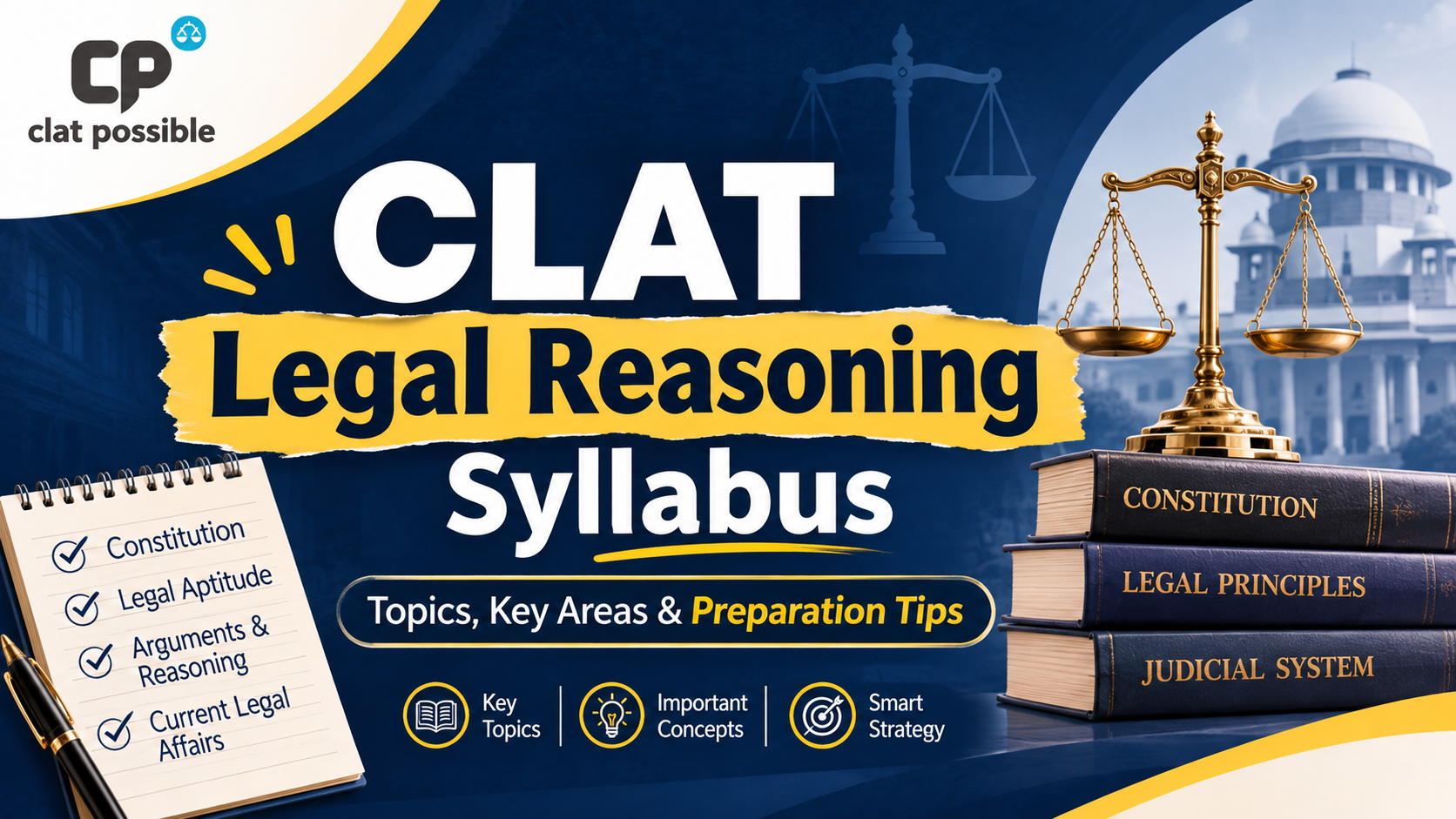
CLAT Legal Reasoning Syllabus 2028

ParticularDetails
Section nameLegal Reasoning
Approximate share of the paperAbout 25% (roughly 28 to 32 of 120 questions in recent papers)
FormatPassage-based multiple-choice questions
Passage lengthAround 450 words each
Passage themesLegal fact situations, public policy questions and moral or philosophical issues
Prior knowledge of lawNot required
Marking+1 for a correct answer, −0.25 for a wrong answer, 0 for unanswered
Status for CLAT 2028Current syllabus applies to CLAT 2027; an Expert Committee proposal to merge Legal and Logical Reasoning is under consideration for CLAT 2028

For the complete exam structure, see our CLAT 2028 guide.

What the Official CLAT Legal Reasoning Syllabus Says

According to the official CLAT UG syllabus, the Legal Reasoning section has passages of around 450 words dealing with legal fact situations, public policy questions or moral and philosophical issues. You are expected to:

  • Identify and infer the rules and principles set out in the passage.
  • Apply those rules and principles to different fact situations.
  • Understand how a change in the rule or principle would change its application to the facts.

The Consortium is clear that you do not need any prior knowledge of law to attempt this section. However, general awareness of current legal and moral issues helps you understand passages faster and apply principles with more confidence.

Will Legal Reasoning Change for CLAT 2028?

It might. CLAT 2027 (6 December 2026) keeps the current five-section pattern. But the Expert Committee set up by the Consortium has recommended merging Legal Reasoning and Logical Reasoning into a single section called Logical Reasoning and Legal Aptitude, and the Consortium has said it will consider the proposals for CLAT 2028. As of October 2026, no final decision had been announced.

FeatureCurrent Legal Reasoning (CLAT 2027)Proposed: Logical Reasoning and Legal Aptitude (not confirmed)
Section structureSeparate Legal Reasoning sectionMerged with Logical Reasoning
Type of passagesLegal, policy and moral passages, often based on real laws or newsPurely hypothetical scenarios
Main tasksIdentify the principle and apply it to factsRule application and rule derivation (working out the rule from examples)
Prior legal knowledgeNot requiredNot required
Number of questionsAbout 28 to 32No more than 10 to 15 per section
Skill rewardedAccurate application at speedDepth, accuracy and reasoning

What this means for you: under both patterns, the core skill is applying a given rule to given facts. If you build that skill now, and add practice on working out a rule from examples, you will be prepared whichever way the Consortium decides.

CLAT Legal Reasoning Topics: Area-Wise Syllabus

Although the passage always gives you the rule, most CLAT Legal Reasoning passages are built around a few areas of law. Knowing the basic ideas in each area helps you read faster and avoid traps.

1. Law of Torts

Torts is one of the most frequently tested areas, because its principles are easy to turn into everyday fact situations.

  • Negligence and duty of care
  • Strict and absolute liability
  • Vicarious liability
  • Defamation, nuisance and trespass
  • Volenti non fit injuria (consent to risk)
  • Remoteness of damage

2. Law of Contract

Contract passages test whether you can track who promised what, when, and under what conditions.

  • Offer, acceptance and revocation
  • Consideration
  • Capacity to contract (minors, persons of unsound mind)
  • Free consent: coercion, undue influence, fraud, misrepresentation, mistake
  • Void and voidable contracts
  • Breach of contract and remedies

3. Criminal Law

Criminal law passages focus on intention, knowledge and the exceptions that excuse an act. The Bharatiya Nyaya Sanhita, 2023 has replaced the Indian Penal Code, so expect passages based on the new law.

  • Elements of a crime: guilty act and guilty mind
  • General exceptions (mistake of fact, necessity, insanity, intoxication)
  • Right of private defence
  • Theft, extortion, cheating and criminal breach of trust
  • Culpable homicide and murder
  • Criminal intimidation and defamation

4. Constitutional Law

Constitutional passages often come from recent Supreme Court judgments or debates.

  • Fundamental Rights, especially Articles 14, 19 and 21
  • Directive Principles of State Policy
  • Writs and remedies
  • Separation of powers and judicial review
  • Centre-State relations
  • Important constitutional amendments and doctrines

5. Other Areas and Legal Current Affairs

These areas appear less often but come up in news-based passages.

  • Consumer protection
  • Basics of family law
  • Environmental law
  • Intellectual property basics
  • Basics of evidence law (now the Bharatiya Sakshya Adhiniyam, 2023)
  • Recent landmark judgments, new laws and legal reforms

Which Legal Reasoning Topics Matter Most?

Area of lawPriorityWhy it matters
Law of TortsHighPrinciples translate easily into everyday situations, so passages are common
Law of ContractHighTests careful tracking of facts, conditions and timelines
Criminal LawHighIntention, exceptions and new criminal laws make for tricky options
Constitutional LawHighFrequently linked to recent judgments and current debates
Legal current affairsMedium to highMany passages are drawn from recent legal news
Consumer, family, environmental and IP lawMediumAppear occasionally, usually through news-based passages

Remember: priority tells you where to build familiarity first. It does not mean you should memorise sections or case names. The passage always gives you the rule you need.

Take Free Demo Class

Types of Legal Reasoning Questions in CLAT

Question typeWhat it asksHow to approach it
Principle applicationApply the given rule to the facts and pick the correct outcomeBreak the rule into conditions; check each condition against the facts one by one
Principle identificationWhich principle from the passage applies to a situation?Match the key facts (who, what, intention, consent) to each principle
Changed factsHow does the answer change if one fact is different?Find which condition of the rule the new fact affects
Changed principleHow would the outcome change if the rule were modified?Reapply the new rule from scratch; do not carry over the old answer
InferenceWhat can be concluded from the passage?Choose only what the passage supports, not what seems fair
Strengthen / weakenWhich statement supports or undermines an argument in the passage?Identify the claim first, then test each option against it
Rule derivation (proposed pattern)Work out the rule from given examplesLook for the common factor that decides each outcome

Sample CLAT Legal Reasoning Question 2028

Passage 1: Law of Torts

The law of negligence requires every person to take reasonable care to avoid acts or omissions which they can reasonably foresee would be likely to injure their “neighbour”, that is, persons so closely and directly affected by their conduct that they ought reasonably to have them in contemplation. To succeed in a claim for negligence, a claimant must prove three things: first, that the defendant owed them a duty of care; second, that the defendant breached that duty by falling below the standard of a reasonable person in the same circumstances; and third, that the breach caused damage which was not too remote. A person who professes a special skill, such as a doctor or an engineer, is judged by the standard of a reasonably competent member of that profession, not by the standard of the most skilled expert in the field.

A defendant who is otherwise negligent may escape liability through the defence of volenti non fit injuria: to a willing person, no injury is done. The defence succeeds only where the claimant, with full knowledge of the nature and extent of the risk, freely and voluntarily agreed to bear that risk. Mere knowledge that a risk exists is not the same as consent to it. Courts have also refused to apply the defence to rescuers. Where a defendant’s negligence creates a situation of danger, and a person is injured while trying to rescue someone from that danger, the rescue is treated as a natural and foreseeable consequence of the defendant’s negligence rather than as a voluntary acceptance of risk.

Finally, where the claimant’s own failure to take reasonable care for their own safety contributed to the damage they suffered, the defence of contributory negligence applies. Unlike volenti, contributory negligence does not defeat the claim altogether. The claimant still recovers, but the damages are reduced in proportion to the claimant’s share of responsibility for the harm.

Question 1. Dr. Mehta, an orthopaedic surgeon, treats Kunal’s fracture using a technique that is accepted and widely used by reasonably competent orthopaedic surgeons. The country’s most renowned orthopaedic surgeon uses a newer technique that leads to slightly faster recovery. Kunal takes longer to recover than he would have with the newer technique, and sues Dr. Mehta for negligence. Will Kunal succeed?

  • (a) No, because Dr. Mehta met the standard of a reasonably competent orthopaedic surgeon.
  • (b) Yes, because a better technique was available and Dr. Mehta did not use it.
  • (c) Yes, because Kunal suffered a slower recovery, which is damage caused by Dr. Mehta’s choice.
  • (d) No, because Kunal consented to the treatment and therefore accepted all its risks.
Show Answer & Explanation

Answer: (a)

A professional is judged by the standard of a reasonably competent member of the profession, not the most skilled expert. Since Dr. Mehta used a technique accepted by reasonably competent orthopaedic surgeons, there is no breach of duty. Option (d) is wrong because consent to treatment is not consent to negligence, and in any case there was no negligence here.

Question 2. A chemical factory negligently allows acid to leak from a damaged container onto a public footpath. A small child is about to step into the pool of acid when Arjun, a passer-by, rushes forward and pulls the child away. In doing so, Arjun slips into the acid and suffers severe burns. The factory argues that Arjun knew the acid was dangerous and chose to go near it. Is the factory liable?

  • (a) No, because Arjun knew the acid was dangerous and voluntarily went near it, so volenti applies.
  • (b) No, because the factory owed a duty only to the child, not to Arjun.
  • (c) Yes, because Arjun was injured while rescuing the child from a danger created by the factory’s negligence.
  • (d) Yes, but Arjun’s damages must be reduced because he chose to step close to the acid.
Show Answer & Explanation

Answer: (c)

The passage states that volenti does not apply to rescuers. A rescue is a natural and foreseeable consequence of creating a dangerous situation, so the factory owed a duty to Arjun as well. Nothing in the facts suggests Arjun acted carelessly in the rescue, so there is no basis to reduce damages under option (d).

Question 3. Sana buys a ticket to a motor race. The ticket states that motor racing is dangerous, that cars may leave the track, and that spectators agree to bear this risk. During the race, a car skids off the track and crashes through a section of the safety barrier that the organisers had negligently failed to repair after it was damaged the previous week. Sana, who had no idea the barrier was damaged, is injured. Can the organisers rely on volenti?

  • (a) Yes, because Sana expressly agreed in writing to bear the risk of cars leaving the track.
  • (b) No, because Sana did not have full knowledge of the nature and extent of the risk created by the damaged barrier.
  • (c) Yes, because the injury was caused by a car leaving the track, which is exactly the risk Sana accepted.
  • (d) No, because volenti can never apply to spectators at a sporting event.
Show Answer & Explanation

Answer: (b)

For volenti, the claimant must have full knowledge of the nature and extent of the risk. Sana accepted the ordinary risk of cars leaving the track, but she did not know of the unrepaired barrier, which was an additional risk created by the organisers’ negligence. Option (d) overstates the rule; the passage does not say volenti never applies to spectators.

Question 4. Karan accepts a lift from his friend Dev. During the drive, Dev overtakes dangerously on a bend and crashes into a truck. Karan was not wearing a seatbelt. Medical evidence shows his injuries would have been much less serious if he had worn one. Karan sues Dev. What is the most likely outcome?

  • (a) Dev is not liable, because Karan voluntarily got into the car and accepted the risks of the journey.
  • (b) Dev is liable, and Karan recovers full damages because the crash was caused only by Dev’s driving.
  • (c) Dev is not liable, because Karan’s own negligence in not wearing a seatbelt defeats his claim.
  • (d) Dev is liable, but Karan’s damages will be reduced because his failure to wear a seatbelt contributed to his injuries.
Show Answer & Explanation

Answer: (d)

Dev breached his duty of care by overtaking dangerously. Karan did not know of or agree to this specific risk when accepting the lift, so volenti fails. However, Karan’s failure to wear a seatbelt contributed to the extent of his injuries, so contributory negligence applies. Under the passage, this reduces his damages rather than defeating his claim, which rules out option (c).

Question 5. Assume the passage did not contain the exception for rescuers, and that volenti applied whenever a claimant, with full knowledge of the risk, voluntarily chose to face it. Assume also that in the facts of Question 2, Arjun had clearly seen the acid and fully understood how dangerous it was before he stepped forward. What would be the outcome?

  • (a) The factory would still be liable, because it was negligent in allowing the acid to leak.
  • (b) The factory would not be liable, because Arjun, with full knowledge of the risk, voluntarily chose to face it.
  • (c) The factory would be liable to the child but not to Arjun, because the child was the only person in danger.
  • (d) The factory would be liable, but Arjun’s damages would be reduced for contributory negligence.
Show Answer & Explanation

Answer: (b)

This question tests how a change in the principle changes the outcome. Without the rescuer exception, and with Arjun having full knowledge of the risk and voluntarily facing it, all the conditions for volenti are met. Volenti is a complete defence, so the factory escapes liability to Arjun. Option (a) ignores the defence, and option (c) is irrelevant because the child was not injured.

Passage 2: Law of Contract

Under the Indian Contract Act, 1872, an agreement becomes a contract when a proposal (or offer) made by one person is accepted by another. The communication of a proposal is complete when it comes to the knowledge of the person to whom it is made. The communication of an acceptance, however, is complete at two different moments. As against the proposer, it is complete when the acceptance is put in a course of transmission to the proposer, so that it is out of the power of the acceptor to recall it. As against the acceptor, it is complete only when the acceptance comes to the knowledge of the proposer.

This difference matters for revocation. A proposal may be revoked at any time before the communication of its acceptance is complete as against the proposer, but not afterwards. An acceptance may be revoked at any time before the communication of the acceptance is complete as against the acceptor, but not afterwards. A revocation is itself complete as against the person who makes it when it is put in a course of transmission, and as against the person to whom it is made when it comes to that person’s knowledge.

An acceptance must be absolute and unqualified. If the person accepting introduces a new term or changes an existing one, the reply is not an acceptance but a counter-proposal, which the original proposer is free to accept or reject. A counter-proposal also brings the original proposal to an end, so it cannot later be accepted. A mere request for information, however, is not a counter-proposal and does not end the original proposal. Finally, silence does not ordinarily amount to acceptance, and a proposer cannot impose on the other party a condition that silence will be treated as acceptance.

Question 6. On 1 March, Priya posts a letter to Dev offering to sell her car for ₹4 lakh. Dev receives it on 3 March and posts a letter of acceptance at 10 a.m. on 4 March. At 11 a.m. on 4 March, Priya posts a letter revoking her offer. Both letters are delivered on 6 March. Is there a contract between Priya and Dev?

  • (a) No, because Priya revoked her offer before Dev’s acceptance came to her knowledge.
  • (b) No, because both letters were delivered on the same day, so they cancel each other out.
  • (c) Yes, because a proposal can never be revoked once it has reached the other party.
  • (d) Yes, because Dev’s acceptance was complete as against Priya when it was posted at 10 a.m., before she sent her revocation.
Show Answer & Explanation

Answer: (d)

A proposal can be revoked only before the acceptance is complete as against the proposer. As against Priya, Dev’s acceptance was complete at 10 a.m., when he posted it. Her revocation at 11 a.m. came too late, so a contract was formed. Option (c) is wrong because a proposal can be revoked after it reaches the other party, as long as acceptance is not yet complete against the proposer.

Question 7. Dev posts a letter accepting Priya’s offer at 10 a.m. on 4 March. At noon the same day, he changes his mind and emails Priya withdrawing his acceptance. Priya reads the email that evening. The acceptance letter reaches her on 6 March. Is there a contract?

  • (a) No, because Dev revoked his acceptance before it came to Priya’s knowledge, which is when it would have been complete as against him.
  • (b) Yes, because the acceptance was complete as against Priya when Dev posted it at 10 a.m.
  • (c) Yes, because an acceptance, once posted, cannot be withdrawn.
  • (d) No, because Priya had not yet received the acceptance letter, so there was nothing for Dev to revoke.
Show Answer & Explanation

Answer: (a)

An acceptance can be revoked before its communication is complete as against the acceptor, which happens only when it comes to the proposer’s knowledge. Priya learnt of the revocation on 4 March, before the acceptance letter reached her on 6 March. So Dev’s revocation was valid and no contract was formed. Option (b) mixes up the two moments of completion; the question here is revocation by the acceptor.

Question 8. Meera offers to sell 100 bags of rice to Raj at ₹2,000 per bag. Raj replies, “I accept, but at ₹1,900 per bag.” Meera refuses. The next day, Raj writes, “Fine, I accept your offer at ₹2,000 per bag.” By then, Meera has sold the rice to someone else. Raj sues Meera for breach of contract. Will he succeed?

  • (a) Yes, because Raj ultimately accepted Meera’s original price without any change.
  • (b) Yes, because Meera never formally withdrew her original offer.
  • (c) No, because Raj’s first reply was a counter-proposal that ended Meera’s original offer, so his later letter was only a fresh proposal.
  • (d) No, because Meera had already sold the rice, which automatically cancels any contract.
Show Answer & Explanation

Answer: (c)

Changing the price is introducing a new term, so Raj’s first reply was a counter-proposal. Under the passage, a counter-proposal ends the original proposal, which can no longer be accepted. Raj’s second letter was therefore a new proposal, which Meera never accepted. Option (b) fails because no withdrawal was needed once the offer had ended.

Question 9. Meera offers to sell 100 bags of rice to Raj at ₹2,000 per bag. Raj replies, “Would you be willing to accept payment in two instalments?” Meera does not reply. Two days later, before Meera has revoked her offer, Raj writes, “I accept your offer at ₹2,000 per bag, with full payment on delivery.” Is there a contract?

  • (a) No, because Raj’s first reply was a counter-proposal that ended Meera’s offer.
  • (b) Yes, because Raj’s first reply was only a request for information, so Meera’s original offer remained open and was validly accepted.
  • (c) No, because Meera never replied to Raj’s question, and her silence cannot be treated as acceptance.
  • (d) Yes, because Meera’s silence meant she agreed to instalment payments.
Show Answer & Explanation

Answer: (b)

Asking whether payment in instalments would be acceptable is a request for information, not a new term. It does not end the original offer. Raj then accepted the original terms unconditionally while the offer was still open, so a contract was formed. Options (c) and (d) misapply the silence rule, which concerns acceptance by the person receiving the offer, not Meera’s failure to answer a question.

Question 10. Ankit writes to his nephew offering to buy the nephew’s horse for ₹50,000, adding: “If I hear nothing more from you, I shall consider the horse mine.” The nephew decides to accept and tells the auctioneer handling his property to keep the horse out of the upcoming auction, but he never replies to Ankit. The auctioneer sells the horse by mistake. Ankit claims there was a contract between him and his nephew. Is he right?

  • (a) Yes, because the nephew intended to accept and showed this by instructing the auctioneer.
  • (b) Yes, because Ankit clearly stated that silence would be treated as acceptance.
  • (c) No, because the horse was sold by the auctioneer, which ends any contract.
  • (d) No, because silence does not amount to acceptance, and Ankit could not impose a condition that it would.
Show Answer & Explanation

Answer: (d)

The passage states that silence does not ordinarily amount to acceptance and that a proposer cannot impose a condition that silence will be treated as acceptance. The nephew’s instruction to the auctioneer was never communicated to Ankit, so there was no acceptance and no contract. Option (a) fails because an uncommunicated intention to accept is not acceptance.

Try Roznama (mini CLAT) Free

Passage 3: Criminal Law

Under the Bharatiya Nyaya Sanhita, 2023, nothing is an offence which is done in the exercise of the right of private defence. Every person has a right, subject to certain restrictions, to defend their own body, and the body of any other person, against any offence affecting the human body. The right of private defence of the body begins as soon as a reasonable apprehension of danger to the body arises from an attempt or a threat to commit an offence, even if the offence has not yet been committed. It continues for as long as that apprehension of danger continues.

The right is subject to important limits. First, there is no right of private defence where there is time to seek the protection of the public authorities. Second, the right never extends to inflicting more harm than is necessary for the purpose of defence. The right of private defence of the body extends to voluntarily causing death only where the act being defended against is of a serious kind, such as an assault which may reasonably cause the apprehension that death or grievous hurt will otherwise result, an attempt to commit rape, or an assault with the intention of kidnapping or abducting a person. In all other cases, the right extends to causing any harm other than death.

Courts have held that a person facing a sudden attack cannot be expected to weigh the force they use “in golden scales”. Whether the force used was excessive is judged from the point of view of a reasonable person in the defender’s position at that moment, not with the benefit of hindsight. However, private defence is a right of defence, not of punishment or revenge. Once the danger has ended, the right comes to an end, and any harm caused after that point is not protected.

Question 11. Late at night on a deserted highway, Vikram’s car breaks down. Two men armed with iron rods approach him, shouting that they will kill him, and one swings a rod at his head. Vikram snatches the other rod and strikes one attacker on the head. The attacker dies. The prosecution argues that a police station was only 2 km away. Is Vikram protected by the right of private defence?

  • (a) Yes, because he faced an assault that reasonably caused the apprehension of death, and there was no time to seek the help of the authorities.
  • (b) No, because a police station was nearby, so Vikram had time to seek the protection of the authorities.
  • (c) No, because the right of private defence never extends to causing death.
  • (d) Yes, because any person who is attacked first may cause any harm to the attacker.
Show Answer & Explanation

Answer: (a)

The attackers threatened to kill Vikram and were already swinging at him, which is an assault reasonably causing the apprehension of death. A police station 2 km away does not give him time to seek protection when the attack is happening right then. So the right extends to causing death. Option (d) overstates the rule, since the right is always limited to the harm necessary for defence.

Question 12. During an argument at a tea stall, Ravi slaps Sohan once and then turns around and starts walking away. Sohan picks up a brick and hits Ravi on the back of his head, causing grievous hurt. Can Sohan claim the right of private defence?

  • (a) Yes, because Ravi committed an offence affecting Sohan’s body by slapping him.
  • (b) Yes, because a person facing an attack cannot be expected to weigh the force used in golden scales.
  • (c) No, because the danger had ended when Ravi walked away, so Sohan’s act was retaliation, not defence.
  • (d) No, because Sohan should have reported the slap to the police instead.
Show Answer & Explanation

Answer: (c)

The right of private defence lasts only as long as the apprehension of danger continues. Once Ravi turned and walked away, there was no continuing danger, so hitting him from behind was revenge, not defence. The “golden scales” principle in option (b) applies to force used during an attack, not after it has ended.

Question 13. A man holds a knife to Lata’s throat and tries to force her into a waiting van to abduct her. In the struggle, Lata grabs a pair of scissors from her bag and stabs him. He dies of his injuries. Is Lata protected by the right of private defence?

  • (a) No, because the right of private defence never extends to causing death.
  • (b) No, because Lata used more force than was necessary, since she could have screamed for help.
  • (c) Yes, but only if Lata can prove that the man would certainly have killed her.
  • (d) Yes, because the right of private defence of the body extends to causing death when defending against an assault intended to abduct a person.
Show Answer & Explanation

Answer: (d)

The passage states that the right of private defence of the body extends to causing death in the case of an assault with the intention of kidnapping or abducting a person. Lata was facing exactly that, and also faced a knife at her throat, which reasonably caused the apprehension of death or grievous hurt. Option (c) is wrong because the test is reasonable apprehension, not certainty.

Question 14. While standing in a queue, Ajay, a fit 25-year-old, is pushed by a frail, unarmed elderly man who is impatient to get ahead. Ajay responds by punching the man repeatedly in the face, fracturing his jaw and nose. Is Ajay protected by the right of private defence?

  • (a) Yes, because the push was an offence affecting Ajay’s body, so he had a right of private defence.
  • (b) No, because although Ajay had a right to defend himself, he inflicted far more harm than was necessary for his defence.
  • (c) Yes, because Ajay cannot be expected to weigh the force he used in golden scales.
  • (d) No, because there is never a right of private defence against an elderly person.
Show Answer & Explanation

Answer: (b)

A push is an offence affecting the body, so Ajay did have a right of private defence. But the right never extends to inflicting more harm than necessary. Repeatedly punching a frail, unarmed man after a mere push is clearly excessive, even judged from the point of view of a reasonable person at that moment. The “golden scales” principle protects reasonable errors of judgement during a real threat, not a disproportionate response like this.

Question 15. Late one night, Imran walks into his house and sees a masked stranger pointing what looks like a gun at his sister. Imran hits the stranger with a cricket bat, causing grievous hurt. It later turns out that the “gun” was a realistic toy and the stranger was a prankster. Is Imran protected by the right of private defence?

  • (a) Yes, because, judged from the point of view of a reasonable person at that moment, there was a reasonable apprehension of death or grievous hurt to his sister.
  • (b) No, because the gun was a toy, so there was never any real danger to his sister.
  • (c) No, because Imran should have called the police before acting.
  • (d) Yes, because a person is always protected when defending a family member, whatever the circumstances.
Show Answer & Explanation

Answer: (a)

The right begins as soon as there is a reasonable apprehension of danger, and excessive force is judged from the point of view of a reasonable person at that moment, not with hindsight. A masked stranger pointing what looked like a real gun at his sister would cause any reasonable person to fear death or grievous hurt. The fact that it was later found to be a toy does not take away Imran’s protection. Option (d) is too broad, since the limits on the right still apply when defending others.

How to Use These Questions

  • Time yourself: aim for 7 to 8 minutes per passage, including reading time.
  • Mark the rule first: underline each principle, its conditions and its exceptions before you look at the options.
  • Review every option: for each question, work out why the three wrong options are wrong, not just why the right one is right.
  • Watch the “changed principle” questions: Question 5 tests whether you can reapply a modified rule from scratch, a skill CLAT tests often.
  • Keep an error log: note whether each mistake came from misreading the rule, missing a fact, or using outside knowledge.

For the full syllabus behind these questions, read our CLAT Legal Reasoning syllabus 2028 guide, and see our list of CLAT legal reasoning books for more practice material.

How to Solve a Legal Reasoning Passage

  1. Read the passage for its purpose: what is this law or principle trying to achieve?
  2. Mark the rule: underline the principle, its conditions and any exceptions.
  3. List the material facts: who did what, when, with what intention, and with whose consent.
  4. Apply condition by condition: check whether each condition of the rule is met by the facts.
  5. Eliminate options: remove options that rely on outside law, personal morality or facts not given.
  6. Recheck exceptions: before you mark your answer, confirm no exception in the passage changes the outcome.

CLAT 2028 Legal Reasoning Preparation Plan

This plan assumes CLAT 2028 will be held around December 2027, based on recent cycles. It works for every CLAT 2028 aspirant; see the table below to adapt it to your situation.

PhaseTime windowFocusGoal
1. FoundationNow to March 2027Basic ideas in torts, contract, criminal and constitutional law; daily newspaper readingExplain each core concept in your own words with an example
2. ApplicationApril to July 2027Two to three passages a few times a week; weekly “change one fact” drill; error logSteady accuracy on untimed passage sets
3. Speed and testingAugust to October 2027Timed sectional tests and full mocks aligned to the confirmed pattern; rule-derivation practice if the new pattern is adoptedConsistent sectional scores within your time plan
4. Final revisionNovember 2027 to the examRevise one-page notes, error log and legal current affairs; fewer, sharper mocksGo in with a tested approach, not new material

How to Use This Plan Based on Where You Are

Your situationHow to adapt the plan
Class 11 studentsFollow all four phases as given. You have the most time, so build strong basics before moving to timed practice.
Class 12 studentsCLAT usually falls before your board exams. Combine Phases 1 and 2 by learning each area of law alongside passage practice, and plan your mocks around school exams.
Droppers and repeat aspirantsStart with an honest review of your last attempt: was it concepts, accuracy, speed or nerves? Revise basics quickly, then spend most of your time in Phases 2 and 3 with regular, well-analysed mocks.
Graduates and working aspirantsThere is no upper age limit for CLAT UG under the current rules. Use shorter daily sessions focused on passages, and take a full mock every weekend.

Best Resources for CLAT Legal Reasoning

  • Official material: the official CLAT UG syllabus and CLAT previous year papers from 2020 onward.
  • One concept book: A.P. Bhardwaj’s Legal Awareness and Legal Reasoning is a good starting point. See our full list of CLAT legal reasoning books.
  • Daily newspaper: The Hindu or The Indian Express, for court rulings, new laws and legal editorials.
  • Current affairs plan: follow our 70-day current affairs plan for structured legal news revision.
  • Mock tests: take sectional tests and full-length CLAT mock tests, and analyse each one.

For a skill-building approach, work on reading speed, and check CLAT English syllabus 2028 guide.

Conclusion

The CLAT Legal Reasoning syllabus is not about knowing law; it is about applying a rule exactly as it is given. Build familiarity with the core areas of law, read legal news daily, practise passages regularly, and train yourself to ask “what if one fact changed?” Whether CLAT 2028 keeps the current section or moves to Logical Reasoning and Legal Aptitude, that skill will carry you through.
CLAT English Syllabus 2028: Topics, Question Types & Preparation Plan

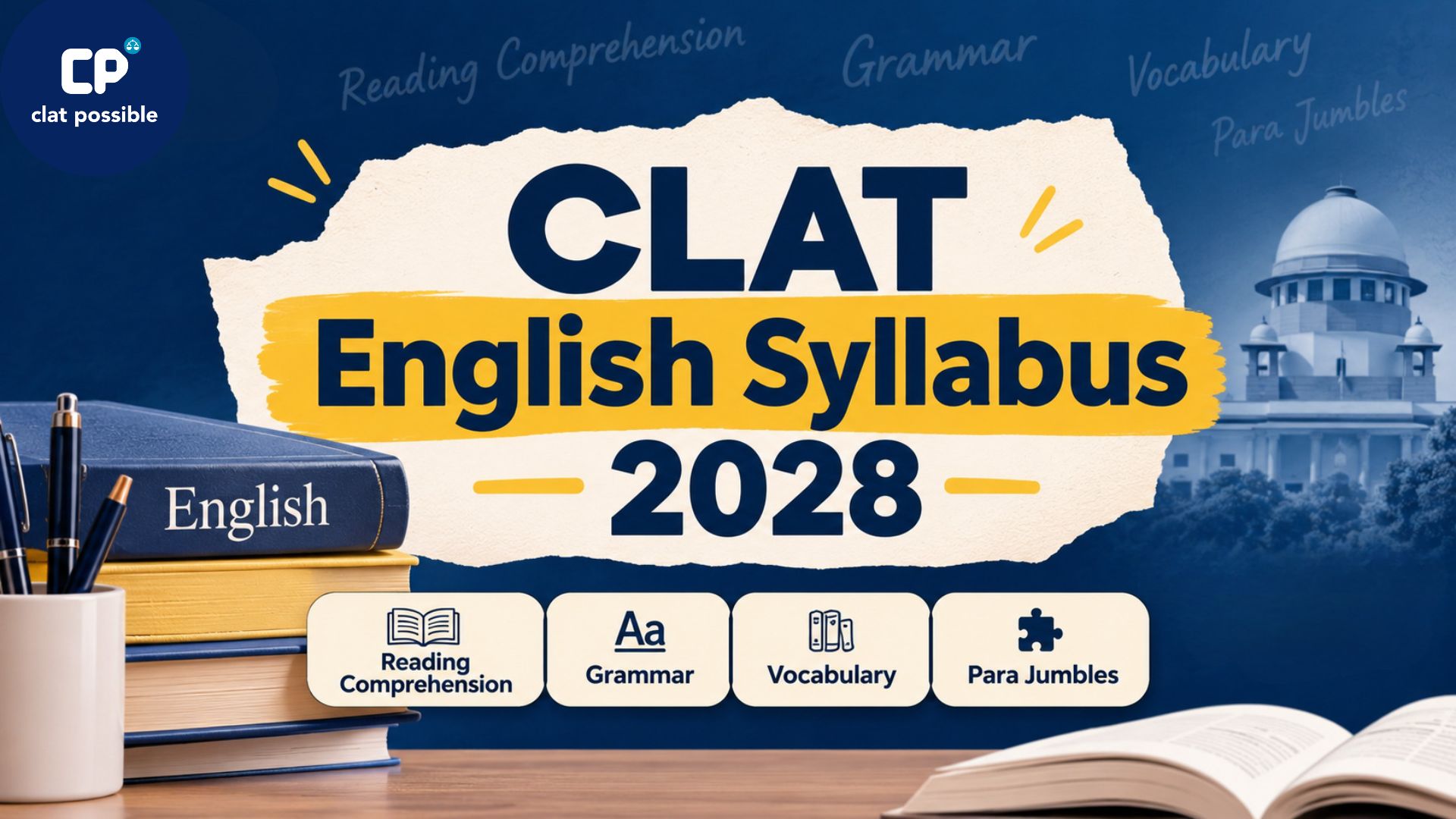
If you are in Class 11 right now, CLAT 2028 is most likely your first attempt. And the English section is the best place to start preparing, because the skill it tests, reading a dense passage quickly and accurately, takes months to build and helps you in every other section of the paper.

CLAT English is not a grammar test. It is a reading test. In this blog, we break down the CLAT English syllabus for 2028, explain each question type, cover the possible pattern change, and give you a month-by-month plan to prepare.

CLAT 2027-2028 Courses by CLAT Possible

CLAT English Syllabus 2028 at a Glance

ParticularDetails
Section nameEnglish Language
Approximate share of the paperAbout 20% (roughly 22 to 24 of 120 questions in recent papers)
FormatPassage-based multiple-choice questions
Passage lengthAbout 450 words each
Reading time per passageRoughly 5 to 7 minutes for a Class 12 student, as per the official syllabus
Passage sourcesContemporary or historically significant fiction and non-fiction writing
Marking+1 for a correct answer, −0.25 for a wrong answer, 0 for unanswered
Status for CLAT 2028Current syllabus applies to CLAT 2027; an Expert Committee proposal to redesign the section is under consideration for CLAT 2028

For the full paper structure, see our complete CLAT 2028 guide.

What the Official Syllabus Says

According to the official CLAT UG syllabus published by the Consortium of NLUs, you will read passages of about 450 words and be expected to:

  • Identify the main point of the passage, along with the arguments and viewpoints in it.
  • Draw inferences and conclusions from the text.
  • Summarise the passage.
  • Compare and contrast the different arguments or viewpoints presented.
  • Work out the meaning of words and phrases from how they are used in the passage.

Notice what is missing from this list: there is no separate grammar section, no list of words to memorise, and no fill-in-the-blanks test on rules. Every question comes from a passage, and almost every question checks whether you truly understood what you read.

Will the English Section Change for CLAT 2028?

Possibly. CLAT 2027 (6 December 2026) keeps the current five-section pattern. However, an Expert Committee has recommended a redesigned three-section paper, and the Consortium has said it will consider the proposals for CLAT 2028. No final decision had been announced as of October 2026.

FeatureCurrent English section (CLAT 2027)Proposed: Language and Comprehension (not confirmed)
Section nameEnglish LanguageLanguage and Comprehension
FocusReading comprehension, inference, vocabulary in contextInference, implication, tone and the strength of arguments
Grammar and vocabularyTested through passagesLess emphasis on grammar and vocabulary
Number of questionsAbout 22 to 24No more than 10 to 15 per section
Skill rewardedReading speed across long passagesDepth and accuracy of understanding

What this means for you: the core skill is the same either way. Under both patterns, you need to read carefully, understand the author’s argument, and choose the option the passage actually supports. Prepare for that, and you are ready for whichever pattern the Consortium confirms.

CLAT English Syllabus 2028: Topic-Wise Breakdown

1. Reading Comprehension

This is the heart of the section. Every question is linked to a passage, so your reading speed and accuracy decide your score.

  • Main idea and central argument
  • Supporting arguments and evidence
  • Author’s viewpoint and purpose
  • Comparing different viewpoints within a passage

2. Inference and Conclusions

These questions ask what follows from the passage, even though it is not stated directly. They are often the trickiest in the section.

  • What can be inferred from a line or paragraph
  • Which conclusion the author would agree with
  • Underlying assumptions in an argument

3. Tone and Author’s Attitude

You need to judge how the author feels about the subject, based only on the words used.

  • Tone words such as critical, sarcastic, optimistic, nostalgic, objective
  • Whether the author supports, opposes or remains neutral

4. Vocabulary in Context

CLAT does not test word lists. It asks what a word or phrase means as used in the passage.

  • Meaning of words and phrases in context
  • Idioms and phrases used in the passage
  • Synonyms and antonyms based on context

5. Summary and Title

You may be asked to pick the best summary of a passage or paragraph, or the most suitable title.

  • Best summary of the passage
  • Most suitable title
  • The author’s main purpose in writing

6. Grammar in Use

Grammar is not tested on its own, but you need it to read accurately. Occasionally, questions may test correct usage within a sentence from the passage.

  • Tenses, subject-verb agreement and modifiers
  • Connectors and how they change meaning (“however”, “therefore”, “despite”)
  • Sentence correction based on passage lines

7. Literary Devices

Fiction and literary non-fiction passages sometimes include figurative language.

  • Metaphor, simile, personification, irony
  • What a figurative line actually means

Question Types in CLAT English (and How to Approach Them)

Question typeWhat it asksHow to approach it
Main ideaWhat is the passage mainly about?Read the first and last paragraphs closely; eliminate options that are too narrow or too broad.
InferenceWhat can be concluded from the passage?Choose only what the passage supports. If an option needs outside knowledge, it is wrong.
Tone / attitudeHow does the author feel about the subject?Underline opinion words and adjectives as you read.
Vocabulary in contextWhat does a word mean as used here?Reread the full sentence and test each option in place of the word.
Summary / titleWhich option best captures the passage?Pick the option that covers the whole passage, not one paragraph.
Strengthen / weakenWhich statement supports or undermines the author’s argument?Identify the author’s main claim first, then test each option against it.
Fact-basedWhat does the passage say about a detail?Go back to the exact line; do not rely on memory.

Take Free Demo Class

Where CLAT English Passages Come From

The official syllabus says passages are drawn from contemporary or historically significant fiction and non-fiction writing. In practice, that covers a wide range:

Passage typeExamples of what you might read
Literary fictionExtracts from novels and short stories, classic and modern
Opinion and editorialsNewspaper editorials and opinion columns on social or political issues
Essays and non-fictionLong-form essays on philosophy, history, science, technology or economics
Social issuesWriting on education, gender, environment, inequality and public policy
Biography and memoirExtracts from autobiographies, memoirs and speeches

The wider your reading, the fewer surprises you will face in the exam. Make sure you read a mix of fiction and non-fiction, not just newspapers.

CLAT 2028 English Preparation Plan

This plan assumes CLAT 2028 will be held around December 2027, based on recent cycles. If you are in Class 11 now, you have about a year, which is plenty of time if you start building the reading habit today.

PhaseTime windowFocusGoal
1. Reading foundationNow to March 2027Daily reading of editorials, essays and fiction; one passage a day without a timerSummarise any 450-word passage in two lines
2. Question typesApril to July 2027Practise each question type; keep a vocabulary-in-context notebook and an error logSteady accuracy on untimed passage sets
3. Speed and accuracyAugust to October 2027Timed sectional tests; full mocks aligned to the confirmed patternFinish each passage in 6 to 7 minutes without losing accuracy
4. Final revisionNovember 2027 to the examRevise your error log and notebook; fewer, sharper mocksA tested time plan for the English section

For the full plan across all sections, read our complete CLAT 2028 study plan.

A Daily English Routine for CLAT 2028

  1. Read one editorial or essay (15 minutes): write a one-line summary and one word for the author’s tone.
  2. Solve one CLAT-style passage (10 minutes): untimed at first, timed once your accuracy is steady.
  3. Review every wrong option (10 minutes): understand why each wrong answer is wrong, not just why the right one is right.
  4. Add 3 to 5 words to your notebook: note each word with the sentence you found it in.
  5. Once a week: read one piece of fiction or a long-form essay outside your comfort zone.

Try Roznama (CLAT mini) Free

Best Resources for CLAT 2028 English

  • Newspapers: The Hindu or The Indian Express, especially the editorial and opinion pages.
  • Long-form reading: essays and features from quality magazines and websites, plus classic and contemporary fiction.
  • Official material: the official CLAT UG syllabus and CLAT previous year papers from 2020 onward.
  • Roznama (Daily Mini CLAT): our free daily practice of about 25 to 30 questions based on the day’s newspaper. Learn more about Roznama.
  • Books: one passage-based English book is enough. See our list of CLAT preparation books.

For more reading tips, see our guide on how to improve reading comprehension for CLAT.

Conclusion

The CLAT English syllabus for 2028 comes down to one skill: reading a passage carefully and answering only from what it says. Whether the Consortium keeps the current English section or moves to Language and Comprehension, that skill will carry you through. Start reading every day, practise each question type, analyse your mistakes, and keep checking the Consortium website for the official CLAT 2028 pattern.
CLAT Subjects 2028: Complete List, Weightage and What Each Section Tests

CLAT subjects are not like your school subjects. There’s no textbook to memorise and no “law” chapter to learn before the exam. Instead, CLAT tests five skills through passages: reading, staying aware of the world, legal reasoning, logical thinking and basic maths. The Consortium of NLUs has officially confirmed that the syllabus and sections for CLAT 2028 will stay the same.

So in this blog, we’ll walk you through all the CLAT exam subjects using the official CLAT 2028 UG syllabus: how many questions each one has, what it really tests, and how to prepare for it.

CLAT 2027-2028 Courses by CLAT Possible

What You’ll Find in This Blog

CLAT Subjects List and Weightage

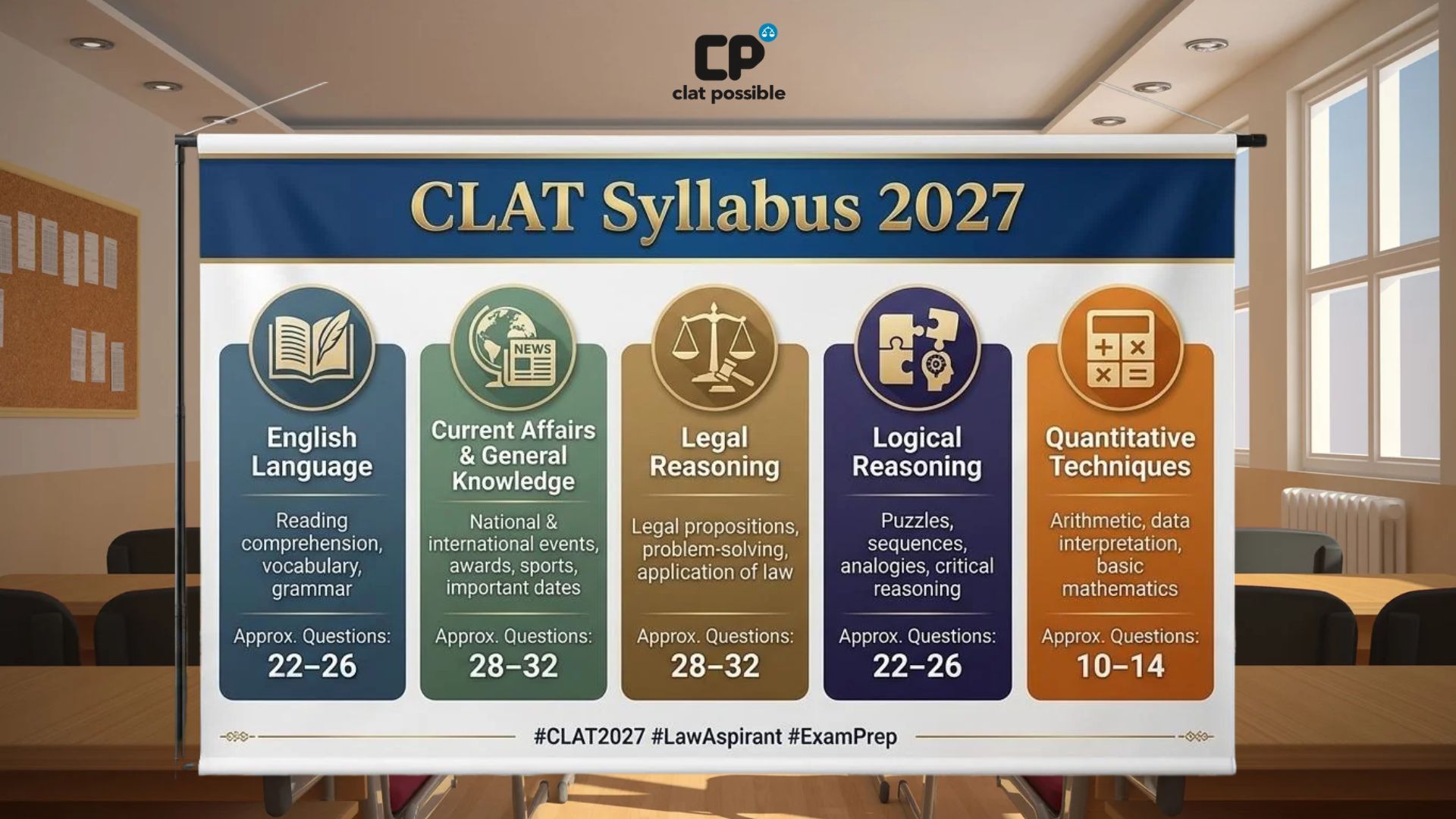
CLAT UG has five subjects, and every one of them is passage-based. Here’s the subject-wise breakdown from the official CLAT 2028 paper pattern, with the approximate number of questions and share of the paper for each.

CLAT subjectApprox. questionsShare of the paperWhat it tests in one line
English Language22 to 2620%How well you understand what you read
Current Affairs including General Knowledge28 to 3225%How aware you are of the world around you
Legal Reasoning28 to 3225%How well you apply a given rule to facts
Logical Reasoning22 to 2620%How well you judge arguments
Quantitative Techniques10 to 1410%How comfortable you are with Class 10 maths

Look at the middle two rows. Current Affairs and Legal Reasoning together make up about half your CLAT score. That alone should shape how you plan your preparation.


CLAT 2028 Exam Pattern

Before going subject by subject, here are the basics of the paper itself, all taken from the Consortium’s official information for CLAT 2028.

WhatDetails
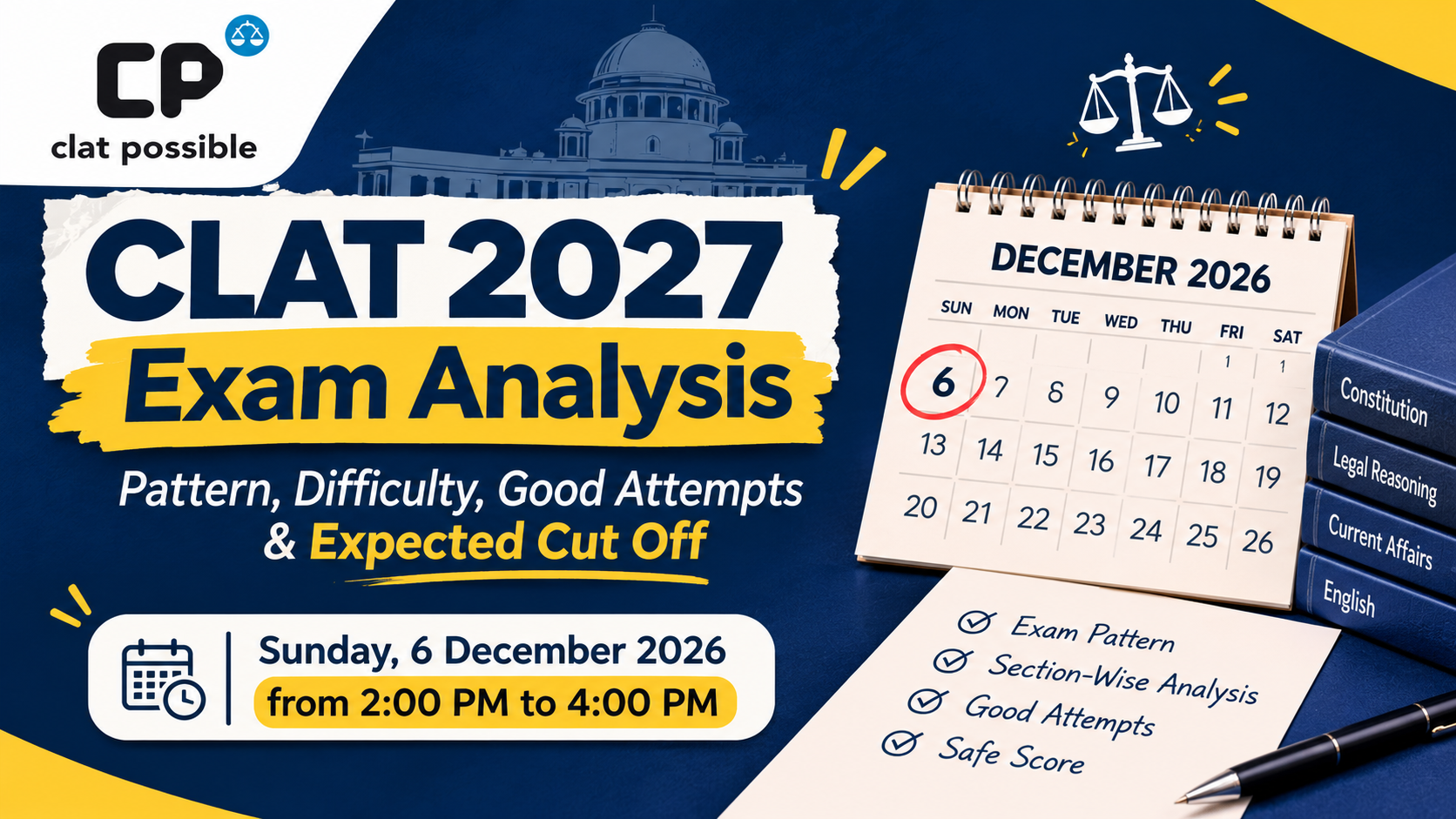
Exam date and timeSunday, 6 December 2026, 2:00 PM to 4:00 PM (2:00 PM to 4:40 PM for eligible PwD candidates)
ModeOffline
Duration2 hours
Total questions and marks120 multiple-choice questions, 1 mark each, 120 marks in total
Negative marking0.25 marks deducted for every wrong answer
Number of subjects5
Changes for CLAT 2028None. The Consortium has confirmed no change to the syllabus, pattern or sections

The Consortium also says the paper tests comprehension and reasoning, and that no prior knowledge is needed, though it can help with current affairs. For a deeper look at the topics, read our CLAT syllabus 2028 guide.

CLAT Subject 1: English Language

English carries about 22 to 26 questions, or 20% of the paper. You’ll get passages of about 450 words each, taken from fiction and non-fiction, both modern and classic. According to the Consortium, a Class 12 student should be able to read each passage in about 5 to 7 minutes.

Under each subject below, we’ve added one short sample question written by our faculty in CLAT style, so you can see what the subject actually feels like. Real CLAT passages are longer, about 450 words.

Here’s what the questions ask you to do:

  • Find the main idea, arguments and viewpoints in the passage
  • Draw inferences and conclusions from it
  • Summarise the passage
  • Compare and contrast different arguments or viewpoints
  • Work out the meaning of words and phrases as they’re used in the passage
Sample English questionPassage extract: The city’s new library opened without any celebration, yet within a month its reading rooms were full before noon. Officials had expected students. They had not expected retired workers, street vendors and young mothers to arrive just as regularly.

Q. Which of the following best states the main point of the extract?
(A) The library is popular only with students
(B) The library drew a much wider range of people than expected
(C) The officials planned the library badly
(D) The library’s opening was poorly publicised

Answer: (B). The passage contrasts who officials expected with the wide mix of people who actually came.

Our tip: read one editorial a day and write its main point in a single line. That one habit trains almost every question type in this section.

CLAT Subject 2: Current Affairs including General Knowledge

This is one of the two heaviest CLAT subjects, with about 28 to 32 questions, or 25% of the paper. The passages are up to 450 words long and come from news, journalism and other non-fiction writing. Some questions may touch on legal information linked to the passage, but you won’t need legal knowledge beyond it.

The Consortium lists these areas:

  • Important events in India and around the world
  • Arts and culture
  • International affairs
  • Historical events that still matter today
Sample Current Affairs questionPassage extract: India added more sites to its list of wetlands of international importance this year, taking the country’s total under the Ramsar Convention to a new high.

Q. The Ramsar Convention, mentioned in the passage, is an international treaty for the conservation of:
(A) Wetlands
(B) Deserts
(C) Coral reefs only
(D) Mountain forests

Answer: (A). The Ramsar Convention, signed in Ramsar, Iran, in 1971, protects wetlands. Notice how the question uses the news to test a static fact.

Our tip: read for context, not trivia. Know why an event matters, who is involved and what changed. If you’re short on time, our free GK Genius PDF lists the top 150 current affairs topics of 2026.

Take Free Demo Class

Legal Reasoning also carries about 28 to 32 questions, or 25% of the paper. The passages are around 450 words each and may describe real situations, legal issues, public policy questions or moral and philosophical questions.

The good news: you don’t need to know any law beforehand. The Consortium says general awareness of current legal and moral issues helps, but the rule you need is always in the passage. The questions ask you to:

  • Identify the rules and principles set out in the passage
  • Apply those rules to different sets of facts
  • Understand how a change in the rule would change the outcome
Sample Legal Reasoning questionPrinciple: A person is liable for negligence if they fail to take reasonable care towards someone they owe a duty of care, and that failure causes harm.
Facts: A shopkeeper mops the floor of his shop during business hours but puts up no warning sign. A customer walks in, slips on the wet floor and breaks her wrist.

Q. Is the shopkeeper liable?
(A) No, because the customer should have looked where she was walking
(B) No, because mopping a floor is a normal activity
(C) Yes, because he failed to take reasonable care to warn customers, and this caused the injury
(D) Yes, because every shopkeeper is responsible for any injury in the shop

Answer: (C). The shopkeeper owed customers a duty of care, failed to warn them, and that failure caused the harm. Option (D) goes beyond the principle given.

Our tip: underline the principle before you look at the options, and answer only from what the passage says, even if you know the real law is different. For the right books to build this skill, see our guide to the best CLAT legal reasoning books.

CLAT Subject 4: Logical Reasoning

Logical Reasoning has about 22 to 26 questions, or 20% of the paper. You’ll get short passages of about 450 words, each followed by one or more questions. This section is all about arguments: spotting them, testing them and seeing where they break.

According to the Consortium, you’ll be asked to:

  • Recognise an argument, its premises and its conclusion
  • Identify the arguments made in a passage
  • Analyse patterns of reasoning and see how conclusions depend on evidence
  • Judge how a conclusion gets stronger or weaker when the facts change
  • Work out what follows from a passage and apply it to new situations
  • Spot relationships, analogies, contradictions and equivalences, and judge how effective an argument is
Sample Logical Reasoning questionArgument: Students who sleep at least seven hours a night score higher in mock tests. Therefore, every CLAT aspirant should sleep at least seven hours before a mock.

Q. Which of the following, if true, most weakens the argument?
(A) Students who already score well feel less stressed, and so they sleep longer
(B) Sleep is known to help memory
(C) Most mock tests are held in the morning
(D) Many CLAT toppers sleep eight hours a night

Answer: (A). It suggests that high scores may cause better sleep, not the other way round, which weakens the conclusion.

Our tip: after every passage you solve, explain in one sentence why each wrong option is wrong. It feels slow at first, but it’s the fastest way to improve accuracy.

CLAT Subject 5: Quantitative Techniques

Quant is the smallest CLAT subject, with about 10 to 14 questions, or 10% of the paper. Instead of long passages, you’ll get short sets of facts, graphs or other number-based information, followed by questions. The maths is at Class 10 level.

The Consortium lists these areas:

  • Ratios and proportions
  • Basic algebra
  • Mensuration
  • Statistical estimation
Sample Quantitative Techniques questionQ. In a class of 60 students, the ratio of boys to girls is 7 : 5. If 5 more girls join the class, what is the new ratio of boys to girls?
(A) 7 : 6
(B) 7 : 5
(C) 6 : 7
(D) 5 : 7

Answer: (A). Boys = 35 and girls = 25. After 5 girls join, girls = 30, so the ratio is 35 : 30, or 7 : 6.

Our tip: don’t skip Quant just because it’s small. These questions are often the quickest marks in the paper if your basics like percentages and ratios are strong.

How to Split Your 2 Hours Across CLAT Subjects

There’s no fixed time limit for each section, so time management is up to you. Here’s a split many of our students find comfortable. Treat it as a starting point and adjust it in your mocks.

CLAT subjectSuggested timeWhy
Current Affairs including GK15 to 18 minutesYou either know it or you don’t; many students start here to settle in
Legal Reasoning32 to 35 minutesHeavy weightage and long passages that need careful reading
English Language20 to 22 minutesAbout 5 to 7 minutes of reading per passage, plus answering
Logical Reasoning25 to 28 minutesTricky options need time to eliminate
Quantitative Techniques10 to 12 minutesFewer questions, quick if your basics are strong
Buffer for OMR and review5 to 10 minutesTo bubble answers and check the OMR sheet

Bubbling answers takes more time than most students expect. Our CLAT OMR sheet guide has a free practice sheet so you can build it into your mocks.

Which CLAT Subject Should You Focus on Most?

All five matter, but not equally. Here’s how we’d think about it:

  • Legal Reasoning and Current Affairs: together they’re about half the paper, so they deserve the biggest share of your time.
  • English and Logical Reasoning: both depend on strong reading. If you read well, you’ll gain in both at once.
  • Quantitative Techniques: small, but often the easiest marks to protect. Don’t leave it for the last week.

Also remember that every mark matters. The ranks in CLAT are packed tightly, and a few extra marks in your strongest subject can move you hundreds of places. See how in our CLAT marks vs rank analysis, and check where your current mock score stands with our free CLAT rank predictor.

What About CLAT PG Subjects?

Everything above is for CLAT UG, the exam for the 5-year integrated law programme. CLAT PG, for the LLM programme, is very different. According to the CLAT PG 2028 syllabus, it has 120 objective questions in 120 minutes, with 0.25 marks deducted for each wrong answer, and it tests the core subjects of an undergraduate law degree:

  • Constitutional Law, Jurisprudence and Administrative Law
  • Law of Contract, Torts and Family Law
  • Criminal Law and Property Law
  • Company Law, Public International Law and Tax Law
  • Environmental Law and Labour and Industrial Law

So if you’re a Class 11 or 12 student, you only need to prepare for the five UG subjects covered in this blog.

Conclusion

CLAT subjects aren’t about how much you memorise; they’re about how well you read, think and apply. Five subjects, 120 questions, 2 hours, and the same pattern as last year. Spend the most time on Legal Reasoning and Current Affairs, read every day for English and Logical Reasoning, and keep your Class 10 maths sharp. Then let your CLAT mock tests tell you which subject to work on next.

CLAT Marks vs Rank 2027: Expected Rank, NLU Cut-Offs and OBC Analysis

CLAT marks vs rank is the question every aspirant asks the moment they finish a mock: “If I score this much, which rank will I get, and which NLU does that open?” The honest answer is that it depends on the year. But past data gives us a very clear picture.

In this blog, we’ve put together the CLAT marks vs rank trend from the last cycle, the closing ranks of top NLUs for General and OBC students, and the marks those ranks roughly needed. We’ll also show you how many ranks a few extra marks can buy you, which matters more than ever with CLAT 2027 on 6 December.

CLAT 2027-2028 Courses by CLAT Possible

What You’ll Find in This Blog

How Your CLAT Rank Is Decided

Your CLAT rank is simply your position among everyone who wrote the exam, based on your final marks out of 120. The Consortium of NLUs gives +1 for every correct answer and takes away 0.25 for every wrong one. So a few careless guesses can quietly move your rank back by hundreds of places.

When two students end up with the same marks, the Consortium breaks the tie in this order:

  1. Higher marks in the Legal Aptitude section
  2. Higher age
  3. A computerised draw of lots

Everyone gets an All India Rank (AIR). If you belong to a reserved category such as OBC, you’re also considered for seats reserved for that category, which is why the closing ranks for OBC seats are often much higher than for General seats.

CLAT Marks vs Rank Table

The table below shows roughly which rank range each band of marks fell into in the last CLAT cycle. The topper scored 112.75 out of 120 in CLAT 2026. Use this as a guide to read your own mock scores, not as a promise for CLAT 2027.

Marks (out of 120)Approximate rank range
110 to 1151 to 9
105 to 11010 to 43
100 to 10543 to 180
95 to 100180 to 552
90 to 95569 to 1,228
85 to 901,285 to 2,413
80 to 852,444 to 4,092
75 to 804,138 to 6,567
70 to 756,620 to 9,729
65 to 709,861 to 13,726
60 to 6513,849 to 18,578
55 to 6018,651 to 23,358
50 to 5524,352 to 29,464
45 to 5030,082 to 35,287
40 to 4535,626 to 40,787
Below 4041,000 and above

Notice how crowded the middle is. Between 85 and 90 marks, more than 1,100 students sit inside just 5 marks. That’s why every single mark counts in CLAT.

What is a Good Score in CLAT?

“Good” depends on which NLU you’re aiming for. Based on last year’s closing ranks, here’s a simple way to think about it for General category, All India seats.

Score (out of 120)What it usually means
100 and aboveA strong chance at NLSIU Bengaluru and NALSAR Hyderabad
95 to 100Top 5 to 8 NLUs, such as WBNUJS, NLU Jodhpur, GNLU and NLIU Bhopal
90 to 95Well-known NLUs such as RMLNLU, HNLU, NLU Odisha, RGNUL and NUALS
85 to 90A good range of newer NLUs, depending on the counselling round
Below 85General All India seats get tough; category and domicile seats can still open doors

NLU-Wise Closing Ranks and Marks Needed (General)

This is where marks vs rank gets really useful. Below are the closing ranks for General category in the final (fifth) allotment list of the last two years. Next to each, we’ve worked out roughly how many marks that closing rank needed in CLAT 2026, using the marks vs rank table above.

NLUClosing rank 2026Closing rank 2025Approx. marks needed (2026)
NLSIU Bengaluru108102About 103
NALSAR Hyderabad164155About 101
WBNUJS Kolkata (BA LLB)343285About 98
NLU Jodhpur364357About 98
GNLU Gandhinagar398402About 97
NLIU Bhopal (BA LLB)459458About 96
MNLU Mumbai500536About 96
RMLNLU Lucknow798721About 93
HNLU Raipur806765About 93
NLU Odisha (BA LLB)848943About 93
RGNUL Punjab1,1411,146About 91
NUALS Kochi1,1561,175About 91
CNLU Patna (BA LLB)1,2351,278About 90
DSNLU Visakhapatnam1,4001,489About 89
NUSRL Ranchi (BA LLB)1,4401,476About 89
TNNLU Tiruchirappalli (BA LLB)1,5281,516About 89
DBRANLU Sonepat1,8101,621About 88
MPDNLU Jabalpur2,0451,762About 87

Two quick takeaways. First, the closing ranks of most top NLUs barely moved between 2025 and 2026, so they’re a reliable guide. Second, just 16 marks separate NLSIU’s last seat from MPDNLU’s last seat. Small gains really do change your college.

Check Your Likely CLAT Rank

CLAT Marks vs Rank for OBC

If you’re an OBC candidate, here’s the good news: you’re considered for both General seats and seats reserved for OBC. Because of that, OBC seats at many NLUs close at a much higher All India Rank than General seats, which means fewer marks are needed.

The table below shows OBC closing ranks (All India Rank) in the final allotment list of the last two years, and roughly how many marks that rank needed in CLAT 2026. Some NLUs reserve OBC seats only for students from their own state; those aren’t included here.

NLUOBC closing rank 2026OBC closing rank 2025Approx. marks needed (2026)
NALSAR Hyderabad8311,219About 93
NLSIU Bengaluru1,0271,324About 92
NLU Jodhpur1,4271,699About 89
GNLU Gandhinagar1,9522,138About 87
NLIU Bhopal (BA LLB)1,9661,757About 87
HNLU Raipur2,1522,385About 86
DSNLU Visakhapatnam2,7313,612About 84
NUSRL Ranchi (BA LLB)2,8292,923About 84
TNNLU Tiruchirappalli (BA LLB)3,2523,090About 83
MPDNLU Jabalpur3,4763,926About 82
DBRANLU Sonepat3,7483,856About 81

So, as an OBC candidate, a score of around 92 to 93 gave a real shot at NLSIU or NALSAR last year, roughly 10 marks fewer than a General candidate needed. Remember to keep your OBC certificate ready in the format your NLU asks for, since you’ll need it at counselling.

How Many Ranks Can 5 Extra Marks Get You?

This is the part most students miss. The same 5 marks are worth very different amounts depending on where you are.

If you move fromYou jump roughly
80 to 85 marksAbout 1,650 ranks
85 to 90 marksAbout 1,100 ranks
90 to 95 marksAbout 650 ranks
95 to 100 marksAbout 370 ranks

In other words, if you’re scoring in the 80s, five more marks can take you from “no NLU yet” to “a good NLU”. And five marks is just five more right answers out of 120, or a few more right answers plus fewer blind guesses. That’s very doable in the time you have left.

Take Free Demo Class

Why CLAT Marks vs Rank Changes Every Year

The same score can mean a different rank in a different year. Here’s why:

  • Paper difficulty: an easy paper pushes scores up, so you need more marks for the same rank. A tough paper does the opposite.
  • Number of candidates: more students means more competition in each marks band.
  • Seats and NLUs: new NLUs or extra seats can push closing ranks further down.
  • Counselling choices: when top scorers choose other colleges, seats open up in later rounds, and closing ranks move.

That’s why we always say: focus on your rank range, not one exact number. And keep checking our CLAT 2027 updates for result and counselling news.

CLAT Marks vs Rank Predictor

Want to know where your own score stands? Our free CLAT rank predictor does the work for you. Enter your score in the Consortium’s Official Mock 1, and it shows your likely rank, the NLUs within reach and the marks you need to move up to the next one.

Here’s how to use it well:

  1. Solve the official mock in one 2-hour sitting, using an OMR sheet. You can print our free practice sheet from the CLAT OMR sheet guide.
  2. Work out your score honestly: correct answers minus 0.25 for each wrong one.
  3. Enter it in the predictor and look at your “next jump” target.
  4. Spend your next few days on the section where those marks are easiest to win back.

For many students, GK is the fastest place to pick up those marks. Our free GK Genius PDF covers the top 150 current affairs topics of 2026.

Conclusion

CLAT marks vs rank isn’t a mystery once you see the data. A score above 100 usually opens the top two NLUs, the mid-90s open the next group, and around 90 still gives you many good options, especially if you’re an OBC candidate. Most importantly, the ranks are packed so tightly that every mark you add between now and 6 December can move you hundreds of places up. Use your mocks, check your rank, and chase your next 5 marks.

CLAT 2028 Preparation: A Month-by-Month Study Plan for Beginners

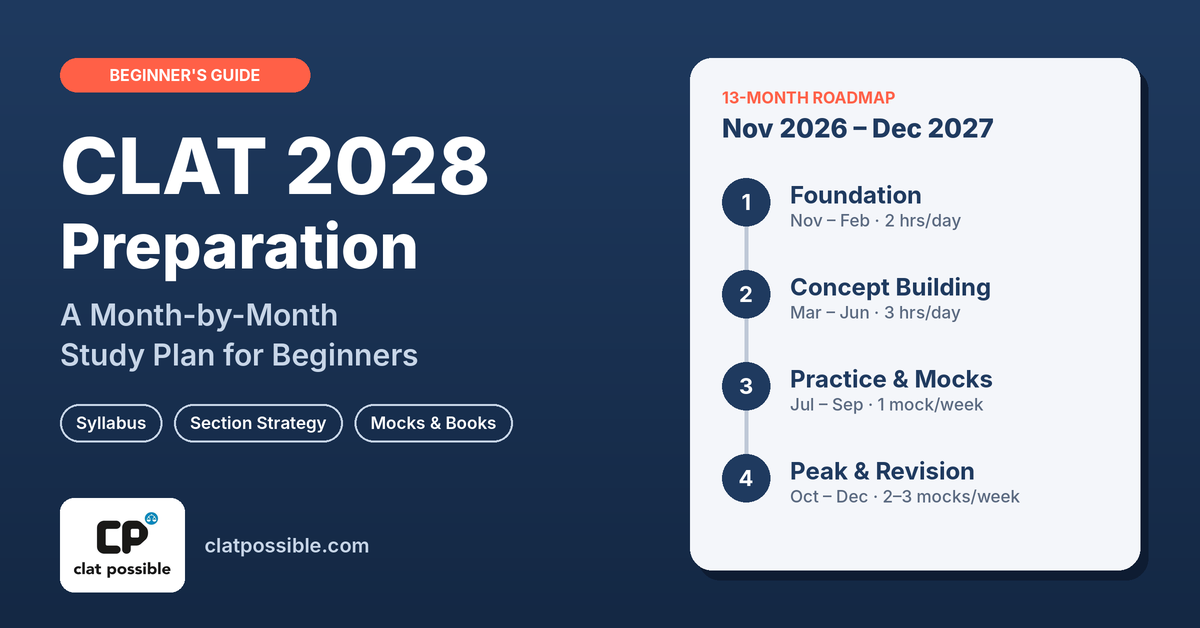
If you are in Class 11 today, you have roughly 13 months until CLAT 2028, which is expected in the first week of December 2027. That is enough time to go from complete beginner to confident test-taker, but only if those months are planned. At CLAT Possible, the students we see struggle are rarely the less talented ones. Instead, they are the ones who started without a plan, studied in bursts, and took their first mock six weeks before the exam. This guide gives you a complete CLAT 2028 study plan, from your first week to exam day.

CLAT Possible 2028 Courses

What This CLAT 2028 Preparation Guide Covers

Why CLAT 2028 Preparation Should Start Now

CLAT rewards reading stamina, reasoning habits and current affairs memory. However, all three build slowly, which is why an early start matters more in CLAT than in most entrance exams. Starting in Class 11 also means you prepare without board-exam pressure for the first few months.

You do not need to study 8 hours a day in Class 11. Instead, you need 2 to 3 focused hours, every day, for 13 months. In short, consistency beats intensity in CLAT.

CLAT 2028 at a Glance

CLAT 2028 will be the Common Law Admission Test for the 2028–29 academic year. The official date is not out yet. For reference, the Consortium has scheduled CLAT 2027 for Sunday, 6 December 2026, from 2:00 PM to 4:00 PM, and has kept the pattern unchanged. Therefore, CLAT 2028 is most likely on the first Sunday of December 2027.

Key HighlightCLAT 2028 (expected)
Conducting bodyConsortium of National Law Universities
Expected exam dateFirst week of December 2027 (tentative)
Expected registrationJuly to October 2027
ModeOffline, pen and paper
Total questions, marks, duration120 questions, 120 marks, 2 hours
Negative marking0.25 marks for every wrong answer
EligibilityClass 12 pass or appearing; 45% (40% for SC/ST); no upper age limit

Dates and pattern for CLAT 2028 are projections based on recent cycles. Always confirm on consortiumofnlus.ac.in once the notification is released.

CLAT 2028 Syllabus and Exam Pattern

The CLAT 2028 syllabus has five sections, and every question is built on a passage. In other words, there is no rote syllabus to memorise; CLAT tests how well you read, reason and apply. The breakdown below follows the current pattern confirmed for CLAT 2027.

SectionQuestionsWeightageWhat it actually tests
English Language22 to 2620%Comprehension, inference, tone, vocabulary in context
Current Affairs including GK28 to 3225%News events, legal and constitutional developments, static GK linked to news
Legal Reasoning28 to 3225%Applying a stated principle to facts; no prior law knowledge needed
Logical Reasoning22 to 2620%Arguments, assumptions, conclusions, strengthen/weaken, puzzles
Quantitative Techniques10 to 1410%Class 10 maths: percentages, ratios, averages, data interpretation
Total120100%+1 for each correct answer, −0.25 for each wrong answer

Three things beginners should notice:

  • Half the paper is GK and Legal. Current Affairs and Legal Reasoning together make up about 50% of your score, so your daily routine must protect time for both.
  • Reading is the hidden sixth section. You will read 25-plus long passages in two hours. Therefore, reading speed with comprehension decides whether you finish the paper.
  • Negative marking punishes guesswork. A wrong answer costs 0.25 marks, so four blind guesses gone wrong wipe out one correct answer.

How to Start CLAT Preparation: Your First 7 Days

Most beginners lose their first month deciding which book to buy. Skip that. Here is how to start CLAT preparation in one week.

DayTaskWhy it matters
Day 1Read the pattern and download the official sample paperYou know exactly what you are preparing for
Day 2Attempt one previous-year CLAT paper untimedYour weak spots matter more than your score
Day 3Read The Hindu or The Indian Express for 30 minutes; note three news itemsStarts your GK notebook and reading habit
Day 4Solve one legal reasoning passage; underline the principle firstThis is the core skill of the section
Day 5Revise percentages and ratios from NCERT Class 8 to 10Quant is built entirely on these basics
Day 6Fix a 2 to 3 hour daily slot around schoolA protected slot is what makes the plan work
Day 7Review the week and list what felt hardestThat list becomes your focus for Month 1

By the end of the week, you will know where you stand and have a routine in place. In fact, that is more than most aspirants have after a month.

CLAT 2028 Study Plan: Month-by-Month Roadmap (November 2026 to December 2027)

This CLAT 2028 study plan runs 13 months in four phases. It assumes you are in Class 11 now and works around school exams, which is where most plans break.

Phase 1: Foundation (November 2026 to February 2027)

Goal: Build reading, news and reasoning habits. No mocks yet. Daily time: 2 hours.

MonthFocusWhat to do
Month 1: November 2026Set the routineNewspaper daily (30 minutes) with 3 to 5 GK notes; 1 English passage a day; NCERT revision of percentages, ratios and averages
Month 2: December 2026Meet legal reasoning1 legal passage a day (principle, facts, application); logical reasoning basics; attempt the CLAT 2027 paper once released and compare with your Day 2 baseline
Month 3: January 2027Widen the baseStatic GK linked to news; recurring legal concepts (contracts, torts, criminal law, constitutional rights); profit and loss, interest, time and work
Month 4: February 2027Protect your school examsClass 11 finals come first; drop to 45 to 60 minutes a day of newspaper plus 1 passage, but do not stop completely

Phase 2: Concept Building (March to June 2027)

Goal: Cover every topic once and start timed sectional practice. Daily time: 3 hours; 5 to 6 hours in summer break.

MonthFocusWhat to do
Month 5: March 2027Restart with sectionalsOne timed sectional test a week; 2 English passages a day with inference and tone questions
Month 6: April 2027Class 12 beginsCritical reasoning (strengthen/weaken, assumptions) plus a few puzzles for speed; data interpretation from tables and graphs
Months 7 and 8: May and June 2027Summer intensive5 to 6 hours a day; solve all previous-year papers since 2020 section by section; first full-length mock at the end of May, then one every two weeks; compile 8 to 9 months of current affairs into one revision file

Phase 3: Practice and Mocks (July to September 2027)

Goal: Shift from learning to performing. Daily time: 3 hours on school days.

MonthFocusWhat to do
Month 9: July 2027Weekly mocks1 full mock a week with analysis as long as the mock itself; start an error log; watch for the CLAT 2028 notification
Month 10: August 2027Fix weak sectionsGive your two weakest sections an extra 45 minutes daily; register for CLAT 2028 early
Month 11: September 2027Build exam strategyTest section orders in mocks and settle on one; set and track time targets per section

Phase 4: Peak and Revision (October to December 2027)

Goal: Peak on exam day, not before it. Daily time: 4 hours.

MonthFocusWhat to do
Month 12: October 2027Two mocks a week2 full mocks weekly plus analysis; revise 12 months of GK, especially legal and constitutional news
Month 13: November 2027Revise and simulate2 to 3 mocks a week at 2:00 PM to train your body clock; re-read your error log weekly; no new books; download the admit card
Exam week: early December 2027Stay freshLight revision of GK notes and the error log only; sleep 7 to 8 hours; walk in rested, not crammed

CLAT 2028 Study Plan: Phase-Wise Summary

PhaseMonthsHours per dayMocks
FoundationNovember 2026 to February 20272None; baseline paper only
Concept BuildingMarch to June 20273 (5 to 6 in summer)First mock in May, then every 2 weeks
Practice and MocksJuly to September 202731 per week
Peak and RevisionOctober to December 202742 to 3 per week

Section-Wise CLAT Preparation Strategy for Beginners

A good CLAT preparation strategy for beginners gives each section a method, not just hours. Here is how our CLAT Possible mentors split the work.

1. Legal Reasoning (28 to 32 Questions)

Treat the passage as the only law that exists, because answers based on outside legal knowledge are the most common trap. Also, use a three-step read: principle, facts, application, and underline the principle before you look at the options. From Phase 2 onward, practise 2 passages a day, and follow legal news, since passages are often built on recent judgments and new laws.

2. Current Affairs including GK (28 to 32 Questions)

Read for context, not trivia: know why an event matters, who is involved and what changed. Keep one GK notebook organised by theme, such as polity, economy, international affairs, environment and legal developments. Above all, revise monthly, since news from 12 to 15 months before the exam can appear.

3. English Language (22 to 26 Questions)

Read 2 editorials a day and summarise each in two lines, which trains main-idea questions. In addition, learn vocabulary from context rather than word lists. By Phase 3, aim to finish a passage in under 6 minutes.

4. Logical Reasoning (22 to 26 Questions)

Focus on argument questions: assumptions, conclusions, strengthen/weaken and flaws. However, do not ignore puzzle-style sets, because the question style can shift from year to year. After each passage, explain in one sentence why the wrong options are wrong.

5. Quantitative Techniques (10 to 14 Questions)

Stick to Class 10 maths and data interpretation, and do not over-invest given the 10% weight. Instead, learn quick calculation tricks such as percentage-fraction equivalents and squares up to 30. Finally, aim for accuracy: eight correct out of eight beats ten attempted with three wrong.

Suggested Time Split for Beginners

SectionShare of study time
Legal Reasoning30%
Current Affairs and GK25%
English Language20%
Logical Reasoning15%
Quantitative Techniques10%

Mock Tests, Revision and Best Books for CLAT 2028

How Many Mocks Should You Take?

Plan for 40 to 50 full-length mocks between May and November 2027. However, the number matters less than the analysis. After every mock, sort your mistakes into three types (concept gap, misread passage, time pressure), re-attempt wrong questions without looking at the answer, and note one change for the next mock.

A Simple Revision Cycle

  • Daily: 15 minutes revising that day’s GK notes.
  • Weekly: A Sunday review of the week’s GK, error log and vocabulary.
  • Monthly: A full revision of the month’s current affairs compilation.

Recommended Books and Resources

SectionRecommended resource
English LanguageThe Hindu or The Indian Express editorials; Word Power Made Easy by Norman Lewis
Current Affairs and GKDaily newspaper; a monthly CLAT current affairs compilation; Lucent’s General Knowledge for static GK
Legal ReasoningPrevious-year CLAT papers (2020 onward); Legal Aptitude for CLAT by A.P. Bhardwaj
Logical ReasoningPrevious-year CLAT papers; R.S. Aggarwal’s A Modern Approach to Verbal and Non-Verbal Reasoning for basics
Quantitative TechniquesNCERT Class 8 to 10 Maths; CLAT-style data interpretation sets
Full-length mocksCLAT Possible mock test series and the official Consortium sample papers

Pick one book per section and finish it twice. After all, five half-read books help no one.

7 Mistakes Beginners Make in CLAT 2028 Preparation

1. Waiting for Class 12 to Start

The 13 months you have now are your biggest advantage. Reading speed and GK memory cannot be rushed later.

2. Collecting Books Instead of Solving Passages

CLAT is a practice exam. Therefore, previous-year papers teach more than any new guide.

3. Skipping Current Affairs for a Month

Missed months are hard to rebuild and can cost you several questions in the GK section.

4. Using Outside Legal Knowledge

In Legal Reasoning, the passage overrides what you know. In short, answer only from the principle given.

5. Taking Mocks Without Analysis

A mock without review is just a timed test. In fact, the analysis is where the score grows.

6. Guessing Blindly

With 0.25 marks lost per wrong answer, attempt a question only when you can eliminate at least two options.

7. Ignoring School

Boards matter for eligibility and for your stamina. Therefore, plan around exams; do not fight them.

How CLAT Possible Helps You Crack CLAT 2028

A plan works best with someone checking that you follow it. At CLAT Possible, our CLAT 2028 programmes are built around the same phases in this guide:

  • Foundation-first teaching for Class 11 students, starting from reading and reasoning basics.
  • Mentorship and doubt support so you never stay stuck on a legal or logical concept.
  • Current affairs material designed for CLAT’s issue-based questions.
  • Mock tests with detailed analysis to track your progress month by month.

Har Ghar Diwali Discount

Conclusion

Your CLAT 2028 preparation starts with the next hour you put in. Therefore, open today’s newspaper, solve one legal passage, and let this month-by-month plan carry you to December 2027. Overall, whether you are just starting out or already a few weeks in, the right plan and the right guidance make every step clearer.

Take Free Demo Class

CLAT 2027 Exam Analysis: Overall Difficulty Level, Expected Cut-Off & Student Reviews

CLAT 2027 is scheduled for Sunday, 6 December 2026, from 2:00 PM to 4:00 PM. This page is for every aspirant who wants a clear breakdown of how the paper actually went, so we have kept it simple. Until the exam, it gives you the official pattern, what each section is likely to test, how to judge a “good attempt” with negative marking, and what CLAT 2026 taught us. After the exam, however, our CLATpossible faculty will update every table with the real section-wise difficulty, good attempts and safe scores.

Take Free Demo Class

What This CLAT 2027 Exam Analysis Covers

CLAT 2027 Exam Analysis at a Glance

Key HighlightDetails
Exam date and time6 December 2026, 2:00 PM to 4:00 PM
Conducting bodyConsortium of National Law Universities
Total questions, marks, duration120 questions, 120 marks, 2 hours
Negative marking0.25 marks for every wrong answer
Overall difficultyTo be updated [UPDATE AFTER EXAM]
Good attempts (overall)To be updated [UPDATE AFTER EXAM]
Safe score rangeTo be updated [UPDATE AFTER EXAM]
Toughest sectionTo be updated [UPDATE AFTER EXAM]
Most scoring sectionTo be updated [UPDATE AFTER EXAM]

CLAT 2027 Exam Pattern and Marking Scheme

The Consortium announced no change in the CLAT 2027 syllabus or exam pattern, so the structure below is what you will face on 6 December. Also, every section is passage-based.

SectionQuestions (official range)Core skill
English Language22 to 26Comprehension, inference, tone, vocabulary in context
Current Affairs including GK28 to 32Awareness of current events, policy, international affairs, static GK
Legal Reasoning28 to 32Applying legal principles to facts, legal awareness
Logical Reasoning28 to 32Critical reasoning and analytical reasoning
Quantitative Techniques10 to 14Basic arithmetic and data interpretation from short sets
Total120+1 for each correct answer, −0.25 for each wrong answer

Section-Wise CLAT 2027 Exam Analysis

For each section, the middle column shows what we expect going in, based on the official pattern and recent trends. Meanwhile, the last column is the actual CLAT 2027 verdict, which our faculty fill in after the paper.

English Language: Detailed CLAT 2027 Analysis

ParameterPre-exam expectationCLAT 2027 actual
Overall difficulty levelEasy to moderate, in line with recent years[UPDATE AFTER EXAM]
Nature of questionsContextual and inference-based, with vocabulary tested in context[UPDATE AFTER EXAM]
Type of passagesNarrative, literary and thematic writing alongside non-fiction[UPDATE AFTER EXAM]
Total questions22 to 26[UPDATE AFTER EXAM]
Passage lengthMedium[UPDATE AFTER EXAM]
Dominant skill testedTone, theme and inference[UPDATE AFTER EXAM]
Standalone grammar questionsUnlikely[UPDATE AFTER EXAM]
Time-consuming?Manageable for decent reading speed[UPDATE AFTER EXAM]
Surprise elementsNone expected[UPDATE AFTER EXAM]
Ideal attempt rangeTo be set by paper difficulty[UPDATE AFTER EXAM]
Expected safe scoreTo be set by paper difficulty[UPDATE AFTER EXAM]
CLATpossible verdictA confidence-builder for steady readers[UPDATE AFTER EXAM]

Current Affairs and General Knowledge: Detailed CLAT 2027 Analysis

ParameterPre-exam expectationCLAT 2027 actual
Overall difficulty levelEasy to moderate, though GK is the least predictable section[UPDATE AFTER EXAM]
Nature of questionsPassage-based, driven by current affairs[UPDATE AFTER EXAM]
Month and year range of current affairsRoughly the 12 months before the exam[UPDATE AFTER EXAM]
Dominant areasInternational affairs, economy, government policy, legal developments[UPDATE AFTER EXAM]
Static GK vs current affairsHeavily current-affairs driven[UPDATE AFTER EXAM]
Total questions28 to 32[UPDATE AFTER EXAM]
Time-consuming?Usually quick if you know the topic[UPDATE AFTER EXAM]
Surprise elementsPossible one or two unexpected topics[UPDATE AFTER EXAM]
Ideal attempt rangeTo be set by paper difficulty[UPDATE AFTER EXAM]
Expected safe scoreTo be set by paper difficulty[UPDATE AFTER EXAM]
CLATpossible verdictRewards regular revision, not last-week cramming[UPDATE AFTER EXAM]

Legal Reasoning: Detailed CLAT 2027 Analysis

ParameterPre-exam expectationCLAT 2027 actual
Overall difficulty levelEasy to moderate[UPDATE AFTER EXAM]
Nature of questionsPrinciple-and-facts questions plus some legal-awareness questions[UPDATE AFTER EXAM]
Type of passagesConstitutional issues, landmark cases, governance and social-legal topics[UPDATE AFTER EXAM]
Total questions28 to 32[UPDATE AFTER EXAM]
Prior legal knowledge needed?Helpful but not essential[UPDATE AFTER EXAM]
Dominant skill testedApplying a stated principle to a fact situation[UPDATE AFTER EXAM]
Time-consuming?Passages can be long; reading speed matters[UPDATE AFTER EXAM]
Surprise elementsPossible direct questions on recent legal developments[UPDATE AFTER EXAM]
Ideal attempt rangeTo be set by paper difficulty[UPDATE AFTER EXAM]
Expected safe scoreTo be set by paper difficulty[UPDATE AFTER EXAM]
CLATpossible verdictScoring for consistent practisers[UPDATE AFTER EXAM]

Logical Reasoning: Detailed CLAT 2027 Analysis

ParameterPre-exam expectationCLAT 2027 actual
Overall difficulty levelModerate; historically the biggest differentiator[UPDATE AFTER EXAM]
Critical vs analytical reasoning mixEither could dominate; prepare for both[UPDATE AFTER EXAM]
Main question typesInference, assumption, strengthen/weaken, puzzles, arrangements, relations, coding-decoding[UPDATE AFTER EXAM]
Total questions28 to 32[UPDATE AFTER EXAM]
Dominant skill testedMulti-step logic and handling several rules at once[UPDATE AFTER EXAM]
Trap questionsPossible; careful reading beats speed[UPDATE AFTER EXAM]
Time-consuming?Likely the section that eats the most time[UPDATE AFTER EXAM]
Surprise elementsA shift in question style from last year is possible[UPDATE AFTER EXAM]
Ideal attempt rangeTo be set by paper difficulty[UPDATE AFTER EXAM]
Expected safe scoreTo be set by paper difficulty[UPDATE AFTER EXAM]
CLATpossible verdictLikely to decide the cut-off band[UPDATE AFTER EXAM]

Quantitative Techniques: Detailed CLAT 2027 Analysis

ParameterPre-exam expectationCLAT 2027 actual
Overall difficulty levelEasy to moderate, calculation-driven[UPDATE AFTER EXAM]
Nature of questionsShort caselets and data sets built on class 10 maths[UPDATE AFTER EXAM]
Dominant topicsPercentages, ratios, averages, profit and loss, data interpretation[UPDATE AFTER EXAM]
Total questions10 to 14[UPDATE AFTER EXAM]
Calculation intensityModerate[UPDATE AFTER EXAM]
Approximation useful?Yes, to save time[UPDATE AFTER EXAM]
Time-consuming?Can be, if you chase every question[UPDATE AFTER EXAM]
Surprise elementsPossible odd question or lengthy data set[UPDATE AFTER EXAM]
Ideal attempt rangeTo be set by paper difficulty[UPDATE AFTER EXAM]
Expected safe scoreTo be set by paper difficulty[UPDATE AFTER EXAM]
CLATpossible verdictShort section, high return for solid arithmetic[UPDATE AFTER EXAM]

Section-Wise Good Attempts and Difficulty: CLAT 2027 Summary

SectionGood attemptsDifficulty level
English Language[UPDATE AFTER EXAM][UPDATE AFTER EXAM]
Current Affairs including GK[UPDATE AFTER EXAM][UPDATE AFTER EXAM]
Legal Reasoning[UPDATE AFTER EXAM][UPDATE AFTER EXAM]
Logical Reasoning[UPDATE AFTER EXAM][UPDATE AFTER EXAM]
Quantitative Techniques[UPDATE AFTER EXAM][UPDATE AFTER EXAM]
Total[UPDATE AFTER EXAM][UPDATE AFTER EXAM]

Good Attempts in CLAT: How to Read Them with Negative Marking

A “good attempt” number means nothing without accuracy, because your score is the number of correct answers minus 0.25 for each wrong one. Therefore, here is what different attempt-and-accuracy combinations are worth, using that formula.

AttemptsAccuracyCorrectWrongScore
9095%85.54.584.4
10090%901087.5
10590%94.510.591.9
11085%93.516.589.4
11092%101.28.899.0
11580%922386.3

Notice the last two rows from the top. For example, a student who attempts 115 questions at 80% accuracy scores less than one who attempts 110 at 92%. In short, extra attempts only help when accuracy holds, although the figures are rounded to one decimal place.

A Simple Time Plan for the 120-Minute Paper

SectionSuggested timeWhy
Current Affairs and GK15 to 18 minutesQuick if you know it; do not linger on unknown topics
English Language20 to 22 minutesRead actively; avoid re-reading whole passages
Legal Reasoning25 to 28 minutesLong passages, so reading speed pays
Logical Reasoning30 to 32 minutesThe section most likely to run over; cap each set
Quantitative Techniques12 to 15 minutesPick the easy sets first
Review3 to 5 minutesCheck marked questions only

This is a starting framework, not a rule. Therefore, test it in your mocks and adjust to your own strengths.

CLAT 2026 Exam Analysis: What the Last Paper Told Us

CLAT 2026 was held on 7 December 2025. Education portals broadly agreed on the paper’s overall feel: moderate in difficulty, with Logical Reasoning reported as the trickiest section and Current Affairs and GK as one of the more scoring ones. Meanwhile, Legal Reasoning leaned on constitutional topics and landmark judgments, while English tested comprehension, tone and vocabulary. Finally, Quantitative Techniques centred on data interpretation and basic arithmetic.

The good-attempt ranges below are approximate figures drawn from post-exam analyses of CLAT 2026. However, institutes report slightly different numbers because attempts depend on each student’s strategy and accuracy, so treat these as a guide, not a rule. For CLAT 2027, our faculty will also publish ranges based on our own students’ papers.

CLAT 2026 Section-Wise Snapshot

SectionDifficultyWhat stood outGood attempts (CLAT 2026)
English LanguageEasy to moderateComprehension, inference, tone and theme, with vocabulary woven in18 to 21
Current Affairs and GKEasy to moderateIndia-centric and international current affairs, treaties, sports22 to 25
Legal ReasoningEasy to moderateConstitutional provisions, amendments, landmark cases20 to 23
Logical ReasoningModerate to difficultPuzzle-style sets, family relations, coding-decoding, timelines16 to 19
Quantitative TechniquesEasy to moderate, calculation-heavyData interpretation, ratios and percentages; calculation load mattered8 to 11
Overall (sum of section ranges)Moderate, with a tough Logical Reasoning sectionFour sections felt manageable; Logical Reasoning slowed many students84 to 99

Year-Wise Difficulty Trend

ExamOverall difficulty (as widely reported)
CLAT 2024Easy to moderate
CLAT 2025Easy to moderate; many analyses called it easy
CLAT 2026Moderate, with a tough Logical Reasoning section

CLAT 2027 Student Reactions

[UPDATE AFTER EXAM: add 3 to 5 short, real reactions from CLATpossible students, with their permission, plus a line on which section surprised them most. Embed the post-exam video here if you record one.]

Key Takeaways from CLAT 2027 Exam Analysis

These are the big lessons from the paper, in plain language. Therefore, our CLATpossible faculty will fill in each one right after the exam on 6 December 2026.

1. The Section That Decided the Paper

[UPDATE AFTER EXAM: name the section that separated high scorers from the rest, and why, in 2 to 3 lines.]

2. Where Aspirants Scored Easily

[UPDATE AFTER EXAM: name the most scoring sections and what made them straightforward.]

3. What English Tested This Year

[UPDATE AFTER EXAM: passage types, vocabulary weightage, and whether tone and inference dominated.]

4. How Predictable Current Affairs Was

[UPDATE AFTER EXAM: topics asked, month range covered, and any surprise questions.]

5. How Legal Reasoning Compared with 2026

[UPDATE AFTER EXAM: principle-based vs legal-awareness split, passage length, and notable topics.]

6. What Quant Demanded: Speed or Concepts?

[UPDATE AFTER EXAM: topics, calculation load, and which sets were worth attempting first.]

7. Will Logical Reasoning Set the Cut-Off?

[UPDATE AFTER EXAM: critical vs analytical mix, time taken, and the impact on the score range.]

8. Overall Difficulty and Good Attempts

[UPDATE AFTER EXAM: overall difficulty rating, good-attempt range, and the safe score band.]

Learnings for CLAT 2028 Aspirants

Whatever the CLAT 2027 paper turns out to be, these habits will still serve you for the next attempt.

1. Make Current Affairs a Daily Habit

Monthly PDFs help, but daily reading is what makes events stick. For example, keep a running notebook and link each event to its background and impact. Above all, prioritise international affairs, economy and policy, government schemes, and legal developments.

2. Read for Meaning, Not Just Words

English rewards readers who can follow tone, argument flow and implied meaning. Therefore, read editorials and long-form writing every day, and summarise each piece in two lines.

3. Treat Legal Reasoning as Application

Questions give you a principle and a fact situation. Also, practise applying the stated rule only, even when it differs from the real law. Instead of memorising sections, learn the logic of principles.

4. Train Both Kinds of Logical Reasoning

Do not bet on critical reasoning alone, because the style can change. Therefore, practise argument-based sets and puzzle-style sets, and cap how long you spend on any single set in mocks.

5. Do a Little Quant Every Day

Fifteen minutes of percentages, ratios, averages and data interpretation keeps the section manageable. In fact, speed comes from practice rather than from extra theory.

6. Respect Negative Marking

Each wrong answer costs 0.25 marks, so attempt a question only when you can eliminate options with a reason. Build accuracy first, and then your attempts will rise on their own.

7. Take Timed Mocks and Review Each One

Mocks teach you pacing, while the review teaches you what to fix. Also, keep an error log and revisit it weekly. Aim for a steady stream of full-length mocks rather than a last-month rush.

8. Stay Calm on Exam Day

Every paper has a section that feels harder than expected. However, aspirants who stay calm and skip smartly protect their score. Therefore, practise this in mocks by deliberately skipping a hard set.

9. Choose Consistency Over Intensity

Two to three focused hours every day beat random eight-hour bursts. After all, small, steady gains compound.

Explore CLAT 2028 Courses

Why CLAT Exam Analysis Matters

  • It shows how you really performed. Raw marks mean little until you know whether the paper was easy, moderate or tough.
  • It helps you estimate your NLU chances. Therefore, safe scores and section-wise attempts let you judge top NLUs against mid-tier ones.
  • It reveals strengths and weak spots. Also, comparing your attempts with the analysis shows where you were solid and where you lost marks.
  • It guides your next step. Instead of guessing when the result is not what you wanted, a clear analysis tells you whether to repeat, try other law entrances, or plan a backup.
  • It shows pattern shifts. Indeed, new question styles and weightage changes are the most useful clues for the next cycle.
  • It reduces overthinking. In short, objective numbers calm both false hope and unnecessary panic.

Conclusion

A good CLAT exam analysis is a report card, a map and a reality check in one. Therefore, use this page before the exam to plan your attempt, and then come back on 6 December for the full CLATpossible section-wise breakdown. Overall, whether you are waiting for your result or starting your CLAT 2028 journey, the right guidance makes the next step clearer.